
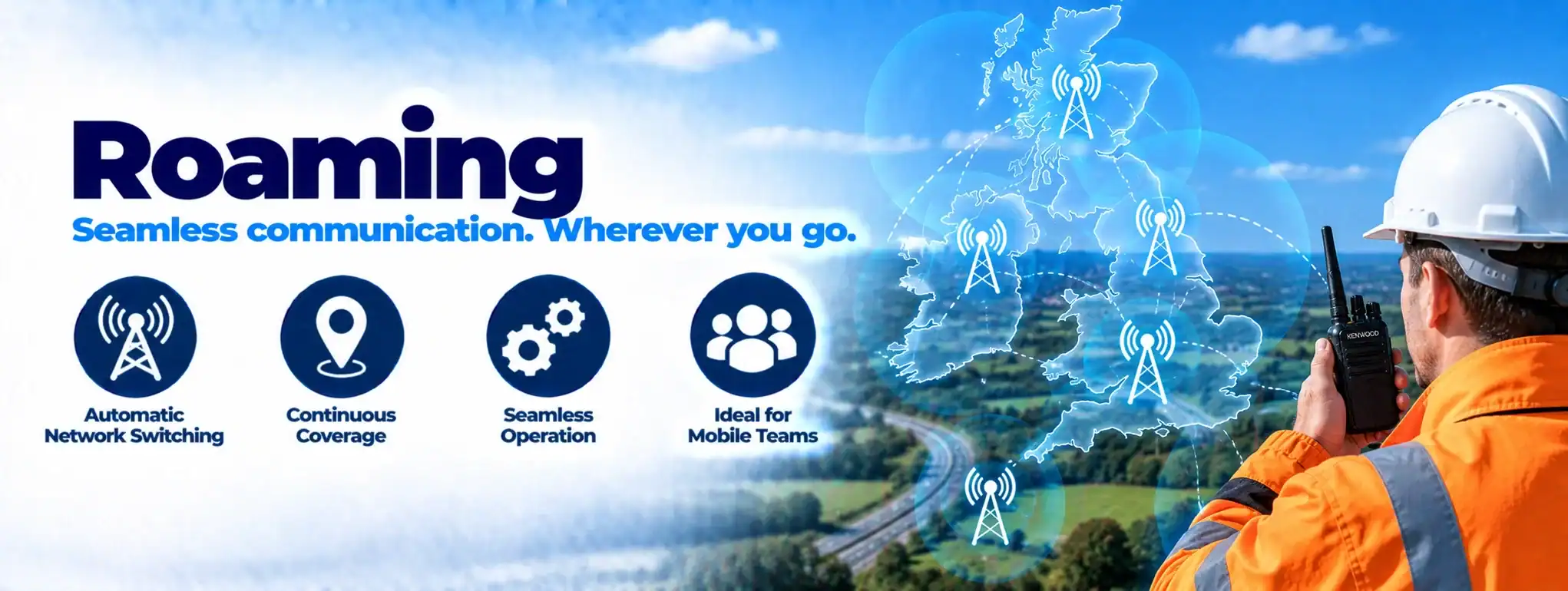
Roaming
Roaming is a radio-system feature that allows a portable or mobile two-way radio to move between different coverageRadio Coverage is the geographical area in which a two-way radio system can provide reliable communication. Coverage depends on the radios, antennas, frequency, terrain, buildings and system infrastructure. areas or radio sites while maintaining communication.
In a multi-site radio systemA Radio System is a complete communication solution comprising two-way radios and, where required, equipment such as repeaters, antennas, base stations, mobile radios and network infrastructure., roaming can allow a radio to automatically identify and connect to a more suitable radio site as the user moves.
For example:
Site A → Site B → Site C
As the user travels between the areas covered by each site, the radio can change its connection according to the system’s roaming configuration.
What is radio roaming?
Radio roaming allows a radio to operate across multiple compatible coverage areas without requiring the user to manually select a different site each time they move.
This is particularly useful for organisations operating across:
- Multiple buildingsAn antenna transmits and receives radio-frequency signals, allowing a two-way radio to communicate. Antenna type, frequency, height and location can all affect radio performance and coverage.
- Large estates
- Industrial sites
- Transport networks
- Multiple offices
- Regional operations
The exact roaming behaviour depends on the radio technology and system design.
How does roaming work?
A roaming-capable radio monitors available radio sites or channels according to its programming.
When the current site becomes unsuitable, the radio can search for another configured site.
A simplified process is:
Radio connected to Site A → Signal weakens → Radio searches → Site B detected → Radio switches to Site B
The radio’s exact decision-making process varies between systems.
Roaming and multi-site radio
Roaming is particularly useful in Multi-Site Radio systems.
Multiple radio sites can provide coverage over a wider geographical area.
Roaming allows compatible radios to move between these sites while continuing to operate as part of the same overall communication system.
Roaming and repeaters
A multi-site system may use several Repeaters.
For example:
RepeaterA Repeater receives a two-way radio transmission and retransmits it, usually from an elevated location, to extend the coverage and reliability of a radio communication system. A → Coverage Area A
Repeater B → Coverage Area B
Repeater C → Coverage Area C
A roaming radio can be configured to move between these coverage areas.
Roaming and IP Site Connect
IP Site ConnectIP Site Connect links compatible DMR radio sites using an IP network, allowing selected radio communications to be shared between separate buildings, facilities or geographical locations. can connect compatible radio sites over an IP networkA Network is a connected system of radios, equipment and infrastructure that allows users to communicate across a defined area. Radio networks can range from simple radio-to-radio systems to large multi-site networks..
Where the system supports roaming, users can move between connected sites while maintaining access to the appropriate communication groups.
The network connection and radio programming must be configured correctly for this to work.
Roaming and DMR
Roaming is supported by some Digital Mobile Radio (DMR)Digital Mobile Radio (DMR) is an ETSI digital radio standard for professional two-way communications, supporting voice, group calling, data and other features on compatible radio systems. systems.
A DMR radio can be programmed with information about compatible sites and the conditions under which it should move between them.
The exact roaming capabilities vary between manufacturers and system architectures.
DMR roaming
A DMR roaming configuration may include multiple sites using compatible:
- Frequencies
- Talkgroups
- Colour codes
- System parameters
The radio can use this information to identify suitable sites as the user moves.
Roaming and talkgroups
A Talkgroup can be available across multiple radio sites.
This can allow users to remain part of the same operational communication group while moving between coverage areas.
For example:
Security Talkgroup → Site A
Security Talkgroup → Site B
Security Talkgroup → Site C
The user can potentially continue communicating with the same group as the radio moves between sites.
Roaming vs scanning
Roaming and Scanning are different functions.
Roaming: Allows a radio to move between configured sites or coverage areas.
Scanning: Allows a radio to monitor multiple channels or communication groups.
A radio may support both functions, but they perform different jobs.
Roaming and site selection
A roaming radio may use signal strength or other configured criteria to determine when another site should be selected.
The exact criteria depend on the radio manufacturer and system.
A radio does not necessarily select the physically closest site.
It selects a site that meets the system’s configured requirements.
Roaming and signal strength
Signal strength is an important consideration in many roaming systems.
As a radio moves away from its current site, the received signal may become weaker.
The radio can then search for another configured site providing a more suitable signal.
However, signal strength is not the only factor that can determine site selection.
Roaming and coverage
Roaming can help extend the usable geographical coverage of a radio system by allowing users to move between multiple coverage areas.
It does not itself increase the RF coverage of an individual site.
The overall coverage still depends on:
- Repeater locations
- Antennas
- Frequencies
- Transmitter powerAn antenna transmits and receives radio-frequency signals, allowing a two-way radio to communicate. Antenna type, frequency, height and location can all affect radio performance and coverage.
- Terrain
- Buildings
- Network design
Roaming and seamless communication
The objective of roaming is often to make movement between sites as straightforward as possible for the user.
However, the change between sites may not always be completely seamless.
There can be a short interruption while the radio searches for and establishes communication with another site.
The behaviour depends on the radio technology and system configuration.
Roaming and handover
Handover is the process of transferring a communication or connection from one radio site to another.
In some radio technologies, roaming and handover can work together.
However, the terms are not necessarily interchangeable.
Roaming can describe the radio’s ability to select or move between sites, while handover can describe the transfer of an active communication.
Roaming and active calls
Not every radio roaming system supports seamless movement between sites during an active call.
Some systems may require the current communication to end before the radio changes sites.
Others can support more advanced handover functionality.
The capabilities should therefore be checked for the specific radio system.
Roaming and trunked radio
Roaming is commonly associated with larger networked and Trunked Radio systems.
A trunked network can manage communication resources across multiple sites and users.
The network architecture can determine how radios move between sites and how communication is maintained.
Roaming and network infrastructure
Multi-site roaming systems can depend on network infrastructureRadio infrastructure is the equipment and supporting systems behind a professional two-way radio network, including repeaters, antennas, base stations, network connections, power systems and dispatch equipment. connecting radio sites.
This may include:
- Fibre
- Ethernet
- WAN
- Wireless links
- Internet connections
- VPNs
Reliable network connectivity can be important for maintaining communication between sites.
Roaming and Quality of Service
Where radio sites communicate through IP networks, Quality of Service (QoS)Quality of Service (QoS) is the management and prioritisation of network traffic to help important communications receive suitable bandwidth, latency and reliability, particularly on IP-based systems. can help prioritise time-sensitive radio traffic.
However, QoS does not itself provide roaming.
Roaming requires compatible radio equipment, site configuration and supporting system architecture.
Roaming and GPS
GPS can provide location information about a radio but is not required for all roaming systems.
A radio may use GPS (Global Positioning System)GPS is a satellite-based positioning system that allows compatible two-way radios to determine their location. GPS data can support tracking, dispatch, fleet management and Geo-Fencing. for tracking while using separate RF and system information to determine which radio site it should use.
Roaming and fleet management
Roaming can be particularly useful for organisations operating mobile workforces.
For example:
- Delivery fleets
- Transport companies
- Utilities
- Security teams
- Field engineers
A radio can move between different coverage areas while remaining part of the wider communication system.
Roaming and transport
Transport operations can cover large geographical areas.
A multi-site radio system with roaming can allow drivers and mobile staff to move between different coverage areas while retaining access to the required communication groups.
Roaming and utilities
Utility workers can travel between geographically separated locations.
Roaming can allow compatible radios to move between radio sites without requiring users to manually reconfigure the radio at each location.
Roaming and security
Security teams operating across large sites or multiple locations can benefit from roaming.
For example, a security officer could move from an external area into a building covered by another radio site while maintaining access to the required communication system.
Roaming and construction
Large construction projects can use multiple radio sites where the working area is too large for a single repeater.
Roaming can allow users to move around the site while the radio selects the appropriate coverage area.
Roaming and events
Large events can sometimes require multiple temporary radio sites.
Roaming can allow staff to move between different areas while using the same overall communication system.
This can be particularly useful where the site is geographically large or has significant obstructions.
Roaming and radio hire
Roaming can be included in more sophisticated Radio HireRadio Hire is the temporary rental of two-way radios and related communication equipment for events, projects and operational requirements, providing professional communication without purchasing the equipment. systems.
For example, a large event or temporary project could use several repeaters connected as a wider network.
Compatible hired radios can then be programmed to roam between the available sites.
Roaming and radio programming
Roaming depends heavily on correct radio programming.
The radio may need information about:
- Available sites
- Frequencies
- Talkgroups
- Site identifiers
- Roaming parameters
- System configuration
Incorrect programming can prevent the radio from selecting the appropriate site.
Roaming and channel configuration
A radio may have a channelA two-way radio channel is a programmed set of communication settings, typically including frequency and signalling, that allows compatible radios to communicate with one another. or zoneA Zone is a group of programmed radio channels or talk groups organised within a two-way radio. Zones make it easier for users to find and switch between different communication services. containing the settings required for roaming.
The user may simply select the relevant operational channel while the radio manages site selection automatically.
The exact user interface varies between radio manufacturers.
Roaming and network capacity
Roaming does not increase the overall capacity of a radio system.
It allows users to access different sites, but each site still has a finite amount of communication capacity.
Capacity planning is therefore important for busy multi-site systems.
Roaming and interference
InterferenceRadio interference occurs when unwanted radio-frequency signals or electrical noise disrupt two-way radio communications, causing distorted audio, broken transmissions, reduced coverage or loss of communication. can affect roaming performance.
A radio may detect a strong signal that is not actually the best usable site because of interference or other RF conditions.
System design and frequencyAn antenna transmits and receives radio-frequency signals, allowing a two-way radio to communicate. Antenna type, frequency, height and location can all affect radio performance and coverage. planning are therefore important.
Roaming and frequency planning
Multi-site systems require careful frequencyFrequency is the number of cycles a radio wave completes each second, measured in Hertz. In two-way radio, frequency determines where a transmission operates within the radio spectrum. planning to avoid unwanted interference between sites.
The frequency arrangement must allow the radio to identify and use appropriate sites while maintaining reliable communication.
Roaming and repeater coverage
The coverage areas of different repeaters should normally overlap appropriately where continuous movement between sites is required.
If there is a large gap between coverage areas, the radio may lose communication before another site becomes available.
Roaming dead spots
Roaming cannot eliminate every dead spotA Dead Spot is an area where two-way radio communication is weak, unreliable or unavailable. Dead spots can be caused by buildings, terrain, distance, interference or inadequate radio coverage..
If none of the configured sites provides a usable signal in a particular location, the radio will still lose coverage.
A Site SurveyA Site Survey is an assessment of a location to determine whether a two-way radio system will provide the required coverage, reliability and performance. can identify gaps between coverage areas.
Roaming and site surveys
A site survey can help determine:
- Where radio sites should be located
- How much coverage each site provides
- Where coverage overlaps
- Where roaming may occur
- Where dead spots exist
- Whether additional infrastructure is required
This is particularly important for large or geographically complex systems.
Roaming and failover
Roaming can sometimes contribute to system resilience.
If a radio loses access to one site, another configured site may be available.
However, this should not automatically be considered FailoverFailover allows a two-way radio system to switch to backup equipment, infrastructure or communication routes when the primary system fails, helping maintain communications..
Failover normally refers to switching to backup infrastructure following a system failure, whereas roaming generally refers to movement between available coverage areas.
Roaming and emergency communication
Emergency communication must be carefully considered in a roaming system.
If a user moves between sites, emergency functions should be tested to ensure they operate as intended across the system.
The precise behaviour depends on the radio technology and network configuration.
Roaming and encryption
Where EncryptionEncryption protects two-way radio communications by converting voice or data into a secure form that can only be understood by authorised radios with the correct encryption capability and keys. is used, the relevant security configuration must be available across the sites the radio is expected to use.
A roaming radio must be appropriately configured to maintain secure communication when moving between compatible sites.
Roaming and interoperability
Roaming normally requires compatible system architecture.
Two radio sites using different technologies or incompatible configurations cannot necessarily provide roaming simply because they are geographically close.
InteroperabilityInteroperability is the ability of different communication systems, devices or organisations to work together and exchange information. In two-way radio, it can connect different radio networks, technologies or users through compatible systems or gateways. and roaming requirements should be considered during system design.
Roaming limitations
Roaming has several limitations.
It does not:
- Increase the range of an individual radio
- Create additional radio spectrumSpectrum is the range of radio frequencies used for wireless communication. Two-way radios operate within specific parts of the radio spectrum, subject to frequency allocation and licensing requirements.
- Guarantee uninterrupted communication
- Remove dead spots
- Automatically connect incompatible systems
- Replace appropriate site planning
The underlying radio network must still provide suitable coverage and capacity.
Choosing a roaming radio system
When designing a roaming-capable system, consider:
- Number of radio sites.
- Required geographical coverage.
- Site overlap.
- Radio technology.
- Frequencies.
- Talkgroups.
- Network connectivity.
- Required handover behaviour.
- Emergency requirements.
- System capacity.
- Encryption.
- Future expansion.
Roaming and DCS
DCS can design and configure multi-site professional radio systems where users need to move between different coverage areas.
For larger operations, roaming can form part of a wider system incorporating repeaters, IP connectivity, GPS, dispatch and other professional communication features.