
Interference
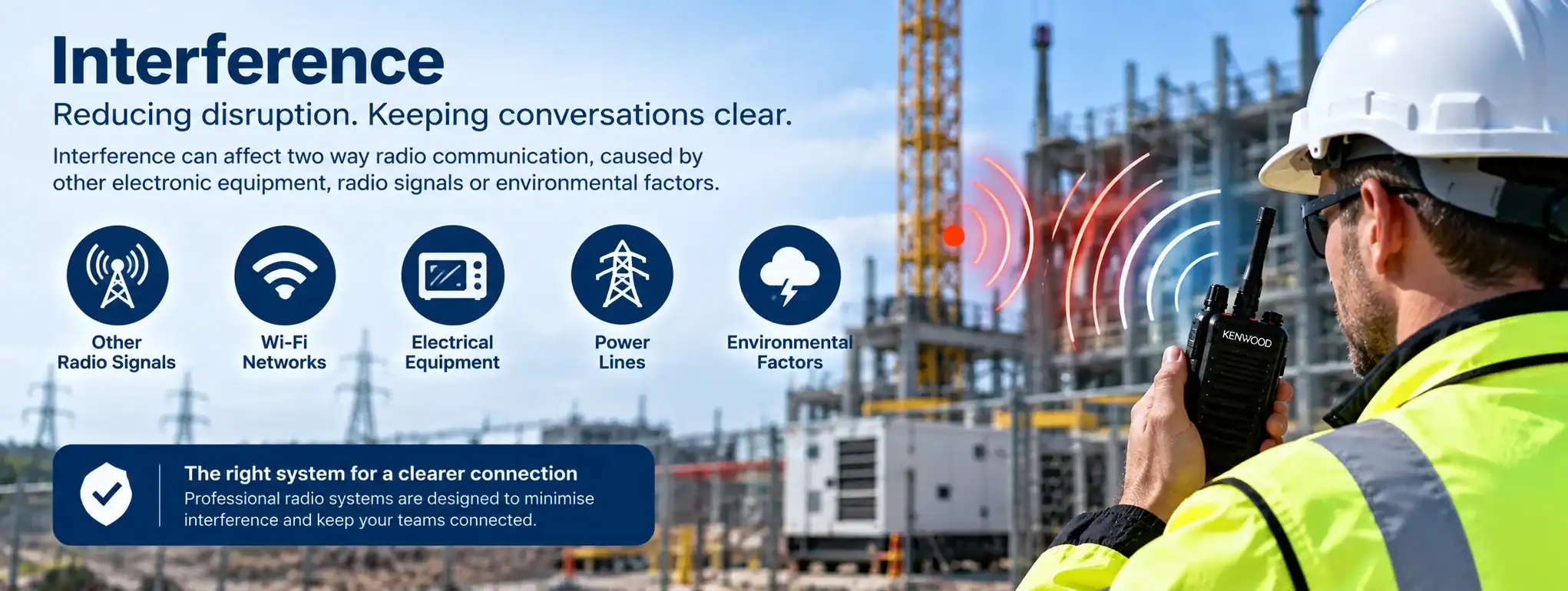
Interference occurs when unwanted radio-frequency signals disrupt, weaken or otherwise affect the intended communication between two-way radios.
Interference can cause problems such as background noise, distorted audio, broken transmissions, reduced coverageRadio Coverage is the geographical area in which a two-way radio system can provide reliable communication. Coverage depends on the radios, antennas, frequency, terrain, buildings and system infrastructure. or completely unusable radio channels.
Interference can originate from other radio transmitters, electrical equipment, nearby radio systems, faulty equipment or other sources of unwanted RF energy.
What causes radio interference?
Radio interference can have many causes.
Common sources include:
- Other radio transmitters
- Nearby radio systems
- Electrical equipment
- Industrial machinery
- Poorly installed equipment
- Faulty antennas
- Damaged coaxial cables
- Electronic devices
- Strong nearby RF signals
- Incorrect radio programming
The source can be either intentional or unintentional.
Co-channel interference
Co-channel interference occurs when two or more transmitters operate on the same frequencyAn antenna transmits and receives radio-frequency signals, allowing a two-way radio to communicate. Antenna type, frequency, height and location can all affect radio performance and coverage. and their signals overlap.
For example, if two separate radio users transmit on the same frequencyFrequency is the number of cycles a radio wave completes each second, measured in Hertz. In two-way radio, frequency determines where a transmission operates within the radio spectrum. at the same time, their signals can interfere with one another.
This can result in:
- Distorted audio
- Missed messages
- Reduced communication range
- Interrupted conversations
Frequency planning is therefore important when designing a professional radio systemA Radio System is a complete communication solution comprising two-way radios and, where required, equipment such as repeaters, antennas, base stations, mobile radios and network infrastructure..
Adjacent-channel interference
Adjacent-channel interference occurs when a nearby frequency interferes with the intended radio channelA two-way radio channel is a programmed set of communication settings, typically including frequency and signalling, that allows compatible radios to communicate with one another..
This can happen when transmitters are operating on frequencies that are too close together or when equipment does not provide sufficient filtering.
Professional radio systems use appropriate frequency planning, filtering and equipment specifications to reduce this type of interference.
Radio frequency interference
Radio-frequency interference, often abbreviated to RFI, refers to unwanted RF energy that affects the operation of a radio system.
RFI can come from:
- Other transmitters
- Electrical systems
- Industrial equipment
- Telecommunications equipment
- Electronic devices
The impact depends on the strength and characteristics of the interfering signal and the susceptibility of the receiving equipment.
Electromagnetic interference
Electromagnetic interference (EMI) is unwanted electromagnetic energy that can affect electronic equipment.
EMI and RF interference can overlap, particularly where electronic equipment generates signals within or near the frequencies used by a radio system.
Potential sources include:
- Motors
- PowerAn antenna transmits and receives radio-frequency signals, allowing a two-way radio to communicate. Antenna type, frequency, height and location can all affect radio performance and coverage. supplies
- Inverters
- Computers
- LED lighting
- Industrial machinery
- Electrical installations
Interference and radio range
Interference can make a radio system appear to have reduced range.
The radio may still be transmitting normally, but the receiving equipment may struggle to distinguish the wanted signal from the interfering signal.
This can result in a Dead SpotA Dead Spot is an area where two-way radio communication is weak, unreliable or unavailable. Dead spots can be caused by buildings, terrain, distance, interference or inadequate radio coverage. or an area where communications become unreliable.
Interference and signal strength
A strong radio signal does not automatically guarantee clear communication.
The receiverA Receiver is the part of a two-way radio that detects and processes incoming radio signals, converting them into audible voice or usable data for the user. must be able to distinguish the intended signal from unwanted signals and noise.
A relatively strong interfering signal can therefore cause problems even when the desired radio signal is also strong.
Interference and noise
Radio noise is unwanted electrical or RF energy that can be heard or detected by the receiving equipment.
Noise can appear as:
- Hissing
- Crackling
- Buzzing
- Clicking
- Static
- Distorted audio
The source of the noise needs to be identified before an appropriate solution can be selected.
Interference on analogue radio
Analogue radioAnalogue radio uses continuously varying radio signals to transmit voice communication. It remains widely used for reliable two-way communication across business, industry, events, security and other applications. is often affected by interference in a gradual way.
As the wanted signal becomes weaker relative to interference and background noise, audio quality can deteriorate.
Users may experience increasing levels of:
- Static
- Background noise
- Distortion
- Reduced intelligibility
This is different from the behaviour commonly associated with digital radio.
Interference on digital radio
Digital radio can behave differently when interference increases.
A digital signal may continue to provide clear audio until the receiver can no longer correctly decode the transmissionTransmission is the process of sending voice, data or signalling from a radio using a radio-frequency signal to another radio, repeater or communication system..
Once the signal falls below the required threshold, users may experience:
- Audio dropouts
- Broken speech
- Digital distortion
- Complete loss of communication
This is sometimes described as the digital cliff effect.
Interference and DMR
DMR (Digital Mobile RadioA Mobile Radio is a two-way radio designed to be installed in a vehicle. It normally uses the vehicle's power supply and an external antenna to provide reliable communication while travelling or working in the field.) systems can be affected by RF interference in the same way as other radio technologies.
Interference can affect:
- Voice quality
- Data
- Coverage
- RepeaterA Repeater receives a two-way radio transmission and retransmits it, usually from an elevated location, to extend the coverage and reliability of a radio communication system. performance
- Signalling
A DMR system should therefore be properly frequency-planned and tested.
Interference and repeaters
A Repeater can both help and suffer from interference.
A repeater can extend useful coverage, but interference affecting the repeater’s receiver can prevent it from correctly receiving transmissions.
Interference can also affect the repeater’s transmitter or cause unwanted signals to be retransmitted if the system is not properly designed.
Repeater desense
Repeater desense occurs when a strong nearby signal reduces the ability of a repeater receiver to detect weaker wanted signals.
This can be particularly problematic at repeater sites where multiple transmitters or frequencies are operating close together.
Solutions can include:
- Improved frequency separation
- Filtering
- Duplexer adjustment
- Additional isolation
- AntennaAn antenna transmits and receives radio-frequency signals, allowing a two-way radio to communicate. Antenna type, frequency, height and location can all affect radio performance and coverage. separation
- Relocating equipment
A specialist RF assessment may be required to identify the cause.
Intermodulation interference
Intermodulation occurs when multiple RF signals interact within a non-linear component and produce additional unwanted frequencies.
These unwanted signals can fall onto frequencies used by the radio system.
Potential sources include:
- Faulty equipment
- Poor-quality connectorsAn antenna transmits and receives radio-frequency signals, allowing a two-way radio to communicate. Antenna type, frequency, height and location can all affect radio performance and coverage.
- Corroded metalwork
- Damaged antennas
- Overloaded RF components
- Poorly maintained installations
Intermodulation can be difficult to diagnose because the resulting interference may appear on frequencies that were not being transmitted intentionally.
Interference from nearby transmitters
A nearby high-power transmitter can interfere with another radio system even when it operates on a different frequency.
This is why radio sites require careful frequency coordination and RF engineering.
Filtering and physical separation can also help reduce unwanted coupling between systems.
Interference from electrical equipment
Electrical equipment can generate electromagnetic energy that affects radio reception.
Possible sources include:
- Motors
- Generators
- Variable-speed drives
- LED lighting
- Power supplies
- Solar inverters
- Industrial machinery
If interference appears only when particular equipment is operating, that equipment may be a potential source.
Interference from LED lighting
Some LED lighting systems and associated power supplies can generate electromagnetic noise.
In certain environments, this can affect radio reception.
If interference occurs only when specific lighting is switched on, investigation of the lighting system and its power supply may help identify the source.
Interference from solar equipment
Solar installations can contain inverters and switching electronics capable of producing electromagnetic noise.
In some circumstancesAn antenna transmits and receives radio-frequency signals, allowing a two-way radio to communicate. Antenna type, frequency, height and location can all affect radio performance and coverage., this noise can affect radio equipment.
The actual impact depends on the equipment, installation and frequencies involved.
Interference from vehicles
Vehicles contain numerous electronic systems that can potentially generate RF or electrical noise.
Potential sources include:
- Alternators
- Ignition systems
- Inverters
- Chargers
- LED lighting
- Electronic control systems
Vehicle-mounted radio installations should therefore use suitable equipment, cabling, grounding and antenna installation.
Interference and antennas
An incorrectly installed or damaged Antenna system can create radio problems that may initially appear to be interference.
Potential issues include:
- Damaged antenna
- Poor connection
- Incorrect antenna
- Damaged coaxial cable
- Poor grounding
- Water ingress
- Incorrect mounting
A radio system should be checked for antenna faults before assuming that external interference is responsible.
Interference and coaxial cable
Coaxial cable carries RF signals between radio equipment and an antenna.
Damaged, poorly terminated or water-damaged coaxial cable can cause signal loss and other RF problems.
Connectors should be inspected as part of radio system maintenance.
Interference and radio accessories
Poorly designed or damaged accessories can sometimes contribute to unwanted electrical noise or audio problems.
However, audio noise should not automatically be classified as RF interference.
The source should be identified before replacing radio equipment.
Interference and frequency planning
Frequency Planning helps minimise interference between radio users and systems.
A professional frequency plan considers:
- Operating frequencies
- Channel spacing
- Transmit power
- Geographic separation
- Repeater locations
- Adjacent systems
- Antenna locations
- Filtering requirements
Good frequency planning is particularly important for multi-channel and multi-site systems.
Interference and radio licensing
Licensed radioA Licensed Radio is a two-way radio operated under an appropriate radio licence. Licensed systems can provide greater control over frequencies, coverage and infrastructure than licence-free radio services such as PMR446. systems are generally coordinated within a regulatory framework intended to manage the use of radio spectrumSpectrum is the range of radio frequencies used for wireless communication. Two-way radios operate within specific parts of the radio spectrum, subject to frequency allocation and licensing requirements..
However, licensing does not guarantee that a radio system will never experience interference.
Local sources of interference, faulty equipment and other transmitters can still create problems.
Interference and PMR446
PMR446 is a licence-exempt radio service designed for short-range communications.
Because PMR446 channels are shared, users can encounter other PMR446 users operating on the same or nearby channels.
This means interference or competing transmissions can occur, particularly in areas where many users are operating.
Interference and radio hire
For Radio HireRadio Hire is the temporary rental of two-way radios and related communication equipment for events, projects and operational requirements, providing professional communication without purchasing the equipment., interference should be considered when planning a temporary radio deployment.
A professional supplier can select suitable frequencies and configure the radios for the intended operating environment.
For larger deployments, frequency coordination and repeater planning may be required.
Interference at events
Large events can contain many communication systems operating in a relatively small area.
These can include:
- Two-way radios
- Wireless microphones
- Wi-FiWi-Fi is a wireless networking technology that connects compatible devices to a local or wider network. In radio systems, it can support programming, updates, data services and IP-based communications.
- Cellular networks
- Production equipment
- Broadcast equipment
- Other RF systems
Careful frequency planning is therefore important when deploying radio systems at large events.
Interference on construction sites
Construction sites can contain electrical machinery, generators, cranes, temporary power systems and other equipment that may produce electromagnetic noise.
Radio interference can therefore be more difficult to diagnose in these environments.
A structured RF investigation can help determine whether the problem originates from the radio system or another piece of equipment.
Interference in industrial environments
Industrial facilities can contain numerous potential sources of electromagnetic interference.
Examples include:
- Motors
- Variable-frequency drives
- Welding equipment
- Industrial controls
- Generators
- Power converters
Radio system design should take these potential sources into account.
Interference and security systems
Security sites may contain multiple wireless systems operating alongside two-way radios.
These can include:
- CCTV
- Wireless alarms
- Access-control systems
- Wi-Fi
- Wireless sensors
Proper system planning can reduce the risk of unwanted interaction.
Interference and digital noise suppression
Digital Noise SuppressionDigital Noise Suppression uses digital audio processing in a two-way radio to reduce unwanted background noise and improve speech clarity, particularly in noisy working environments. can improve the intelligibility of voice communications by reducing certain types of unwanted background noise.
However, noise suppression does not eliminate RF interference.
It is an audio-processing function rather than a solution to an underlying RF problem.
Interference and squelch
SquelchAnalogue radio uses continuously varying radio signals to transmit voice communication. It remains widely used for reliable two-way communication across business, industry, events, security and other applications. prevents a radio speaker from opening when the received signal is below a configured threshold.
Adjusting squelch can reduce unwanted background noise in some situations.
However, excessive squelch can also prevent weak but usable signals from being heard.
Squelch should therefore be configured appropriately for the radio system.
Interference and CTCSS
CTCSS can prevent a radio from opening its speaker unless the received signal contains the expected sub-audible tone.
This can reduce the amount of unwanted traffic heard by users sharing a frequency.
CTCSS does not eliminate the interfering signal itself and does not provide encryptionEncryption protects two-way radio communications by converting voice or data into a secure form that can only be understood by authorised radios with the correct encryption capability and keys..
Interference and DCS
DCS (Digital-Coded Squelch) performs a similar function using a digital signalling code.
It can help radios ignore transmissions that do not contain the expected code.
Like CTCSS, DCS does not prevent other users from transmitting on the frequency.
Interference and encryption
Encryption protects the content of authorised communications but does not prevent RF interference.
An encrypted radio transmission can still be affected by another transmitter operating on or near the same frequency.
Security and RF interference are therefore separate considerations.
Interference and coverage surveys
A Coverage Survey can help identify whether poor communication is caused by insufficient signal strength or interference.
Testing can be performed at different locations to determine:
- Signal strength
- Audio quality
- Interference levels
- Dead spots
- Repeater performance
For larger systems, specialist RF measurement equipment may be used.
Diagnosing radio interference
When interference occurs, the first step is to determine whether the problem is actually RF interference.
Useful checks can include:
- Determine when the problem occurs.
- Check whether all radios are affected.
- Test different locations.
- Test different channels.
- Check the antenna system.
- Check nearby electrical equipment.
- Check for other transmitters.
- Test with known-good equipment.
- Measure the RF environment where necessary.
This can help distinguish interference from equipment faults or coverage problems.
Interference vs poor coverage
Poor coverage and interference can produce similar symptoms.
Poor coverage usually occurs because the wanted radio signal is too weak.
Interference occurs when unwanted signals or noise affect the wanted communication.
The two problems can also occur together.
Interference vs equipment fault
A faulty radio, antenna or cable can create symptoms that resemble interference.
Testing with known-good equipment can help identify whether the problem is caused by the radio system itself.
Interference and system design
Interference should be considered during the design stage rather than only after a problem occurs.
A professional radio system should consider:
- Frequency selection
- Channel spacing
- Antenna location
- Repeater location
- RF filtering
- Equipment quality
- Nearby transmitters
- Electrical equipment
- Site environment
Good design can significantly reduce the risk of interference.
Interference and maintenance
Regular maintenance can help prevent interference caused by equipment faults.
Checks can include:
- Antenna condition
- Coaxial cables
- Connectors
- Repeater equipment
- Filters
- Duplexers
- Power supplies
- Grounding
- Physical damage
Faulty or corroded components should be repaired or replaced as appropriate.
Interference limitations
Not all interference can be eliminated.
Radio spectrum is shared by many users and technologies, and some environments contain large amounts of electromagnetic activity.
The objective is normally to identify, reduce and manage interference so that the radio system provides the required level of communication reliability.
Interference and DCS
DCS can help investigate radio communication problems where interference, coverage or equipment faults are affecting system performance.
For professional radio systems, identifying the actual cause of the problem is important before making changes to frequencies, equipment or infrastructureRadio infrastructure is the equipment and supporting systems behind a professional two-way radio network, including repeaters, antennas, base stations, network connections, power systems and dispatch equipment..
Where necessary, RF testing and coverage assessment can help determine the most appropriate solution.