
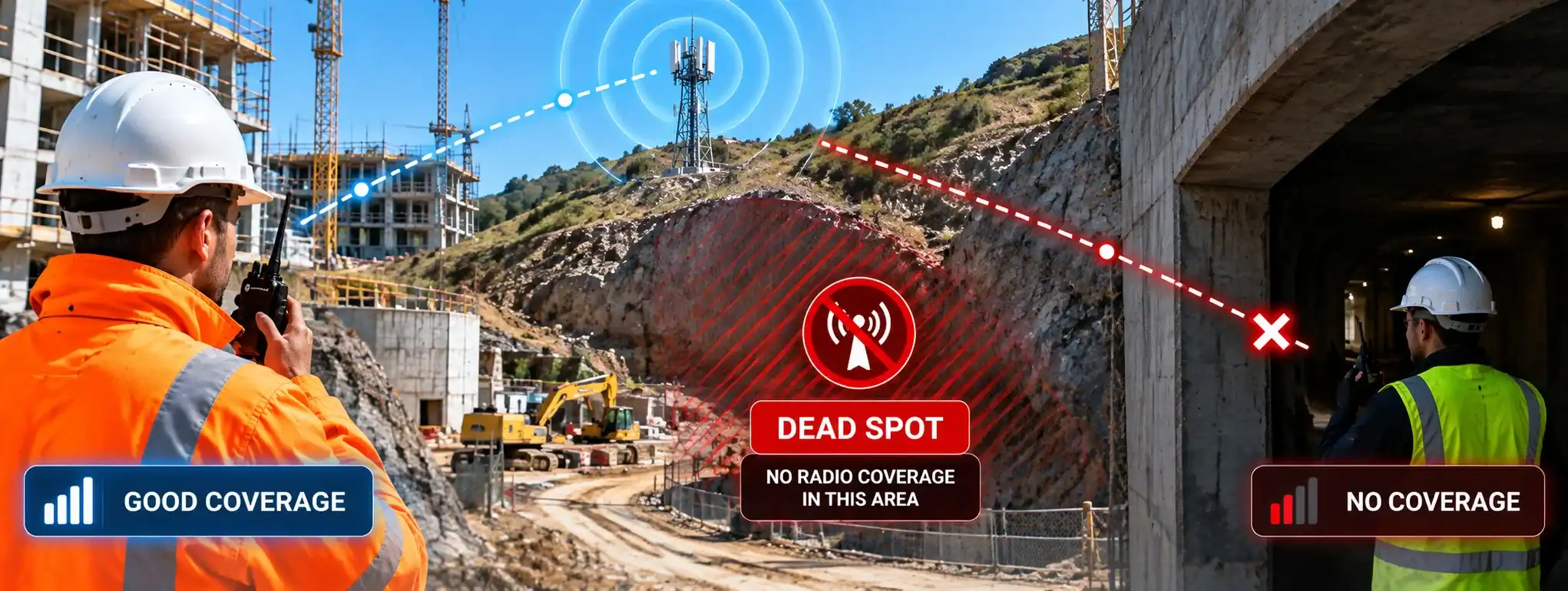
Dead Spot
A Dead Spot is an area where a two-way radio cannot establish or maintain reliable communication, even though the area may be within the general coverageRadio Coverage is the geographical area in which a two-way radio system can provide reliable communication. Coverage depends on the radios, antennas, frequency, terrain, buildings and system infrastructure. area of the radio systemA Radio System is a complete communication solution comprising two-way radios and, where required, equipment such as repeaters, antennas, base stations, mobile radios and network infrastructure.. Dead spots can affect either radio reception, transmissionTransmission is the process of sending voice, data or signalling from a radio using a radio-frequency signal to another radio, repeater or communication system., or both, and can occur in buildingsAn antenna transmits and receives radio-frequency signals, allowing a two-way radio to communicate. Antenna type, frequency, height and location can all affect radio performance and coverage., underground areas, vehicles, valleys, behind physical obstructions or at the edge of a radio system’s coverage.
Dead spots are an important consideration when designing and testing a professional two-way radio system. A system may provide good overall coverage while still having small areas where communication becomes unreliable or unavailable.
The location and severity of a dead spot can vary depending on the radio equipment, frequencyAn antenna transmits and receives radio-frequency signals, allowing a two-way radio to communicate. Antenna type, frequency, height and location can all affect radio performance and coverage., antennaAn antenna transmits and receives radio-frequency signals, allowing a two-way radio to communicate. Antenna type, frequency, height and location can all affect radio performance and coverage., terrain, building construction, radio position and the location of any repeaterA Repeater receives a two-way radio transmission and retransmits it, usually from an elevated location, to extend the coverage and reliability of a radio communication system. or other networkA Network is a connected system of radios, equipment and infrastructure that allows users to communicate across a defined area. Radio networks can range from simple radio-to-radio systems to large multi-site networks. infrastructureRadio infrastructure is the equipment and supporting systems behind a professional two-way radio network, including repeaters, antennas, base stations, network connections, power systems and dispatch equipment..
What causes a radio Dead Spot?
Dead spots can be caused by many different factors.
Common causes include:
- Buildings and structural materials
- Reinforced concrete
- Steel structures
- Underground locations
- Hills and valleys
- Dense woodland
- Distance from a repeater
- Poor antenna positioning
- Radio interferenceRadio interference occurs when unwanted radio-frequency signals or electrical noise disrupt two-way radio communications, causing distorted audio, broken transmissions, reduced coverage or loss of communication.
- Signal reflections
- Changes in terrain
- Vehicles or other large metal structures
- Areas at the edge of a coverage zoneA Zone is a group of programmed radio channels or talk groups organised within a two-way radio. Zones make it easier for users to find and switch between different communication services.
In many cases, more than one factor contributes to a dead spot.
Dead Spots inside buildings
Buildings are a common cause of radio dead spots.
Walls, floors, ceilings and structural materials can weaken radio signals. Materials such as reinforced concrete and steel can be particularly challenging.
A radio system may therefore work normally outside a building but experience reduced or lost communication inside certain rooms.
Large or complex buildings can have dead spots in areas such as:
- Basements
- Stairwells
- Lift shafts
- Plant rooms
- Underground car parks
- Storage areas
- Rooms surrounded by reinforced concrete
- Areas deep inside large buildings
Dead Spots and underground areas
Underground locations can be particularly difficult for conventional radio systems.
Basements, tunnels, underground car parks and other below-ground areas can be surrounded by large amounts of earth, concrete and metal, all of which can reduce radio signal strength.
Where reliable communication is required in these areas, additional radio infrastructure may be necessary.
Dead Spots and terrain
Natural terrain can create radio dead spots.
Hills, mountains, valleys and other changes in elevation can obstruct or weaken radio signals.
For example, two radio users may be relatively close together but unable to communicate because a hill is positioned between them.
A strategically positioned repeater can often help overcome this type of coverage problem by providing a better radio path between users.
Dead Spots and repeaters
A repeater can significantly improve coverage and eliminate or reduce dead spots in many situations.
Because a repeater is normally installed at a strategically selected location, often at a greater height than handheld radios, it can provide a more effective communication path.
The basic arrangement is:
Radio → Repeater → Radio
However, a repeater does not automatically eliminate every dead spot. The location, antenna, frequencyFrequency is the number of cycles a radio wave completes each second, measured in Hertz. In two-way radio, frequency determines where a transmission operates within the radio spectrum., powerAn antenna transmits and receives radio-frequency signals, allowing a two-way radio to communicate. Antenna type, frequency, height and location can all affect radio performance and coverage. and surrounding environment still need to be considered.
Dead Spots and antenna position
Antenna position can have a significant effect on radio coverage.
An antenna located inside a building or close to large metal structures may perform differently from an antenna installed in a clear, elevated position.
For repeater systems, antenna height and location are particularly important.
Moving an antenna or improving its installation can sometimes reduce a dead spot without changing the radios themselves.
Dead Spots and radio frequency
Different radio frequencies propagate through buildings and the surrounding environment in different ways.
Some frequencies may provide better penetration or propagation characteristics in particular environments, while others may be more affected by certain obstacles.
The choice of frequency is therefore an important part of radio system design.
In the UK, frequency selection for professional radio systems must also take account of the relevant OfcomOfcom (Office of Communications) is the UK's communications regulator. For two-way radio users, Ofcom manages and regulates access to radio spectrum and the use of radio frequencies in the UK. licensing arrangements.
Dead Spots and radio power
Transmit power can influence the strength of a radio signal, but increasing power is not always the solution to a dead spot.
A radio signal must be received successfully at the other end of the communication path.
A higher-power transmitter cannot necessarily overcome a physical obstruction, poor antenna position or an unsuitable radio path.
Professional radio systems should therefore consider the complete communication link rather than relying solely on transmitter power.
Dead Spots and handheld radios
Handheld radios can experience dead spots because of their position relative to the user and surrounding environment.
Holding a radio inside a building, placing it behind the body or operating it close to large metal objects can affect radio performance.
Users may sometimes find that moving only a short distance, changing floors or moving towards a window or open area restores communication.
This can indicate that the radio is operating close to the edge of usable coverage.
Dead Spots and vehicle radios
Vehicles can also create challenging radio environments.
The metal body of a vehicle can affect radio signals, particularly when a handheld radio is being used inside the vehicle.
A professionally installed mobile radioA Mobile Radio is a two-way radio designed to be installed in a vehicle. It normally uses the vehicle's power supply and an external antenna to provide reliable communication while travelling or working in the field. normally uses an external vehicle antenna, which can provide better radio performance than relying on a handheld radio inside the vehicle.
The effectiveness depends on the antenna installation, vehicle type and radio system.
Dead Spots and signal reflections
Radio signals can reflect from buildings, structures and other objects.
In some environments, reflected signals can combine with direct signals in ways that weaken communication at particular locations.
This can result in areas where moving only a short distance causes a noticeable change in signal quality.
These effects can contribute to dead spots, particularly in complex urban or indoor environments.
Dead Spots and interference
Radio interference can reduce the ability of a radio system to communicate reliably.
Interference may come from other radio systems, electrical equipment or other sources of radio-frequency energy.
A location affected by interference may appear to be a coverage problem even though the radio signal itself is sufficiently strong.
A proper radio survey can help distinguish between a genuine coverage dead spot and an area affected by interference.
Dead Spots at the edge of coverage
Dead spots can occur at the outer edge of a radio system’s usable coverage.
As the distance from the radio or repeater increases, the received signal generally becomes weaker.
Eventually, communication may become unreliable.
In analogue systems, this may be experienced as increasing background noise and reduced audio quality.
In digital systems, communication may remain clear until the signal becomes too weak, at which point communication can become unreliable or stop altogether.
Digital radio Dead Spots
Digital radio does not eliminate dead spots.
A digital radio can provide clear audio under weaker signal conditions than might be expected from an analogue system, but it still requires an adequate signal to maintain communication.
When the signal becomes insufficient, the radio may experience dropped audio, loss of communication or complete loss of service.
Digital systems therefore still require proper coverage planning and testing.
Dead Spots in DMR systems
DMR (Digital Mobile Radio) systems can experience dead spots in the same way as other radio systems.
A DMR repeater can extend coverage, but areas outside the effective coverage of the repeater may still experience unreliable communication.
Networked DMR systems can use multiple radio sites to provide wider coverage and help overcome geographical limitations.
Finding Dead Spots
A professional radio survey can be used to identify dead spots.
Testing may involve taking radios throughout the required coverage area and recording communication performance.
Tests can include:
- Voice transmission
- Voice reception
- Signal strength
- Audio quality
- Indoor coverage
- Outdoor coverage
- Different floors
- Underground areas
- Vehicle locations
- Areas around buildings and structures
The results can then be used to identify areas requiring additional coverage.
Coverage mapping
For larger radio installations, coverage information can be recorded and used to create a coverage map.
A coverage map can show areas where radio communications are:
Reliable → Marginal → Unreliable → Unavailable
This can help engineers determine where additional infrastructure may be required.
Eliminating Dead Spots
The appropriate solution depends on the cause of the dead spot.
Possible solutions include:
- Repositioning a repeater
- Installing a higher or better-positioned antenna
- Adding another repeater or radio site
- Improving antenna installation
- Using an appropriate radio frequency
- Installing additional indoor coverage infrastructure
- Using a distributed antenna system where appropriate
- Adjusting the radio system configuration
- Providing an alternative communication method
The correct solution should be established through testing rather than simply increasing radio power.
Dead Spots and indoor coverage systems
Large buildings may require dedicated indoor radio coverage solutions.
A Distributed Antenna System (DAS) or other suitable radio coverage infrastructure can distribute radio signals throughout difficult areas of a building.
These systems can be useful in environments such as:
- Large offices
- Shopping centres
- Hospitals
- Hotels
- Stadiums
- Warehouses
- Underground facilities
The appropriate solution depends on the building and radio system.
Dead Spots and radio hire
Dead spots are particularly important when hiring two-way radios for large events, construction projects and temporary operations.
A radio system that works well at one site may not provide the same coverage at another.
For this reason, professional radio hireRadio Hire is the temporary rental of two-way radios and related communication equipment for events, projects and operational requirements, providing professional communication without purchasing the equipment. providers may carry out a site assessment or coverage test before supplying equipment for larger or more demanding applications.
Where dead spots are identified, a repeater or other coverage solution may be supplied as part of the temporary radio system.
Dead Spots at events
Large events can contain many potential radio dead spots.
Temporary structures, stages, exhibition halls, underground areas, crowds and large buildings can all affect radio performance.
Security, event management, production and other operational teams may need reliable communication across different areas.
Coverage testing can identify potential dead spots before the event begins, allowing the radio system to be configured appropriately.
Looking for dependable communications for your team? You can arrange radio hire from DCS for events, projects and temporary operations.
Dead Spots on construction sites
Construction sites can change continuously.
As buildings rise and new steelwork, concrete walls and other structures are installed, radio coverage can change.
A location that previously provided good communication may subsequently become a dead spot.
For longer construction projects, radio coverage may therefore need to be reviewed as the site develops.
Dead Spots and coverage testing
A dead spot should not necessarily be assumed to indicate faulty radio equipment.
The problem may be caused by the environment or radio system design.
Coverage testing helps determine whether the problem affects:
- One radio
- Multiple radios
- One location
- Several locations
- Transmission
- Reception
- A particular channelA two-way radio channel is a programmed set of communication settings, typically including frequency and signalling, that allows compatible radios to communicate with one another.
- A particular repeater
This information can help identify the appropriate solution.
Dead Spot vs poor signal
A poor signal means that radio communication may still be possible but is becoming unreliable or degraded.
A dead spot generally refers to an area where usable communication is unavailable or cannot be maintained reliably.
The boundary between the two is not always precise, particularly because radio performance can change gradually as conditions change.
For professional systems, the important consideration is whether the communication is reliable enough for the intended operation.
Dead Spots and system reliability
For safety-critical or operationally important communications, eliminating significant dead spots should be part of the overall radio system design.
The objective should be to provide reliable communication throughout the areas where users are expected to operate.
Coverage requirements should therefore be established before equipment is selected, rather than discovering significant coverage problems after the system has been deployed.
Dead Spots and DCS
DCS can assess radio coverage requirements and identify suitable solutions for reducing or eliminating dead spots.
Depending on the environment, this may involve selecting appropriate radios and antennas, installing a repeater, improving antenna positioning or designing a wider radio network.
For larger or critical installations, a professional radio survey can identify dead spots before the system is put into full operation.
If you need radios for a short-term requirement, business radio hire can provide the equipment you need without a long-term investment.