
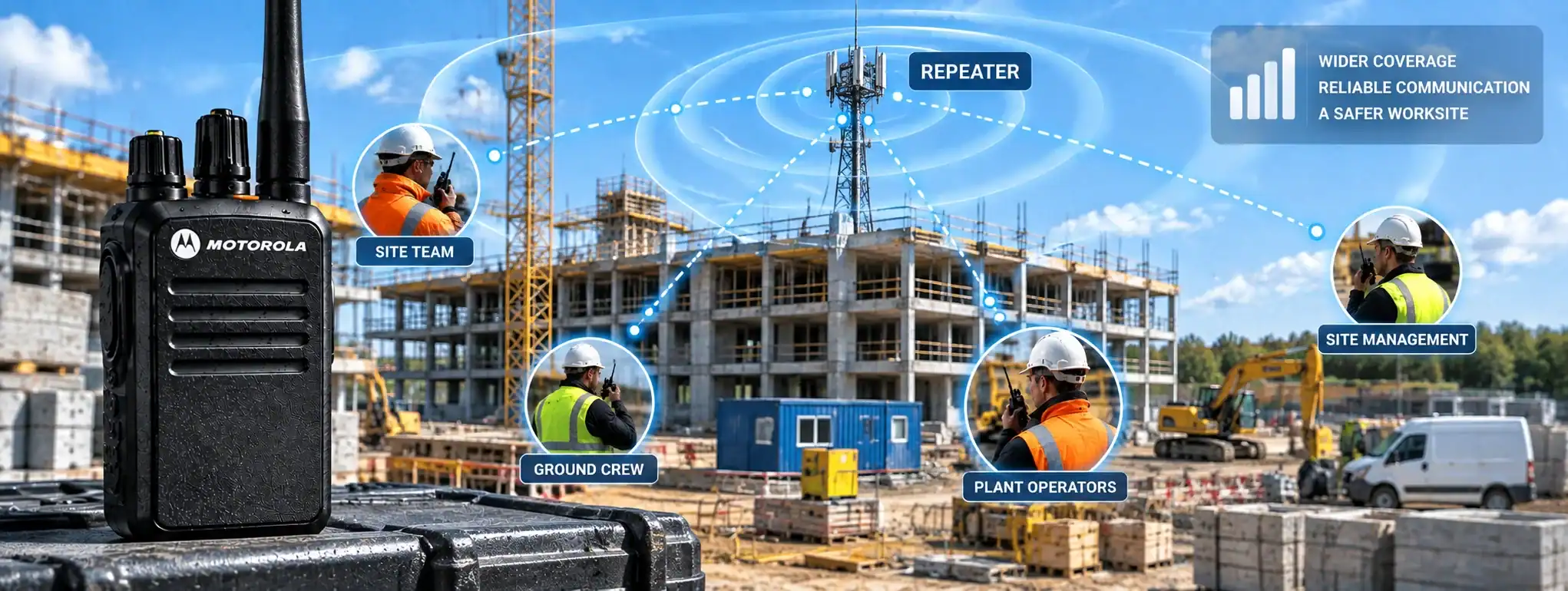
Coverage
Coverage refers to the geographical area in which a two-way radio systemA Radio System is a complete communication solution comprising two-way radios and, where required, equipment such as repeaters, antennas, base stations, mobile radios and network infrastructure. can provide reliable communication. In practical terms, it describes how far radio users can move from each other, or from a repeaterA Repeater receives a two-way radio transmission and retransmits it, usually from an elevated location, to extend the coverage and reliability of a radio communication system. or radio networkA Network is a connected system of radios, equipment and infrastructure that allows users to communicate across a defined area. Radio networks can range from simple radio-to-radio systems to large multi-site networks., while still being able to communicate effectively.
Radio coverage is not simply a measurement of maximum distance. A radio may be capable of transmitting a signal over a considerable distance under ideal conditions, but the usable coverage of a professional radio system depends on the environment, terrain, buildingsAn antenna transmits and receives radio-frequency signals, allowing a two-way radio to communicate. Antenna type, frequency, height and location can all affect radio performance and coverage., radio equipment, antennas, frequencyAn antenna transmits and receives radio-frequency signals, allowing a two-way radio to communicate. Antenna type, frequency, height and location can all affect radio performance and coverage., powerAn antenna transmits and receives radio-frequency signals, allowing a two-way radio to communicate. Antenna type, frequency, height and location can all affect radio performance and coverage. and whether a repeater or wider network is being used.
Good radio system design aims to provide reliable coverage, rather than simply achieving the greatest possible range.
What determines radio coverage?
A number of factors influence the coverage available from a two-way radio system.
These include:
- Transmit power
- Radio frequencyFrequency is the number of cycles a radio wave completes each second, measured in Hertz. In two-way radio, frequency determines where a transmission operates within the radio spectrum.
- AntennaAn antenna transmits and receives radio-frequency signals, allowing a two-way radio to communicate. Antenna type, frequency, height and location can all affect radio performance and coverage. type and position
- Radio sensitivity
- Terrain
- Buildings and other structures
- Vegetation
- Distance between users
- Height of the antenna
- Repeater location
- Repeater power
- Indoor construction materials
- Network infrastructureRadio infrastructure is the equipment and supporting systems behind a professional two-way radio network, including repeaters, antennas, base stations, network connections, power systems and dispatch equipment.
- Atmospheric and environmental conditions
Because these factors vary from one location to another, the same radio equipment can provide very different coverage in different environments.
Coverage vs radio range
Coverage and range are closely related but are not exactly the same thing.
Range generally refers to the maximum distance over which communication may be possible.
Coverage refers to the area in which communication can be expected to work reliably.
For professional radio systems, coverage is usually the more useful measurement because users need dependable communication rather than simply a theoretical maximum distance.
For example, a radio might communicate several miles in open countryside but have significantly reduced coverage inside a large concrete building.
Coverage in urban areas
Buildings, roads, structures and other obstacles can significantly affect radio coverage in towns and cities.
Signals may be weakened or blocked by:
- Concrete
- Steel
- Reinforced concrete
- Underground areas
- Metal structures
- Dense buildings
- Lift shafts
- Plant rooms
The effect varies according to the construction and radio frequency being used.
A system that provides good outdoor coverage may therefore require additional infrastructure to provide reliable coverage inside large or complex buildings.
Indoor radio coverage
Indoor coverage can be more difficult to predict than outdoor coverage.
Walls, floors, ceilings, metalwork and other building materials can reduce radio signals.
Large buildings such as:
- Warehouses
- Hospitals
- Hotels
- Shopping centres
- Factories
- Stadiums
- Underground facilities
may require careful radio planning to ensure that users can communicate throughout the required areas.
In some situations, additional infrastructure such as repeaters, distributed antenna systems or other coverage solutions may be required.
Coverage in rural areas
Open countryside can provide good radio coverage because there may be fewer physical obstacles between radio users.
However, hills, valleys, woodland and changes in elevation can significantly affect coverage.
A radio system covering a large rural site may therefore benefit from a strategically positioned repeater, particularly where users need to communicate across areas separated by hills or other terrain.
Coverage and line of sight
Radio signals generally travel more effectively when there is a clear line of sight between transmitting and receiving antennas.
Obstructions between radios can reduce the strength of the received signal.
Line of sight is particularly important at higher frequencies and when radios are being used over longer distances.
However, professional radio systems are not necessarily dependent on a perfect visual line of sight. Radio propagation can allow communication around or through some obstacles, depending on the frequency, environment and system design.
Coverage and radio frequency
The frequency used by a radio system can influence how radio signals propagate through the environment.
Different frequency bands have different propagation characteristics.
Lower-frequency radio signals can sometimes provide better penetration and propagation characteristics in particular environments, while higher frequencies can offer other advantages such as available bandwidth and antenna characteristics.
The most appropriate frequency depends on the application, licensing arrangements and required coverage.
Coverage and transmit power
Transmit power can influence the distance over which a radio signal can be received.
A higher-power radio can potentially provide greater coverage than a lower-power device under comparable conditions.
However, increasing transmit power does not automatically solve coverage problems.
Coverage is also affected by the receiving radio, antenna, terrain, buildings and interferenceRadio interference occurs when unwanted radio-frequency signals or electrical noise disrupt two-way radio communications, causing distorted audio, broken transmissions, reduced coverage or loss of communication..
For professional systems, transmit power must also remain within the limits permitted for the relevant equipment and radio licence.
Coverage and antennas
The antenna is a critical part of a radio system.
The position, type, height and efficiency of an antenna can have a significant effect on coverage.
For example, a repeater antenna mounted high above the surrounding terrain can provide considerably wider coverage than a similar antenna positioned at ground level.
Mobile radios with externally mounted vehicle antennas can also have different coverage characteristics from handheld radios using their built-in or supplied antennas.
Coverage and handheld radios
Handheld two-way radios are designed to provide portable communication, but their coverage can be affected by the user’s surroundings.
A person holding a radio inside a building may experience different coverage from someone standing outdoors.
The radio’s antenna can also be partially obstructed by the user’s body or nearby structures.
For this reason, manufacturers’ quoted range figures should generally be treated as indicative rather than a guarantee of coverage in a particular working environment.
Coverage and mobile radios
Mobile radios installed in vehicles can often provide different coverage characteristics from handheld radios.
They may use a higher-power transmitter and an externally mounted vehicle antenna.
The vehicle antenna can be positioned away from the user’s body and, depending on the vehicle and installation, may provide improved radio performance.
Mobile radios are therefore commonly used where users need reliable communication while travelling across larger areas.
Coverage and repeaters
A repeater is one of the most common ways of extending the coverage of a professional two-way radio system.
Instead of radios communicating directly with one another, a repeater receives a transmissionTransmission is the process of sending voice, data or signalling from a radio using a radio-frequency signal to another radio, repeater or communication system. and retransmits it from a strategically positioned location.
The basic arrangement is:
Radio A → Repeater → Radio B
Because the repeater can be positioned at an elevated or otherwise advantageous location, it can often provide substantially greater coverage than direct radio-to-radio communication.
Repeater coverage
The coverage provided by a repeater depends on factors including:
- Repeater location
- Antenna height
- Antenna type
- Transmit power
- Receiving sensitivity
- Terrain
- Frequency
- Building density
- Radio location
A well-positioned repeater can provide reliable coverage across a large site, industrial facility, event venue or geographical area.
Coverage and multiple repeaters
Large or geographically challenging radio systems may use more than one repeater or radio site.
Multiple sites can be connected to create a wider coverage area.
Depending on the system, users may be able to move between coverage areas while remaining part of the same communication network.
This can be particularly useful for organisations operating across towns, cities, campuses or large geographical regions.
Coverage and auto roaming
Some networked radio systems support Auto RoamingAuto roaming allows compatible two-way radios to automatically move between radio sites or channels as users move through different coverage areas, helping maintain reliable communication., allowing compatible radios to move between coverage areas or network sites automatically.
As the user moves, the radio can select an appropriate available site according to the system’s configuration.
This can help maintain communications across larger geographical areas without requiring the user to manually select a different radio channelA two-way radio channel is a programmed set of communication settings, typically including frequency and signalling, that allows compatible radios to communicate with one another. or site.
Coverage holes
A coverage hole is an area within an intended service area where radio communications are weak, unreliable or unavailable.
Coverage holes can occur because of:
- Terrain
- Buildings
- Underground areas
- Distance from a repeater
- Obstructions
- Radio interference
- Poor antenna positioning
- Network configuration
Identifying and eliminating coverage holes is an important part of professional radio system design.
Coverage testing
A coverage test or radio survey can be used to determine how well a radio system performs throughout a required area.
Testing may involve taking radios to different locations and checking:
- Signal strength
- Audio quality
- Ability to transmit
- Ability to receive
- Indoor coverage
- Outdoor coverage
- Dead spots
- Repeater performance
For larger or more complex installations, specialist radio engineers may carry out a detailed site surveyA Site Survey is an assessment of a location to determine whether a two-way radio system will provide the required coverage, reliability and performance. before recommending equipment or infrastructure.
Coverage and buildings
Building construction can have a major effect on radio coverage.
Materials such as reinforced concrete and steel can attenuate radio signals, while underground rooms and areas surrounded by heavy construction can be particularly challenging.
In large buildings, coverage may need to be considered floor by floor rather than simply as a single geographical area.
Coverage and basements
Basements and underground areas can be particularly difficult for conventional radio systems because the surrounding ground and building structure can significantly weaken radio signals.
Facilities such as car parks, tunnels and underground plant rooms may therefore require additional radio infrastructure if reliable communication is essential.
Coverage and radio systems
Coverage can be provided using different types of radio system.
These can include:
- Direct radio-to-radio communication
- Repeater-based systems
- Multi-site radio networks
- Digital radio systems
- BroadbandBroadband is a high-speed data connection used by systems such as PoC radio to carry voice, video and other communications over mobile networks, Wi-Fi or IP networks. Push-to-Talk systems
- Hybrid radio and broadband systems
Each approach has different coverage characteristics and infrastructure requirements.
Coverage and DMR
DMR (Digital Mobile RadioA Mobile Radio is a two-way radio designed to be installed in a vehicle. It normally uses the vehicle's power supply and an external antenna to provide reliable communication while travelling or working in the field.) systems can provide coverage using direct radio communication, repeaters or networked infrastructure.
A DMR repeater can extend coverage beyond the range available from direct radio-to-radio communication.
Networked DMR systems can also connect multiple radio sites where appropriate, allowing users to communicate across larger areas.
The actual coverage depends on the radio equipment, frequency, antennas, repeater infrastructure and environment.
Digital radio coverage
Digital radio can provide clear audio over a range of signal conditions, but digital radio does not eliminate the effects of distance or physical obstructions.
As the received signal becomes too weak, a digital radio may eventually lose intelligible communication rather than gradually producing increasing levels of analogue noise.
This is sometimes described as the digital cliff effect.
Digital radio therefore still requires proper coverage planning and testing.
Coverage and analogue radio
Analogue radioAnalogue radio uses continuously varying radio signals to transmit voice communication. It remains widely used for reliable two-way communication across business, industry, events, security and other applications. signals can also provide substantial coverage when correctly designed.
As the signal becomes weaker, analogue audio may gradually become noisier and less intelligible.
The point at which communication becomes unusable depends on the equipment, environment and user’s ability to understand the audio.
Coverage and radio licensing
In the UK, the frequencies and operating conditions of many professional radio systems are subject to OfcomOfcom (Office of Communications) is the UK's communications regulator. For two-way radio users, Ofcom manages and regulates access to radio spectrum and the use of radio frequencies in the UK. licensing requirements.
The licence and associated frequency allocation can influence how a radio system is designed.
A radio system should therefore be planned around the appropriate licence, equipment and required geographical coverage.
Coverage and radio hire
Coverage is one of the most important considerations when hiring two-way radios.
A radio that works well in one environment may not provide the same performance in another.
For events, construction projects, security operations and large sites, the required coverage should be established before the equipment is supplied.
Where necessary, a radio hireRadio Hire is the temporary rental of two-way radios and related communication equipment for events, projects and operational requirements, providing professional communication without purchasing the equipment. company can assess the site and provide repeaters or other infrastructure to achieve the required coverage.
Coverage for events
Large events can present challenging coverage requirements.
Crowds, temporary structures, buildings and the size of the event site can all affect radio performance.
An event radio system may therefore use repeaters, strategically positioned antennas or other infrastructure to provide reliable coverage throughout the operational area.
For particularly large events, coverage planning should include the locations where security, production, management and other teams are expected to work.
Coverage for construction sites
Construction sites can change significantly as work progresses.
New structures, steelwork, concrete and changing building layouts can affect radio coverage.
A radio system that works well at the beginning of a project may therefore require adjustment as the site develops.
Repeaters and suitable antenna locations can help maintain reliable communications across larger construction sites.
Coverage vs maximum range claims
Manufacturers may quote maximum radio range under particular test conditions.
These figures should not be interpreted as a guaranteed working range in every environment.
Actual coverage can be significantly affected by terrain, buildings, antennas, radio position and interference.
For professional applications, the most useful question is generally not “How far can the radio transmit?” but “Will the radio provide reliable communication throughout the area where it will be used?”
Designing for reliable coverage
Professional radio system design should begin by identifying the area that needs to be covered.
This may include:
- Outdoor working areas
- Buildings
- Basements
- Car parks
- Warehouses
- Remote areas
- Vehicles
- Control rooms
- Multiple sites
Once the required coverage area is understood, the appropriate radios, antennas, repeaters and network infrastructure can be selected.
Coverage and DCS
DCS can assess radio coverage requirements and recommend appropriate equipment and infrastructure for professional two-way radio systems.
Where greater coverage is required, this may involve higher-performance antennas, mobile radios, repeaters or networked radio systems.
For critical applications, a radio survey and coverage test can help ensure that the proposed system provides reliable communication throughout the required working area.