Ofcom
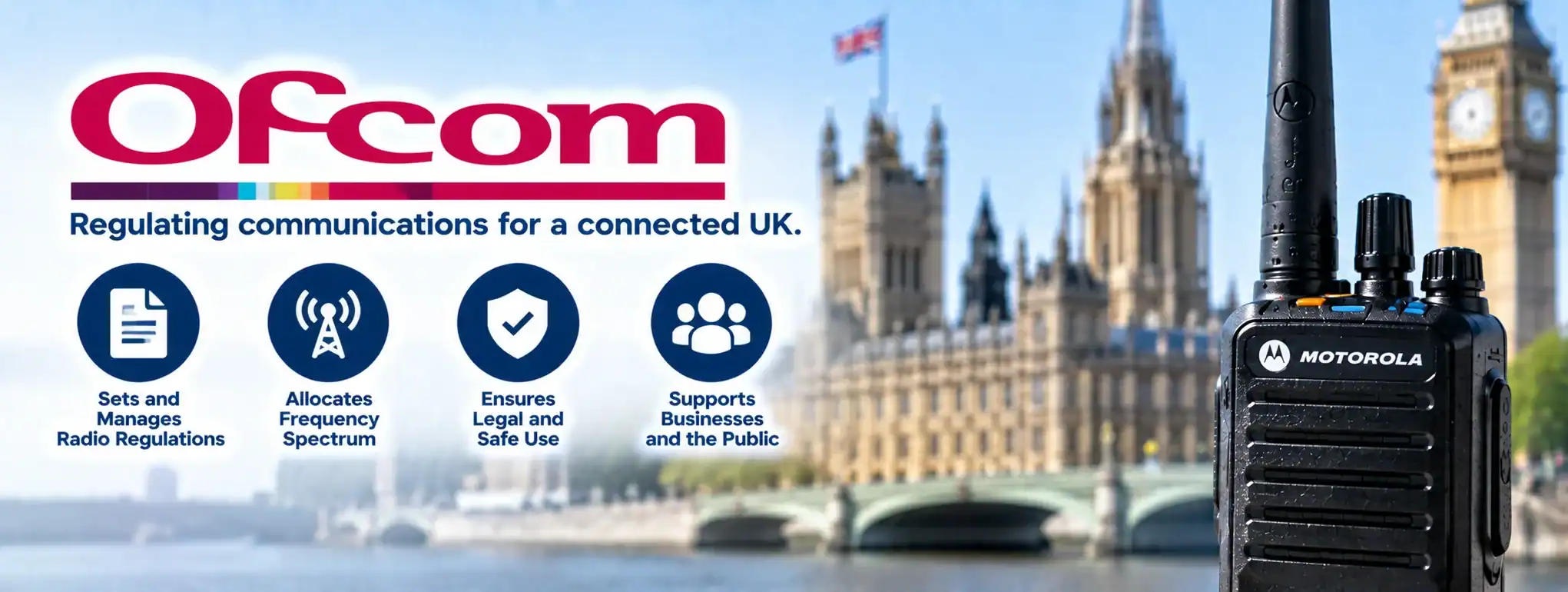
Ofcom (Office of Communications) is the UK’s communications regulator. It regulates a wide range of communication services and technologies, including radio spectrumSpectrum is the range of radio frequencies used for wireless communication. Two-way radios operate within specific parts of the radio spectrum, subject to frequency allocation and licensing requirements. and the use of radio frequencies for two-way radio communication.
For businesses using professional two-way radios in the UK, Ofcom is particularly important because it manages and regulates access to radio spectrum and sets the rules under which different radio services can operate.
What is Ofcom?
Ofcom is an independent regulator responsible for overseeing communications services in the UK.
Its responsibilities include areas such as:
- Radio spectrum
- Television
- Radio broadcasting
- Telecommunications
- Postal services
- BroadbandBroadband is a high-speed data connection used by systems such as PoC radio to carry voice, video and other communications over mobile networks, Wi-Fi or IP networks. and mobile communications
For two-way radio users, one of Ofcom’s most relevant responsibilities is the management and regulation of the UK’s radio spectrum.
Ofcom and radio spectrum
Radio spectrum is the range of radio frequencies used by wireless communication systems.
Ofcom manages access to spectrum in the UK to help ensure that different users and services can operate without causing unacceptable interferenceRadio interference occurs when unwanted radio-frequency signals or electrical noise disrupt two-way radio communications, causing distorted audio, broken transmissions, reduced coverage or loss of communication. to each other.
This includes spectrum used by:
- Business radioBusiness Radio refers to professional two-way radio systems used by businesses and organisations for instant communication, often using licensed frequencies and equipment designed for commercial use.
- Mobile communications
- Broadcasting
- Aviation
- Maritime services
- Emergency services
- Satellite services
- Licence-free radioA Licence-Free Radio is a two-way radio that can be used without an individual radio licence when it complies with the applicable licence-exempt rules. In the UK, PMR446 is the main licence-free radio service. services
Ofcom and two-way radio
Ofcom regulates the use of radio frequencies for professional two-way radio communication in the UK.
Businesses using licensed radioA Licensed Radio is a two-way radio operated under an appropriate radio licence. Licensed systems can provide greater control over frequencies, coverage and infrastructure than licence-free radio services such as PMR446. systems may need an appropriate Ofcom radio licence before operating their equipment.
The licence determines the frequencies and conditions under which the radio systemA Radio System is a complete communication solution comprising two-way radios and, where required, equipment such as repeaters, antennas, base stations, mobile radios and network infrastructure. can operate.
Ofcom radio licences
Ofcom provides different types of radio authorisation depending on how spectrum is being used.
For professional two-way radio, businesses may use a Business Radio LicenceA Business Radio Licence is an Ofcom authorisation allowing professional two-way radios to use specified frequencies and operating conditions for business communications in the UK..
The appropriate licence depends on factors such as:
- Location
- FrequencyAn antenna transmits and receives radio-frequency signals, allowing a two-way radio to communicate. Antenna type, frequency, height and location can all affect radio performance and coverage. requirements
- CoverageRadio Coverage is the geographical area in which a two-way radio system can provide reliable communication. Coverage depends on the radios, antennas, frequency, terrain, buildings and system infrastructure.
- Number of sites
- Type of radio service
- Whether communication is local or wide-area
Ofcom Business Radio
Business Radio is a category of radio communication used by organisations for operational communications.
It can be used by businesses and organisations including:
- Construction companies
- Security companies
- Transport operators
- Warehouses
- Farms
- Utilities
- Hotels
- Event organisers
- Manufacturing businesses
- Facilities-management teams
Business radio systems can use handheld radios, mobile radios, base stations and repeaters.
Ofcom and licensed radio
A Licensed Radio system operates using radio frequencies authorised by Ofcom.
Licensing can provide access to frequencies that are coordinated for professional use.
This can help reduce the risk of interference and allow businesses to operate communication systems designed for their specific requirements.
Ofcom and licence-free radio
Not every two-way radio requires an individual radio licence.
For example, PMR446 is a licence-free radio service subject to specific technical and operating restrictions.
Licence-free does not mean that any radio can be used without authorisation.
The equipment must meet the requirements of the relevant licence-exempt service.
Ofcom and PMR446
PMR446 is a short-range licence-free radio service available in the UK and across much of Europe.
PMR446 equipment is subject to restrictions relating to matters such as:
- FrequencyFrequency is the number of cycles a radio wave completes each second, measured in Hertz. In two-way radio, frequency determines where a transmission operates within the radio spectrum.
- Transmitter powerAn antenna transmits and receives radio-frequency signals, allowing a two-way radio to communicate. Antenna type, frequency, height and location can all affect radio performance and coverage.
- AntennaAn antenna transmits and receives radio-frequency signals, allowing a two-way radio to communicate. Antenna type, frequency, height and location can all affect radio performance and coverage. configuration
- Equipment type
Professional licensed radio equipment should not simply be operated on PMR446 frequencies unless it complies with the requirements of the licence-exempt service.
Ofcom and radio frequencies
Ofcom manages the UK’s radio-frequency spectrum.
A professional radio system may be allocated specific frequencies depending on its licence.
Frequency selection is important because different frequencies have different propagation characteristics and may be more suitable for particular environments.
Ofcom and frequency coordination
Frequency coordination helps prevent radio systems from interfering with each other.
Ofcom considers spectrum availability and existing users when managing licensed radio frequencies.
Professional radio suppliers can also help customers select suitable equipment and frequencies within the relevant licensing framework.
Ofcom and interference
Interference occurs when unwanted radio signals affect communication.
Ofcom’s spectrum-management role helps manage interference between different radio users and services.
Businesses should ensure that their radio equipment is correctly configured and operated within the conditions of its licence.
Ofcom and radio coverage
Ofcom licensing does not guarantee that a radio system will provide a particular geographical level of coverage.
Coverage depends on the design and installation of the radio system.
Important factors include:
- Frequency
- Transmitter power
- Antenna height
- Antenna position
- Terrain
- BuildingsAn antenna transmits and receives radio-frequency signals, allowing a two-way radio to communicate. Antenna type, frequency, height and location can all affect radio performance and coverage.
- RepeaterA Repeater receives a two-way radio transmission and retransmits it, usually from an elevated location, to extend the coverage and reliability of a radio communication system. location
- Radio equipment
A professional Site SurveyA Site Survey is an assessment of a location to determine whether a two-way radio system will provide the required coverage, reliability and performance. may be appropriate where reliable coverage is important.
Ofcom and repeaters
A Repeater can be used to extend the coverage of a professional radio system.
Repeaters receive transmissions from radios and retransmit them from a strategically positioned location.
The use of repeaters and associated frequencies must comply with the relevant Ofcom licensing requirements.
Ofcom and radio channels
A licensed radio system can be assigned specific channels or frequencies.
The number of available channels depends on the licence and spectrum allocation.
Businesses may use separate channels or talkgroups for different departments.
For example:
- Operations
- Security
- Maintenance
- Management
Ofcom and narrowband radio
Modern professional radio systems often use NarrowbandNarrowband describes a radio communication system that uses a relatively small amount of frequency spectrum to transmit information. It is widely used in professional two-way radio to make efficient use of available radio channels. channelA two-way radio channel is a programmed set of communication settings, typically including frequency and signalling, that allows compatible radios to communicate with one another. arrangements to make efficient use of radio spectrum.
Ofcom’s spectrum-management framework includes technical requirements governing how licensed radio channels are used.
The permitted bandwidth depends on the relevant frequency allocation and licence.
Ofcom and DMR
Digital Mobile Radio (DMR)Digital Mobile Radio (DMR) is an ETSI digital radio standard for professional two-way communications, supporting voice, group calling, data and other features on compatible radio systems. is a digital radio technology widely used in professional business radio.
DMR equipment can operate under appropriate licensed radio arrangements.
The fact that a radio uses DMR does not by itself determine whether a licence is required. The frequency, service and operating conditions must also be considered.
Ofcom and MOTOTRBO™
MOTOTRBO™MOTOTRBO™ is Motorola Solutions' professional digital two-way radio platform, based on the DMR standard. It supports business communication ranging from simple radio systems to multi-site networks. is a professional digital radio platform based on DMR technology.
MOTOTRBO™ systems used for business communications in the UK may operate on frequencies authorised under the relevant Ofcom radio licensing arrangements.
The equipment must be configured to comply with the applicable licence.
Ofcom and radio hire
Two-way radios supplied for Radio HireRadio Hire is the temporary rental of two-way radios and related communication equipment for events, projects and operational requirements, providing professional communication without purchasing the equipment. in the UK can operate under appropriate radio licensing arrangements.
A radio-hire company may provide equipment that is already configured for the frequencies and operating conditions required for the particular hire system.
Customers should use hired radio equipment only as instructed by the supplier.
Ofcom and event radio hire
Events often require temporary radio communication between:
- Event management
- Security
- Stewards
- Production teams
- Medical teams
- Site operations
Professional radio-hire companies can provide suitable equipment and licensing arrangements where required.
Ofcom and construction radio
Construction sites can use licensed business radio systems to communicate between workers, supervisors and plant operators.
A system may include:
Handheld Radios + Repeater + Base StationA base station is a fixed two-way radio installed at a permanent location, allowing an operator to communicate with handheld or mobile radios across a site or operating area.
The appropriate frequency and licensing arrangement depends on the site and system requirements.
Ofcom and security radio
Security companies can use licensed business radio systems for communication between:
- Security officers
- Supervisors
- Control rooms
- Patrol vehicles
Professional radio systems can provide group calling, emergency functions and other features where supported.
Ofcom and transport radio
Transport operators can use professional radio systems to communicate between:
- Drivers
- Control rooms
- Depots
- Supervisors
- Maintenance teams
Vehicle-mounted Mobile Radios can be used alongside handheld radios.
Ofcom and agricultural radio
Farms and agricultural businesses can use licensed radio systems to provide communication across large areas.
A repeater can improve coverage where direct radio communication is insufficient.
This can be useful for:
- Tractor operators
- Farm vehicles
- Ground teams
- Farm managers
Ofcom and marine radio
Marine radioA Marine Radio is a two-way radio designed for communication between vessels, shore stations and marine operations. Marine VHF radios are widely used for operational and safety communication on the water. operates under specific maritime radio arrangements.
Marine VHF services are subject to their own licensing and operating requirements.
Businesses involved in marine operations should ensure that the appropriate marine radio licence and operator requirements are followed.
Ofcom and aviation radio
Aviation radio is subject to separate regulatory and technical requirements.
Aircraft and aviation organisations must use the appropriate frequencies and equipment for their particular service.
Business radio licences should not be assumed to cover aviation radio use.
Ofcom and emergency services
Emergency-service radio systems operate under specific arrangements and spectrum allocations.
Commercial businesses should not attempt to use frequencies allocated to emergency services.
Ofcom and radio equipment
Radio equipment used in the UK must meet applicable technical and regulatory requirements.
Businesses should use equipment that is appropriate for the intended frequency and service.
Programming a radio to a frequency does not automatically make its operation legal.
Ofcom and radio programming
A professional radio’s CodeplugA Codeplug is the configuration data programmed into a two-way radio that defines its channels, frequencies, talkgroups, radio ID and other operating features. can contain settings such as:
- Frequencies
- Channels
- Talkgroups
- Power levels
- Scan lists
- Other operating parameters
The configuration should match the authorised radio system and its licensing conditions.
Ofcom and transmit power
Radio licences can specify technical parameters relating to how a radio system operates.
Transmit power is one factor that can affect coverage and interference.
Users should not simply increase transmitter power to obtain greater range if doing so would exceed the authorised operating conditions.
Ofcom and antennas
Antennas form an important part of professional radio systems.
The antenna type, height and location can affect radio coverage.
The use of an antenna must also comply with the technical conditions applicable to the radio service.
Ofcom and radio system design
A professional radio system should be designed around both operational requirements and regulatory requirements.
Planning can include:
- Required coverage.
- Number of users.
- Frequency requirements.
- Channel requirements.
- Repeater requirements.
- Antenna locations.
- Transmitter power.
- Interference considerations.
- Licensing.
- Future expansion.
Ofcom and radio licensing responsibility
Businesses should understand who is responsible for the radio licence being used.
Depending on the arrangement, the licence may be held by the business operating the system or by another authorised party, such as a radio-hire provider.
The exact licensing arrangement should be confirmed before operating the equipment.
Ofcom and radio hire licensing
For temporary radio systems, the licensing arrangement should be established before the equipment is used.
A professional radio-hire company can advise on the appropriate arrangement for the hire.
Users should not assume that a radio supplied for hire can be operated on any frequency.
Ofcom and radio interference complaints
Ofcom has responsibilities for managing harmful interference affecting radio spectrum users.
Where a radio system experiences persistent interference, the cause should first be investigated to determine whether the problem is related to equipment, configuration, coverage or another radio user.
Ofcom and radio compliance
Radio users are responsible for operating equipment in accordance with the applicable regulatory requirements.
This includes following the conditions associated with the relevant licence or licence-exempt service.
Non-compliant equipment or operation can create interference and may result in regulatory action.
Ofcom and radio standards
Radio equipment may need to comply with relevant UK and international technical standards.
Standards can cover matters such as:
- Frequency use
- Transmitter characteristics
- ReceiverA Receiver is the part of a two-way radio that detects and processes incoming radio signals, converting them into audible voice or usable data for the user. performance
- Electromagnetic compatibility
- Equipment safety
- Radio emissions
The applicable requirements depend on the type of equipment and service.
Ofcom and spectrum efficiency
Efficient use of radio spectrum is an important part of spectrum management.
Technologies such as narrowband analogue radioAnalogue radio uses continuously varying radio signals to transmit voice communication. It remains widely used for reliable two-way communication across business, industry, events, security and other applications. and DMR can allow more efficient use of available spectrum than some older wider-channel systems.
Ofcom and digital radio
Digital radio technologies can provide additional services within professional radio systems.
These may include:
- Group calling
- Individual calls
- GPS
- Emergency alerts
- Data
- EncryptionEncryption protects two-way radio communications by converting voice or data into a secure form that can only be understood by authorised radios with the correct encryption capability and keys.
- Dispatch
Ofcom regulates the spectrum in which these systems operate, while the technical features are determined by the radio technology and manufacturer.
Ofcom and radio network design
Larger radio networks can require more detailed planning.
A multi-site networkA Network is a connected system of radios, equipment and infrastructure that allows users to communicate across a defined area. Radio networks can range from simple radio-to-radio systems to large multi-site networks. may include:
Handheld Radios + Mobile Radios + Repeaters + IP Network + Dispatch
Each part of the system must operate within the applicable regulatory framework.
Ofcom and radio site planning
The location of repeaters and antennas can have a significant effect on coverage.
For larger systems, radio engineers may assess:
- Site elevation
- Building height
- Antenna position
- Frequency
- Coverage requirements
- Interference
- Existing spectrum users
Ofcom and DCS
DCS can advise businesses on professional two-way radio systems and the licensing considerations associated with their use in the UK.
Whether a radio system requires a licence, and which type is appropriate, depends on the equipment, frequencies, location and intended use.
Businesses should ensure that their radio system operates within the conditions of the relevant Ofcom authorisation.