
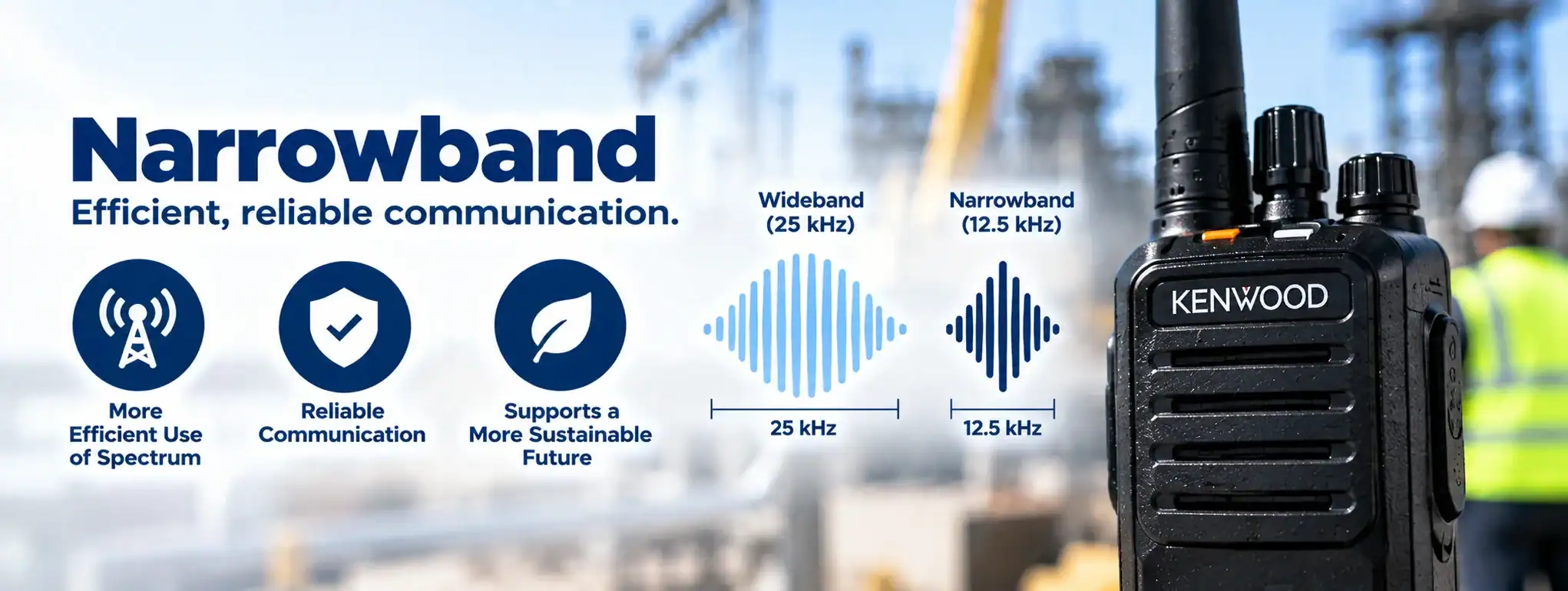
Narrowband
Narrowband describes a radio communication system that uses a relatively narrow range of radio frequencies to transmit information.
In two-way radio, narrowband technology is commonly used to allow more communication channels to fit within a limited amount of radio spectrumSpectrum is the range of radio frequencies used for wireless communication. Two-way radios operate within specific parts of the radio spectrum, subject to frequency allocation and licensing requirements.. It is particularly important in professional radio systems where efficient use of available frequencies is required.
What is narrowband?
A radio signal occupies a certain amount of frequencyAn antenna transmits and receives radio-frequency signals, allowing a two-way radio to communicate. Antenna type, frequency, height and location can all affect radio performance and coverage. spectrum. The width of this occupied spectrum is known as its Bandwidth.
A narrowband radio systemA Radio System is a complete communication solution comprising two-way radios and, where required, equipment such as repeaters, antennas, base stations, mobile radios and network infrastructure. uses a smaller bandwidth than a wideband system.
The term does not necessarily describe one particular radio technology. It is a general description of how much spectrum a radio signal occupies.
Narrowband and bandwidth
Bandwidth refers to the range of frequencies used by a radio transmissionTransmission is the process of sending voice, data or signalling from a radio using a radio-frequency signal to another radio, repeater or communication system..
For example, a channelA two-way radio channel is a programmed set of communication settings, typically including frequency and signalling, that allows compatible radios to communicate with one another. may be allocated a particular amount of spectrum around its operating frequencyFrequency is the number of cycles a radio wave completes each second, measured in Hertz. In two-way radio, frequency determines where a transmission operates within the radio spectrum..
A narrowband system uses a relatively small portion of that spectrum.
The exact bandwidth depends on the radio technology, channel plan and regulatory requirements.
Narrowband radio
Narrowband radio is widely used in professional two-way radio systems.
It can be found in:
- Business radioBusiness Radio refers to professional two-way radio systems used by businesses and organisations for instant communication, often using licensed frequencies and equipment designed for commercial use.
- Security radioA Security Radio is a professional two-way radio used by security personnel to communicate quickly and reliably, with features such as group calling, emergency alerts, Lone Worker and Man Down.
- Transport radio
- Construction radio
- Utility radio
- Public-sector communication
- Industrial radio
- Event radio systems
Both analogue and digital radio technologies can use narrowband channel arrangements.
Narrowband analogue radio
Analogue two-way radio systems can use narrowband FM to reduce the amount of spectrum required for each channel.
This allows more channels to be accommodated within a defined frequency band.
Narrowband analogue radioAnalogue radio uses continuously varying radio signals to transmit voice communication. It remains widely used for reliable two-way communication across business, industry, events, security and other applications. has been widely adopted by professional radio users.
Narrowband digital radio
Digital radio systems can also operate using narrowband channel allocations.
For example, DMR (Digital Mobile RadioA Mobile Radio is a two-way radio designed to be installed in a vehicle. It normally uses the vehicle's power supply and an external antenna to provide reliable communication while travelling or working in the field.) uses defined channel bandwidths and a structured approach to using the available radio spectrum.
Digital technology can provide additional functionality while operating within a relatively narrow channel.
Narrowband and DMR
DMR is designed around a 12.5 kHz channel bandwidth and uses TDMA (Time Division Multiple Access) to divide the channel into two timeslots.
This allows two logical communication paths to share the same 12.5 kHz radio channel under suitable conditions.
Narrowband operation is therefore an important part of efficient professional radio spectrum use.
Narrowband and PMR446
PMR446 is a licence-free radioA Licence-Free Radio is a two-way radio that can be used without an individual radio licence when it complies with the applicable licence-exempt rules. In the UK, PMR446 is the main licence-free radio service. service using defined frequencies and technical parameters.
PMR446 equipment uses narrowband channel arrangements within the designated PMR446 spectrum.
The equipment must comply with the applicable technical requirements for licence-free operation.
Narrowband and licensed radio
Licensed professional radio systems commonly use narrowband channels to make efficient use of the available spectrum.
A radio licence specifies the frequencies and other operating conditions under which the system can be used.
The exact channel bandwidth depends on the frequency band, licence and radio technology.
Narrowband and frequency
Narrowband should not be confused with a particular Frequency.
Frequency identifies where a radio channel sits within the spectrum.
Bandwidth describes how much spectrum the transmitted signal occupies around that frequency.
Narrowband and channel spacing
Radio systems use defined channel spacing to separate adjacent communication channels.
Narrower channel arrangements can allow more channels to fit into a given frequency range.
However, reducing channel bandwidth can also place greater demands on receiverA Receiver is the part of a two-way radio that detects and processes incoming radio signals, converting them into audible voice or usable data for the user. performance and frequency accuracy.
Narrowband and interference
Narrowband systems can help reduce the amount of spectrum occupied by individual transmissions.
However, narrowband does not eliminate InterferenceRadio interference occurs when unwanted radio-frequency signals or electrical noise disrupt two-way radio communications, causing distorted audio, broken transmissions, reduced coverage or loss of communication..
Interference can still occur when:
- Frequencies are poorly coordinated
- Adjacent channels are too close
- Unwanted signals are present
- Equipment is incorrectly configured
- Radio signals are overloaded
- External electrical equipment produces interference
Proper frequency planning remains important.
Narrowband and adjacent-channel interference
Adjacent-channel interference occurs when a transmission on one channel affects another nearby channel.
Radio equipment is designed with filtering and receiver selectivity to reduce this problem.
Good frequency planning and correctly configured equipment are important when operating multiple channels in the same area.
Narrowband and radio coverage
Narrowband operation does not automatically determine the coverageRadio Coverage is the geographical area in which a two-way radio system can provide reliable communication. Coverage depends on the radios, antennas, frequency, terrain, buildings and system infrastructure. of a radio system.
Coverage is influenced by factors such as:
- Transmitter powerAn antenna transmits and receives radio-frequency signals, allowing a two-way radio to communicate. Antenna type, frequency, height and location can all affect radio performance and coverage.
- AntennaAn antenna transmits and receives radio-frequency signals, allowing a two-way radio to communicate. Antenna type, frequency, height and location can all affect radio performance and coverage. height
- Antenna efficiency
- Frequency
- Terrain
- BuildingsAn antenna transmits and receives radio-frequency signals, allowing a two-way radio to communicate. Antenna type, frequency, height and location can all affect radio performance and coverage.
- RepeaterA Repeater receives a two-way radio transmission and retransmits it, usually from an elevated location, to extend the coverage and reliability of a radio communication system. location
- Receiver sensitivity
A narrowband radio can therefore provide extensive coverage when used as part of a suitably designed radio system.
Narrowband and repeater systems
Narrowband radios can operate through Repeaters.
A repeater receives a transmission and retransmits it from a higher or strategically positioned location.
This can extend coverage while continuing to use the allocated narrowband channel arrangement.
Narrowband and two-way radio
Many professional two-way radio systems use narrowband channels because radio spectrum is a limited resource.
A typical system may include:
Handheld Radios → Repeater → Handheld / Mobile Radios
The exact bandwidth and channel arrangement depend on the radio system.
Narrowband and mobile radio
Mobile Radios can operate using narrowband channels.
Vehicle-mounted radios may use an external antenna and higher effective antenna position to provide reliable communication.
Narrowband operation itself does not determine whether a radio is handheld or mobile.
Narrowband and handheld radios
Professional handheld radios can use narrowband channel arrangements for both analogue and digital communication.
The radio’s specification determines the supported channel bandwidths and frequencies.
Narrowband and wideband
Wideband radio uses a larger bandwidth than narrowband radio.
In general:
Narrowband = smaller occupied bandwidth
Wideband = larger occupied bandwidth
The terms are relative to the radio system and technology being considered.
Narrowband migration
Some organisations have migrated from older wideband radio systems to narrower channel arrangements to comply with spectrum-management requirements or increase the efficient use of available frequencies.
The transition may require:
- Radio reprogramming
- New equipment
- Frequency coordination
- System testing
- Repeater configuration
- Updated licensing
Narrowband and radio licensing in the UK
In the UK, professional radio frequencies are managed by OfcomOfcom (Office of Communications) is the UK's communications regulator. For two-way radio users, Ofcom manages and regulates access to radio spectrum and the use of radio frequencies in the UK..
The permitted frequency, channel bandwidth and technical characteristics depend on the relevant radio licence and service.
Businesses should ensure that radio equipment is configured to operate within the conditions of the applicable licence.
Narrowband and spectrum efficiency
One of the principal advantages of narrowband operation is improved spectrum efficiency.
Using less bandwidth per communication channel can allow more channels to be accommodated within a limited frequency allocation.
This is particularly important in areas where many organisations need access to radio spectrum.
Narrowband limitations
Narrowband operation also involves trade-offs.
Depending on the technology, reducing bandwidth can affect:
- Audio characteristics
- Data capacity
- Receiver design
- Channel planning
- System compatibility
The effect depends heavily on the radio technology being used.
Narrowband and digital voice quality
Digital narrowband radio can produce clear speech when the signal is sufficiently strong.
However, digital radio behaves differently from analogue radio as signal strength decreases.
Once the received signal falls below the system’s usable threshold, audio can deteriorate rapidly or communication can be lost.
Narrowband and radio system design
When designing a narrowband radio system, engineers may consider:
- Frequency band.
- Channel bandwidth.
- Channel spacing.
- Required coverage.
- Transmitter power.
- Antenna configuration.
- Repeater requirements.
- Number of users.
- Interference.
- Licensing requirements.
- Analogue or digital technology.
- Future expansion.
Narrowband and DCS
DCS can advise on suitable professional two-way radio systems operating within the applicable UK radio licensing framework.
Whether a narrowband radio system is appropriate depends on the required coverage, number of users, frequency allocation, operating environment and communication requirements.