
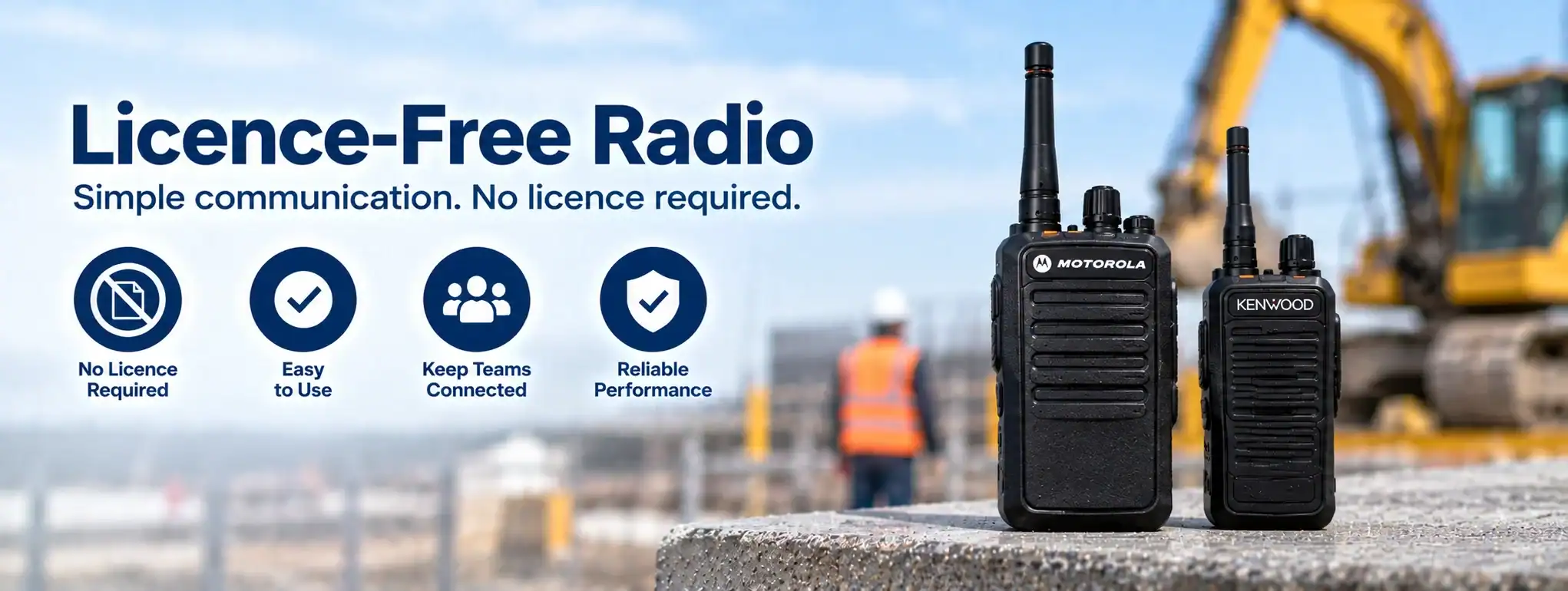
Licence-Free Radio
A Licence-Free Radio is a two-way radio that can be operated without the user obtaining an individual radio licence, provided the equipment complies with the applicable regulations and is used within the permitted limits.
In the UK, the most common licence-free two-way radios are PMR446 radios. These operate on designated frequencies and are subject to restrictions on equipment type, powerAn antenna transmits and receives radio-frequency signals, allowing a two-way radio to communicate. Antenna type, frequency, height and location can all affect radio performance and coverage. and use.
Licence-free radios can provide a simple communication solution for businesses, events, leisure activities and short-range site communications where the limitations of the service are suitable.
What is a licence-free radio?
A licence-free radio is designed to operate on frequencies and under technical conditions that allow users to communicate without applying for an individual radio frequencyAn antenna transmits and receives radio-frequency signals, allowing a two-way radio to communicate. Antenna type, frequency, height and location can all affect radio performance and coverage. licence.
The term does not mean that the radio has no rules.
Users must operate compliant equipment within the conditions applicable to the licence-exempt service.
Licence-Free Radio in the UK
In the UK, PMR446 is the principal licence-exempt service for short-range personal and business radioBusiness Radio refers to professional two-way radio systems used by businesses and organisations for instant communication, often using licensed frequencies and equipment designed for commercial use. communication.
PMR446 equipment operates within the designated PMR446 frequencyFrequency is the number of cycles a radio wave completes each second, measured in Hertz. In two-way radio, frequency determines where a transmission operates within the radio spectrum. range and is subject to technical restrictions.
The equipment must comply with the applicable requirements for PMR446 operation.
What is PMR446?
PMR446 stands for Private Mobile RadioA Mobile Radio is a two-way radio designed to be installed in a vehicle. It normally uses the vehicle's power supply and an external antenna to provide reliable communication while travelling or working in the field. 446.
It is a licence-exempt radio service intended for short-range voice communication.
PMR446 radios are widely available and are commonly used for:
- Events
- Hospitality
- Retail
- Leisure
- Outdoor activities
- Small sites
- Family communication
- Temporary operations
Licence-Free Radio frequencies
PMR446 operates in the 446 MHz frequency range.
The specific channels and technical arrangements are defined by the relevant regulations and standards.
Users should use equipment specifically designed for PMR446 rather than attempting to configure other professional radios to operate as licence-free equipment.
Licence-Free Radio power
Licence-free radios are subject to strict technical limits, including limits on transmitted power.
These limits help ensure that PMR446 remains a shared short-range radio service.
Higher-power professional radio equipment cannot simply be operated at PMR446 frequencies and treated as licence-free.
Licence-Free Radio range
The practical range of a licence-free radio varies considerably.
It can be affected by:
- BuildingsAn antenna transmits and receives radio-frequency signals, allowing a two-way radio to communicate. Antenna type, frequency, height and location can all affect radio performance and coverage.
- Walls
- Terrain
- Trees
- Vehicles
- InterferenceRadio interference occurs when unwanted radio-frequency signals or electrical noise disrupt two-way radio communications, causing distorted audio, broken transmissions, reduced coverage or loss of communication.
- AntennaAn antenna transmits and receives radio-frequency signals, allowing a two-way radio to communicate. Antenna type, frequency, height and location can all affect radio performance and coverage. position
- Radio design
- User location
Manufacturers may quote ranges under ideal conditions, but real-world coverageRadio Coverage is the geographical area in which a two-way radio system can provide reliable communication. Coverage depends on the radios, antennas, frequency, terrain, buildings and system infrastructure. can be significantly less.
Licence-Free Radio and buildings
Buildings can reduce PMR446 radio range because walls, floors, metal structures and other materials can weaken the radio signal.
A radio that performs well outdoors may therefore have considerably less coverage inside a large building.
Licence-Free Radio and outdoor use
PMR446 radios can be useful for short-range outdoor communication.
They may be suitable for activities such as:
- Outdoor events
- Campsites
- Sports activities
- Leisure
- Small construction tasks
- Site operations
The actual coverage depends on the environment.
Licence-Free Radio and interference
Because PMR446 is a shared licence-exempt service, users may encounter other radios operating on the same or nearby channels.
This can result in:
- Interference
- Unwanted conversations
- Reduced availability
- Difficulty communicating
Users have limited control over interference compared with a professionally licensed radioA Licensed Radio is a two-way radio operated under an appropriate radio licence. Licensed systems can provide greater control over frequencies, coverage and infrastructure than licence-free radio services such as PMR446.radio systemA Radio System is a complete communication solution comprising two-way radios and, where required, equipment such as repeaters, antennas, base stations, mobile radios and network infrastructure. using coordinated frequencies.
Licence-Free Radio and privacy
Licence-free radio communications should not be considered private simply because users are operating their own radios.
Other compatible radios within range may be able to receive transmissions on the same channelA two-way radio channel is a programmed set of communication settings, typically including frequency and signalling, that allows compatible radios to communicate with one another..
Where confidential communications are required, a suitable professional radio system with appropriate security features may be more appropriate.
Licence-Free Radio and channels
PMR446 radios provide multiple designated channels.
Users can select different channels to separate conversations.
However, selecting a different channel does not necessarily guarantee privacy or freedom from interference.
Other users may be operating on the same channel.
Licence-Free Radio and CTCSS
Many PMR446 radios support CTCSS tones.
CTCSS can prevent a radio from opening its speaker when it receives transmissions that do not contain the expected tone.
This can make a channel appear quieter.
However, CTCSS does not encrypt the communication and does not prevent another user from hearing the transmissionTransmission is the process of sending voice, data or signalling from a radio using a radio-frequency signal to another radio, repeater or communication system..
Licence-Free Radio and DCS
Some licence-free radios also support DCS (Digital Coded SquelchAnalogue radio uses continuously varying radio signals to transmit voice communication. It remains widely used for reliable two-way communication across business, industry, events, security and other applications.).
Like CTCSS, DCS can help manage which transmissions open the radio’s squelch.
It should not be confused with encryptionEncryption protects two-way radio communications by converting voice or data into a secure form that can only be understood by authorised radios with the correct encryption capability and keys. or private communication.
Licence-Free Radio and digital PMR446
PMR446 equipment can use digital technology where the equipment complies with the requirements for the licence-exempt service.
Digital operation can provide additional features depending on the equipment.
Users should ensure that any digital PMR446 equipment is specifically compliant with the applicable regulations.
Licence-Free Radio and professional radios
Professional two-way radios can provide greater range, features and system flexibility than typical licence-free radios.
However, professional radios operating on licensed frequencies generally require the appropriate authorisation.
A licence-free radio is therefore not simply a lower-cost version of a professional licensed radio.
Licence-Free Radio vs licensed radio
The main difference is the regulatory framework under which the equipment operates.
Licence-Free Radio:
- No individual frequency licence required
- Typically short-range
- Strict technical limits
- Shared frequencies
- Limited system flexibility
Licensed Radio:
- Requires appropriate radio authorisation
- Can provide greater coverage
- Can use coordinated frequencies
- Greater system flexibility
- Can support more sophisticated radio infrastructureRadio infrastructure is the equipment and supporting systems behind a professional two-way radio network, including repeaters, antennas, base stations, network connections, power systems and dispatch equipment.
Licence-Free Radio and Business Radio Licence
A Business Radio LicenceA Business Radio Licence is an Ofcom authorisation allowing professional two-way radios to use specified frequencies and operating conditions for business communications in the UK. is used for professional radio systems operating under licensed frequencies.
A business that needs reliable coverage across a large site, dedicated frequencies or more advanced infrastructure may be better suited to a licensed radio system.
PMR446 does not require a Business Radio Licence when operated within the applicable licence-exempt conditions.
Licence-Free Radio and repeaters
Standard PMR446 operation is subject to specific technical restrictions.
Users should not assume that a PMR446 radio can be connected to a repeaterA Repeater receives a two-way radio transmission and retransmits it, usually from an elevated location, to extend the coverage and reliability of a radio communication system. simply because the radio has sufficient range.
Repeater use and other forms of infrastructure are subject to the rules applying to the particular radio service and equipment.
Licence-Free Radio and antennas
PMR446 equipment is subject to technical requirements concerning the radio and antenna system.
Users should not modify licence-free equipment by fitting an alternative antenna or otherwise altering the equipment in a way that takes it outside the permitted specification.
Licence-Free Radio and encryption
Typical licence-free radios are not designed to provide the same communication-security capabilities available from professional digital radio systems.
CTCSS or DCS should not be considered encryption.
Where secure communications are required, a suitable professional radio system should be considered.
Licence-Free Radio and emergency calls
Some licence-free radios include emergency-style functions or dedicated buttons.
However, these features do not automatically provide the same emergency communication infrastructure as a professional radio networkA Network is a connected system of radios, equipment and infrastructure that allows users to communicate across a defined area. Radio networks can range from simple radio-to-radio systems to large multi-site networks..
Users should understand exactly what an emergency function does on the particular radio.
Licence-Free Radio and GPS
Basic PMR446 radios generally provide straightforward voice communication.
Advanced GPS and data functions are more commonly associated with professional digital radio systems or other network-connected communication platforms.
Licence-Free Radio and Bluetooth
Some licence-free radios may include Bluetooth®Bluetooth® is a short-range wireless technology used with compatible two-way radios to connect accessories such as headsets, earpieces and microphones without a physical cable. or other wireless connectivity.
This can allow compatible accessories to be used without a physical audio connection.
Bluetooth capability does not change the radio’s licence-exempt operating requirements.
Licence-Free Radio accessories
Common accessories include:
- Earpieces
- Headsets
- Speaker microphones
- Belt clips
- Batteries
- Charging docks
Accessories should be compatible with the particular radio.
Licence-Free Radio and charging
Licence-free radios are generally supplied with rechargeable batteries and charging equipment.
Charging arrangements vary by model and can include:
- Single chargers
- Multi-unit charging docks
- USB charging
- Vehicle charging accessories
Licence-Free Radio and battery life
Battery life depends on:
- Battery capacity
- Transmit time
- Receive time
- Standby time
- Temperature
- Radio settings
- Battery age
For business use, spare batteries or charging facilities may be appropriate.
Licence-Free Radio and radio hire
Licence-free radios can be useful for Radio HireRadio Hire is the temporary rental of two-way radios and related communication equipment for events, projects and operational requirements, providing professional communication without purchasing the equipment. where the required communication area is relatively small and the limitations of PMR446 are acceptable.
They can be particularly suitable for:
- Small events
- Hospitality
- Leisure
- Short-term site work
- Small teams
- Simple voice communication
For larger or more demanding operations, licensed professional radio equipment may be more appropriate.
Licence-Free Radio for events
PMR446 radios can be useful for small events where staff need simple short-range communication.
For larger events, interference and coverage limitations can become more significant.
Professional licensed radio systems can provide greater control over frequencies and coverage.
Licence-Free Radio for hospitality
Hotels, restaurants and small venues may use licence-free radios for basic communication between staff.
They can be useful where users are operating within a relatively confined area.
Licence-Free Radio for retail
Retail businesses can use licence-free radios to communicate between staff within a store or small premises.
For larger retail sites or multiple locations, a licensed system may provide better coverage and management.
Licence-Free Radio for construction
Licence-free radios can be useful for small construction projects or short-range tasks.
However, large construction sites can present significant coverage challenges due to buildings, machinery and other obstructions.
A professional licensed system may be more suitable where reliable site-wide coverage is required.
Licence-Free Radio for security
Security teams may use licence-free radios for basic communication over small areas.
For larger security operations or situations requiring dedicated channels, emergency functions, recording or central dispatch, a professional licensed system is generally more appropriate.
Licence-Free Radio for transport
PMR446 can provide short-range communication around small transport facilities or operational areas.
Vehicle-to-vehicle or wide-area communication may require a more suitable licensed radio solution.
Licence-Free Radio for schools
Schools and other educational sites can use licence-free radios for basic staff communication.
The suitability depends on the size and construction of the site and the level of communication reliability required.
Licence-Free Radio and coverage
One of the most important considerations when choosing a licence-free radio is whether it can provide sufficient real-world coverage.
Coverage should be tested in the actual environment rather than relying solely on the manufacturer’s stated maximum range.
Licence-Free Radio and dead spots
A Dead SpotA Dead Spot is an area where two-way radio communication is weak, unreliable or unavailable. Dead spots can be caused by buildings, terrain, distance, interference or inadequate radio coverage. can occur where buildings, terrain or other obstacles prevent reliable communication.
If a licence-free radio cannot provide adequate coverage, increasing the transmitted power is not an appropriate solution because PMR446 equipment must remain within its permitted technical limits.
A different radio system may be required.
Licence-Free Radio and interoperability
PMR446 radios from different manufacturers can communicate when they use compatible PMR446 channels and signalling arrangements.
However, additional features may not work across different manufacturers.
Compatibility should therefore be tested if equipment from multiple manufacturers is being used.
Licence-Free Radio and professional radio systems
Licence-free radios can sometimes be used alongside professional radio systems for separate tasks.
However, they should not automatically be expected to communicate directly with licensed radios.
A suitable interoperabilityInteroperability is the ability of different communication systems, devices or organisations to work together and exchange information. In two-way radio, it can connect different radio networks, technologies or users through compatible systems or gateways. solution may be required if the two systems need to communicate.
Licence-Free Radio limitations
The main limitations of licence-free radio include:
- Limited transmitted power
- Shared frequencies
- Shorter practical range
- Limited infrastructure options
- Potential interference
- Less advanced functionality
- No guaranteed exclusive channel
These limitations make licence-free radio most appropriate for relatively simple, short-range communication.
When should you use a licence-free radio?
Licence-free radio can be a good choice when:
- The communication area is relatively small.
- Simple voice communication is required.
- Users do not need dedicated frequencies.
- The environment does not create major coverage problems.
- Advanced radio infrastructure is not required.
- The limitations of PMR446 are acceptable.
When should you use a licensed radio?
A licensed professional radio system may be more appropriate when an organisation requires:
- Larger coverage areas
- Dedicated frequencies
- Repeaters
- Multi-site communication
- Better control of interference
- GPS
- Dispatch
- Advanced emergency functions
- Greater system capacity
- More sophisticated management
Licence-Free Radio and DCS
DCS can supply licence-free PMR446 radios for suitable short-range applications, as well as professional licensed radio systems where greater coverage or functionality is required.
The right choice depends on the size of the operating area, environment, number of users and communication requirements.