
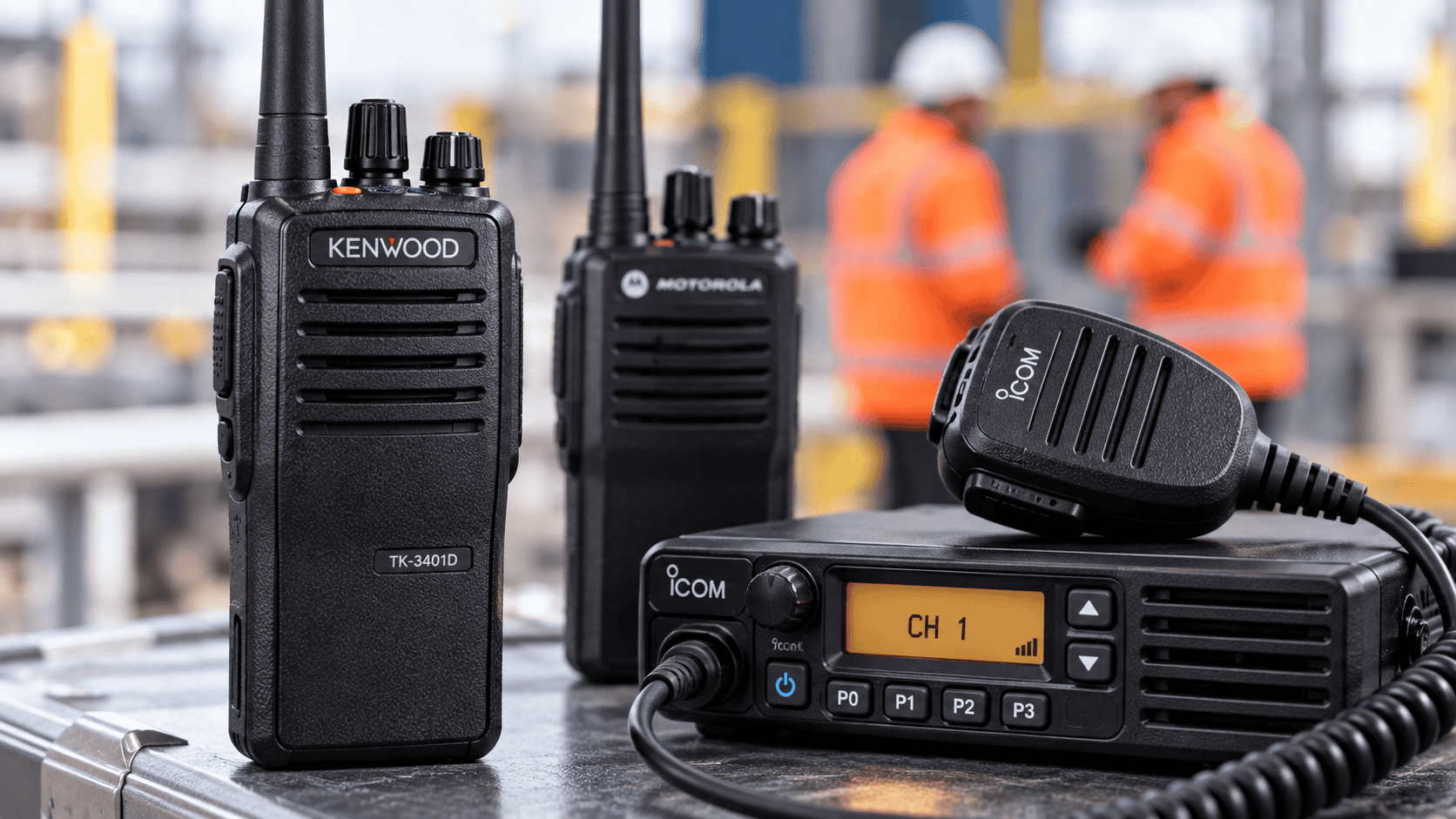
Analogue Radio
What is an analogue radio?
An analogue radio is a two-way radio that transmits and receives information using an analogue radio signal. In a traditional analogue system, the information being transmitted – usually speech – is represented by continuously varying changes in the radio signal.
Analogue two-way radios have been widely used for business, industry, events, security, construction, transport, hospitality and many other applications. Although digital radio systems are increasingly common, analogue radios remain in use because they can be simple to operate, reliable and cost-effective.
How does an analogue two-way radio work?
When someone speaks into an analogue radio, the microphone converts their voice into an electrical audio signal. The radio uses this information to modulate a radio-frequency carrier, which is then transmitted through the antennaAn antenna transmits and receives radio-frequency signals, allowing a two-way radio to communicate. Antenna type, frequency, height and location can all affect radio performance and coverage..
For most business two-way radio applications, analogue voice communication uses FM (frequencyAn antenna transmits and receives radio-frequency signals, allowing a two-way radio to communicate. Antenna type, frequency, height and location can all affect radio performance and coverage. modulationAnalogue radio uses continuously varying radio signals to transmit voice communication. It remains widely used for reliable two-way communication across business, industry, events, security and other applications.). The radio receiverA Receiver is the part of a two-way radio that detects and processes incoming radio signals, converting them into audible voice or usable data for the user. detects the transmitted signal and converts it back into an audio signal that can be heard through the radio’s speaker.
Unlike digital radio, the voice information is not converted into a stream of digital data before transmissionTransmission is the process of sending voice, data or signalling from a radio using a radio-frequency signal to another radio, repeater or communication system.. Instead, the information is carried by variations in the analogue radio signal.
The process can be summarised as:
Voice → microphone → analogue audio signal → radio transmitter → RF signal → radio receiver → speaker → voice
Analogue radio frequencies
Analogue two-way radios operate on specific radio frequencies allocated for particular services and applications.
In the UK, some business and professional radio systems operate under an OfcomOfcom (Office of Communications) is the UK's communications regulator. For two-way radio users, Ofcom manages and regulates access to radio spectrum and the use of radio frequencies in the UK. licence, while PMR446 radios can operate on designated licence-free frequencies subject to the applicable technical restrictions.
The frequencyFrequency is the number of cycles a radio wave completes each second, measured in Hertz. In two-way radio, frequency determines where a transmission operates within the radio spectrum. used by a radio systemA Radio System is a complete communication solution comprising two-way radios and, where required, equipment such as repeaters, antennas, base stations, mobile radios and network infrastructure. affects how the system propagates and interacts with the surrounding environment. However, frequency alone does not determine the usable range of a radio. Terrain, buildingsAn antenna transmits and receives radio-frequency signals, allowing a two-way radio to communicate. Antenna type, frequency, height and location can all affect radio performance and coverage., structures, vegetation, antenna performance, radio powerAn antenna transmits and receives radio-frequency signals, allowing a two-way radio to communicate. Antenna type, frequency, height and location can all affect radio performance and coverage. and other sources of interferenceRadio interference occurs when unwanted radio-frequency signals or electrical noise disrupt two-way radio communications, causing distorted audio, broken transmissions, reduced coverage or loss of communication. can all affect coverageRadio Coverage is the geographical area in which a two-way radio system can provide reliable communication. Coverage depends on the radios, antennas, frequency, terrain, buildings and system infrastructure..
Analogue radio range
The range of an analogue radio system depends on the equipment and the environment in which it is being used.
In open areas with a clear line of sight, radios may communicate over considerable distances. Buildings, walls, underground areas, hills and other obstructions can reduce the usable range significantly.
For larger sites or areas where reliable coverage is required, an analogue radio system may use infrastructureRadio infrastructure is the equipment and supporting systems behind a professional two-way radio network, including repeaters, antennas, base stations, network connections, power systems and dispatch equipment. such as a repeaterA Repeater receives a two-way radio transmission and retransmits it, usually from an elevated location, to extend the coverage and reliability of a radio communication system.. A repeater receives a radio transmission and retransmits it, extending the area in which users can communicate.
This is particularly useful for large sites, multi-building operations, outdoor areas and locations where the terrain prevents direct radio-to-radio communication.
Analogue radio channels
An analogue radio system normally provides users with a number of programmed channels. Each channelA two-way radio channel is a programmed set of communication settings, typically including frequency and signalling, that allows compatible radios to communicate with one another. is configured for a particular frequency or frequency pair, depending on the radio system.
Channels can be used to separate different teams, departments, work areas or activities. For example, a large event might use separate channels for security, production and operations.
Some analogue radios also use signalling systems such as CTCSS or DCS. These can help prevent a radio from opening its speaker when it detects transmissions that do not carry the expected signalling code.
It is important to understand that CTCSS and DCS do not make a radio transmission private or encrypted. Other users with compatible equipment may still be able to receive the underlying transmission.
Analogue radio and privacy
Analogue radio communication should not automatically be considered private or secure.
Unless additional security technology is used, analogue transmissions can potentially be received by another compatible radio operating within range and configured appropriately.
For organisations that require stronger communication security, a digital radio system with appropriate encryptionEncryption protects two-way radio communications by converting voice or data into a secure form that can only be understood by authorised radios with the correct encryption capability and keys. or other security measures may be more suitable.
Analogue radio vs digital radio
The main difference between analogue and digital radio is how the voice information is represented and transmitted.
With an analogue system, the voice is carried as a continuously varying analogue signal. With a digital system, the audio is converted into digital data before it is transmitted.
Digital radio systems can provide features that are more difficult or impossible to achieve with conventional analogue systems, including digital audio processing, individual calling, text and data services, enhanced management features and, on suitable systems, encryption.
However, analogue radio still has practical advantages. It is well established, straightforward to use and supported by a large range of two-way radio equipment.
For some applications, particularly where the requirement is simply reliable push-to-talk voice communication, analogue radio can still be an appropriate solution.
Analogue radio for business use
Analogue two-way radios can be particularly useful where teams need immediate communication without relying on a mobile phone networkA Network is a connected system of radios, equipment and infrastructure that allows users to communicate across a defined area. Radio networks can range from simple radio-to-radio systems to large multi-site networks..
A typical business radioBusiness Radio refers to professional two-way radio systems used by businesses and organisations for instant communication, often using licensed frequencies and equipment designed for commercial use. system may allow several users to communicate on the same channel using push-to-talk. This can make analogue radio useful for coordinating staff, responding to incidents, managing operations and maintaining contact across a working site.
Analogue radios are used across many sectors, including:
- Construction
- Security
- Hospitality
- Events
- Warehousing and logistics
- Agriculture
- Manufacturing
- Transport
- Retail
- Facilities management
The appropriate radio system depends on factors such as the size of the site, required coverage, number of users, licensing requirements, operating environment and whether advanced features are required.
Advantages of analogue two-way radio
Analogue radio can offer several practical benefits:
- Simple push-to-talk operation
- Familiar and widely supported technology
- Reliable voice communication
- A wide choice of compatible equipment
- Straightforward channel-based communication
- Suitable for many short- and medium-range applications
- Can be used with radio infrastructure such as repeaters
- Can be a cost-effective option where advanced digital features are not required
Limitations of analogue radio
Analogue systems also have limitations.
Audio quality can deteriorate as the received signal becomes weaker. Instead of maintaining clear audio until the signal is lost, an analogue transmission may gradually become noisier and more difficult to understand.
Analogue systems also generally provide fewer advanced communication and management features than modern digital radio systems.
Where an organisation requires features such as individual addressing, detailed call management, integrated data services or encryption, a digital radio system may be more appropriate.
Are analogue radios still used?
Yes. Analogue two-way radios remain in use across many industries and applications.
The choice between analogue and digital radio should be based on the operational requirements of the user rather than simply assuming that newer technology is always the best option. For straightforward voice communication, an analogue system can still provide an effective and dependable solution.
For larger or more demanding communication requirements, digital radio, repeater systems or other radio technologies may provide additional capabilities.
Analogue radio at DCS
DCS Two-Way Radio can advise on the most appropriate radio system for your requirements, whether you need straightforward analogue radios for a temporary application or a more comprehensive business communication system.
The right choice depends on your location, coverage requirements, number of users and how the radios will be used. Where necessary, equipment can be configured for the required channels and communication system.
If you are unsure whether analogue or digital two-way radio is right for your application, speak to DCS for advice on the options available.
Need reliable two way radios for your next event, project or temporary operation? Our radio hire service provides flexible communication solutions for businesses that need to keep their teams connected without purchasing equipment.