
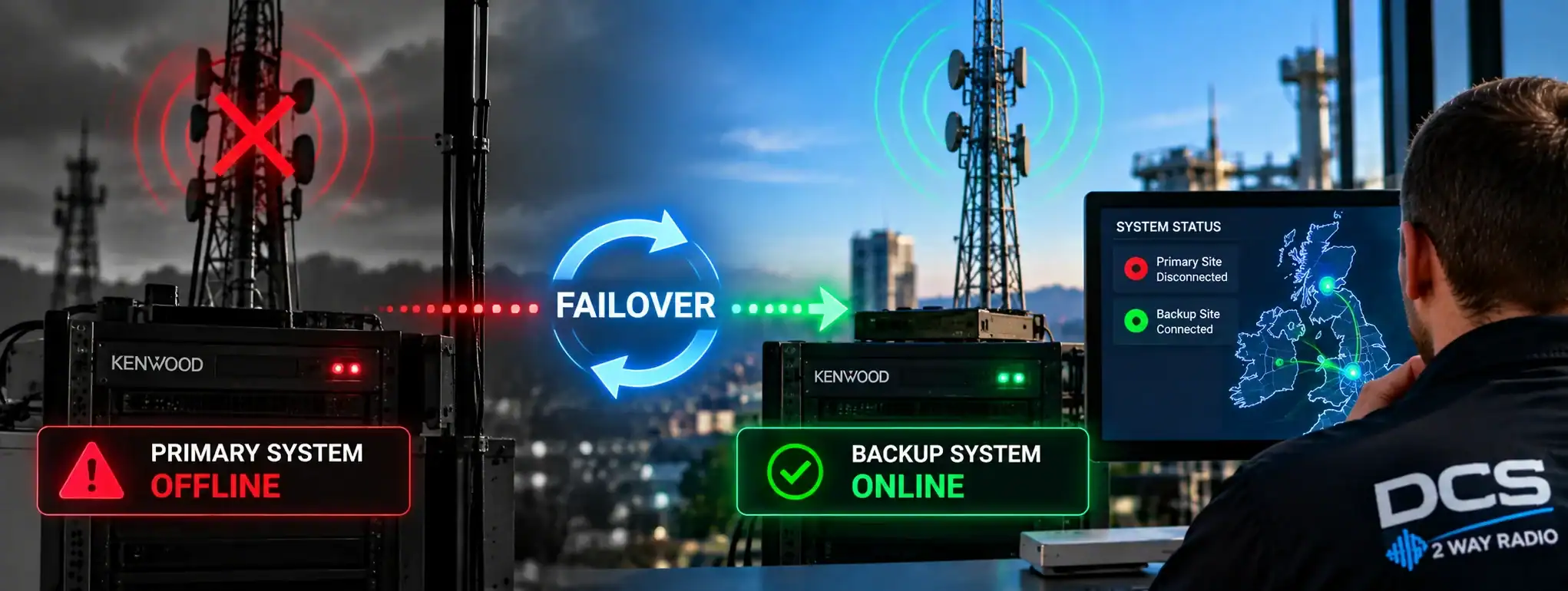
Failover
Failover is a system design feature that allows a communication system to continue operating when its primary equipment, connection or service becomes unavailable. Instead of relying on a single point of failure, the system automatically or manually switches to a secondary system, connection or piece of equipment.
In professional two-way radio systems, failover can be used to improve resilience, availability and continuity of communications.
Failover is particularly important for organisations where radio communications are operationally important or where losing communication could affect safety, security or business continuity.
How does Failover work?
A failover system normally has a primary system and an alternative system or route.
A simplified example is:
Primary system → failure detected → secondary system activated → communications continue
The changeover may happen automatically, or an operator may need to activate the backup system manually.
The exact method depends on the radio systemA Radio System is a complete communication solution comprising two-way radios and, where required, equipment such as repeaters, antennas, base stations, mobile radios and network infrastructure. and the type of failure being protected against.
Failover in two-way radio systems
Failover can be used in several parts of a professional radio system.
For example, a system may have backup arrangements for:
- Repeaters
- PowerAn antenna transmits and receives radio-frequency signals, allowing a two-way radio to communicate. Antenna type, frequency, height and location can all affect radio performance and coverage. supplies
- NetworkA Network is a connected system of radios, equipment and infrastructure that allows users to communicate across a defined area. Radio networks can range from simple radio-to-radio systems to large multi-site networks. connections
- Control equipment
- Dispatch systems
- Servers
- Radio sites
- Internet connections
The aim is to ensure that the failure of one component does not necessarily result in a complete loss of communication.
Repeater Failover
A radio system that relies on a RepeaterA Repeater receives a two-way radio transmission and retransmits it, usually from an elevated location, to extend the coverage and reliability of a radio communication system. can potentially use a second repeater as a backup.
If the primary repeater fails, the system may switch to a secondary repeater or an alternative communication method.
This can be particularly useful where radio coverageRadio Coverage is the geographical area in which a two-way radio system can provide reliable communication. Coverage depends on the radios, antennas, frequency, terrain, buildings and system infrastructure. is important across a large site or where the radio system is used for critical operations.
The exact failover arrangement depends on the radio infrastructureRadio infrastructure is the equipment and supporting systems behind a professional two-way radio network, including repeaters, antennas, base stations, network connections, power systems and dispatch equipment..
Repeater redundancy
Redundancy and Failover are closely related.
Redundancy means having additional equipment or capacity available so that there is an alternative if the primary component fails.
Failover describes the process of switching communications to that alternative.
For example:
Redundant repeater → primary repeater fails → failover → backup repeater
Network Failover
Modern radio systems can use IP networks to connect repeaters, control rooms and other infrastructure.
If the primary network connection fails, a system may use a secondary connection.
For example, a site could have:
Primary connection: wired broadbandBroadband is a high-speed data connection used by systems such as PoC radio to carry voice, video and other communications over mobile networks, Wi-Fi or IP networks.
Backup connection: cellular or other network connection
If the primary connection becomes unavailable, the system can switch to the alternative connection.
Internet Failover
IP-connected radio systems and cloud-based communication platforms may depend on an internet connection.
Internet Failover provides an alternative connection if the primary internet service fails.
This can be particularly important for:
- Cloud DispatchCloud Dispatch is a cloud-based radio management and communication system that allows authorised dispatchers to communicate with, monitor and manage two-way radio users through an internet-connected platform.
- Radio over IP
- Remote radio sites
- Cloud ManagementCloud Management uses an online platform to remotely manage and monitor compatible two-way radios, users, devices and communication settings from a central location.
- Networked repeaters
The backup connection must have sufficient capacity and reliability for the services it is expected to support.
Power Failover
Radio infrastructure can also be protected against electrical power failure.
A system may use:
- Battery backup
- Uninterruptible Power Supply (UPS)
- Generator
- Secondary power supply
- Alternative power source
If the primary electrical supply fails, the backup power system can keep critical equipment operating.
Battery backup
Battery backup can provide temporary power to radio infrastructure during a mains power failure.
The available operating time depends on factors such as:
- Battery capacity
- Equipment power consumption
- Number of connected devices
- Radio traffic
- Condition of the batteries
Battery backup can provide valuable time for the primary power supply to be restored or for another backup system to take over.
Failover and dispatch systems
A professional Dispatch system can also incorporate failover.
For example, a dispatch platform may have backup servers or alternative network connections.
If the primary dispatch service becomes unavailable, the system may transfer operations to a secondary component.
The exact failover capabilities depend on the dispatch platform.
Failover and Cloud Dispatch
Cloud-based dispatch systems can be designed with resilient infrastructure so that the failure of an individual server or service does not necessarily interrupt the entire system.
However, cloud availability and radio availability are not the same thing.
A cloud dispatch system can remain operational while a local radio site has lost power or network connectivity.
A complete resilience strategy therefore needs to consider the entire communication path.
Failover and radio sites
Large radio networks may contain multiple radio sites.
If one site becomes unavailable, another site may provide overlapping coverage or an alternative communication route.
This can provide geographical redundancy.
However, whether communications continue after a site failure depends on the network architecture and coverage provided by the remaining sites.
Geographical redundancy
Geographical Redundancy means locating backup infrastructure in a different physical location from the primary equipment.
This helps protect against failures affecting an entire site.
For example, if a primary radio site is affected by a power failure, equipment failure or physical incident, a geographically separate site may continue providing service.
Failover and DMR
Professional DMR (Digital Mobile RadioA Mobile Radio is a two-way radio designed to be installed in a vehicle. It normally uses the vehicle's power supply and an external antenna to provide reliable communication while travelling or working in the field.) systems can incorporate redundancy and failover at different levels.
Depending on the system, this may include:
- Repeater redundancy
- Network redundancy
- Power redundancy
- Server redundancy
- Alternative network connections
- Site redundancy
The capabilities available depend on the DMR infrastructure and manufacturer.
DMR repeater failover
Some DMR systems can be designed with multiple repeaters or alternative operating modes.
If network connectivity between repeaters is lost, certain systems can continue local communications even though wider network functions may be unavailable.
This is sometimes referred to as Local Mode, Fallback Mode or another manufacturer-specific term.
The exact behaviour depends on the radio system.
Failover and trunked radio
Trunked radio systems can incorporate redundancy into their network architecture.
Multiple infrastructure components may provide alternative routes or services if a component fails.
Because trunked systems are more complex than conventional radio systems, the exact failover mechanisms vary between technologies.
Failover and radio coverage
Failover does not necessarily mean that radio coverage will remain unchanged.
For example, if the primary repeater provides coverage across a large area and the backup repeater covers only part of that area, communications may continue but with reduced coverage.
A resilient system should therefore consider both equipment redundancy and the coverage provided by the backup arrangement.
Failover and emergency communications
Failover is particularly important where radio communications support emergency or safety-related operations.
If the primary communication infrastructure fails, a backup arrangement can help maintain contact between users and control personnel.
Emergency communication plans should identify what happens if the primary radio system becomes unavailable.
Failover and Emergency Alarm
An Emergency AlarmAn Emergency Alarm allows a two-way radio user to quickly alert a dispatcher, control room or other authorised users that assistance may be required. relies on the radio system being able to transmit the alert to its intended recipient.
Where emergency communication is critical, the system design should consider what happens if a repeater, network connection or control system fails.
Failover can provide an alternative communication path where the equipment supports it.
Failover and event radio systems
Large events can benefit from resilient radio infrastructure.
For example, an event may have:
- Primary repeater
- Backup repeater
- Battery backup
- Secondary network connection
- Spare radios
- Spare batteries
The level of redundancy required depends on the size and importance of the event.
Failover and security operations
Security operations may rely on continuous radio communication between personnel and a control room.
A resilient radio system can reduce the impact of equipment or network failures.
Where radio communications are safety-critical, organisations should identify the consequences of losing each major component and plan an appropriate backup.
Failover and radio hire
Temporary radio systems can also incorporate redundancy.
For larger events or critical operations, a hire system may include backup equipment or alternative infrastructure.
This can reduce the risk of a single equipment failure affecting the entire communication system.
The appropriate level of redundancy depends on the operational requirements.
Automatic Failover
Automatic Failover occurs when the system detects a failure and switches to the backup system without requiring an operator to intervene.
Automatic failover can reduce downtime and speed up recovery.
The system needs to be designed so that it can reliably detect when the primary service is unavailable and activate the appropriate alternative.
Manual Failover
Manual Failover requires an operator or technician to activate the backup system.
This can be appropriate where automatic switching is not practical or where an operator needs to assess the failure before changing systems.
Manual failover procedures should be documented and tested.
Failover testing
A failover system should be tested rather than simply assumed to work.
Testing can involve deliberately taking the primary component offline and confirming that the backup arrangement operates as expected.
Tests can check:
- Communication continuity
- Switching time
- Coverage
- Emergency functions
- Dispatch connectivity
- Network connections
- Backup power
- Restoration of the primary system
Testing should be carried out in accordance with the equipment manufacturer’s recommendations and the organisation’s procedures.
Failover and business continuity
Failover forms part of a wider Business Continuity strategy.
A business continuity plan should consider what happens if communications are interrupted by:
- Equipment failure
- Power failure
- Network failure
- Severe weather
- Site access problems
- Infrastructure damage
- Cybersecurity incidents
Radio failover can provide one element of the organisation’s overall resilience strategy.
Failover vs backup equipment
Having spare equipment does not automatically mean that a system has failover.
A spare radio kept in a cupboard is simply backup equipment.
A failover system normally involves a defined alternative communication path or system that can take over when the primary system becomes unavailable.
Failover vs redundancy
The terms are often used together but have slightly different meanings.
Redundancy means having additional equipment, capacity or infrastructure available to provide resilience.
Failover is the process of moving from the failed primary component to the available alternative.
A resilient radio system may therefore use redundancy to provide the resources required for failover.
Failover limitations
Failover cannot protect against every possible failure.
A backup system can itself fail, and some failures may affect both the primary and secondary systems.
For example, two radio sites located in the same building may both be affected by the same power failure.
Effective resilience therefore considers common points of failure as well as individual equipment failures.
Failover and system design
When designing a resilient radio system, consideration should be given to:
- What components represent single points of failure
- Which components need redundancy
- How quickly communications must be restored
- Whether failover should be automatic or manual
- How much coverage the backup system must provide
- How backup power will be supplied
- How network connectivity will be maintained
- How emergency communications will operate
- How the system will be tested
The required level of failover depends on the importance of the radio system to the organisation.
Failover and DCS
DCS can design professional radio systems with appropriate resilience and backup arrangements where required.
Depending on the application, this can include redundant repeaters, backup power, alternative network connections and other measures designed to reduce the impact of equipment or infrastructure failure.
The appropriate failover strategy depends on the radio system, site, coverage requirements and operational importance of the communications.
For temporary operations, events and projects, two way radio hire provides a straightforward way to keep everyone connected.