
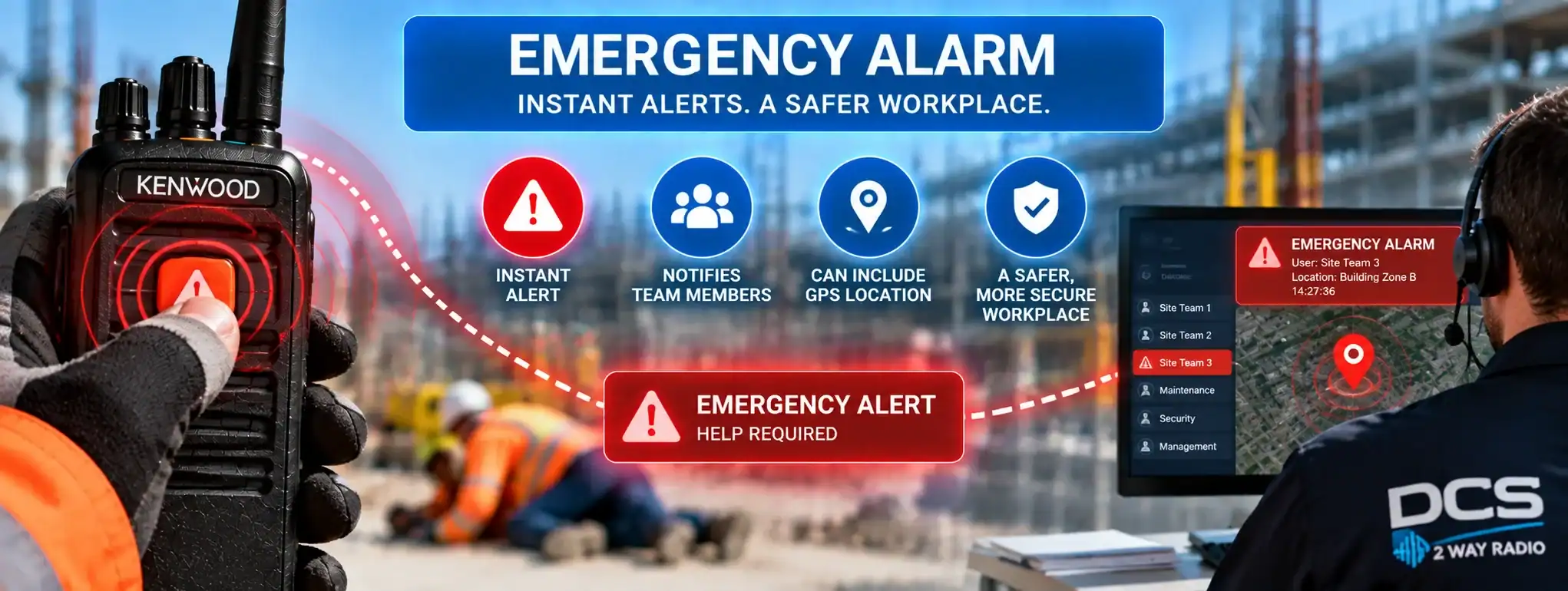
Emergency Alarm
An Emergency Alarm is a feature on a professional two-way radio that allows a user to quickly signal that an emergency or situation requiring assistance has occurred. The alarm can send an alert to other radio users, a dispatcher or a control room, depending on how the radio systemA Radio System is a complete communication solution comprising two-way radios and, where required, equipment such as repeaters, antennas, base stations, mobile radios and network infrastructure. has been configured.
Emergency alarms are commonly used by security personnel, lone workers, event staff, construction workers and other users who may need to request assistance quickly.
The exact operation varies between radio manufacturers and systems. An Emergency Alarm may activate an audible or visual alert, send an emergency signal through the radio networkA Network is a connected system of radios, equipment and infrastructure that allows users to communicate across a defined area. Radio networks can range from simple radio-to-radio systems to large multi-site networks., identify the radio that raised the alarm, or initiate an emergency communication.
How does an Emergency Alarm work?
An Emergency Alarm is normally activated using a dedicated Emergency ButtonAn Emergency Button is a dedicated two-way radio control that allows users to quickly send an emergency alert to a dispatcher, control room or authorised radio users. on the radio.
The button is often positioned so that it can be located quickly, even when the user cannot easily look at the radio.
A simplified sequence is:
User activates emergency button → radio sends emergency signal → system receives alert → authorised personnel are notified
Depending on the system, the radio may then automatically transmit, open a communication channelA two-way radio channel is a programmed set of communication settings, typically including frequency and signalling, that allows compatible radios to communicate with one another. or allow the dispatcher to communicate with the user.
Emergency Alarm button
Professional two-way radios may have a dedicated emergency button, often located on the top or front of the radio.
The button can be configured to activate the emergency function after being pressed for a specified period.
This can help reduce the risk of accidentally triggering an emergency alert during normal radio use.
The precise activation method depends on the radio manufacturer and programming.
Emergency Alarm and emergency calls
An Emergency Alarm and an Emergency CallAn Emergency Call is a priority two-way radio function that allows a user to quickly request assistance and, on supported systems, establish an urgent voice communication with a dispatcher or control room. are related but can perform different functions.
An Emergency Alarm primarily alerts the radio system or other authorised users that assistance may be required.
An Emergency Call can establish or prioritise a voice communication following the alarm.
Some radio systems combine both functions, while others allow them to be configured separately.
Emergency Alarm and DMR
Emergency Alarm functionality is available on many professional DMR (Digital Mobile RadioA Mobile Radio is a two-way radio designed to be installed in a vehicle. It normally uses the vehicle's power supply and an external antenna to provide reliable communication while travelling or working in the field.) systems.
A DMR radio can send an emergency indication through the radio system to other compatible equipment or a dispatch system.
Depending on the system, the alarm may identify the individual radio that activated it.
The exact emergency functions available depend on the radio, repeaterA Repeater receives a two-way radio transmission and retransmits it, usually from an elevated location, to extend the coverage and reliability of a radio communication system. or network and dispatch software being used.
Emergency Alarm and Radio ID
Digital radio systems can associate an emergency alarm with the individual radio that generated it.
For example, a DMR system can use the radio’s Radio ID to identify the transmitting device.
A dispatcher may therefore receive information indicating which radio has raised the emergency alert.
This can be particularly useful in large organisations where many radios are operating simultaneously.
Emergency Alarm and dispatch systems
A professional Dispatch system can receive emergency alerts from compatible radios.
A dispatcher may see an on-screen notification identifying the radio or user that activated the alarm.
Depending on the system, the dispatcher may then be able to:
- Contact the user
- Monitor the relevant talkgroup
- View the radio’s location
- Record the communication
- Escalate the incident
- Coordinate other personnel
The available functions depend on the dispatch platform and radio network.
Emergency Alarm and control rooms
In a control-room environment, emergency alarms can provide a rapid method of bringing an incident to an operator’s attention.
Instead of relying on the user making a normal voice call, the radio can send a dedicated emergency signal.
This can help prioritise potentially important communications when a control room is monitoring several channels or talkgroups.
Emergency Alarm and priority
Emergency traffic can be configured to receive higher priority than ordinary radio communications on some systems.
For example, a radio network may interrupt or temporarily override normal communication to ensure that an emergency alert reaches the dispatcher.
The precise priority behaviour depends on the radio technology and system configuration.
Emergency Alarm and emergency voice transmission
Some radios can be configured to automatically transmit after an emergency button is activated.
This may allow the user to speak without having to press the normal Push-to-Talk button.
In some systems, the radio can automatically transmit for a defined period.
This functionality can be useful if the user is unable to operate the radio normally.
It must be configured and tested carefully because the exact behaviour varies between radio models.
Emergency Alarm and hot microphone
A Hot Microphone function can allow a radio to transmit automatically following an emergency activation.
For example, after an emergency alarm is triggered, the radio may open its microphone for a predetermined period.
This can allow a dispatcher or supervisor to hear what is happening around the radio without requiring the user to press the PTT.
The feature is system-dependent and should not be assumed to be available on every radio.
Emergency Alarm and lone worker
Emergency Alarm functionality can be combined with Lone WorkerA Lone Worker is someone who works without direct supervision or immediate assistance nearby. Compatible two-way radios can provide safety features such as timed check-ins, emergency alerts and GPS location. features.
A lone-worker system may require the user to periodically acknowledge an alert.
If the user fails to respond within the programmed time, the radio can automatically generate an emergency alarm.
This can provide an additional layer of protection for personnel working alone.
Emergency Alarm and Man Down
Some professional radios can combine Emergency Alarm functionality with Man DownMan Down is a safety feature on some professional two-way radios that can detect a possible fall or unusual radio position and automatically raise an alert if the user does not respond. detection.
If the radio detects that it has been placed in an unusual orientation or has remained stationary for a configured period, it can generate an alert.
This can be useful where a user may be unable to press the emergency button following a fall or other incident.
The exact detection method and alarm behaviour vary between manufacturers.
Emergency Alarm and GPS
Compatible radios can include GPS information with an emergency alarm.
Where the radio system supports location reporting, the dispatcher may be able to see the approximate location of the radio that raised the alarm.
This can help identify where assistance may be required.
GPS availability and accuracy depend on the radio, system and surrounding environment.
Emergency Alarm and indoor locations
GPS does not always work reliably inside buildingsAn antenna transmits and receives radio-frequency signals, allowing a two-way radio to communicate. Antenna type, frequency, height and location can all affect radio performance and coverage..
For indoor radio systems, other location technologies may be required if precise location information is important.
An Emergency Alarm can still identify the radio that raised the alert even when GPS coordinates are unavailable, provided the radio system supports radio identification.
Emergency Alarm and talkgroups
Emergency alarms can operate alongside normal Talkgroups.
A radio user may normally communicate with their own team but send an emergency alert to a dispatcher or designated emergency group.
This allows the emergency communication to reach personnel who may not normally be listening to the user’s talkgroup.
The exact routing is determined by the system configuration.
Emergency Alarm and group calls
An emergency alarm may be configured to alert a particular communication group.
For example, an organisation could configure emergency alerts to notify:
- Security Control
- Site Management
- Supervisors
- Operations Control
This allows the system to distribute the alert to the personnel responsible for responding.
Emergency Alarm and individual calls
Some systems can direct emergency notifications to a particular dispatcher, supervisor or radio.
This can be useful where a defined person or control position is responsible for responding to emergency alerts.
The exact behaviour depends on the radio network.
Emergency Alarm and radio recording
Emergency communications can be recorded when the radio system includes Digital Voice RecordingDigital Voice Recording records two-way radio communications as digital audio, allowing authorised users to replay and review conversations for monitoring, training, incident investigation or record keeping. or radio logging.
This can provide a record of communications associated with the emergency.
Depending on the system, the recording may include the alarm notification, subsequent voice communications and information such as the radio ID and time.
Emergency Alarm and security operations
Security teams can use emergency alarms to request immediate assistance.
For example, a security officer dealing with a threatening situation may be able to activate the emergency button without having to make a conventional voice transmissionTransmission is the process of sending voice, data or signalling from a radio using a radio-frequency signal to another radio, repeater or communication system..
The control room can then respond according to the organisation’s emergency procedures.
Emergency Alarm at events
Large events can involve security teams, stewards, medical personnel and event management operating across a wide area.
Emergency alarms can provide a rapid way for staff to alert event control that assistance is required.
The radio system can then be used to coordinate the appropriate response.
Emergency Alarm on construction sites
Construction sites can contain machinery, elevated work areas, vehicles and other hazards.
An emergency alarm can provide workers with a rapid method of requesting assistance.
Where radios support Man Down or Lone Worker functionality, these features can be incorporated into the wider emergency communication system.
Emergency Alarm for lone workers
Workers operating alone may not always be able to make a conventional radio call following an incident.
An emergency alarm button provides a direct method of requesting assistance.
When combined with Lone Worker or Man Down functionality, the radio can provide both manual and automatic emergency alerting.
The radio system should always be tested in the actual environment where it will be used.
Emergency Alarm and emergency procedures
An Emergency Alarm is a communication tool and should form part of a wider emergency procedure.
Organisations should define:
- Who receives the alarm
- Who is responsible for responding
- What happens after activation
- How the incident is escalated
- How false alarms are handled
- How the system is tested
- How communications are recorded
Users should be trained to understand when and how the emergency function should be used.
Emergency Alarm testing
Emergency functions should be tested regularly according to the organisation’s procedures and equipment manufacturer’s recommendations.
Testing can confirm that:
- The emergency button works
- The alarm reaches the intended recipient
- The correct radio identity is displayed
- Any location information is received
- Dispatchers can respond
- Emergency voice functions operate correctly
Testing should be coordinated so that a test alarm is not mistaken for a genuine emergency.
Emergency Alarm and false activations
Accidental emergency activations can occur if the emergency button is pressed unintentionally.
For this reason, some radios require the button to be held for a specified period before the alarm is generated.
Users should also understand the procedure for cancelling or resetting a false alarm.
Emergency Alarm limitations
An Emergency Alarm cannot guarantee that assistance will reach a user.
Its effectiveness depends on the radio having a usable connection to the radio system and the alarm reaching someone capable of responding.
Factors such as poor coverageRadio Coverage is the geographical area in which a two-way radio system can provide reliable communication. Coverage depends on the radios, antennas, frequency, terrain, buildings and system infrastructure., radio failure, depleted battery, damaged equipment or repeater failure can affect communication.
Emergency radio functions should therefore form part of a wider safety and communication plan.
Emergency Alarm and radio coverage
Reliable radio coverage is particularly important when emergency functions are being used.
A radio that cannot reach the required repeater or network may not be able to send its emergency signal.
Coverage should therefore be tested throughout the areas where users may need to activate emergency functions, including difficult locations such as basements, enclosed structures and remote areas.
Emergency Alarm and radio hire
Emergency Alarm functionality can be useful when hiring professional radios for security, events and temporary operations.
Where emergency features are required, the radio hireRadio Hire is the temporary rental of two-way radios and related communication equipment for events, projects and operational requirements, providing professional communication without purchasing the equipment. system should be configured specifically for the application.
Users should be shown how the emergency button works and the response procedure should be established before the radios are deployed.
Emergency Alarm and DCS
DCS can provide professional two-way radio systems with emergency communication features where supported by the selected equipment.
Depending on the application, a system can incorporate emergency alarms, lone-worker functionality, Man Down detection, GPS, dispatch and voice recording.
The appropriate configuration depends on the operational requirements and the capabilities of the radio system.