
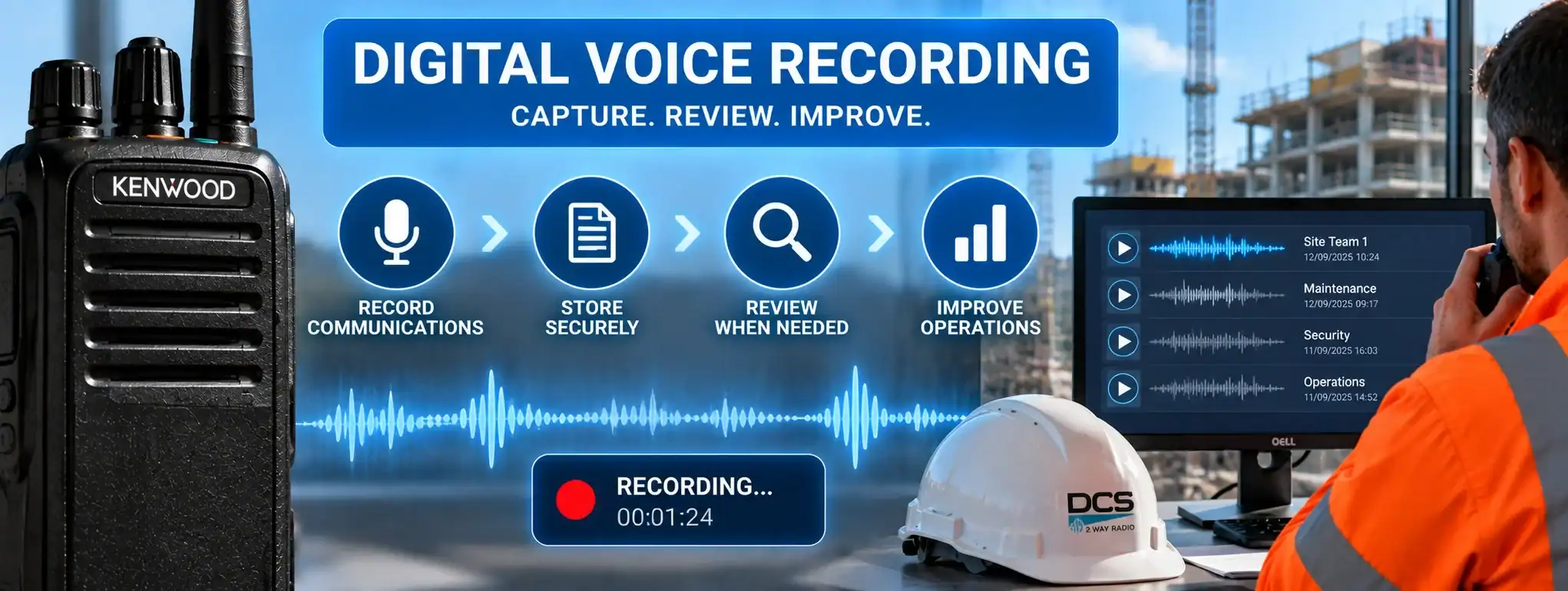
Digital Voice Recording
Digital Voice Recording is a feature that allows voice communications made through a two-way radio systemA Radio System is a complete communication solution comprising two-way radios and, where required, equipment such as repeaters, antennas, base stations, mobile radios and network infrastructure. to be recorded and stored as digital audio files. It can be used to retain a record of radio conversations for later review, investigation, training, operational monitoring or record keeping.
Digital voice recording can be built into some professional two-way radios, dispatch systems, control-room software and radio recording platforms. The exact method of recording and the features available depend on the radio equipment and system architecture.
In professional environments, recording can be particularly useful where radio communications are an important part of day-to-day operations and there is a need to review what was communicated at a particular time.
How does Digital Voice Recording work?
A digital voice recording system captures the audio from radio communications and stores it in a digital format.
A simplified process is:
Radio communication → audio capture → digital recording → storage → playback
Depending on the system, recordings may be stored locally on a radio, computer, server or other recording device, or within a supported cloud-based platform.
The system may also store additional information alongside the recording, such as the date, time, channelA two-way radio channel is a programmed set of communication settings, typically including frequency and signalling, that allows compatible radios to communicate with one another., talkgroup, radio ID or user.
What can be recorded?
The precise recording capability depends on the radio system.
A recording system may capture:
- Incoming radio transmissions
- Outgoing radio transmissions
- Group calls
- Individual calls
- Dispatch communications
- Control-room communications
- Selected channels or talkgroups
- Other supported radio audio
Some systems can record all radio traffic, while others allow administrators to select which channels, talkgroups or users are recorded.
Digital Voice Recording and two-way radios
Traditional two-way radio communications are normally short, operational conversations.
Digital Voice Recording allows those conversations to be retained rather than disappearing once the transmissionTransmission is the process of sending voice, data or signalling from a radio using a radio-frequency signal to another radio, repeater or communication system. has finished.
For example, a security team might use radios throughout an event. A recording system could retain communications between security personnel and the control room so that an incident can be reviewed afterwards.
Digital Voice Recording and dispatch systems
Digital Voice Recording is commonly associated with professional Dispatch systems.
A control room may monitor several radio channels or talkgroups simultaneously. Recording software can capture these communications and associate them with the relevant channel or communication group.
This can allow an operator to search for and replay a particular transmission without having to listen to an entire recording continuously.
Digital Voice Recording and control rooms
In a control-room environment, recorded radio communications can provide an important operational record.
For example, a control room may coordinate:
- Security teams
- Transport operations
- Emergency response
- Facilities teams
- Event staff
- Maintenance personnel
Recording these communications can make it possible to establish what information was passed between the control room and field personnel.
Digital Voice Recording and timestamps
Professional recording systems can associate recordings with accurate timestamps.
This allows an administrator to identify when a particular transmission took place.
A recording may also include information such as:
Date → Time → Radio/User → Channel/Talkgroup → Audio
The information available depends on the recording system.
Digital Voice Recording and radio identification
On compatible digital radio systems, recordings can potentially be associated with the identity of the transmitting radio.
For example, a DMR system may provide a Radio ID that identifies the transmitting device.
This can make recordings more useful because an administrator may be able to determine not only what was said, but which radio or user transmitted it.
Digital Voice Recording and DMR
Digital Voice Recording can be used with compatible DMR (Digital Mobile RadioA Mobile Radio is a two-way radio designed to be installed in a vehicle. It normally uses the vehicle's power supply and an external antenna to provide reliable communication while travelling or working in the field.) systems.
Because DMR uses digitally processed voice communications, compatible recording systems can capture the resulting audio and associated system information.
Depending on the system, recordings may be linked to:
- Radio ID
- Talkgroup
- Channel
- Individual call
- Group call
- Date and time
Recording functionality is not automatically included in every DMR radio. It normally requires compatible recording or dispatch equipment.
Digital Voice Recording and analogue radio
Digital recording can also be used with analogue radioAnalogue radio uses continuously varying radio signals to transmit voice communication. It remains widely used for reliable two-way communication across business, industry, events, security and other applications. systems.
The radio audio is converted into a digital audio format by the recording equipment before being stored.
Therefore, the term Digital Voice Recording describes how the audio is recorded and stored rather than necessarily indicating that the underlying radio system is digital.
Digital Voice Recording and call recording
Digital Voice Recording is sometimes referred to as radio call recordingCall Recording is a two-way radio feature or system function that captures and stores radio communications for later playback, review, incident investigation or record keeping. or radio voice recording.
The terminology can vary between manufacturers and software providers.
Unlike a telephone call recording system, radio communications are normally push-to-talk transmissions that may involve several users sharing the same channel or talkgroup.
A recording system therefore needs to be designed to handle the characteristics of radio communications.
Digital Voice Recording and group calls
Group communications can be particularly useful to record because several users may participate in the same conversation.
A recording system can capture the transmissions as they occur.
On compatible systems, metadata can help identify the individual radio responsible for each transmission.
This can provide a chronological record of the conversation between members of the group.
Digital Voice Recording and individual calls
Some radio systems support individual calls between two specific users.
Where supported, these communications can also be recorded.
The recording platform may store the identities of the participating radios alongside the audio.
Digital Voice Recording and emergency communications
Recorded radio communications can be particularly valuable when reviewing an emergency or significant incident.
A recording may help establish:
- What happened
- When communications took place
- What information was passed
- Who transmitted information
- What instructions were given
- How the incident developed
For this reason, recording can be an important feature of professional control-room and security communications systems.
Digital Voice Recording and incident investigation
Radio recordings can provide a useful source of information when investigating an operational incident.
For example, after an event or security incident, authorised personnel may be able to review communications made before, during and after the incident.
This can help establish a timeline and identify relevant communications.
The recording should be considered alongside other evidence rather than treated as the sole record of an incident.
Digital Voice Recording and training
Recorded communications can also be used for training purposes where appropriate.
Supervisors can review examples of radio communications to assess:
- Radio procedure
- Clarity
- Brevity
- Correct use of channels
- Communication discipline
- Response to incidents
Any use of recordings for training should follow the organisation’s applicable privacy and data-handling policies.
Digital Voice Recording and quality monitoring
Recording can help organisations monitor the quality of their radio communications.
Supervisors can review whether users are:
- Using the correct talkgroup
- Communicating clearly
- Following radio procedures
- Providing sufficient information
- Responding appropriately to calls
This can help identify areas where additional training or changes to operating procedures may be useful.
Digital Voice Recording and storage
Recorded radio communications require suitable storage.
Depending on the system, recordings may be stored on:
- A local computer
- A dedicated recording server
- NetworkA Network is a connected system of radios, equipment and infrastructure that allows users to communicate across a defined area. Radio networks can range from simple radio-to-radio systems to large multi-site networks. storage
- Cloud storage
- A specialist recording appliance
Storage requirements depend on the number of channels being recorded, recording quality, number of users and required retention period.
Large radio systems can generate significant amounts of recorded audio over time.
Digital Voice Recording and retention
Organisations using voice recording should establish appropriate retention policies.
Not every radio transmission necessarily needs to be retained indefinitely.
A retention policy can specify:
- How long recordings are kept
- Which communications are retained
- Who can access recordings
- When recordings are deleted
- How recordings are protected
The appropriate retention period depends on the organisation, the purpose of recording and applicable legal or regulatory requirements.
Digital Voice Recording and security
Recorded radio communications can contain sensitive operational information.
Access to recordings should therefore be controlled appropriately.
Professional recording systems may provide features such as:
- User authentication
- Access permissions
- Audit logs
- Secure storage
- Controlled playback
- Export controls
The available security features vary between systems.
Digital Voice Recording and privacy
Radio recordings may contain personal information or other sensitive operational information.
Organisations should therefore consider applicable data protection and privacy requirements when recording radio communications.
Users should understand when communications are being recorded where required, and access to recordings should be limited to authorised personnel.
The precise legal requirements depend on how and why the recordings are used.
Digital Voice Recording and cloud systems
Some modern radio systems provide cloud-based voice recording.
In these systems, recorded communications can be stored on a remote platform rather than exclusively on local equipment.
Cloud-based recording can make recordings accessible to authorised users from different locations, depending on the platform’s design and permissions.
It also introduces additional considerations around internet connectivity, security, data storage and service availability.
Digital Voice Recording and radio hire
Digital Voice Recording can be useful for temporary radio systems where communications need to be retained during an event or project.
For example, a large event may record communications between:
- Event control
- Security
- Production
- Medical teams
- Stewards
- Management
This can provide an operational record that can be reviewed after the event.
Recording capability must be specifically supported by the radio system and recording equipment supplied.
Digital Voice Recording at events
Large events can generate a high volume of radio traffic.
Recording can help event organisers review communications associated with incidents, operational decisions or significant events.
It can also provide a useful record for post-event analysis and operational improvement.
Where recordings contain personal information, appropriate privacy and retention procedures should be followed.
Digital Voice Recording for security
Security teams frequently rely on radio communications to coordinate personnel and respond to incidents.
Recording can provide a chronological record of radio traffic that can be reviewed following an incident.
For security operations, recording systems may be integrated with control-room software so that operators can monitor live communications and access previous recordings from the same interface.
Digital Voice Recording and playback
A recording system should provide a practical way for authorised users to locate and replay communications.
Depending on the platform, users may be able to search by:
- Date
- Time
- Channel
- Talkgroup
- Radio
- User
- Call type
The more metadata associated with a recording, the easier it can be to locate a specific transmission.
Digital Voice Recording and export
Some systems allow authorised users to export selected recordings.
This may be useful when an audio recording needs to be retained as part of an incident report or supplied to an authorised investigator.
Export functionality should be controlled to prevent unauthorised distribution of recorded communications.
Digital Voice Recording limitations
Not every two-way radio supports voice recording.
Recording may require additional hardware, software, a dispatch platform or a dedicated recording system.
The recording system must also be correctly connected to the radio infrastructureRadio infrastructure is the equipment and supporting systems behind a professional two-way radio network, including repeaters, antennas, base stations, network connections, power systems and dispatch equipment. so that the required communications are captured.
If a radio system is not designed for recording, simply adding a recording device may not provide the metadata or functionality required for professional use.
Digital Voice Recording vs radio logging
Radio logging generally refers to the broader process of capturing and retaining radio communications and associated information.
Digital Voice Recording is one component of this process.
A professional radio logging system may record:
- Voice
- Date and time
- Radio ID
- Channel
- Talkgroup
- Call information
- System events
This can provide a more complete operational record than audio recording alone.
Digital Voice Recording and DCS
DCS can provide professional radio communication systems with recording and logging capabilities where required.
For organisations that need a record of radio communications, the system can be designed around the number of users, channels, talkgroups and required retention arrangements.
Recording can be particularly useful for security, events, transport, control rooms and other operations where radio communications form an important part of day-to-day activity.