
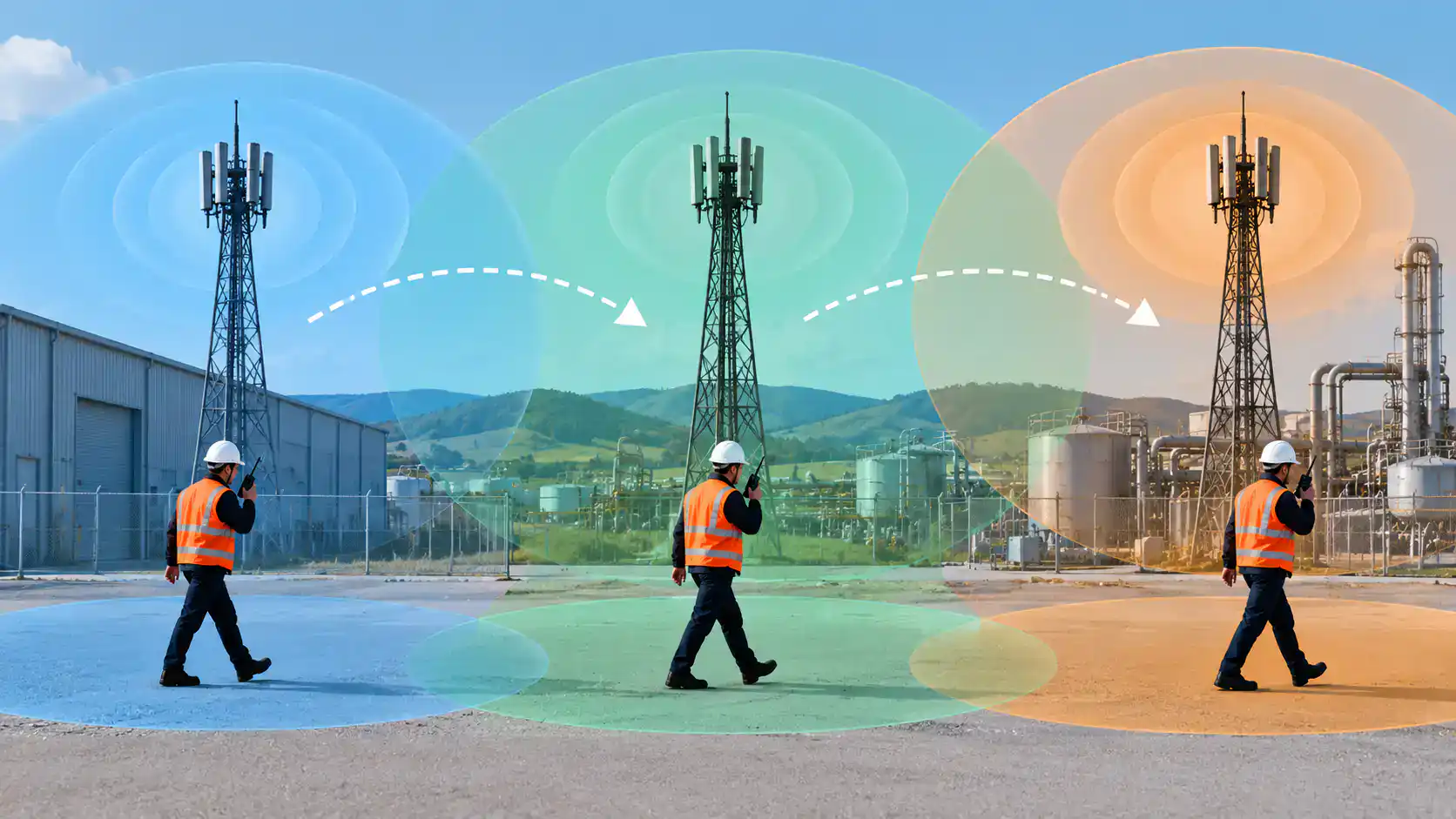
Auto Roaming
Auto roamingRoaming allows a compatible two-way radio to move between different radio sites or coverage areas, automatically selecting an appropriate site as the user moves. is a feature of some two-way radio systems that allows a radio to automatically move between compatible radio sites, channels or access points as the user moves through an area.
The purpose of auto roaming is to help maintain reliable communication when a user moves beyond the effective coverageRadio Coverage is the geographical area in which a two-way radio system can provide reliable communication. Coverage depends on the radios, antennas, frequency, terrain, buildings and system infrastructure. of one radio site or moves into an area where another site provides a stronger or more suitable signal.
Unlike manually changing channels or selecting a different site, the radio can make the change automatically according to the configuration of the radio systemA Radio System is a complete communication solution comprising two-way radios and, where required, equipment such as repeaters, antennas, base stations, mobile radios and network infrastructure..
How does auto roaming work?
A radio system using auto roaming is normally configured with information about the sites, channels or frequencies that the radio is permitted to use.
As the user moves, the radio monitors the available signals and can determine when it should change to another suitable site or channelA two-way radio channel is a programmed set of communication settings, typically including frequency and signalling, that allows compatible radios to communicate with one another..
A simplified example would be:
Radio Site A → user moves → signal from Site A weakens → Site B becomes preferable → radio connects to Site B
The exact method used to make this decision varies between radio manufacturers and technologies.
Some systems use received signal strength or other radio-quality measurements to determine when a change should occur. The radio may also use programmed roaming thresholds, scan lists or site information.
Why is auto roaming useful?
Auto roaming is particularly useful for organisations where users need to move around a large area while maintaining radio communications.
For example, a company may have several radio sites covering a large industrial facility, multiple buildingsAn antenna transmits and receives radio-frequency signals, allowing a two-way radio to communicate. Antenna type, frequency, height and location can all affect radio performance and coverage. or a wide geographical area. Without roaming, users might need to manually change channels when moving between coverage areas.
With auto roaming configured correctly, the radio can manage the change automatically, making the system easier for users to operate.
Auto roaming and repeaters
Auto roaming can be used in radio systems containing multiple repeaters or radio sites.
A single repeaterA Repeater receives a two-way radio transmission and retransmits it, usually from an elevated location, to extend the coverage and reliability of a radio communication system. may provide coverage over one building, site or geographical area. Larger systems can use multiple repeaters or interconnected radio sites to extend coverage.
Auto roaming allows compatible radios to move between these coverage areas as users travel.
The radio does not necessarily communicate directly with every repeater at the same time. Instead, it selects an appropriate site according to the system’s configuration and the conditions detected by the radio.
Auto roaming and digital radio
Auto roaming is commonly associated with professional digital radio systems, although the precise implementation depends on the radio technology.
Digital radio systems can provide sophisticated site-selection and roaming capabilities, particularly where several networked sites form a wider communication system.
The features available vary between technologies such as DMR, TETRA and other professional radio platforms.
Not every digital radio supports automatic roaming, and radios must be configured correctly for the particular system.
Auto roaming vs channel scanning
Auto roaming and channel scanning are related but different functions.
Channel scanning allows a radio to monitor multiple programmed channels to determine whether there is activity on them.
Auto roaming is concerned with selecting or moving between suitable radio sites, channels or networkA Network is a connected system of radios, equipment and infrastructure that allows users to communicate across a defined area. Radio networks can range from simple radio-to-radio systems to large multi-site networks. resources as the user moves through different coverage areas.
A radio may support both features, but they perform different functions.
Auto roaming and radio coverage
Auto roaming does not increase the fundamental range of an individual radio site or repeater.
Instead, it allows multiple coverage areas to work together so that users can move between them without having to manually select a different radio resource.
The overall coverage of a roaming system depends on factors such as:
- Number and location of radio sites
- Repeater coverage
- AntennaAn antenna transmits and receives radio-frequency signals, allowing a two-way radio to communicate. Antenna type, frequency, height and location can all affect radio performance and coverage. height and position
- Terrain
- Buildings and other obstructions
- Radio frequencyAn antenna transmits and receives radio-frequency signals, allowing a two-way radio to communicate. Antenna type, frequency, height and location can all affect radio performance and coverage.
- Network design
- Roaming configuration
Good system design is therefore essential if seamless or reliable roaming is required.
Auto roaming in large sites
Auto roaming can be useful on large properties where a single radio site cannot provide consistent coverage.
Examples can include:
- Large industrial facilities
- Ports and logistics sites
- Airports
- Universities
- Hospitals
- Utilities
- Large event venues
- Multi-building commercial sites
A user may move between buildings or working areas while the radio automatically selects the appropriate coverage area.
Auto roaming in vehicle-based operations
Auto roaming can also be useful where radio users travel between different geographical areas.
For example, transport, utilities, infrastructureRadio infrastructure is the equipment and supporting systems behind a professional two-way radio network, including repeaters, antennas, base stations, network connections, power systems and dispatch equipment. and field-service teams may operate across a wide area covered by multiple radio sites.
A roaming-capable radio system can reduce the need for drivers or field workers to manually change channels as they move from one coverage area to another.
The precise capabilities depend on the radio network and whether the sites are connected as part of a coordinated system.
Configuring auto roaming
Auto roaming normally requires configuration by a radio system administrator or radio engineer.
The radio may need to be programmed with information such as:
- Available sites
- Channels or frequencies
- Roaming thresholds
- Preferred sites
- Scan or roaming lists
- System identification information
- Other parameters specific to the radio technology
Incorrect configuration can result in unnecessary site changes, delayed communications or the radio remaining connected to a less suitable site.
For this reason, roaming should be designed and tested as part of the complete radio system rather than treated simply as a setting on the handheld radio.
Does auto roaming work on all two-way radios?
No. Auto roaming is not a standard feature on every two-way radio.
Its availability depends on the radio model, communication technology and the design of the radio system.
Simple conventional radios operating on a single channel generally have no need for automatic roaming. More sophisticated multi-site digital systems may provide advanced roaming capabilities.
Before selecting equipment, the radio’s specifications should therefore be checked to establish whether it supports the required roaming functionality.
Auto roaming and two-way radio hire
For temporary radio systems covering large sites or multiple locations, auto roaming can make radios considerably easier for users to operate.
Where a hire system requires multiple coverage areas, DCS can assess the site and determine whether a multi-site or repeater-based system with roaming capabilities is appropriate.
The exact solution depends on the required coverage, number of users, site layout and radio technology being used.
If you’re planning a temporary operation or large event, radio hire for businesses provides a practical alternative to purchasing equipment.