
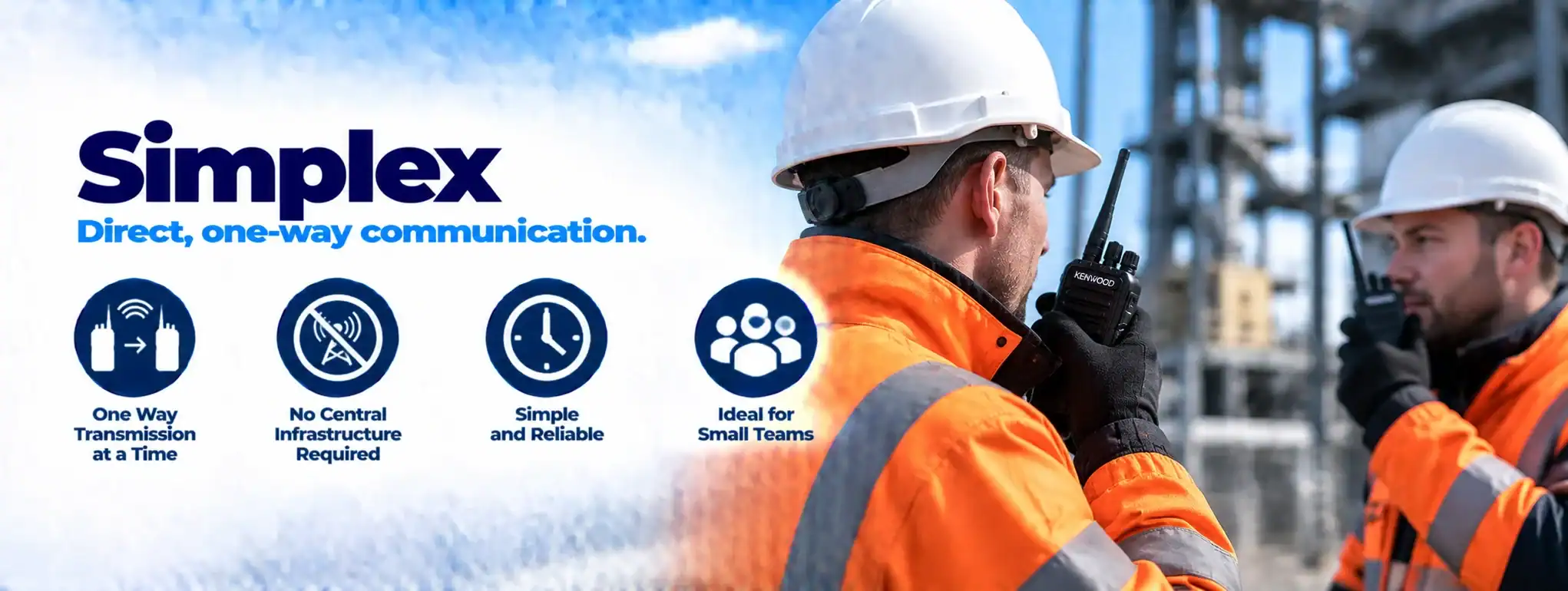
Simplex
Simplex is a method of two-way radio communication in which radios transmit and receive on the same frequencyAn antenna transmits and receives radio-frequency signals, allowing a two-way radio to communicate. Antenna type, frequency, height and location can all affect radio performance and coverage., allowing users to communicate directly with each other without requiring a repeaterA Repeater receives a two-way radio transmission and retransmits it, usually from an elevated location, to extend the coverage and reliability of a radio communication system. or other intermediate infrastructureRadio infrastructure is the equipment and supporting systems behind a professional two-way radio network, including repeaters, antennas, base stations, network connections, power systems and dispatch equipment..
In a typical simplex conversation, one person presses Push-to-Talk (PTT)Push-to-Talk (PTT) is the button or control used to activate a two-way radio's transmitter. Press it to speak and release it to listen. to transmit while the other person listens. The receiving user then releases their PTT and transmits a response.
A simple simplex arrangement is:
Radio A ↔ Radio B
Unlike a repeater-based system:
Radio A → Repeater → Radio B
simplex communication takes place directly between the radios.
How does simplex radio work?
A simplex radio uses the same radio frequencyFrequency is the number of cycles a radio wave completes each second, measured in Hertz. In two-way radio, frequency determines where a transmission operates within the radio spectrum. for both transmissionTransmission is the process of sending voice, data or signalling from a radio using a radio-frequency signal to another radio, repeater or communication system. and reception.
When the user presses PTT:
Radio transmits → Other radios receive
When the user releases PTT:
Other user transmits → Original radio receives
Because both users cannot normally transmit on the same frequency at exactly the same time, simplex communication is a form of Half-DuplexHalf-Duplex allows two-way communication in both directions, but users normally take turns transmitting. It is the standard operating method for most Push-to-Talk professional two-way radio systems. communication.
Simplex frequency
A simplex channelA two-way radio channel is a programmed set of communication settings, typically including frequency and signalling, that allows compatible radios to communicate with one another. uses one frequency for both transmitting and receiving.
For example:
Transmit frequency: 446.00625 MHz
Receive frequency: 446.00625 MHz
The exact frequency depends on the radio service and the channel being used.
Simplex vs duplex
Simplex and duplexduplex, duplex radio, duplex communication, duplex frequencies, duplex operation, duplex spacing, frequency offset, repeater duplex, duplex repeater, full duplex, half duplex, radio repeater describe different methods of radio communication.
Simplex: One frequency is used for both transmission and reception.
Duplex: Separate frequencies are used for transmission and reception.
A repeater-based radio systemA Radio System is a complete communication solution comprising two-way radios and, where required, equipment such as repeaters, antennas, base stations, mobile radios and network infrastructure. normally uses separate input and output frequencies.
Simplex vs repeater
The main difference is whether an intermediate repeater is used.
| Simplex | Repeater |
|---|---|
| Radio-to-radio | Radio-to-repeater-to-radio |
| Same frequency | Normally separate transmit/receive frequencies |
| No repeater required | Repeater required |
| Limited by direct radio coverageRadio Coverage is the geographical area in which a two-way radio system can provide reliable communication. Coverage depends on the radios, antennas, frequency, terrain, buildings and system infrastructure. | Can provide extended coverage |
| Simple system | More infrastructure required |
Simplex can be an effective solution where users are operating within relatively close range.
Simplex range
Simplex range depends on the environment and radio equipment.
Factors include:
- Transmitter powerAn antenna transmits and receives radio-frequency signals, allowing a two-way radio to communicate. Antenna type, frequency, height and location can all affect radio performance and coverage.
- AntennaAn antenna transmits and receives radio-frequency signals, allowing a two-way radio to communicate. Antenna type, frequency, height and location can all affect radio performance and coverage.
- Frequency
- Antenna height
- Terrain
- BuildingsAn antenna transmits and receives radio-frequency signals, allowing a two-way radio to communicate. Antenna type, frequency, height and location can all affect radio performance and coverage.
- Obstacles
- Radio sensitivity
- InterferenceRadio interference occurs when unwanted radio-frequency signals or electrical noise disrupt two-way radio communications, causing distorted audio, broken transmissions, reduced coverage or loss of communication.
There is therefore no universal simplex range.
A manufacturer may quote a theoretical range, but real-world coverage can be considerably different.
Simplex and line of sight
Simplex communication is often strongly influenced by the available propagation path between the radios.
Outdoor radios with a relatively unobstructed path may achieve greater range than radios operating inside buildings or behind substantial obstacles.
Simplex and buildings
Buildings can reduce simplex coverage because walls, reinforced concrete, steelwork and other materials can attenuate radio signals.
This can make simplex less suitable for large or complex buildings where reliable coverage is required throughout the site.
Simplex and terrain
Hills, valleys and other geographical features can block or weaken simplex signals.
This is particularly relevant for:
- Farms
- Estates
- Construction sites
- Outdoor events
- Countryside operations
A repeater may be considered where terrain prevents reliable direct communication.
Simplex and VHF
VHF radios can operate in simplex mode where the relevant radio service and frequency allocation permit it.
VHF can be useful for many outdoor and open-area applications, although actual performance depends on the environment.
Simplex and UHF
UHF radios can also operate in simplex mode.
UHF is commonly used for many professional indoor and urban applications, although buildings and other structures can significantly affect coverage.
Simplex and PMR446
PMR446 is a licence-free radioA Licence-Free Radio is a two-way radio that can be used without an individual radio licence when it complies with the applicable licence-exempt rules. In the UK, PMR446 is the main licence-free radio service. service designed for short-range personal and business communications.
PMR446 radios operate on shared frequencies and are generally used for direct radio-to-radio communication.
PMR446 equipment is subject to specific technical requirements, including restrictions on transmitter power and antenna arrangements.
Simplex and licence-free radio
Simplex does not automatically mean that a radio is licence-free.
A radio can operate in simplex mode on licensed frequencies.
Whether a licence is required depends on the frequency and radio service being used.
Simplex and Ofcom
In the UK, the use of radio frequencies is regulated by OfcomOfcom (Office of Communications) is the UK's communications regulator. For two-way radio users, Ofcom manages and regulates access to radio spectrum and the use of radio frequencies in the UK..
Professional users operating on licensed business-radio frequencies must comply with the conditions of the relevant licence.
Simplex operation can therefore be used with licensed professional radios where the appropriate frequency authorisation permits it.
Simplex and licensed radio
A licensed professional radio system can use simplex channels for direct communication.
For example:
Radio A ↔ Radio B
without requiring a repeater.
This can be useful for short-range communications or where a simple backup channel is required.
Simplex and DMR
Digital Mobile Radio (DMR)Digital Mobile Radio (DMR) is an ETSI digital radio standard for professional two-way communications, supporting voice, group calling, data and other features on compatible radio systems. equipment can support simplex operation where the radio and system configuration allow it.
In a DMR simplex system, compatible radios communicate directly without a repeater.
DMR simplex can provide digital voice and other supported digital features while retaining the direct radio-to-radio architecture.
DMR simplex
A DMR simplex channel can be configured with appropriate parameters such as:
- Frequency
- Colour code
- Talkgroup or contact settings
- Time-slot configuration where applicable
The exact configuration depends on the equipment and radio system.
Simplex and time slots
Some digital radio technologies can use time slots for sharing a frequency.
The exact behaviour depends on the technology.
A simplex digital radio channel should therefore be configured according to the manufacturer’s specifications rather than assuming that repeater and simplex settings are interchangeable.
Simplex and talkgroups
Digital radios can use group addressing when operating in compatible simplex configurations.
This can allow several radios to participate in the same communication group.
However, all radios must be correctly configured and within suitable RF coverage.
Simplex and scanning
A simplex channel can be included in a radio’s Scan ListA Scan List is a programmed collection of channels or talkgroups that a two-way radio monitors automatically when its scanning function is enabled..
This allows a radio to monitor the simplex channel alongside other configured channels.
Scanning does not extend the range of the simplex channel.
Simplex and selective calling
Compatible simplex systems can support Selective CallingSelective Calling allows a two-way radio system to direct a transmission to a specific radio or group of radios rather than all users on the channel..
For example, signalling can allow a radio to respond only to transmissions intended for a particular radio or group.
The exact feature depends on the radio technology.
Simplex and privacy
Simplex communication should not automatically be considered private.
Because the radios transmit directly over the air, other compatible radios within range may be able to receive the transmission.
Where confidentiality is required, appropriate encryptionEncryption protects two-way radio communications by converting voice or data into a secure form that can only be understood by authorised radios with the correct encryption capability and keys. and security measures should be considered.
Simplex and encryption
Digital radios may support Encryption while operating in simplex mode.
Encryption protects the content of compatible communications but does not prevent the RF signal from being present or detected.
All participating radios must have compatible security configuration.
Simplex and interference
Because simplex radios share the same frequency for transmitting and receiving, interference can prevent successful communication.
Potential sources include:
- Other users
- Nearby transmitters
- Electrical equipment
- RF congestion
- Poorly configured radios
A licensed frequency plan can help manage interference for professional systems.
Simplex and simultaneous transmission
Simplex communication normally does not allow two users to speak simultaneously.
If one user transmits while another transmits at the same time on the same frequency, the signals can interfere with each other.
This is why users normally take turns using PTT.
Simplex and half-duplex
Simplex is closely associated with half-duplex radio operation.
The user:
Presses PTT → Speaks → Releases PTT → Listens
The other user then takes their turn.
Simplex vs full duplex
Full DuplexFull Duplex allows two-way radio users to transmit and receive simultaneously, providing a continuous, telephone-style conversation rather than requiring users to take turns using Push-to-Talk. allows transmission and reception to occur simultaneously, similar to a telephone conversation.
Simplex radio does not normally provide this type of simultaneous two-way conversation.
Simplex and repeaters
Simplex channels are sometimes used alongside repeater channels.
For example:
Channel 1 → Repeater
Channel 2 → Simplex
This can provide users with a direct communication option in addition to the wider-area repeater system.
Simplex as a backup channel
A simplex channel can provide a useful backup when a repeater or networkA Network is a connected system of radios, equipment and infrastructure that allows users to communicate across a defined area. Radio networks can range from simple radio-to-radio systems to large multi-site networks. is unavailable.
However, its coverage will normally be limited to direct radio-to-radio communication.
For critical operations, the backup arrangement should be tested in the actual operating environment.
Simplex and radio hire
Simplex channels are commonly used in Radio HireRadio Hire is the temporary rental of two-way radios and related communication equipment for events, projects and operational requirements, providing professional communication without purchasing the equipment. systems where users are operating within a relatively small area and a repeater is unnecessary.
Typical applications include:
- Small events
- Warehouses
- Hospitality
- Short-term construction work
- Security teams
- Small outdoor operations
Simplex radio hire
A hire company can pre-program radios with a dedicated simplex channel.
For example:
Channel 1 → Event Operations
The radios can then communicate directly without requiring repeater infrastructure.
For larger sites, a repeater may be added if direct coverage is insufficient.
Simplex and events
Small events can often use simplex radio channels where staff remain relatively close together.
Larger events may require repeaters because of:
- Large site areas
- Buildings
- Crowds
- Terrain
- Temporary structures
A coverage assessment can determine the appropriate approach.
Simplex and security
Security personnel working within a relatively confined area can use simplex radios for direct communication.
For larger security operations, repeaters or networked radio systems may be required.
Simplex and construction
Construction teams can use simplex channels for direct communication between workers operating in the same general area.
As the site expands or structures become more substantial, coverage requirements may change.
Simplex and agriculture
Farm workers operating within relatively close proximity can use simplex radio communication.
Large farms and estates may require repeaters to overcome distance and terrain.
Simplex and hospitality
Hotels, restaurants and venues can use simplex radios where staff operate within a relatively compact area.
For larger buildings, basement areas or multi-site operations, additional infrastructure may be required.
Simplex and transport
Simplex can be useful for short-range communication between transport personnel operating in the same location.
For example:
- Depot operations
- Loading areas
- Yards
- Vehicle marshalling
Long-distance transport operations generally require a wider-area communication solution.
Simplex and vehicle radios
Mobile radios installed in vehicles can communicate directly with handheld radios where the system is configured for simplex operation.
The vehicle antenna can provide advantages over a handheld antenna, but actual coverage depends on the installation and environment.
Simplex and mobile radio
A Mobile RadioA Mobile Radio is a two-way radio designed to be installed in a vehicle. It normally uses the vehicle's power supply and an external antenna to provide reliable communication while travelling or working in the field. can operate in simplex mode when configured for a suitable direct channel.
This can be useful for vehicle-to-vehicle communication where users are operating within direct radio range.
Simplex and portable radio
A Portable RadioA Portable Radio is a battery-powered two-way radio designed to be carried and operated by an individual, providing mobile communication for professional and operational users. can use simplex channels for direct communication.
This is the most familiar form of walkie-talkie operation.
Simplex and repeater coverage
If direct simplex communication does not provide sufficient coverage, a repeater can be introduced.
The transition is:
Simplex → Direct radio communication
Repeater → Extended radio coverage
The appropriate solution depends on the required coverage and operating environment.
Simplex and site surveys
A Site SurveyA Site Survey is an assessment of a location to determine whether a two-way radio system will provide the required coverage, reliability and performance. can determine whether simplex communication is adequate for a particular location.
Testing can identify:
- Coverage limits
- Dead spots
- Building attenuation
- Terrain effects
- Interference
- Areas requiring repeater coverage
Simplex and RSSI
RSSI (Received Signal Strength Indicator)RSSI (Received Signal Strength Indicator) is a measurement of the strength of a radio signal received by a two-way radio or other wireless device, commonly used to assess coverage and diagnose reception problems. can be used during testing to measure received signal strength between radios.
RSSI can help engineers assess how signal strength changes across a simplex coverage area.
However, signal strength alone does not guarantee clear or reliable communication.
Simplex and radio system design
Simplex can be appropriate when the communication requirement is relatively straightforward.
A system designer should consider:
- Required coverage.
- Number of users.
- Operating environment.
- Distance between users.
- Frequency.
- Licensing.
- Interference.
- Building construction.
- Terrain.
- Whether a repeater is required.
Advantages of simplex radio
Simplex systems can offer several advantages:
- Simple configuration
- Direct radio-to-radio communication
- No repeater required
- Lower infrastructure requirements
- Easy deployment
- Useful as a backup communication method
Limitations of simplex radio
Simplex also has limitations:
- Limited by direct RF coverage
- Cannot normally communicate around significant obstacles
- Users cannot normally transmit simultaneously
- Does not provide repeater-extended coverage
- Can be affected by interference
- Coverage can vary significantly by environment
When should a repeater be used instead?
A repeater may be more appropriate when:
- Users are spread across a large area.
- Buildings block direct communication.
- Terrain limits coverage.
- Reliable site-wide communication is required.
- Multiple operational teams need wider coverage.
- Users need to communicate over greater distances.
A site survey can help determine whether simplex is sufficient.
Simplex and DCS
DCS can provide simplex radio systems for applications where direct radio-to-radio communication is sufficient.
Where greater coverage is required, DCS can also design systems using repeaters, multi-site infrastructure and other professional radio technologies.