
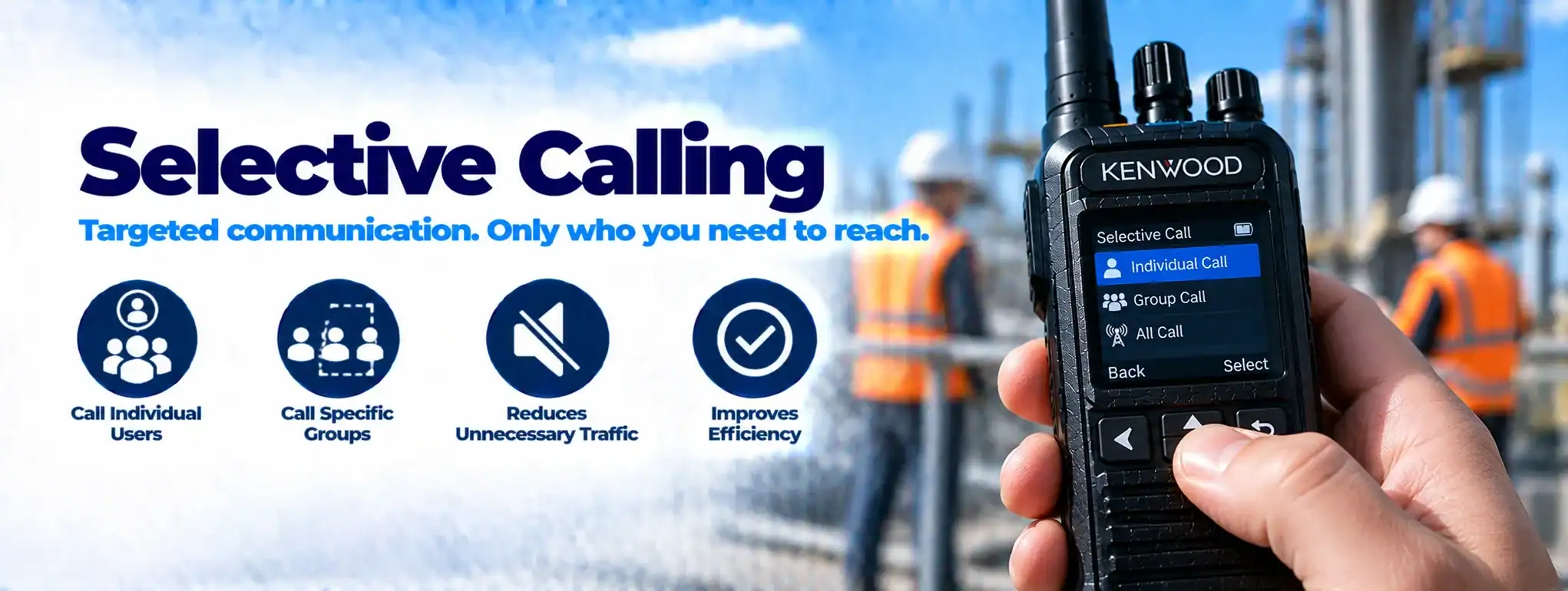
Selective Calling
Selective Calling is a two-way radio feature that allows a radio systemA Radio System is a complete communication solution comprising two-way radios and, where required, equipment such as repeaters, antennas, base stations, mobile radios and network infrastructure. to direct a transmissionTransmission is the process of sending voice, data or signalling from a radio using a radio-frequency signal to another radio, repeater or communication system. to a specific radio, group of radios or predefined communication group rather than broadcasting the communication to every radio using the same system.
It allows users to control who receives a particular communication and is commonly used in professional radio systems where different teams, individuals or departments need separate communications.
Selective calling can be implemented using different analogue and digital signalling technologies.
What is selective calling?
In a basic radio system, a transmission may be heard by every radio monitoring the same channelA two-way radio channel is a programmed set of communication settings, typically including frequency and signalling, that allows compatible radios to communicate with one another..
Selective calling adds signalling that identifies the intended recipient.
For example:
Radio A → Radio B
rather than:
Radio A → All radios on channel
This can make radio communication more organised and reduce unnecessary traffic for users who do not need to hear a particular conversation.
How does selective calling work?
A radio transmission can contain signalling information identifying the intended radio or group.
The receiving radios monitor this signalling.
If the signalling matches the radio’s programmed identity or group, the radio opens its audio or responds according to the configured function.
A simplified example is:
Transmission → Selective-call signal → Radio checks identity → Matching radio responds
The exact signalling method depends on the radio technology.
Selective calling in analogue radio
Selective calling has traditionally been used in analogue two-way radio systems.
Analogue systems can use signalling methods to identify particular radios or groups.
Examples include:
- CTCSS
- DCS
- 2-Tone
- 5-Tone
- DTMF
These systems provide different levels of selective signalling and control.
CTCSS and selective calling
CTCSS (Continuous Tone-Coded SquelchAnalogue radio uses continuously varying radio signals to transmit voice communication. It remains widely used for reliable two-way communication across business, industry, events, security and other applications. System) uses a sub-audible tone to control which radios open their squelch.
A radio programmed for a particular CTCSS tone can remain quiet when it receives a signal using a different tone.
CTCSS is often described as selective calling, although technically it is primarily a squelch-control system rather than a secure private communication method.
DCS and selective calling
DCS (Digital Coded Squelch) uses a digital code to control receiverA Receiver is the part of a two-way radio that detects and processes incoming radio signals, converting them into audible voice or usable data for the user. squelch.
Like CTCSS, it can prevent a radio from opening its speaker for transmissions using a different programmed code.
DCS does not encrypt the communication and does not prevent other users from receiving the underlying RF transmission with suitable equipment.
2-Tone selective calling
2-Tone signalling uses a sequence of two audio tones to identify a particular radio or group.
It can be used to trigger functions such as:
- Individual alerts
- Group alerts
- Call tones
- PagingPaging is a communication method used to send a short alert or notification to an individual or group. In two-way radio systems, it can quickly notify users that their attention or response is required.
- Emergency notifications
The exact capabilities depend on the radio equipment.
5-Tone selective calling
5-Tone signalling uses a sequence of five tones to identify radios or initiate specific functions.
It has historically been used in professional and public-service radio systems for functions such as:
- Individual calling
- Group calling
- Status signalling
- Selective alerting
The specific implementation depends on the radio system.
DTMF selective calling
DTMF (Dual-Tone Multi-Frequency) signalling uses combinations of audio tones.
It can be used for functions such as:
- Individual calling
- Remote control
- Radio identification
- Selective signalling
The availability and implementation depend on the radio equipment.
Selective calling in digital radio
Digital radio systems can provide more sophisticated forms of selective calling.
Instead of relying on audible or sub-audible analogue tones, digital systems can transmit addressing information as part of the digital communication protocol.
This can allow functions such as:
- Individual calls
- Group calls
- All-call functions
- Emergency calls
- Status messages
Selective calling and DMR
Digital Mobile Radio (DMR)Digital Mobile Radio (DMR) is an ETSI digital radio standard for professional two-way communications, supporting voice, group calling, data and other features on compatible radio systems. supports different types of addressed communication.
A DMR system can distinguish between individual radios and groups of radios.
For example:
Private CallPrivate Call is a two-way radio feature that allows one radio user to communicate directly with another individual radio user rather than making the conversation part of a general group call. → One radio
Group Call → Defined group
All Call → Multiple or all available radios, where supported
This provides a more sophisticated form of selective communication than basic analogue signalling.
Selective calling and Private Call
Private Call allows a user to communicate with a specific radio rather than the entire talkgroup.
This is one of the most common forms of selective communication on professional digital radio systems.
For example:
Supervisor → Individual security officer
The communication is directed to the intended radio according to the system’s configuration.
Selective calling and Group Call
A Group Call directs a transmission to a predefined group of radios.
For example:
Security supervisor → Security team
Other radios outside the group do not normally participate in that group communication.
Selective calling and All Call
Some professional digital radio systems support an All Call function.
This can allow an authorised user to communicate with all radios or all users within a defined system.
All Call is generally used for important announcements rather than routine communication.
Selective calling and Paging
Selective calling can be used for Paging.
A radio or pager can be configured to respond when it receives a particular selective-call signal.
For example:
Control room → Selective alert → Specific radio → Alert
This can be useful where staff need to be alerted without continuously monitoring a voice channel.
Selective calling and emergency alerts
Selective calling can be used to deliver emergency or priority alerts in compatible systems.
An alert can be directed towards:
- An individual
- A team
- A control room
- A predefined emergency group
The actual emergency functionality depends on the radio system.
Selective calling and Priority Call
A Priority CallPriority Call is a two-way radio feature that gives important or authorised communications higher priority than routine radio traffic, helping urgent messages access the system when channels are busy. can use selective addressing to ensure that a communication is directed to the appropriate user or group.
More advanced radio systems can also assign priority to the communication within the system.
Selective calling and call priority are therefore related but separate concepts.
Selective calling and scan lists
Selective calling can work alongside a Scan ListA Scan List is a programmed collection of channels or talkgroups that a two-way radio monitors automatically when its scanning function is enabled..
A radio may scan several channels or groups while responding only to calls or signalling intended for it.
The exact behaviour depends on the radio’s programming.
Selective calling and radio identification
Selective calling requires radios to have identities or signalling parameters that allow the system to determine the intended recipient.
Depending on the technology, this may be based on:
- Radio ID
- Call ID
- Group ID
- Tone sequence
- Digital signalling code
Selective calling and radio IDs
Digital professional radios normally have a unique Radio ID within the relevant system.
This allows the system to address an individual radio.
For example:
Radio ID 1024 → Radio ID 1057
The receiving radio can recognise that the communication is intended for it.
Selective calling and talkgroups
Talkgroups provide a way of organising radios into communication groups.
Selective calling can direct communication to a particular talkgroup rather than to every radio on the wider networkA Network is a connected system of radios, equipment and infrastructure that allows users to communicate across a defined area. Radio networks can range from simple radio-to-radio systems to large multi-site networks..
This is especially useful in large professional radio systems.
Selective calling and encryption
Selective calling should not be confused with EncryptionEncryption protects two-way radio communications by converting voice or data into a secure form that can only be understood by authorised radios with the correct encryption capability and keys..
Selective calling determines who the communication is intended for.
Encryption protects the content of the communication from unauthorised access.
A selectively addressed transmission is not necessarily private or secure.
Selective calling and privacy
Selective calling can reduce unwanted audio by preventing radios from opening their speakers for communications not intended for them.
However, it does not necessarily prevent another radio from receiving or monitoring the RF transmission.
Therefore:
Selective calling ≠ secure communication
Where confidentiality is required, appropriate encryption and security measures should be considered.
Selective calling and interference
Selective calling can help reduce the amount of unwanted traffic heard by users.
For example, radios using different signalling codes can share a frequencyAn antenna transmits and receives radio-frequency signals, allowing a two-way radio to communicate. Antenna type, frequency, height and location can all affect radio performance and coverage. while remaining quiet when other groups are transmitting.
However, selective calling does not eliminate RF interferenceRadio interference occurs when unwanted radio-frequency signals or electrical noise disrupt two-way radio communications, causing distorted audio, broken transmissions, reduced coverage or loss of communication..
The underlying signal is still present on the radio frequencyFrequency is the number of cycles a radio wave completes each second, measured in Hertz. In two-way radio, frequency determines where a transmission operates within the radio spectrum..
Selective calling and frequency
Selective calling does not necessarily require a separate radio frequency for every user.
Multiple users can share a frequency or channel while signalling determines which radios respond to particular calls.
This can improve the efficiency of some radio systems.
Selective calling and radio capacity
Selective calling does not itself increase the number of simultaneous conversations a radio system can support.
It controls which radios respond to communications.
System capacity is determined by the available channels, time slots, repeaters and network architecture.
Selective calling and repeaters
Selective calling can be used through compatible Repeaters.
The repeaterA Repeater receives a two-way radio transmission and retransmits it, usually from an elevated location, to extend the coverage and reliability of a radio communication system. relays the radio transmission while the receiving radios use the appropriate signalling to determine whether they should respond.
The repeater must be configured to support the relevant signalling or digital protocol.
Selective calling and radio networks
In networked radio systems, selective calling can operate across multiple connected sites.
This allows individual users or groups to be addressed across a wider geographical area.
The exact functionality depends on the network architecture.
Selective calling and roaming
RoamingRoaming allows a compatible two-way radio to move between different radio sites or coverage areas, automatically selecting an appropriate site as the user moves. allows compatible radios to move between radio sites.
Selective calling determines which radio or group should receive a particular communication.
A radio can therefore use both functions within the same professional system.
Selective calling and control rooms
Control rooms can use selective calling to contact individual radios or groups.
For example:
Control room → Security supervisor
rather than transmitting the message to every security officer.
This can make communications more efficient.
Selective calling for security
Security operations can use selective calling to communicate with:
- Individual guards
- Supervisors
- Patrol teams
- Control rooms
- Emergency teams
For example, a control room can directly contact a particular patrol officer without interrupting the entire security team.
Selective calling for events
Large events can involve many separate teams.
Selective calling can allow event control to contact specific groups or individuals.
For example:
Event Control → Security
Event Control → Medical
Event Control → Production
This reduces unnecessary traffic for teams that do not need the information.
Selective calling for construction
Construction sites can use selective calling to communicate with particular teams or supervisors.
For example:
Site Manager → Plant Supervisor
or:
Site Control → All Site Radios
The appropriate function depends on the radio system.
Selective calling for transport
Transport operators can use selective calling to contact individual vehicles, drivers or operational groups.
This can be particularly useful where many vehicles share the same radio system.
Selective calling for utilities
Utility companies can use selective calling to contact specific field workers or teams.
For example:
Control → Engineer 12
rather than transmitting the communication to every field engineer.
Selective calling and lone workers
A control room can use selective calling to contact a Lone WorkerA Lone Worker is someone who works without direct supervision or immediate assistance nearby. Compatible two-way radios can provide safety features such as timed check-ins, emergency alerts and GPS location. directly.
This can provide a useful communication method for workers operating away from colleagues.
Additional lone-worker safety features may be required depending on the application.
Selective calling and radio hire
Selective calling can be configured as part of a professional Radio HireRadio Hire is the temporary rental of two-way radios and related communication equipment for events, projects and operational requirements, providing professional communication without purchasing the equipment. system.
For temporary events or projects, radios can be programmed with appropriate individual IDs, groups and calling functions before deployment.
This allows the hired system to operate according to the customer’s communication structure.
Selective calling and radio programming
Selective calling normally requires appropriate radio programming.
Depending on the system, programming may include:
- Radio ID
- Group ID
- CTCSS tone
- DCS code
- Tone sequences
- Call permissions
- Emergency settings
- Priority settings
Programming requirements vary considerably between radio technologies.
Selective calling and analogue radio hire
Analogue hired radios can use signalling such as CTCSS or DCS to control which radios respond to particular channels.
For more advanced individual calling, compatible equipment may support additional signalling methods.
Selective calling and digital radio hire
Digital radio hire systems can provide more sophisticated selective calling through individual IDs and talkgroups.
This can be particularly useful for larger events and complex temporary operations.
Selective calling limitations
Selective calling has several limitations.
It does not necessarily:
- Prevent interception
- Encrypt communications
- Increase radio range
- Increase system capacity
- Eliminate interference
- Guarantee delivery of a message
The capabilities depend on the radio technology and system design.
Choosing a selective-calling system
When selecting a radio system with selective calling, consider:
- Individual calling requirements.
- Group calling requirements.
- Number of users.
- Analogue or digital technology.
- Required privacy.
- Emergency requirements.
- Control-room requirements.
- Number of radio sites.
- Required signalling.
- Whether encryption is required.
Selective calling and DCS
DCS can provide selective communication features for professional two-way radio systems.
DCS can configure compatible radios with individual and group communication functions, including selective calling, emergency features, repeaters and control-room communications where required.