
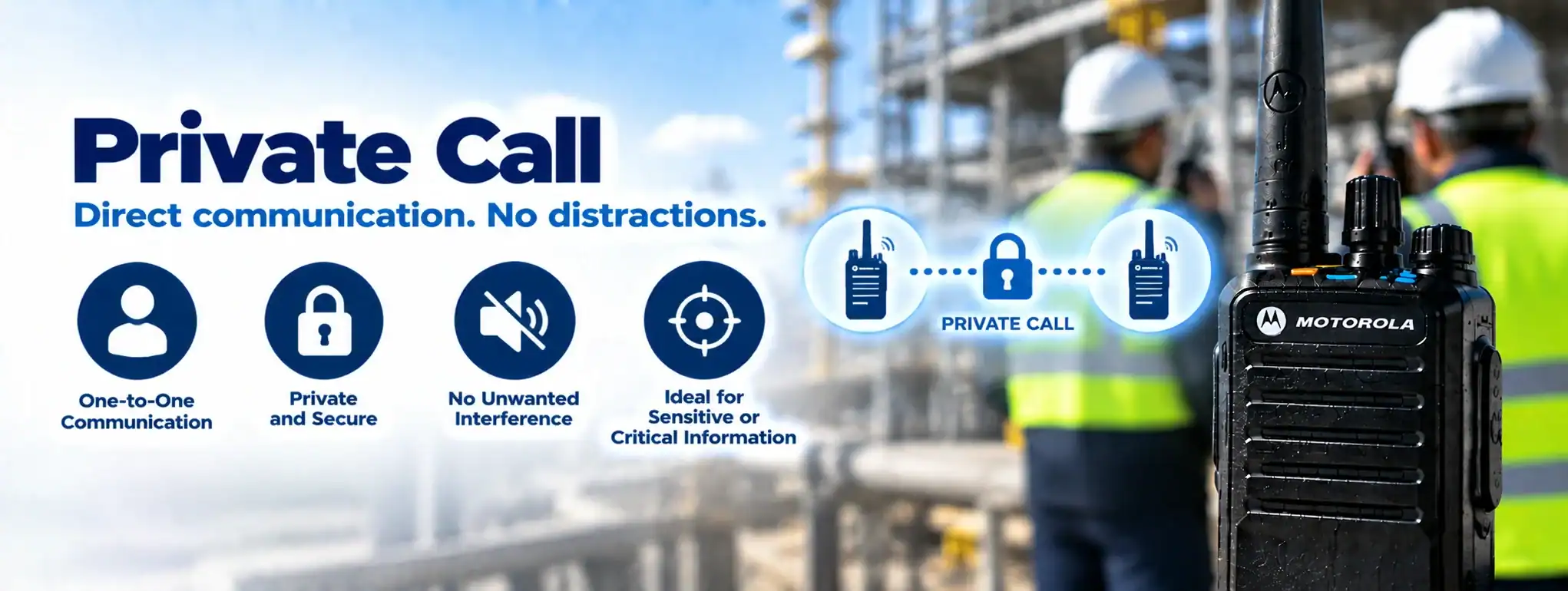
Private Call
Private Call is a two-way radio feature that allows one radio user to communicate directly with another individual radio user without making the conversation part of a general group call.
Private calling is commonly available on professional digital radio systems and can be useful when information needs to be communicated between specific users without unnecessarily involving an entire team.
What is a private call?
A private call establishes communication between two specific radio users.
For example:
Radio User A → Radio User B
Other users on the system are not normally part of the call.
The exact behaviour depends on the radio technology and system configuration.
Private Call vs Group Call
The main difference is the number of intended participants.
Private Call:
One radio user ↔ One radio user
Group Call:
One radio user → Multiple radio users
Group calling is generally used when everyone in a team needs to hear the communication, while private calling is useful for one-to-one conversations.
Private Call on digital radio
Private calling is particularly common on professional digital radio systems.
Digital systems can use radio identification to address a specific radio rather than transmitting a call to every radio using the same channelA two-way radio channel is a programmed set of communication settings, typically including frequency and signalling, that allows compatible radios to communicate with one another. or talkgroup.
The receiving radio can identify that the call is intended specifically for it.
Private Call and DMR
Digital Mobile Radio (DMR)Digital Mobile Radio (DMR) is an ETSI digital radio standard for professional two-way communications, supporting voice, group calling, data and other features on compatible radio systems. supports individual calling between compatible radios.
Depending on the DMR system, this may be referred to as an Individual Call or Private Call.
The exact terminology and available functionality vary between manufacturers and radio systems.
Private Call and MOTOTRBO™
Compatible MOTOTRBO™MOTOTRBO™ is Motorola Solutions' professional digital two-way radio platform, based on the DMR standard. It supports business communication ranging from simple radio systems to multi-site networks. systems support individual radio-to-radio communication.
This allows users to contact a specific radio rather than communicating with an entire talkgroup.
The available calling features depend on the radio model and system architecture.
Private Call and radio IDs
Digital radio systems can assign each radio a unique identification number.
A user can select the required radio ID and initiate a private call.
For example:
Radio ID 104 → Radio ID 217
This allows the system to identify the intended recipient.
Private Call and talkgroups
A Talkgroup is used for group communication.
A private call instead addresses a specific radio.
For example:
Talkgroup: Operations Team
Private Call: Operations Supervisor
This allows users to switch between team-wide and one-to-one communication.
Private Call and dispatch
Private calling can be useful in a Dispatch environment.
A dispatcher may need to speak directly with one individual without interrupting an entire operational group.
For example:
Dispatcher → Private Call → Supervisor
This can be useful when passing information that is relevant only to one person.
Private Call and control rooms
Control rooms can use private calls to communicate directly with individual radio users.
For example, a security control room could contact a particular security officer rather than broadcasting the message to every officer.
Private Call and security
Private calls can be useful for security operations where officers need to communicate directly with supervisors or control rooms.
For example:
Officer → Supervisor
The conversation can take place without requiring the entire security team to participate.
However, whether other system users or administrators can monitor, record or otherwise access the communication depends on the radio systemA Radio System is a complete communication solution comprising two-way radios and, where required, equipment such as repeaters, antennas, base stations, mobile radios and network infrastructure. and configuration.
Is a private call actually private?
The term Private Call describes the intended call recipient; it does not necessarily mean that the communication is cryptographically private.
A private call can still be subject to system monitoring, recording or administrative access where those capabilities are configured.
If communications require protection against unauthorised interception, appropriate EncryptionEncryption protects two-way radio communications by converting voice or data into a secure form that can only be understood by authorised radios with the correct encryption capability and keys. should be considered.
Private Call and encryption
Private calling and encryption are separate functions.
Private Call: Determines who the call is addressed to.
Encryption: Protects the content of the communication.
A compatible radio system may support both at the same time.
Private Call and end-to-end encryption
End-to-End EncryptionEnd-to-End Encryption protects radio communications between authorised endpoints, keeping voice or data encrypted through the network until it reaches the intended receiving device. (E2EE) provides a stronger security architecture in which communications are protected between authorised endpoints.
A private call can potentially use encryption where supported, but simply making a call a “Private Call” does not automatically provide end-to-end encryption.
Private Call and call alert
Some professional radio systems provide a Call AlertCall Alert is a two-way radio feature that sends a notification to a specific radio user, prompting them to respond without immediately starting a voice conversation. function.
A user can send an alert to another radio asking them to respond.
For example:
User A → Call Alert → User B
User B can then return the call.
This is different from immediately establishing a private voice call.
Private Call and paging
PagingPaging is a communication method used to send a short alert or notification to an individual or group. In two-way radio systems, it can quickly notify users that their attention or response is required. can be used to notify a particular radio user that communication is required.
A private call can then be established once the user responds.
This can be useful where the recipient may not be actively monitoring the radio.
Private Call and priority
A private call can sometimes be assigned a higher priority depending on the radio system.
However, Priority CallPriority Call is a two-way radio feature that gives important or authorised communications higher priority than routine radio traffic, helping urgent messages access the system when channels are busy. and Private Call describe different characteristics.
Private Call = Who the communication is intended for
Priority Call = How the communication is prioritised
A call can potentially be both private and high priority if the system supports it.
Private Call and emergency calls
An Emergency CallAn Emergency Call is a priority two-way radio function that allows a user to quickly request assistance and, on supported systems, establish an urgent voice communication with a dispatcher or control room. is designed to communicate an urgent or emergency situation.
A private call is not necessarily an emergency communication.
A system may, however, allow an emergency event to result in communication with a particular individual or control-room user.
Private Call and radio channels
On conventional radio systems, private calling can require specific signalling or digital addressing.
On networked or trunked systems, the infrastructureRadio infrastructure is the equipment and supporting systems behind a professional two-way radio network, including repeaters, antennas, base stations, network connections, power systems and dispatch equipment. can manage the call between the relevant radios.
The user experience can therefore vary considerably between radio technologies.
Private Call and trunked radio
Private calling can be particularly useful on Trunked Radio systems.
The networkA Network is a connected system of radios, equipment and infrastructure that allows users to communicate across a defined area. Radio networks can range from simple radio-to-radio systems to large multi-site networks. can dynamically allocate the required radio resources to establish communication between the selected users.
This can allow users to make individual calls without needing a dedicated channel for every pair of users.
Private Call and conventional radio
Some conventional digital radio systems also support individual calls.
The exact functionality depends on the radio protocol and equipment.
Analogue systems can provide selective callingSelective Calling allows a two-way radio system to direct a transmission to a specific radio or group of radios rather than all users on the channel. features, but these are not necessarily equivalent to the individual calling available on modern digital systems.
Private Call and scan
A radio using Scan may monitor several channels or talkgroups.
Whether a private call can interrupt scanning, and how the radio behaves when receiving one, depends on the equipment and programming.
Private Call and radio programming
Private calling depends on correctly configured radio identities and system settings.
The radio’s CodeplugA Codeplug is the configuration data programmed into a two-way radio that defines its channels, frequencies, talkgroups, radio ID and other operating features. can contain information needed for individual calling, such as radio IDs and call lists.
Private Call and OTAP
Where supported, some radio configuration associated with individual calling can be managed using Over-the-Air Programming (OTAP)Over-the-Air Programming (OTAP) allows compatible two-way radios to be configured or updated remotely through a radio network, reducing the need to physically connect each radio to a programming computer..
This can help administrators update call lists or other settings without physically connecting every radio.
The available options depend on the radio manufacturer and management platform.
Private Call and GPS
A private call can be particularly useful when combined with GPS location information.
For example, a dispatcher could identify a particular field worker’s location and then contact that individual directly.
Private Call and fleet management
In transport, logistics and field-service operations, individual calls can allow control-room staff to communicate directly with a particular driver or worker.
For example:
Control Room → Driver 27
This avoids broadcasting the instruction to the entire fleet.
Private Call and job tracking
A Job TrackingJob Tracking is the process of monitoring the progress, status and, where supported, location of a job or field worker from assignment through to completion, often using GPS, radio and dispatch systems. system may identify which worker is assigned to a particular task.
A dispatcher can then contact that worker using a private call where the radio system supports the required integration.
Private Call and incident management
Private calls can be useful during Incident ManagementIncident Management is the process of coordinating people, communications and resources during an incident. Two-way radios can provide rapid communication between teams, control rooms and responders. when a dispatcher or supervisor needs to communicate directly with one person.
For example:
Incident → Supervisor → Private Call → Assigned Officer
This can reduce unnecessary radio traffic on the main operational group.
Private Call in construction
Construction supervisors may use private calls to communicate directly with plant operators, site managers or individual workers.
This can be useful when a message is relevant to one person rather than the entire site team.
Private Call at events
Event control rooms can use private calls to communicate directly with security supervisors, production managers or other key personnel.
This can reduce congestion on busy event radio channels.
Private Call in hospitality
Hotel and venue staff can use private calls to communicate directly with managers or specific departments.
For example:
Front Desk → Maintenance Supervisor
This can keep routine team communications separate from individual requests.
Private Call in transport
Transport operators can use individual calls between control rooms and drivers.
For example:
Control Room → Driver → Private Call
This can be useful when an instruction applies only to one vehicle.
Private Call and radio hire
Professional Radio HireRadio Hire is the temporary rental of two-way radios and related communication equipment for events, projects and operational requirements, providing professional communication without purchasing the equipment. systems can provide private calling where the supplied radios and system support the feature.
This can be useful for temporary operations where supervisors or control-room staff need to communicate individually with selected users.
Not all hired radios support private calling.
Private Call and licence-free radios
Basic PMR446 radios generally focus on straightforward group communication.
Some licence-free radios may provide selective calling or alert functions, but these should not automatically be considered equivalent to the individual calling capabilities available on professional digital systems.
Private Call and licensed radio
Professional licensed radioA Licensed Radio is a two-way radio operated under an appropriate radio licence. Licensed systems can provide greater control over frequencies, coverage and infrastructure than licence-free radio services such as PMR446. systems can provide more advanced individual calling functionality.
In the UK, the radio system must operate within the conditions of the applicable Ofcom Business Radio LicenceAn Ofcom Business Radio Licence authorises businesses and organisations in the UK to use specified radio frequencies for professional two-way radio communication, subject to the licence conditions. where a licence is required.
Private Call limitations
Private calling depends on compatible equipment and system infrastructure.
Potential limitations include:
- Radio compatibility
- System configuration
- Network coverageRadio Coverage is the geographical area in which a two-way radio system can provide reliable communication. Coverage depends on the radios, antennas, frequency, terrain, buildings and system infrastructure.
- Radio IDs
- Channel or talkgroup configuration
- Network capacity
- Encryption compatibility
A private call cannot overcome a lack of radio coverage or network connectivity.
Private Call and radio coverage
The receiving radio must have access to the relevant radio network.
On a repeater-based or networked system, the call may be routed through the infrastructure.
For example:
Radio A → RepeaterA Repeater receives a two-way radio transmission and retransmits it, usually from an elevated location, to extend the coverage and reliability of a radio communication system./Network → Radio B
Private Call and repeaters
A Repeater can extend the coverage available to portable radios and can form part of the communication path for a private call.
This is particularly useful where users are separated by distance, buildingsAn antenna transmits and receives radio-frequency signals, allowing a two-way radio to communicate. Antenna type, frequency, height and location can all affect radio performance and coverage. or terrain.
Private Call and multi-site systems
In a multi-site radio network, private calls may be routed between users operating at different locations.
For example:
Site A → Network → Site B
This can allow an individual user at one location to communicate with another user elsewhere in the organisation.
Private Call and cloud systems
Some modern radio systems use network and Cloud ManagementCloud Management uses an online platform to remotely manage and monitor compatible two-way radios, users, devices and communication settings from a central location. technologies to manage users and communications.
Individual calling can form part of these wider communication platforms where supported.
Private Call and interoperability
Individual calling between different radio technologies is not automatically possible.
Different manufacturers, protocols and systems may use different addressing and call-management methods.
InteroperabilityInteroperability is the ability of different communication systems, devices or organisations to work together and exchange information. In two-way radio, it can connect different radio networks, technologies or users through compatible systems or gateways. therefore needs to be considered when connecting separate radio systems.
Private Call vs mobile phone
Private radio calling can provide direct one-to-one communication without dialling a telephone number.
The main advantage in an operational environment is that users can switch between individual and group communications using the same radio system.
A mobile phone may provide broader geographical coverage, while a professional radio system can provide dedicated operational communication and rapid group calling.
Private Call and DCS
DCS can provide professional two-way radio systems where users need both group and individual communication.
Private calling can be particularly useful for supervisors, control rooms and operational teams that need to communicate directly with selected radio users without unnecessarily occupying a group channel.