
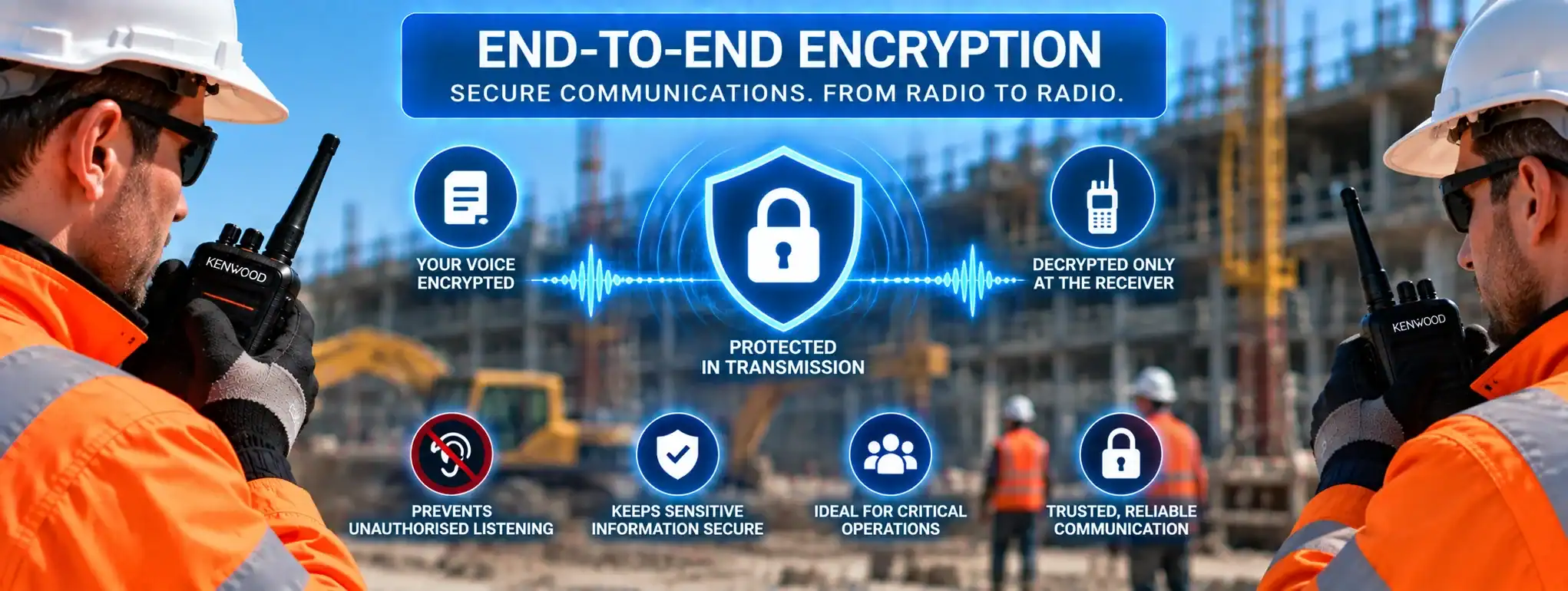
End-to-End Encryption
End-to-End EncryptionEncryption protects two-way radio communications by converting voice or data into a secure form that can only be understood by authorised radios with the correct encryption capability and keys. (E2EE) is a security method that protects the content of a communication from the point where it is sent until it reaches the intended receiving device. The communication is encrypted at the transmitting end and decrypted only by an authorised receiving endpoint.
In a two-way radio systemA Radio System is a complete communication solution comprising two-way radios and, where required, equipment such as repeaters, antennas, base stations, mobile radios and network infrastructure., End-to-End Encryption is designed so that the voice or data remains encrypted while travelling through the radio networkA Network is a connected system of radios, equipment and infrastructure that allows users to communicate across a defined area. Radio networks can range from simple radio-to-radio systems to large multi-site networks. and associated infrastructureRadio infrastructure is the equipment and supporting systems behind a professional two-way radio network, including repeaters, antennas, base stations, network connections, power systems and dispatch equipment.. This can provide a higher level of protection against unauthorised access to the content of communications.
End-to-End Encryption is particularly relevant where radio users need to protect sensitive operational, security or confidential information.
How does End-to-End Encryption work?
In a simplified E2EE radio system:
Radio A → Encryption → Radio Network → Encryption remains intact → Radio B → Decryption
The transmitting radio encrypts the voice or data before it enters the communication network.
The encrypted information can then pass through radio infrastructure such as repeaters or network connections without necessarily being decrypted by that infrastructure.
The receiving authorised radio decrypts the communication and converts it back into usable voice or data.
End-to-End Encryption vs Encryption
End-to-End Encryption is a specific form of encryption.
Encryption is the general process of protecting information so that unauthorised users cannot understand it.
End-to-End Encryption means that the communication remains protected between the intended endpoints, rather than being decrypted at an intermediate point in the communication path.
Therefore, a radio system can use encryption without necessarily providing end-to-end encryption.
Why is End-to-End Encryption important?
Radio transmissions can travel through multiple components before reaching the intended recipient.
These may include:
- Repeaters
- Radio networks
- IP connections
- Dispatch systems
- Control infrastructure
- Network servers
With an appropriately designed E2EE system, the communication remains encrypted while passing through the network.
This reduces the number of points at which the content needs to be exposed in an unencrypted form.
End-to-End Encryption in two-way radio
E2EE can be used to protect voice communications between authorised radio users.
For example, a security organisation could use encrypted communication between radios operating across a network.
The radio network can transport the encrypted communication while the authorised receiving radios handle decryption.
The exact architecture depends on the radio technology and manufacturer.
End-to-End Encryption and DMR
Some professional DMR (Digital Mobile RadioA Mobile Radio is a two-way radio designed to be installed in a vehicle. It normally uses the vehicle's power supply and an external antenna to provide reliable communication while travelling or working in the field.) systems can support encryption, including implementations designed to provide end-to-end protection.
However, encryption capabilities vary considerably between DMR manufacturers, radio models and system architectures.
The presence of an encryption feature does not automatically mean that a particular DMR system provides true end-to-end encryption.
The complete communication path and security architecture must be considered.
End-to-End Encryption and encryption keys
E2EE relies on cryptographic keys that allow authorised equipment to encrypt and decrypt communications.
The transmitting and receiving endpoints must have the appropriate security credentials or keys.
Effective key management is therefore an important part of an E2EE radio system.
Keys should be protected from unauthorised access and managed according to the organisation’s security procedures.
End-to-End Encryption and key management
A secure E2EE system requires more than simply installing encryption software.
Organisations may need procedures for:
- Creating encryption keys
- Distributing keys securely
- Updating keys
- Revoking compromised keys
- Managing lost radios
- Adding new radios
- Removing retired radios
- Controlling access to security credentials
Poor key management can undermine the protection provided by encryption.
End-to-End Encryption and repeaters
A repeaterA Repeater receives a two-way radio transmission and retransmits it, usually from an elevated location, to extend the coverage and reliability of a radio communication system. can be part of an E2EE radio network.
In an appropriately designed system, the repeater can relay encrypted traffic without needing access to the unencrypted voice content.
The repeater effectively transports the protected communication between the transmitting and receiving endpoints.
The precise operation depends on the radio system.
End-to-End Encryption and network infrastructure
Radio communications can be transported through different types of infrastructure.
For example:
Radio → Repeater → IP Network → Repeater → Radio
With E2EE, the voice or data can remain encrypted across the network between the endpoints.
This can be particularly important in larger systems where communications pass through multiple sites or network components.
End-to-End Encryption and dispatch systems
The relationship between E2EE and Dispatch systems depends on the architecture.
If a dispatch system needs to hear and process the content of an encrypted communication, it must be an authorised endpoint or have the appropriate security capabilities.
A system designed so that encryption remains entirely between individual radios may prevent unauthorised infrastructure from accessing the audio.
This distinction is important when designing an encrypted radio network.
End-to-End Encryption and cloud systems
Modern radio systems may use cloud-based infrastructure for management, dispatch and networking.
E2EE can potentially protect communications while they pass through cloud-connected infrastructure, depending on the system architecture.
However, not every cloud radio system that uses encryption provides E2EE.
The manufacturer or service provider should be able to explain where communications are encrypted and where they are decrypted.
End-to-End Encryption and individual calls
E2EE can be used for Individual Calls between specific authorised radios where supported.
The transmitting radio encrypts the communication and the intended receiving radio decrypts it.
This can be useful when particularly sensitive information needs to be communicated between specific personnel.
End-to-End Encryption and group calls
E2EE can also be used for authorised Group Calls.
Multiple radios participating in the group must have the necessary security configuration.
This allows a team to communicate securely while maintaining group communication.
The system must be capable of managing encryption for all authorised group members.
End-to-End Encryption and talkgroups
Encrypted Talkgroups can provide protected communications for defined teams.
For example:
- Security
- Management
- Operations
- Incident Response
An organisation can establish different security policies for different communication groups.
Whether those talkgroups use true end-to-end encryption depends on the underlying system architecture.
End-to-End Encryption and AES
AES (Advanced Encryption Standard) is a cryptographic standard used by some professional radio systems.
AES can be used as part of an E2EE implementation.
However, AES encryptionAES encryption protects digital two-way radio communications by converting voice or data into an encrypted form that can only be decrypted by compatible radios with the correct encryption key. by itself does not define whether a system is end-to-end encrypted.
The complete architecture determines where encryption begins, where decryption occurs and which infrastructure can access the plaintext communication.
End-to-End Encryption and AES-256
Some professional radio systems support AES-256 encryption.
AES-256 refers to the cryptographic key size used by the AES algorithm.
It can provide strong cryptographic protection when correctly implemented and managed.
However, the use of AES-256 alone does not prove that a communication system provides E2EE.
Key management, endpoint security and the handling of communications throughout the network are also important.
End-to-End Encryption and radio monitoring
E2EE is designed to prevent unauthorised listeners from understanding the content of protected communications.
A receiverA Receiver is the part of a two-way radio that detects and processes incoming radio signals, converting them into audible voice or usable data for the user. may still be able to detect or record the underlying radio transmissionTransmission is the process of sending voice, data or signalling from a radio using a radio-frequency signal to another radio, repeater or communication system., but without the appropriate security credentials the protected content should not be intelligible.
Encryption therefore protects the information being communicated rather than making the radio transmission itself invisible.
End-to-End Encryption and radio interception
Radio transmissions can potentially be detected by equipment within range.
E2EE is intended to prevent an unauthorised party from converting the intercepted protected data into the original voice or information.
The security of the communication therefore depends on the strength and correct implementation of the cryptographic system.
End-to-End Encryption and lost radios
A lost or stolen radio can represent a security risk if it contains encryption keys or other credentials.
Professional radio systems may provide mechanisms for changing or revoking credentials associated with a device.
Organisations using E2EE should have procedures for immediately dealing with lost, stolen or compromised equipment.
End-to-End Encryption and radio programming
Encryption configuration may form part of a radio’s CodeplugA Codeplug is the configuration data programmed into a two-way radio that defines its channels, frequencies, talkgroups, radio ID and other operating features. or separate security configuration.
The radios must be correctly configured to communicate with the intended encrypted groups or users.
Incorrect configuration can result in radios being unable to communicate even when they are otherwise compatible.
End-to-End Encryption and radio compatibility
Two radios supporting encryption are not necessarily compatible with one another.
Compatibility can depend on:
- Encryption algorithm
- Key format
- Key management
- Radio manufacturer
- Network architecture
- FirmwareFirmware is the software built into a two-way radio that controls its underlying operation, features and hardware. Manufacturers may release updates to improve performance, fix faults or add functionality.
- Communication mode
- Security configuration
This is particularly important when equipment from different manufacturers is being combined.
End-to-End Encryption and analogue radio
Traditional analogue radioAnalogue radio uses continuously varying radio signals to transmit voice communication. It remains widely used for reliable two-way communication across business, industry, events, security and other applications. generally does not provide modern cryptographic E2EE in the same way as advanced digital radio systems.
Some analogue systems have offered voice scrambling or other privacy features, but these should not automatically be considered equivalent to modern end-to-end cryptographic protection.
Where strong communication security is required, the actual technology and security architecture should be assessed.
End-to-End Encryption vs scrambling
Voice Scrambling and E2EE are not the same thing.
Scrambling can alter or disguise an audio signal so that it is more difficult to understand.
Modern E2EE uses cryptographic techniques designed to protect the underlying information from unauthorised access.
A feature described as “scrambling” should therefore not automatically be treated as equivalent to end-to-end encryption.
End-to-End Encryption and CTCSS or DCS
CTCSS and DCS are sometimes incorrectly described as privacy or security features.
They do not encrypt radio communications.
They are signalling techniques used for functions such as controlling which radios open their speakers in response to a transmission.
They provide no equivalent to E2EE.
End-to-End Encryption and emergency calls
Emergency communications can also be encrypted where the radio system supports encrypted emergency traffic.
However, emergency functionality and encryption must be configured together correctly.
The system must ensure that authorised emergency recipients can still receive and respond to the communication.
End-to-End Encryption and GPS
Some radio systems transmit GPS or other location information alongside voice communications.
Where sensitive location information is being transmitted, organisations should consider whether that data is also protected by the system’s encryption architecture.
The exact treatment of location information varies between radio systems.
End-to-End Encryption and voice recording
Digital Voice RecordingDigital Voice Recording records two-way radio communications as digital audio, allowing authorised users to replay and review conversations for monitoring, training, incident investigation or record keeping. can present a particular consideration in an E2EE system.
If a dispatch or recording system needs to record the content of encrypted communications, it must have an appropriate authorised position within the security architecture.
An E2EE design that prevents intermediate systems from decrypting communications may also prevent those systems from recording the unencrypted audio.
This should be considered when designing the system.
End-to-End Encryption and security operations
Security organisations can use E2EE to protect sensitive radio communications.
Examples may include:
- Security incidents
- Personnel movements
- Access information
- Incident response
- Sensitive operational details
The appropriate level of encryption depends on the sensitivity of the information and the organisation’s security requirements.
End-to-End Encryption for critical communications
Organisations operating critical infrastructure or other sensitive services may require strong protection for operational communications.
E2EE can form part of a wider communications-security strategy.
It should be considered alongside radio resilience, network availability, authentication, key management and physical security.
End-to-End Encryption and radio hire
Encrypted radio systems can be used for temporary operations where sensitive communications need protection.
Before deploying an encrypted hire system, the encryption capabilities of the radios, repeaters and any dispatch equipment should be confirmed.
All authorised radios must have compatible security configuration.
End-to-End Encryption limitations
E2EE protects the content of communications, but it does not solve every security problem.
It does not necessarily protect against:
- A compromised authorised radio
- Someone speaking sensitive information aloud
- Stolen equipment
- Poor key management
- Unauthorised users who have valid credentials
- Compromised dispatch endpoints
- Operational security failures
E2EE should therefore form part of a broader security strategy.
End-to-End Encryption and system design
When designing an E2EE radio system, it is important to establish:
- Which communications need protection
- Who should have access
- Where encryption begins
- Where decryption occurs
- How encryption keys are managed
- How lost radios are handled
- Whether repeaters can relay encrypted traffic
- Whether dispatch and recording systems need access
- How the system will be tested
These decisions should be made before equipment is selected and programmed.
End-to-End Encryption and DCS
DCS can advise on professional digital radio systems where secure communications are required.
Where the selected equipment supports it, encrypted communications can be incorporated into handheld radios, mobile radios, repeaters, dispatch systems and wider radio networks.
The appropriate security architecture depends on the sensitivity of the communications, the radio technology and the operational requirements.