
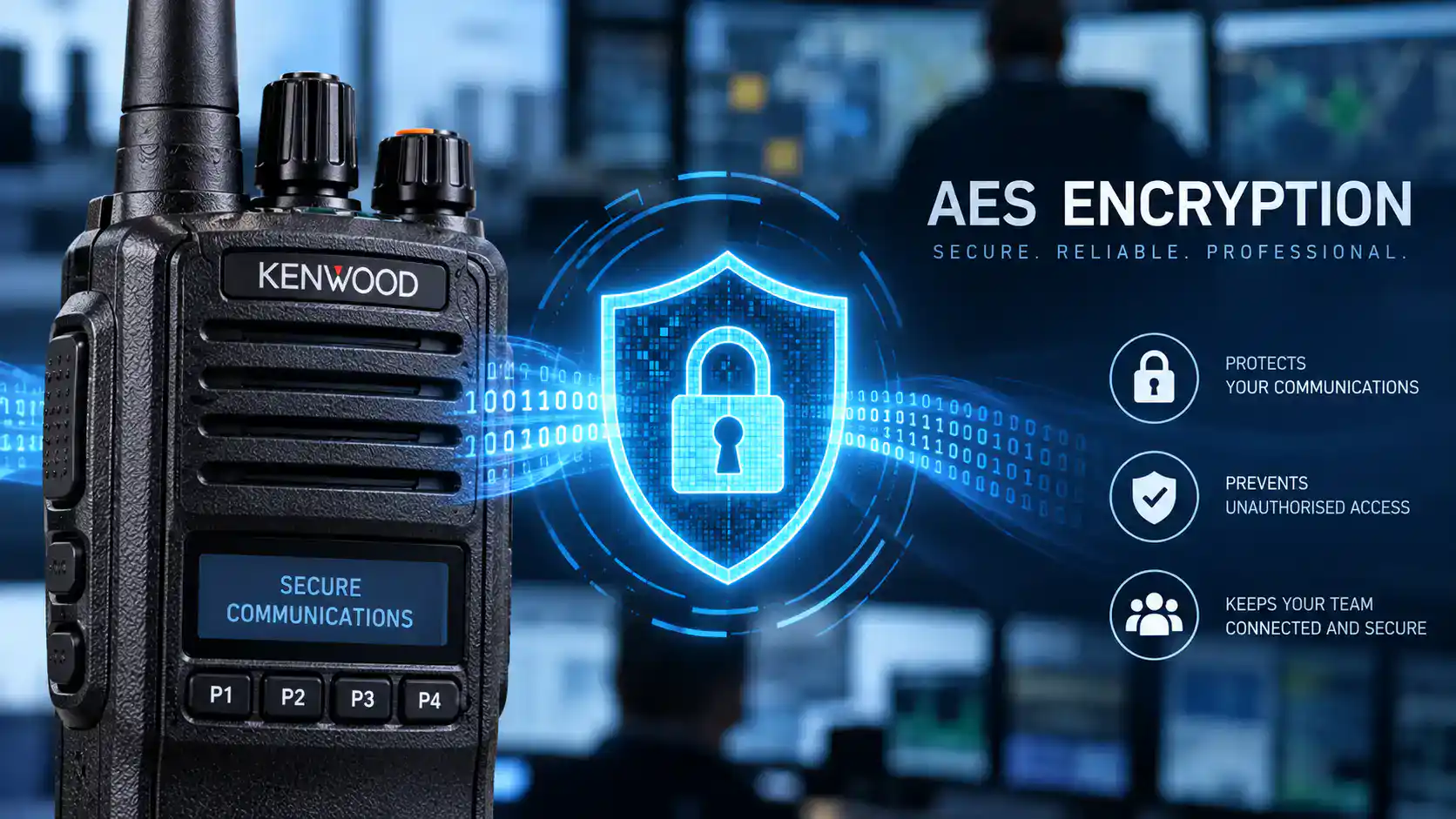
AES Encryption
AES encryptionEncryption protects two-way radio communications by converting voice or data into a secure form that can only be understood by authorised radios with the correct encryption capability and keys. is a method of protecting digital information by converting it into an encrypted form that cannot be understood without the appropriate encryption key. AES stands for Advanced Encryption Standard and is a widely used symmetric encryption standard for protecting sensitive data.
In two-way radio systems, AES encryption can be used to protect digital radio communications from unauthorised interception. When AES encryption is enabled, the voice or other information is encrypted before it is transmitted. A compatible receiving radio with the correct encryption key can then decrypt the transmissionTransmission is the process of sending voice, data or signalling from a radio using a radio-frequency signal to another radio, repeater or communication system. and reproduce the original communication.
How does AES encryption work?
AES uses a symmetric key system, meaning the same cryptographic key is used to encrypt and decrypt the information.
When a user speaks into a compatible digital two-way radio, the radio converts the audio into digital information and applies the encryption process before transmitting it. The receiving radio uses the appropriate key to decrypt the information so that the authorised user can hear the communication.
In simplified terms:
Voice → digital audio → AES encryption → radio transmission → AES decryption → voice
Without the appropriate key, the encrypted information cannot normally be interpreted as intelligible voice communication.
AES encryption in two-way radios
AES encryption is available on some professional digital two-way radio systems. It is generally intended for organisations that require a higher level of communication security than an unencrypted radio systemA Radio System is a complete communication solution comprising two-way radios and, where required, equipment such as repeaters, antennas, base stations, mobile radios and network infrastructure. provides.
Encryption capabilities vary between radio manufacturers, models and communication standards. Some radios may support different encryption options, while others may require specific hardware, software licences or configurations before encryption can be used.
The exact implementation should therefore be checked against the radio manufacturer’s specifications.
AES-128 and AES-256
AES is available with different key lengths, including AES-128 and AES-256.
The numbers refer to the length of the encryption key in bits. AES-256 uses a longer key than AES-128 and therefore provides a larger key space.
Both are established AES variants, but the availability of each option in a two-way radio system depends on the manufacturer and radio platform. A radio described simply as having “AES encryption” should not automatically be assumed to support every AES key length.
Encryption keys
An encryption key is the cryptographic information used by compatible radios to encrypt and decrypt communications.
For a group of radios to communicate using the same encrypted channelA two-way radio channel is a programmed set of communication settings, typically including frequency and signalling, that allows compatible radios to communicate with one another., the radios must generally be configured with compatible encryption settings and the appropriate key.
Encryption key management is therefore an important part of operating a secure radio system. Keys should be controlled carefully and only provided to authorised equipment and users.
If a radio is lost, stolen or removed from an organisation’s control, the potential security implications should be considered and the organisation’s key-management procedures followed.
AES encryption and radio security
AES encryption can significantly improve the confidentiality of radio communications, but it should not be regarded as the only part of a secure communication system.
Security also depends on factors such as:
- Proper encryption configuration
- Secure management of encryption keys
- Physical security of radio equipment
- User access controls
- Radio programming
- System administration
- Procedures for lost or stolen radios
Encryption protects the transmitted information, but it does not prevent someone from physically obtaining a radio or gaining access to information through other means.
AES encryption vs analogue radio
Traditional analogue two-way radio communication does not use AES encryption in the same way as a digital radio system.
AES is designed to encrypt digital information. Consequently, AES encryption is associated primarily with digital radio systems and other digital communication technologies.
Some analogue radios may offer signalling or scrambling features, but these should not automatically be described as equivalent to AES encryption. In particular, basic analogue privacy codes such as CTCSS and DCS do not encrypt a radio transmission.
AES encryption and digital radio
AES encryption is most relevant where a digital radio system is being used and there is a requirement to protect communications from unauthorised listening.
Digital radio platforms can combine encryption with other features such as individual calling, group calling, data communication and system management.
The exact security features available depend on the radio technology and system architecture being used.
Is AES encryption secure?
AES is a well-established modern encryption standard and is widely used to protect sensitive digital information.
However, the security of a real-world radio system depends on more than simply stating that it uses AES. Correct implementation, key management, equipment configuration and operational security are all important.
For organisations with sensitive communications, the encryption capabilities of the complete radio system should therefore be assessed rather than relying solely on the term “AES encrypted”.
AES encryption for business radio systems
AES encryption may be appropriate for organisations where radio communications contain commercially sensitive, operationally sensitive or otherwise confidential information.
Potential applications can include security operations, critical infrastructureRadio infrastructure is the equipment and supporting systems behind a professional two-way radio network, including repeaters, antennas, base stations, network connections, power systems and dispatch equipment., industrial sites, public-facing operations and organisations where unauthorised access to communications could present a risk.
Whether encryption is necessary depends on the nature of the communications and the organisation’s security requirements.
DCS can advise on the available radio options and help determine whether an encrypted digital radio system is appropriate for a particular application.
Need reliable communications for your next project or event? Our professional radio hire service provides the equipment and support your team needs.