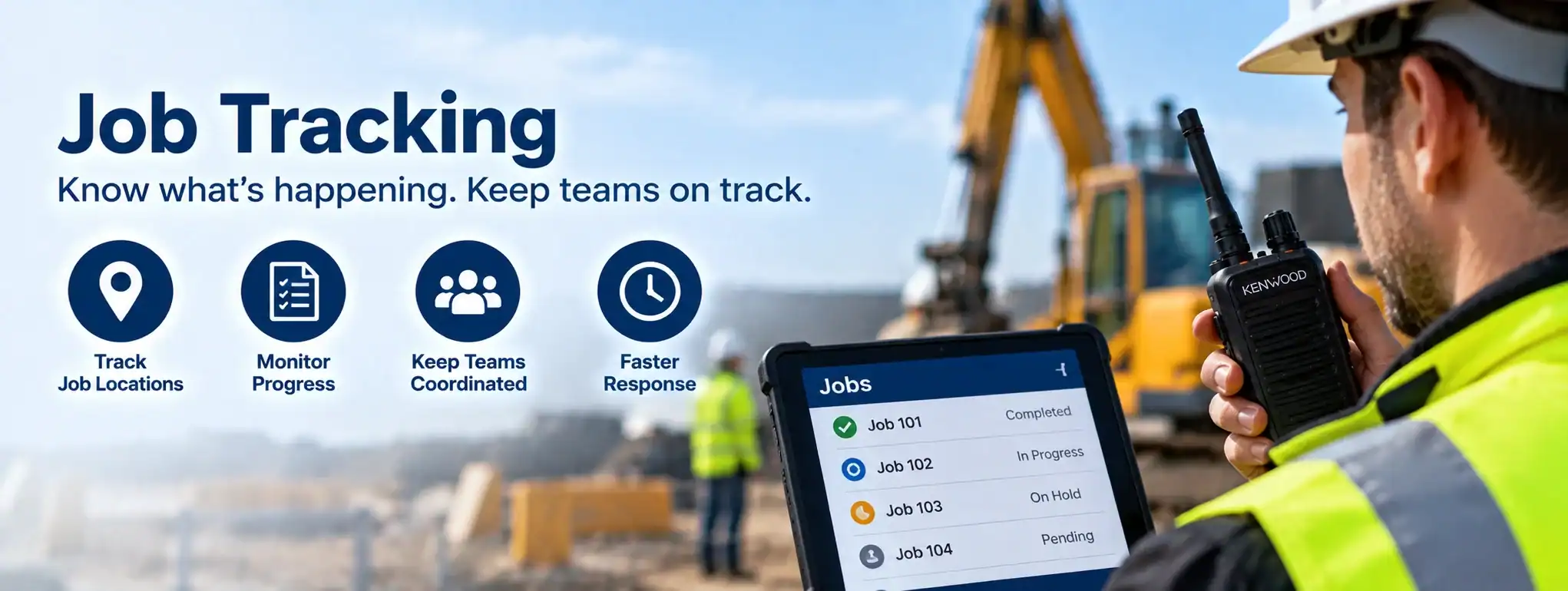
Job Tracking
Job Tracking is the process of monitoring the progress, location and status of a job or work assignment from the time it is created until it is completed.
In two-way radio operations, job tracking can combine radio communication with systems such as GPS, dispatch and job-management software. This can help organisations coordinate mobile workers, monitor work in progress and maintain a record of completed tasks.
Job tracking is commonly used in field service, facilities management, utilities, transport, security, construction and other industries where workers operate away from a central location.
What is job tracking?
Job tracking provides visibility of work as it progresses.
Depending on the system, it can show:
- Job assigned
- Worker assigned
- Worker location
- Job status
- Time of assignment
- Arrival time
- Work in progress
- Completion time
- Notes or updates
The exact information available depends on the job-management and communication systems being used.
Job tracking and two-way radios
Two-way radios provide immediate voice communication between mobile workers and operational teams.
When combined with job tracking, the radio can form part of a wider workflow:
Job created → Worker assigned → Radio communication → Job completed
This allows operational teams to communicate with workers while also maintaining information about the job itself.
Job tracking and GPS
GPS (Global Positioning System)GPS is a satellite-based positioning system that allows compatible two-way radios to determine their location. GPS data can support tracking, dispatch, fleet management and Geo-Fencing. can provide location information for compatible radios and mobile devices.
Where supported, a dispatcher may be able to see the approximate location of a worker while a job is being carried out.
For example:
Job location → Available worker → GPS location → Job assignment
Location tracking capabilities depend on the radio, networkA Network is a connected system of radios, equipment and infrastructure that allows users to communicate across a defined area. Radio networks can range from simple radio-to-radio systems to large multi-site networks. and software platform.
Job tracking and dispatch
A Dispatch system can combine job assignments with radio communications.
A dispatcher may be able to:
- Create or receive a job.
- Identify an appropriate worker.
- Contact the worker by radio.
- Assign the job.
- Monitor progress.
- Receive an update when the job is complete.
This can reduce the need to manage communications and job information through completely separate systems.
Job tracking and Job Tickets
A Job TicketA Job Ticket is a record of a specific task or work assignment. In radio operations, it can be used alongside dispatch and two-way communications to assign, manage and record field work. provides a record of a particular task or assignment.
Job tracking allows that ticket to be monitored as it progresses.
For example:
Job Ticket Created → Assigned → En Route → On Site → In Progress → Completed
This provides a structured record of the work.
Job tracking and job status
A tracking system can use different statuses to show the current stage of a job.
Common examples include:
- New
- Assigned
- Accepted
- En Route
- On Site
- In Progress
- Completed
- Cancelled
The available statuses depend on the software being used.
Job tracking and worker location
Location information can help operational teams understand where mobile workers are in relation to their assigned jobs.
For example, a dispatcher may be able to identify which available worker is closest to a particular job.
Location information should be used in accordance with the organisation’s policies and applicable privacy requirements.
Job tracking and fleet management
Fleet ManagementFleet Management is the process of managing a two-way radio fleet, including equipment, users, programming, maintenance, firmware, security and radio system configuration. systems can combine job information with vehicle and driver information.
This can allow an organisation to coordinate:
- Vehicles
- Drivers
- Field workers
- Jobs
- Locations
- Routes
- Radio communications
This is particularly useful for transport, logistics and field-service operations.
Job tracking and field service
Field-service organisations can use job tracking to manage engineers and technicians working at customer locations.
For example:
Customer request → Job created → Engineer assigned → Engineer travels to site → Work completed
Two-way radio communication can provide immediate contact between the field worker and the control team.
Job tracking and facilities management
Facilities-management teams can use job tracking to monitor maintenance tasks across buildingsAn antenna transmits and receives radio-frequency signals, allowing a two-way radio to communicate. Antenna type, frequency, height and location can all affect radio performance and coverage. or estates.
Examples include:
- Equipment repairs
- Inspections
- Maintenance requests
- Fault response
- Security issues
- Emergency work
A job can be assigned to a specific engineer or team and tracked through to completion.
Job tracking and utilities
Utility companies can use job tracking to coordinate field workers carrying out maintenance, inspections and repairs.
GPS and communication systems can help control teams understand where workers are operating and which jobs are currently in progress.
Job tracking and transport
Transport organisations can use job tracking to monitor tasks involving:
- Drivers
- Vehicles
- Deliveries
- Collections
- Depot operations
- Maintenance
- Inspections
Radio communication can provide a direct link between drivers and operational control.
Job tracking and security
Security teams can use job tracking to manage and record operational tasks such as:
- Patrols
- Alarm responses
- Access checks
- Incident response
- Site inspections
A control room can communicate with security personnel by radio while tracking the associated task.
Job tracking and construction
Construction companies can use job tracking to coordinate site teams, plant operators, engineers and contractors.
Tasks may include:
- Equipment inspections
- Maintenance
- Material movements
- Site checks
- Repairs
- Incident response
Two-way radios can provide immediate communication while the job-management system records the work.
Job tracking and events
Large events can involve many temporary tasks being allocated to different teams.
Job tracking can help coordinate:
- Security
- Maintenance
- Site operations
- Technical teams
- Cleaning
- Transport
- Event management
Radio communication allows teams to respond quickly while job information can be recorded separately or through an integrated system.
Job tracking and Cloud Dispatch
Cloud DispatchCloud Dispatch is a cloud-based radio management and communication system that allows authorised dispatchers to communicate with, monitor and manage two-way radio users through an internet-connected platform. can provide a central platform for radio communications and operational information.
Where supported, job information, radio users and GPS locations can be viewed through the same platform.
This can provide a single operational view for authorised dispatchers.
Job tracking and cloud management
Cloud ManagementCloud Management uses an online platform to remotely manage and monitor compatible two-way radios, users, devices and communication settings from a central location. can provide remote access to supported radio and communication systems.
Although cloud management and job tracking perform different functions, they can form part of the same wider communication and workforce-management environment.
Job tracking and messaging
Compatible radio systems may support text or data messaging.
Where available, job information can be sent electronically to a radio or connected device.
For example:
Dispatcher → Job details → Worker
This can reduce the amount of information that needs to be communicated verbally.
Job tracking and group calls
Some jobs require several workers to coordinate their activities.
A Call GroupA Call Group is a predefined group of two-way radio users who can communicate with each other through a shared channel or talkgroup without transmitting to every radio on the system. or talkgroup can allow the dispatcher to communicate with multiple workers simultaneously.
This can be particularly useful when several people are assigned to the same task.
Job tracking and emergency work
Job tracking can help organisations manage urgent tasks.
For example:
Emergency request → Job created → Priority assigned → Worker contacted → Response tracked → Job closed
A compatible radio systemA Radio System is a complete communication solution comprising two-way radios and, where required, equipment such as repeaters, antennas, base stations, mobile radios and network infrastructure. can also provide emergency communication features alongside the job-management process.
Job tracking and Incident Management
Job tracking can form part of an Incident ManagementIncident Management is the process of coordinating people, communications and resources during an incident. Two-way radios can provide rapid communication between teams, control rooms and responders. workflow.
An incident can be recorded, assigned to a worker and tracked until the situation has been resolved.
For example:
Incident → Job Ticket → Assignment → Response → Resolution
This creates a structured record of the response.
Job tracking and lone workers
Job tracking can be useful for organisations with Lone WorkerA Lone Worker is someone who works without direct supervision or immediate assistance nearby. Compatible two-way radios can provide safety features such as timed check-ins, emergency alerts and GPS location. operations.
A control centre can know which worker has been assigned to a particular task and, where GPS is available, their approximate location.
Compatible radio systems may also provide additional safety features such as emergency alerts or man-down functionality.
Job tracking should form part of a wider lone-worker procedure rather than being relied upon as the sole safety measure.
Job tracking and emergency alerts
Where a radio supports an Emergency ButtonAn Emergency Button is a dedicated two-way radio control that allows users to quickly send an emergency alert to a dispatcher, control room or authorised radio users. or Emergency AlarmAn Emergency Alarm allows a two-way radio user to quickly alert a dispatcher, control room or other authorised users that assistance may be required., an emergency event can potentially be associated with the worker or job being monitored.
This can help an operations team understand who has raised an alert and where they were located, subject to the capabilities of the system.
Job tracking and geo-fencing
Geo-FencingGeo-Fencing uses GPS and a virtual geographical boundary to identify when a radio user or tracked device enters or leaves a defined area, triggering alerts or other actions where supported. can be used alongside GPS-based job tracking.
A system can define geographical areas and use location information to identify when a compatible device enters or leaves those areas.
This can potentially support operational alerts or automated workflows.
The exact functionality depends on the software platform.
Job tracking and call recording
Call RecordingCall Recording is a two-way radio feature or system function that captures and stores radio communications for later playback, review, incident investigation or record keeping. can provide a record of radio conversations associated with operational work.
This can be useful when reviewing how a job was assigned, communicated or completed.
Call recording and job tracking are separate functions, although they can be integrated in some systems.
Job tracking and time records
Job tracking can record important timestamps such as:
- Job created
- Job assigned
- Worker accepted
- Worker dispatched
- Worker arrived
- Work started
- Work completed
This can help organisations understand response times and operational performance.
Job tracking and proof of completion
A completed job can be recorded with information such as:
- Completion time
- Worker
- Location
- Notes
- Work carried out
- Customer confirmation
Some systems may also support photographs, signatures or other supporting information.
Job tracking and reporting
Historical job information can be used to produce operational reports.
Reports may show:
- Number of jobs
- Completion rates
- Response times
- Outstanding work
- Worker activity
- Location information
- Job priorities
This can help organisations identify operational trends and areas for improvement.
Job tracking and automation
Modern systems can automate parts of the job-tracking process.
For example, a system may automatically:
- Assign jobs
- Update statuses
- Send notifications
- Record timestamps
- Generate alerts
- Escalate overdue work
The available functionality depends on the software platform.
Job tracking and interoperability
InteroperabilityInteroperability is the ability of different communication systems, devices or organisations to work together and exchange information. In two-way radio, it can connect different radio networks, technologies or users through compatible systems or gateways. can allow job-management systems to work alongside different communication technologies.
For example:
Job Management System → Dispatch Platform → Radio Network → Field Worker
Where appropriate interfaces are available, users operating different communication systems may be included within the same operational workflow.
Job tracking and hybrid communication
Hybrid CommunicationHybrid Communication combines two or more communication technologies, such as two-way radio, DMR, cellular, Wi-Fi or IP networks, allowing different systems or users to communicate through a common platform. can combine two-way radio with cellular, Wi-FiWi-Fi is a wireless networking technology that connects compatible devices to a local or wider network. In radio systems, it can support programming, updates, data services and IP-based communications. and cloud-based communication.
This can allow job information and communications to reach workers using different devices or networks.
For example:
Radio user + smartphone user + control room
The exact capabilities depend on the communication platform.
Job tracking and radio hire
Job tracking can also be used during temporary Radio HireRadio Hire is the temporary rental of two-way radios and related communication equipment for events, projects and operational requirements, providing professional communication without purchasing the equipment. operations.
For example, an event organiser could allocate tasks to security or operations teams while using hired radios for immediate communication.
The job-management system can track the work while the radio network provides voice communication.
Job tracking and radio coverage
GPS-based job tracking depends on the communication system being able to transmit location information.
Poor radio or network coverageRadio Coverage is the geographical area in which a two-way radio system can provide reliable communication. Coverage depends on the radios, antennas, frequency, terrain, buildings and system infrastructure. can affect the availability or timeliness of tracking information.
Coverage should therefore be considered when designing a tracking system.
Job tracking and network connectivity
Modern tracking systems may depend on cellular, Wi-Fi or other IP connectivity.
If a device temporarily loses network connectivity, location or job updates may be delayed until the connection is restored.
The behaviour during network loss depends on the specific system.
Job tracking and privacy
Location-based job tracking can involve information about individual workers.
Organisations should ensure that tracking is used appropriately and that workers understand how location information is collected and used.
The relevant privacy and data-protection requirements should be considered when implementing a tracking system.
Job tracking and data security
Job-tracking systems may contain operational and customer information.
Security measures can include:
- User authentication
- Access controls
- Secure communications
- Data protection
- Account management
- Audit records
The appropriate security arrangements depend on the system and information being processed.
Job tracking limitations
Job tracking does not automatically provide complete visibility of every worker or job.
Its effectiveness depends on:
- GPS availability
- Network connectivity
- Radio coverage
- Device compatibility
- Software integration
- User behaviour
- System configuration
Location information can also have limitations in buildings, underground areas and other environments where GPS signals are weak or unavailable.
Job tracking and system design
A professional job-tracking system should be designed around the complete operational workflow.
For example:
Job Request → Job Ticket → Dispatcher → Radio / Mobile Worker → GPS → Job Update → Completion Record
This ensures that communication, location and job information work together rather than operating as isolated systems.
Job tracking and DCS
DCS can help organisations use professional two-way radio alongside wider dispatch, GPS and job-management systems.
For businesses managing field teams, security personnel, maintenance workers or mobile operations, job tracking can provide greater visibility of work while two-way radio provides immediate communication between workers and operational control.
The appropriate solution depends on the organisation’s workflow, radio system, coverage requirements and software integration.
If you’re planning a temporary operation or large event, radio hire for businesses provides a practical alternative to purchasing equipment.