Job Ticket
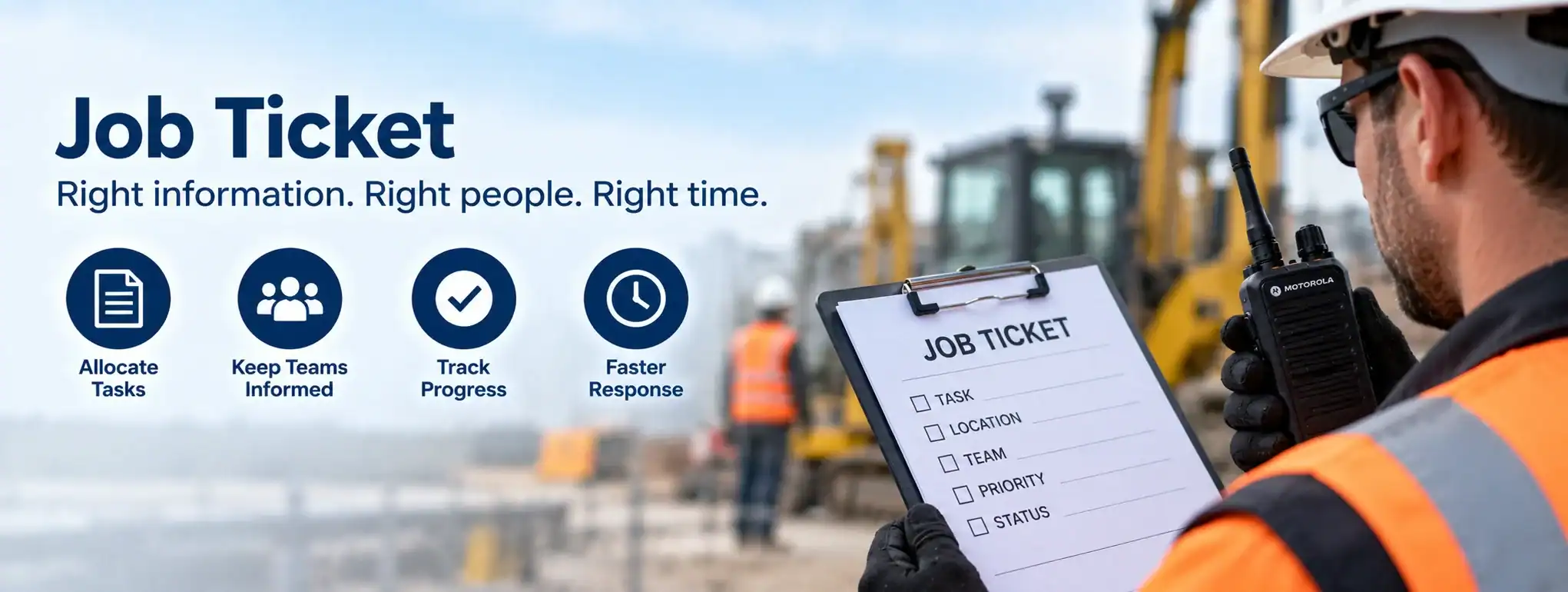
A Job Ticket is a record containing the details of a specific job, task or work assignment. In two-way radio operations, job tickets can be used to provide field workers with information about the work they need to complete and to record progress or completion.
Job tickets are commonly used in industries such as facilities management, maintenance, utilities, transport, security and field service operations.
What is a job ticket?
A job ticket provides a structured record of work that needs to be carried out.
Depending on the system, it may include:
- Job reference
- Location
- Description of the work
- Priority
- Assigned worker or team
- Required equipment
- Customer information
- Status
- Completion details
- Notes
- Time and date
Digital job-ticket systems can allow this information to be created, assigned and updated electronically.
Job tickets and two-way radios
Two-way radios can provide the communication link between workers in the field and a control room or dispatcher managing job tickets.
For example:
Control Room → Job Ticket → Field Worker → Radio Communication → Job Completed
A dispatcher can assign work to a radio user or team and use the radio systemA Radio System is a complete communication solution comprising two-way radios and, where required, equipment such as repeaters, antennas, base stations, mobile radios and network infrastructure. to communicate additional instructions.
Job tickets and dispatch
A Dispatch system can combine radio communication with job management.
A dispatcher may be able to:
- Create a job
- Assign a job
- Contact the assigned worker
- Track progress
- Update job status
- Receive completion information
This can reduce the need for separate communication and job-management processes.
Job tickets and field workers
Field workers can receive job information before travelling to a location.
Depending on the system, the worker may receive:
- Job location
- Work description
- Priority
- Customer details
- Access information
- Required equipment
- Completion instructions
The worker can then use the radio or connected device to communicate with the control room.
Job tickets and radio messaging
Some modern radio systems support text or data messaging.
Where supported, job-related information can be sent electronically rather than communicated entirely by voice.
For example:
Dispatcher → Job details → Radio / Mobile Device → Worker
The exact functionality depends on the radio system and connected software.
Job tickets and GPS
GPS can add location information to a job-ticket workflow.
A compatible system may allow a dispatcher to see the approximate location of a field worker and assign jobs based on operational requirements.
For example:
Job location → Dispatcher → Nearest available worker
Location functionality depends on the radio, networkA Network is a connected system of radios, equipment and infrastructure that allows users to communicate across a defined area. Radio networks can range from simple radio-to-radio systems to large multi-site networks. and software platform.
Job tickets and fleet management
Fleet ManagementFleet Management is the process of managing a two-way radio fleet, including equipment, users, programming, maintenance, firmware, security and radio system configuration. systems can combine vehicle or workforce information with job assignments.
For example, a transport or service organisation may use the system to coordinate:
- Vehicles
- Drivers
- Field workers
- Locations
- Job status
- Radio communications
This can provide a more complete view of ongoing operations.
Job tickets and incident management
Job tickets can form part of an Incident ManagementIncident Management is the process of coordinating people, communications and resources during an incident. Two-way radios can provide rapid communication between teams, control rooms and responders. system.
A reported problem can become a job ticket that is assigned to an appropriate worker or team.
For example:
Incident reported → Job ticket created → Worker assigned → Work completed → Ticket closed
Radio communication can be used throughout the process.
Job tickets and status updates
A job ticket can have different statuses, such as:
- New
- Assigned
- Accepted
- En route
- On site
- In progress
- Completed
- Cancelled
The available statuses depend on the job-management system.
Job tickets and priority
Jobs can be assigned different priority levels.
For example:
Emergency → High → Normal → Low
A dispatcher can use priority information when deciding which worker or team should receive a particular assignment.
Job tickets and emergency work
Urgent jobs can be communicated quickly using a combination of job-ticket software and two-way radio.
For example:
Emergency request → Control room → Job ticket → Radio alert → Field worker
Where the radio system supports emergency functions, an emergency alert can also be raised independently of the job-ticket system.
Job tickets and call groups
A job may need to be communicated to an entire team rather than an individual worker.
A Call GroupA Call Group is a predefined group of two-way radio users who can communicate with each other through a shared channel or talkgroup without transmitting to every radio on the system. or talkgroup can allow the dispatcher to communicate with multiple workers at once.
This can be useful when several workers are assigned to the same job.
Job tickets and cloud systems
Cloud-based job management can allow authorised staff to access job information from different locations.
A cloud platform can potentially connect:
- Control rooms
- Field workers
- Dispatchers
- Mobile devices
- Radio systems
This can be particularly useful for organisations with geographically distributed workers.
Job tickets and Cloud Dispatch
Cloud DispatchCloud Dispatch is a cloud-based radio management and communication system that allows authorised dispatchers to communicate with, monitor and manage two-way radio users through an internet-connected platform. can provide a central platform for managing radio communications while also connecting with other operational systems.
Where supported, job-ticket information can be presented alongside radio communications, GPS and other operational information.
The exact integration depends on the software platforms involved.
Job tickets and radio hire
Job tickets can also be relevant to temporary Radio HireRadio Hire is the temporary rental of two-way radios and related communication equipment for events, projects and operational requirements, providing professional communication without purchasing the equipment. operations.
For example, a temporary event or construction project may use job assignments to coordinate:
- Security teams
- Maintenance workers
- Site teams
- Event staff
- Technical crews
Two-way radios can provide immediate voice communication while job information is managed separately or through an integrated system.
Job tickets in facilities management
Facilities-management teams can use job tickets to allocate maintenance tasks.
For example:
Fault reported → Job ticket created → Engineer assigned → Engineer contacted by radio → Job completed
This can help coordinate engineers working across a large building or estate.
Job tickets in utilities
Utility companies can use job tickets to coordinate field work such as maintenance, inspections and repairs.
Radio communication can allow field teams to maintain contact with control centres while carrying out assigned work.
Job tickets in transport
Transport organisations can use job tickets to manage tasks involving:
- Drivers
- Vehicles
- Maintenance
- Depot operations
- Deliveries
- Inspections
Radio communication can provide a direct link between drivers and operational control.
Job tickets in security
Security organisations can use job tickets to record and assign tasks such as:
- Patrols
- Incident response
- Access checks
- Alarm investigations
- Maintenance requests
Security staff can use two-way radios to communicate with control rooms while carrying out assigned work.
Job tickets in construction
Construction sites can use job tickets to allocate tasks to:
- Plant operators
- Maintenance teams
- Site staff
- Contractors
- Engineers
Two-way radios provide immediate communication between workers and site management.
Job tickets and proof of completion
A job ticket can provide a record that a task has been completed.
Depending on the system, completion information may include:
- Completion time
- Worker
- Location
- Notes
- Status
- Photos
- Customer confirmation
This can provide an audit trail for completed work.
Job tickets and call recording
Where radio communications are recorded, Call RecordingCall Recording is a two-way radio feature or system function that captures and stores radio communications for later playback, review, incident investigation or record keeping. can provide an additional record of conversations relating to job assignments.
This can be useful where organisations need to review operational communications.
Recording requirements should be considered separately from the job-ticket system.
Job tickets and interoperability
Where an organisation uses multiple communication systems, InteroperabilityInteroperability is the ability of different communication systems, devices or organisations to work together and exchange information. In two-way radio, it can connect different radio networks, technologies or users through compatible systems or gateways. can allow job-related communications to reach users on different platforms where suitable integration is available.
For example:
Job Management System → Dispatch Platform → Radio Network → Field Worker
The specific integration depends on the systems involved.
Job tickets and automation
Modern job-management platforms can automate parts of the assignment process.
For example, a system may automatically assign a job based on:
- Worker availability
- Location
- Skills
- Priority
- Workload
Automation can reduce manual administration, although the available functionality depends on the platform.
Job tickets and lone workers
Job-ticket systems can be useful when managing Lone WorkerA Lone Worker is someone who works without direct supervision or immediate assistance nearby. Compatible two-way radios can provide safety features such as timed check-ins, emergency alerts and GPS location. operations.
A control centre can know which worker has been assigned to a particular job and where the work is expected to take place.
A compatible radio system can provide additional safety functions such as emergency alerts or man-down detection.
Job tickets and compliance
Job tickets can provide a documented record of work undertaken.
Depending on the industry, records may be useful for:
- Maintenance history
- Service records
- Auditing
- Incident investigations
- Customer records
- Operational reporting
The specific information retained should reflect the organisation’s requirements.
Job tickets and radio system design
When job-ticket functionality is required alongside two-way radios, the complete workflow should be considered.
For example:
Job Management → Dispatch → Radio Network → Worker → Job Completion → System Update
This ensures that the radio system supports the operational process rather than operating as a completely separate communication channelA two-way radio channel is a programmed set of communication settings, typically including frequency and signalling, that allows compatible radios to communicate with one another..
Job tickets vs work orders
A Job Ticket and a Work Order can describe similar processes, although terminology varies between industries and software platforms.
A job ticket generally records a specific task or assignment, while a work order may contain more formal instructions, authorisation or maintenance information.
The exact distinction depends on the organisation and software being used.
Job tickets and DCS
DCS can help organisations integrate two-way radio communications into wider operational workflows where appropriate.
For businesses managing field teams, maintenance staff, security personnel or other mobile workers, radio communication can complement job-ticket and dispatch systems by providing immediate contact between workers and operational control.
The exact integration depends on the radio system, software and operational requirements.