
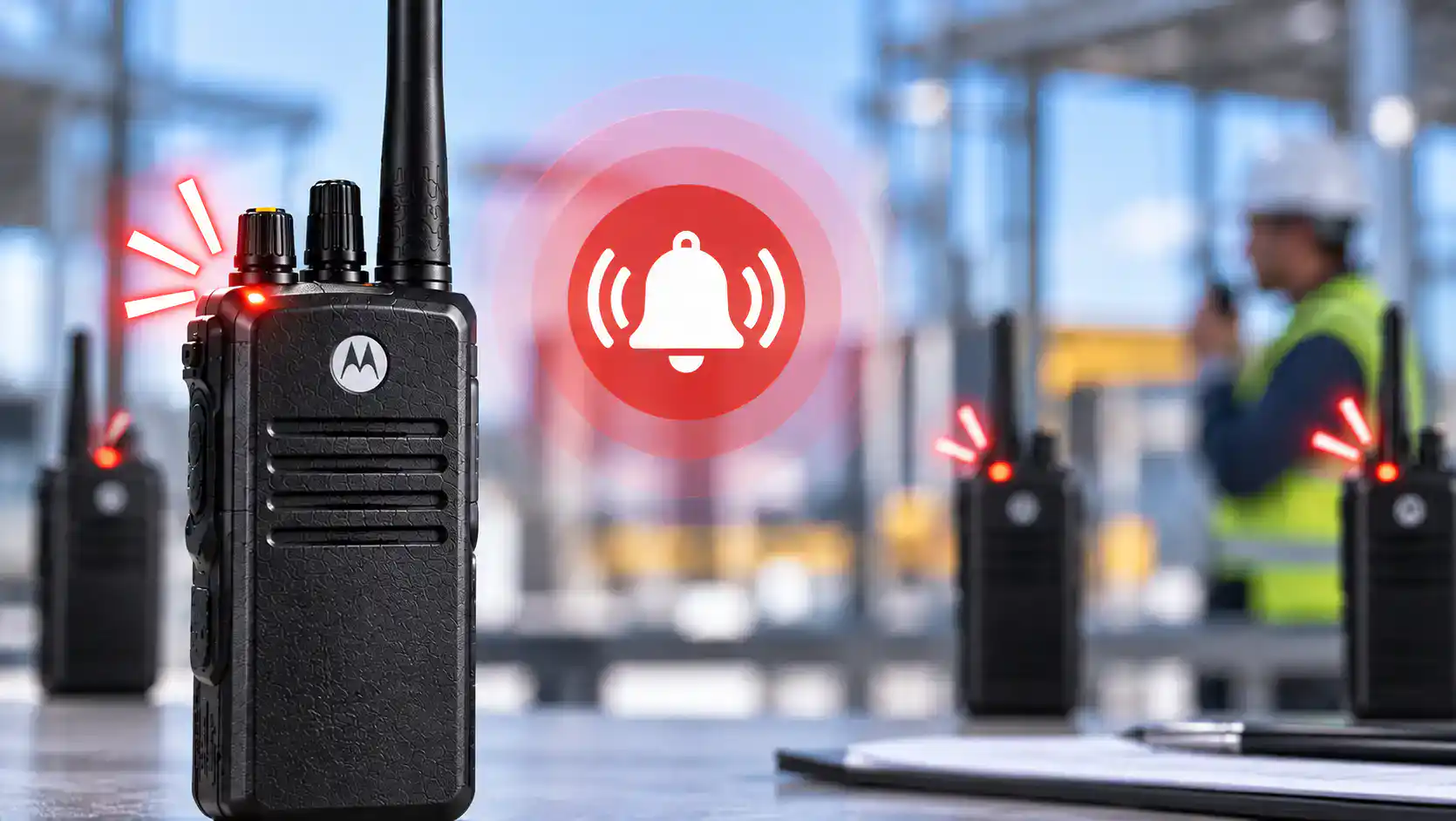
Call Alert
Call Alert is a two-way radio feature that allows one radio user to send a notification to another radio, requesting their attention without immediately opening a voice conversation.
When a Call Alert is received, the target radio normally provides an audible tone, visual indication or vibration to notify the user that another radio user is trying to contact them. The recipient can then respond using the appropriate call or push-to-talk function.
Call Alert can be particularly useful when a user needs to attract another person’s attention but does not need to interrupt an ongoing conversation or broadcast a voice message across the radio channelA two-way radio channel is a programmed set of communication settings, typically including frequency and signalling, that allows compatible radios to communicate with one another..
How does Call Alert work?
A Call Alert is normally initiated by selecting another radio or radio ID from the sending radio’s contact list and choosing the Call Alert function.
The sending radio transmits a signalling message identifying the intended recipient.
The receiving radio recognises the message and alerts its user.
A typical sequence is:
Radio A → Call Alert → Radio B → notification to user
The exact procedure varies according to the radio manufacturer, radio technology and system configuration.
What happens when a Call Alert is received?
The receiving radio may provide one or more indications that a Call Alert has been received.
Depending on the equipment, this can include:
- An audible alert tone
- A visual notification
- A flashing display or indicator
- Vibration
- A message identifying the calling radio
The user can then decide whether to respond.
The precise notification method depends on the radio model and how it has been programmed.
Call Alert vs a voice call
A Call Alert is different from making a normal voice call.
A voice call establishes a voice communication between users, allowing them to speak to one another.
A Call Alert is primarily a notification that another user wants their attention.
This can be useful where the recipient is temporarily unavailable or where the sender does not want to interrupt an existing conversation.
Call Alert in digital two-way radio
Call Alert is commonly associated with professional digital radio systems.
Digital technologies such as DMR can support individual signalling and calling functions that allow one radio to address another specific radio rather than transmitting to everyone on a channel.
Depending on the radio systemA Radio System is a complete communication solution comprising two-way radios and, where required, equipment such as repeaters, antennas, base stations, mobile radios and network infrastructure., Call Alert may form part of a wider set of individual communication functions, including:
- Individual calls
- Group calls
- Text messages
- Status messages
- Emergency alerts
The terminology and available features vary between manufacturers.
Call Alert and radio identification
Call Alert normally relies on individual radio identification.
In a digital radio system, each radio can have an assigned identity or ID. This allows the system to direct the alert to a particular radio rather than simply broadcasting it to every radio using the channel.
This is one of the advantages of digital radio systems over simple analogue voice communication.
Call Alert and group communications
Call Alert is generally intended to notify an individual radio user rather than an entire group.
For example, a supervisor could send a Call Alert to a particular member of their team who needs to make contact.
If the message needs to reach an entire team, a group call or other group communication function may be more appropriate.
The available options depend on the radio system.
Call Alert and two-way radio channels
A Call Alert does not necessarily work in the same way as a voice transmissionTransmission is the process of sending voice, data or signalling from a radio using a radio-frequency signal to another radio, repeater or communication system..
The radio system uses signalling to identify the intended recipient and deliver the notification.
On a digital radio networkA Network is a connected system of radios, equipment and infrastructure that allows users to communicate across a defined area. Radio networks can range from simple radio-to-radio systems to large multi-site networks., this signalling can form part of the digital communication protocol. On some systems, the alert may use the radio system’s control or signalling capabilities rather than opening a normal voice transmission.
The precise operation depends on the technology and system configuration.
Call Alert and DMR
DMR (Digital Mobile RadioA Mobile Radio is a two-way radio designed to be installed in a vehicle. It normally uses the vehicle's power supply and an external antenna to provide reliable communication while travelling or working in the field.) supports a range of individual and group communication functions.
On compatible DMR equipment, a Call Alert can be directed to a specific radio using its programmed radio ID.
This allows a user to request another user’s attention without making a general call to everyone sharing the channel.
The actual Call Alert functionality available depends on the DMR radio manufacturer, model and system configuration.
Call Alert in professional radio systems
Call Alert can be useful in organisations where users need to communicate with specific colleagues throughout the working day.
Typical applications include:
- Security teams
- Construction sites
- Manufacturing
- Warehouses
- Hotels
- Facilities management
- Transport operations
- Events
For example, a control-room operator could send a Call Alert to a particular security officer and wait for them to respond rather than repeatedly transmitting a voice message over a shared channel.
Call Alert and control rooms
Call Alert can be particularly useful where a radio system includes a control station or dispatcher.
A dispatcher can use the function to attract the attention of an individual radio user.
This can be useful when the dispatcher needs to establish contact but does not want to broadcast a voice message to an entire group.
More advanced radio systems may provide additional dispatcher functions, such as individual calls, group calls, emergency alerts and status monitoring.
Call Alert and radio hire
Call Alert can be available on compatible professional digital radios supplied for hire.
Where a temporary radio system has been programmed with individual radio IDs and supported digital features, users may be able to send alerts directly to specific members of the team.
This can be particularly useful for events, security operations and other activities where a control point needs to contact individual staff members.
The availability of Call Alert depends on the radio equipment and the configuration of the hired system.
Call Alert and emergency functions
Call Alert should not normally be confused with an Emergency Alert.
A Call Alert is generally intended to request another user’s attention.
An emergency function is designed to indicate that urgent assistance is required and may have priority over normal communications.
Professional radio systems can provide both functions, but they serve different purposes and should be configured accordingly.
Call Alert and radio programming
Call Alert is normally configured through the radio’s programming and system settings.
The radios need to be configured so that individual users can be identified and the appropriate signalling functions are available.
On larger systems, the radio IDs, contact lists, talkgroups and other settings may all need to be programmed correctly.
This is why professional radio programming should be carried out according to the manufacturer’s specifications and the requirements of the communication system.
Call Alert limitations
Call Alert is dependent on the radio system supporting the function and on the receiving radio being able to receive the relevant signalling.
If the receiving radio is switched off, outside the coverageRadio Coverage is the geographical area in which a two-way radio system can provide reliable communication. Coverage depends on the radios, antennas, frequency, terrain, buildings and system infrastructure. area or not correctly configured, the alert may not be received.
Call Alert therefore does not guarantee that the recipient has seen or acted upon the notification.
For urgent situations, a dedicated emergency communication function may be more appropriate.
Call Alert and DCS
Call Alert can form part of a wider professional two-way radio system where users need both group communications and the ability to contact individuals directly.
DCS can advise on compatible digital radio equipment and programming requirements where features such as individual calling, Call Alert, group calling and emergency functions are required.