
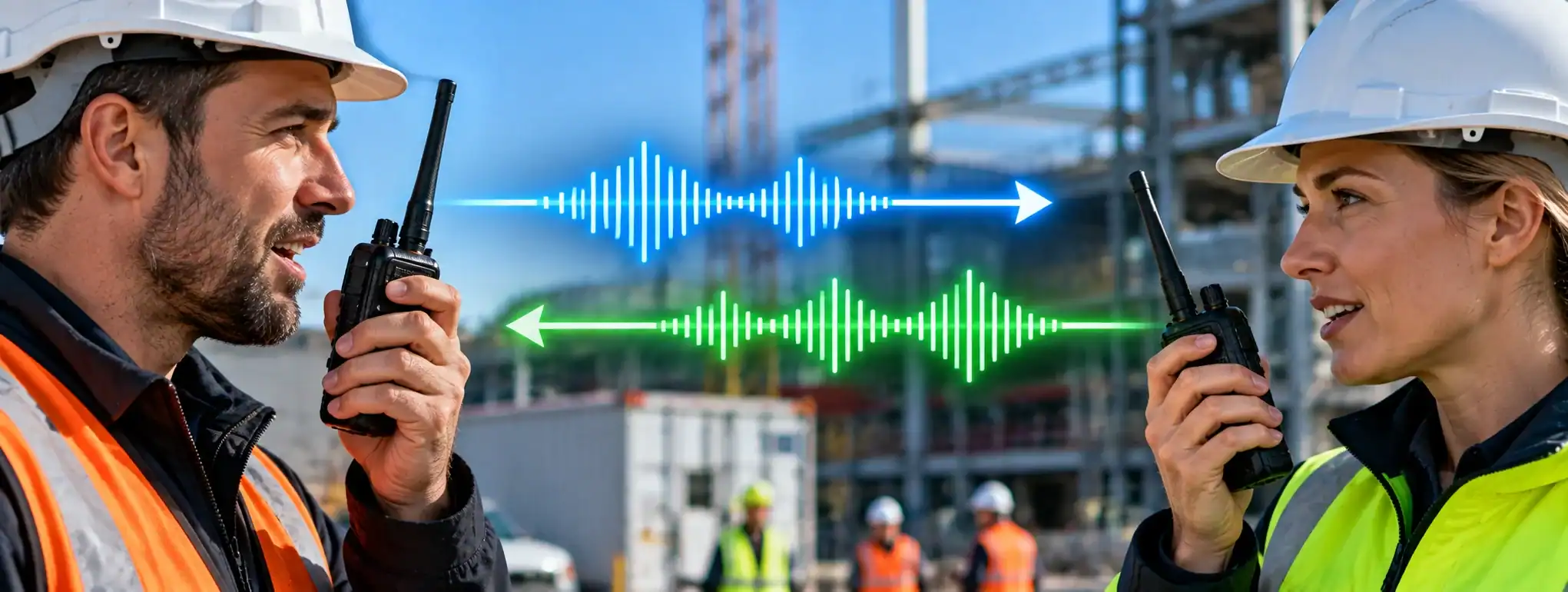
Full Duplex
Full Duplexduplex, duplex radio, duplex communication, duplex frequencies, duplex operation, duplex spacing, frequency offset, repeater duplex, duplex repeater, full duplex, half duplex, radio repeater is a method of radio communication in which two-way communication can take place simultaneously, allowing both parties to transmit and receive at the same time.
Unlike conventional two-way radio communication, where users normally take turns transmitting and receiving, Full Duplex allows both sides of a conversation to speak and listen simultaneously, in a similar way to a telephone call.
Full Duplex operation requires suitable radio equipment, frequencyAn antenna transmits and receives radio-frequency signals, allowing a two-way radio to communicate. Antenna type, frequency, height and location can all affect radio performance and coverage. arrangements and networkA Network is a connected system of radios, equipment and infrastructure that allows users to communicate across a defined area. Radio networks can range from simple radio-to-radio systems to large multi-site networks. infrastructureRadio infrastructure is the equipment and supporting systems behind a professional two-way radio network, including repeaters, antennas, base stations, network connections, power systems and dispatch equipment.. It is different from the SimplexSimplex is a method of two-way radio communication where radios transmit and receive on the same frequency, communicating directly without a repeater. and Half Duplex communication methods commonly used by professional two-way radios.
How does Full Duplex work?
In a Full Duplex system, separate communication paths are used for transmitting and receiving.
A simplified example is:
User A transmits → User B receives
while simultaneously:
User B transmits → User A receives
The two directions operate at the same time without the users having to release the communication before the other person can respond.
Full Duplex vs Simplex
Simplex communication uses the same frequencyFrequency is the number of cycles a radio wave completes each second, measured in Hertz. In two-way radio, frequency determines where a transmission operates within the radio spectrum. for transmitting and receiving.
Users take turns speaking. When one radio transmits, the other radios listen.
This is the traditional Push-to-Talk operation used by many two-way radio systems.
Full Duplex, by comparison, allows both sides to transmit and receive simultaneously.
Full Duplex vs Half Duplex
Half Duplex allows communication in both directions, but not simultaneously.
A typical professional two-way radio operates in this way:
User A speaks → User B listens → User A releases PTT → User B speaks
Full Duplex removes this requirement to take turns.
Both parties can transmit and receive at the same time.
Full Duplex and two-way radios
Most conventional handheld professional two-way radios are designed primarily for Push-to-Talk, turn-taking communication rather than telephone-style Full Duplex conversations.
However, some radio systems and specialist equipment can provide Full Duplex functionality.
The availability of Full Duplex depends on the radio technology, equipment and network architecture.
Full Duplex and frequencies
Full Duplex generally requires separate transmit and receive paths.
A radio may therefore transmit on one frequency while receiving on another.
This is commonly associated with Duplex radio systems.
The separation between the transmit and receive frequencies is known as the Frequency Offset or duplex spacing.
Full Duplex and repeaters
A RepeaterA Repeater receives a two-way radio transmission and retransmits it, usually from an elevated location, to extend the coverage and reliability of a radio communication system. can provide the infrastructure needed for certain duplex communication arrangements.
In a conventional repeater system, the radio transmits to the repeater on one frequency while receiving the repeater’s retransmission on another.
However, a standard repeater arrangement does not automatically mean that users have Full Duplex conversations.
Many repeater-based professional radio systems still operate using Push-to-Talk and require users to take turns speaking.
Full Duplex and DMR
DMR (Digital Mobile RadioA Mobile Radio is a two-way radio designed to be installed in a vehicle. It normally uses the vehicle's power supply and an external antenna to provide reliable communication while travelling or working in the field.) uses digital time-slot technology and can support different communication arrangements depending on the system.
However, standard DMR Push-to-Talk communication should not automatically be described as Full Duplex.
The fact that a DMR system uses separate transmit and receive frequencies or two time slots does not by itself mean that two users can have simultaneous two-way voice communication.
The specific equipment and system architecture determine whether Full Duplex is supported.
Full Duplex and digital radio
Digital radio technologies can provide sophisticated communication features, but digital operation does not automatically mean Full Duplex.
A digital radio can still operate using conventional Push-to-Talk, where one person transmits while everyone else listens.
Full Duplex is a specific communication mode requiring appropriate system support.
Full Duplex and Push-to-Talk
Push-to-Talk (PTT)Push-to-Talk (PTT) is the button or control used to activate a two-way radio's transmitter. Press it to speak and release it to listen. is normally associated with half-duplexHalf-Duplex allows two-way communication in both directions, but users normally take turns transmitting. It is the standard operating method for most Push-to-Talk professional two-way radio systems. radio communication.
The user presses the PTT button to transmit and releases it to listen.
In a Full Duplex system, the communication can operate more like a telephone call, so continuous simultaneous speaking and listening is possible.
Some systems may still use a control button to initiate or terminate the call.
Full Duplex and telephone-style communication
The main advantage of Full Duplex is that it provides a more natural conversational experience.
Instead of:
“Go ahead.” → “Over.” → “Go ahead.”
two users can speak naturally, interrupt each other and respond immediately.
This can be useful for applications where continuous conversation is more important than rapid group communication.
Full Duplex and group communication
Full Duplex is generally more straightforward for one-to-one conversations than for large group communications.
With a conventional group radio call, many users may share the same communication channelA two-way radio channel is a programmed set of communication settings, typically including frequency and signalling, that allows compatible radios to communicate with one another..
Allowing multiple users to transmit simultaneously would create a much more complex system and can result in overlapping audio.
For this reason, conventional group radio communication generally remains half duplex.
Full Duplex and individual calls
Full Duplex can be particularly useful for Individual Calls, where one radio communicates directly with another authorised endpoint.
A dedicated communication path can allow both participants to speak and listen simultaneously.
The exact functionality depends on the radio systemA Radio System is a complete communication solution comprising two-way radios and, where required, equipment such as repeaters, antennas, base stations, mobile radios and network infrastructure..
Full Duplex and dispatch
A Dispatch system may support different communication modes depending on its architecture.
A dispatcher may use a telephone-style interface for some communications while maintaining Push-to-Talk radio communication with field users.
Full Duplex capability therefore depends on the specific dispatch system and the radio network to which it is connected.
Full Duplex and control rooms
Control rooms may use specialist communications equipment that combines radio and telephone-style communications.
Where Full Duplex is supported, an operator can maintain simultaneous transmit and receive audio.
This can be useful in applications where continuous communication is required.
Full Duplex and radio networks
A Full Duplex communication can be supported by a network of radio infrastructure, provided that the network is designed to maintain separate communication paths for the two directions.
Network capacity, latencyLatency is the delay between a radio transmission being sent and the resulting voice or data being received. It can be introduced by digital processing, repeaters, IP networks, gateways and cloud systems. and equipment compatibility can all affect performance.
Full Duplex and frequency separation
Separate transmit and receive frequencies allow the transmitting and receiving signals to operate simultaneously without directly occupying the same frequency.
The amount of frequency separation required depends on the radio band and system design.
Filters and other radio-frequency components may also be required to prevent the transmitter from interfering with the receiverA Receiver is the part of a two-way radio that detects and processes incoming radio signals, converting them into audible voice or usable data for the user..
Full Duplex and antennas
Full Duplex systems can place greater demands on radio-frequency design because transmissionTransmission is the process of sending voice, data or signalling from a radio using a radio-frequency signal to another radio, repeater or communication system. and reception occur simultaneously.
Depending on the system, separate antennas, antennaAn antenna transmits and receives radio-frequency signals, allowing a two-way radio to communicate. Antenna type, frequency, height and location can all affect radio performance and coverage. isolation, filters or other RF components may be required.
The exact arrangement depends on the equipment and operating frequency.
Full Duplex and interference
Because transmission and reception occur simultaneously, a Full Duplex radio system must carefully manage interferenceRadio interference occurs when unwanted radio-frequency signals or electrical noise disrupt two-way radio communications, causing distorted audio, broken transmissions, reduced coverage or loss of communication. between its own transmitter and receiver.
If insufficient isolation exists, the radio’s transmitted signal can overwhelm its receiver.
Professional equipment is designed to address these issues through appropriate RF architecture and filtering.
Full Duplex and coverage
Full Duplex does not automatically increase radio coverageRadio Coverage is the geographical area in which a two-way radio system can provide reliable communication. Coverage depends on the radios, antennas, frequency, terrain, buildings and system infrastructure..
Coverage is determined by factors such as:
- Frequency
- Transmit powerAn antenna transmits and receives radio-frequency signals, allowing a two-way radio to communicate. Antenna type, frequency, height and location can all affect radio performance and coverage.
- Antenna
- Antenna height
- Terrain
- BuildingsAn antenna transmits and receives radio-frequency signals, allowing a two-way radio to communicate. Antenna type, frequency, height and location can all affect radio performance and coverage.
- Radio sensitivity
- Network infrastructure
Full Duplex describes how communication occurs, not how far the radio signal travels.
Full Duplex and emergency communications
Some specialist communication systems may support Full Duplex for emergency or control-room applications.
However, conventional professional two-way radio emergency functions generally continue to use established Push-to-Talk or priority-call methods.
The exact behaviour depends on the radio system.
Full Duplex and radio recording
Where Full Duplex conversations are recorded, the system may need to capture audio from both directions simultaneously.
A compatible Digital Voice RecordingDigital Voice Recording records two-way radio communications as digital audio, allowing authorised users to replay and review conversations for monitoring, training, incident investigation or record keeping. or dispatch platform can provide this functionality where supported.
The recording capabilities depend on the communication system.
Full Duplex and encryption
Full Duplex communications can potentially use EncryptionEncryption protects two-way radio communications by converting voice or data into a secure form that can only be understood by authorised radios with the correct encryption capability and keys. where the radio system supports both functions.
Encryption protects the content of the communication, while Full Duplex describes the ability to transmit and receive simultaneously.
These are separate features.
Full Duplex and analogue radio
Analogue radioAnalogue radio uses continuously varying radio signals to transmit voice communication. It remains widely used for reliable two-way communication across business, industry, events, security and other applications. systems can technically support Full Duplex communication where suitable equipment, frequencies and infrastructure are available.
However, many conventional analogue business-radio systems are designed around half-duplex Push-to-Talk operation.
The fact that a radio uses analogue technology does not by itself determine whether Full Duplex is possible.
Full Duplex and mobile radios
Vehicle-mounted Mobile Radios can form part of a Full Duplex system where the equipment and network support it.
Mobile installations can provide additional space for antennas and other RF equipment, which can be useful in specialist duplex applications.
Full Duplex and base stations
A Base StationA base station is a fixed two-way radio installed at a permanent location, allowing an operator to communicate with handheld or mobile radios across a site or operating area. can provide a fixed communication point within a radio network.
Depending on the equipment and system architecture, a base station may support duplex operation.
Again, duplex operation does not necessarily mean that the users have simultaneous two-way voice communication.
Full Duplex and radio hire
Full Duplex is less common in conventional event and business radioBusiness Radio refers to professional two-way radio systems used by businesses and organisations for instant communication, often using licensed frequencies and equipment designed for commercial use.radio hireRadio Hire is the temporary rental of two-way radios and related communication equipment for events, projects and operational requirements, providing professional communication without purchasing the equipment. systems because most event radio communication is based on rapid Push-to-Talk group communication.
However, specialist temporary communication systems may support duplex or telephone-style communications where the application requires it.
The equipment and network architecture should be assessed before assuming Full Duplex capability.
Full Duplex advantages
Where supported and appropriate, Full Duplex can provide:
- Natural two-way conversation
- Simultaneous speaking and listening
- Faster conversational exchanges
- Telephone-style communication
- Useful one-to-one communication
It can be particularly valuable where users need continuous conversation rather than short operational radio messages.
Full Duplex limitations
Full Duplex systems can be more complex than conventional Push-to-Talk radio systems.
Potential considerations include:
- Additional frequency requirements
- More complex RF design
- Greater infrastructure requirements
- Equipment compatibility
- Network capacity
- Cost and system complexity
For many operational applications, half-duplex Push-to-Talk remains more practical because it allows large groups to share a communication channel efficiently.
Full Duplex vs two-way radio
The term “two-way radio” does not automatically mean Full Duplex.
A two-way radio simply provides communication in both directions.
Most professional two-way radio communication is half duplex, meaning users communicate in both directions but normally take turns transmitting.
Full Duplex is a specific capability that allows both directions to operate simultaneously.
Full Duplex and system design
When considering Full Duplex, organisations should establish:
- Whether simultaneous communication is genuinely required
- Number of users
- Individual or group communication requirements
- Available frequencies
- Radio technology
- Network architecture
- Antenna requirements
- Coverage requirements
- Dispatch requirements
- Recording requirements
- Encryption requirements
For many business, security and event applications, conventional Push-to-Talk radio remains the most efficient solution.
Full Duplex and DCS
DCS can advise on professional two-way radio systems and identify suitable communication technology for applications where duplex communication is required.
Where supported by the selected equipment and network, duplex communications can be incorporated into radio and dispatch solutions.
The appropriate system depends on the required communication method, number of users, coverage and operational requirements.
When your team needs dependable communications without buying equipment, reliable radio hire offers a flexible solution.
If you need radios for a short-term requirement, business radio hire can provide the equipment you need without a long-term investment.