
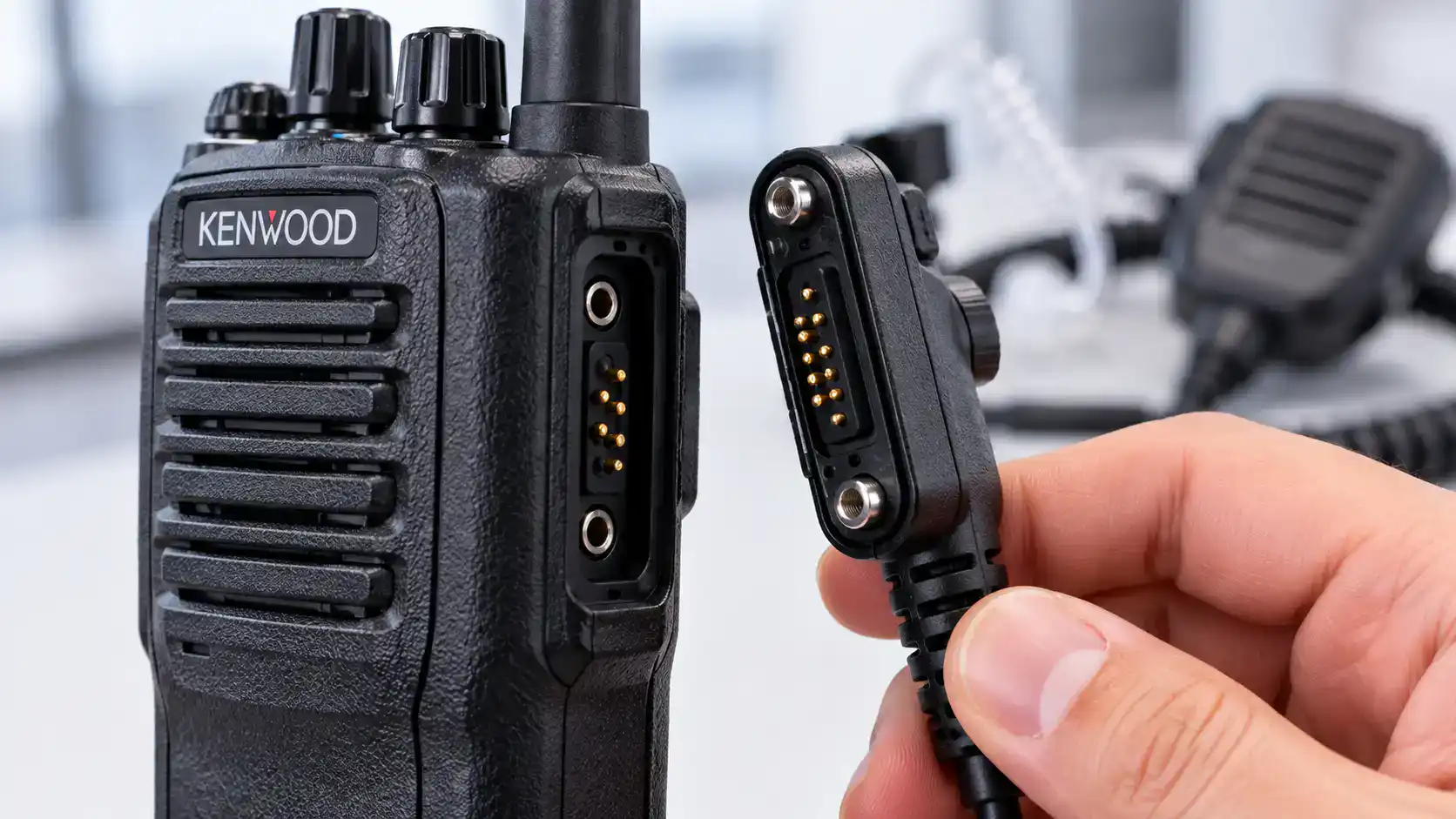
Accessory Connector
An accessory connector is the socket or interface on a two-way radio used to connect external accessories to the radio. Depending on the radio model, the connector can provide connections for audio accessories, remote speaker microphones, headsets, earpieces, programming equipment and other radio accessories.
The location, physical design and electrical connections of an accessory connector vary between radio manufacturers and models. There is no single universal two-way radio accessory connector, so an accessory designed for one radio will not necessarily be compatible with another.
What does an accessory connector do?
The accessory connector provides a physical and electrical connection between the radio and an external accessory.
For example, a remote speaker microphone (RSM)A Remote Speaker Microphone (RSM) is an external radio accessory combining a microphone, speaker and Push-to-Talk button, allowing users to operate a two-way radio without handling the radio itself. can connect to the radio through its accessory connector. The microphone allows the user to speak and listen without having to remove the radio from a belt or harness. Some remote speaker microphones also include a push-to-talk (PTT)Push-to-Talk (PTT) is the button or control used to activate a two-way radio's transmitter. Press it to speak and release it to listen. button, allowing the user to transmit directly from the microphone.
Other accessories may use the connector to provide audio input and output, control signals or other functions supported by the particular radio.
Types of accessory connector
Two-way radios use a variety of accessory connector designs. Some radios have a simple external audio connector, while professional radios may use proprietary multi-pin connectorsAn antenna transmits and receives radio-frequency signals, allowing a two-way radio to communicate. Antenna type, frequency, height and location can all affect radio performance and coverage. designed specifically for that manufacturer’s equipment.
Connectors may differ in:
- Number of contacts or pins
- Physical shape and size
- Electrical configuration
- Audio connections
- Push-to-talk connections
- Programming or data connections
- Mechanical locking or retention
- Waterproofing and environmental protection
Some modern professional radios use connectors designed to maintain protection against dust and water when compatible accessories are fitted.
Accessory compatibility
Accessory compatibility is an important consideration when selecting equipment for a two-way radio systemA Radio System is a complete communication solution comprising two-way radios and, where required, equipment such as repeaters, antennas, base stations, mobile radios and network infrastructure..
Two accessories may look physically similar but use different electrical connections or wiring. Conversely, an accessory may physically connect to a radio but not support all of its functions.
Compatibility can depend on the exact radio model, connector type, radio firmwareFirmware is the software built into a two-way radio that controls its underlying operation, features and hardware. Manufacturers may release updates to improve performance, fix faults or add functionality., accessory specification and manufacturer.
For this reason, accessories should be checked against the specific radio model before purchase or deployment.
Common accessories connected through an accessory connector
Depending on the radio, the accessory connector may be used for:
- Remote speaker microphones
- Earpieces
- Headsets
- Surveillance-style audio accessories
- PTT accessories
- Covert or discreet communication accessories
- Programming cables
- Audio adapters
- Specialist communication accessories
The available options vary considerably between radio models.
Accessory connectors and waterproof radios
On radios designed for demanding environments, the accessory connector can also be an important part of the radio’s environmental protection.
A connector that is left uncovered may provide an opening into the radio housing, so some radios have a protective cover fitted when no accessory is connected. When an accessory is fitted, the connector and accessory may form part of the radio’s environmental sealing system.
If a radio is being used in wet, dusty or outdoor environments, it is important to use compatible accessories and follow the manufacturer’s instructions for maintaining the radio’s specified level of protection.
Accessory connectors and radio hire
When hiring two-way radios, accessory compatibility is particularly important because users may require specific audio equipment for their working environment.
For example, a security team may require remote speaker microphones, while event staff working in noisy areas may need suitable earpieces or headsets.
The correct accessory will depend on the radio model and the user’s operational requirements. DCS can advise on compatible radio accessories when supplying or hiring two-way radio equipment.
Why accessory connectors matter
The accessory connector is a small part of a two-way radio, but it can have a significant effect on how the radio is used.
Choosing the correct connector and compatible accessories can improve usability, allow hands-free or discreet operation, and make radios more practical in specialist working environments.
Because connector designs vary between manufacturers and models, the exact radio model should always be checked before selecting an accessory.