
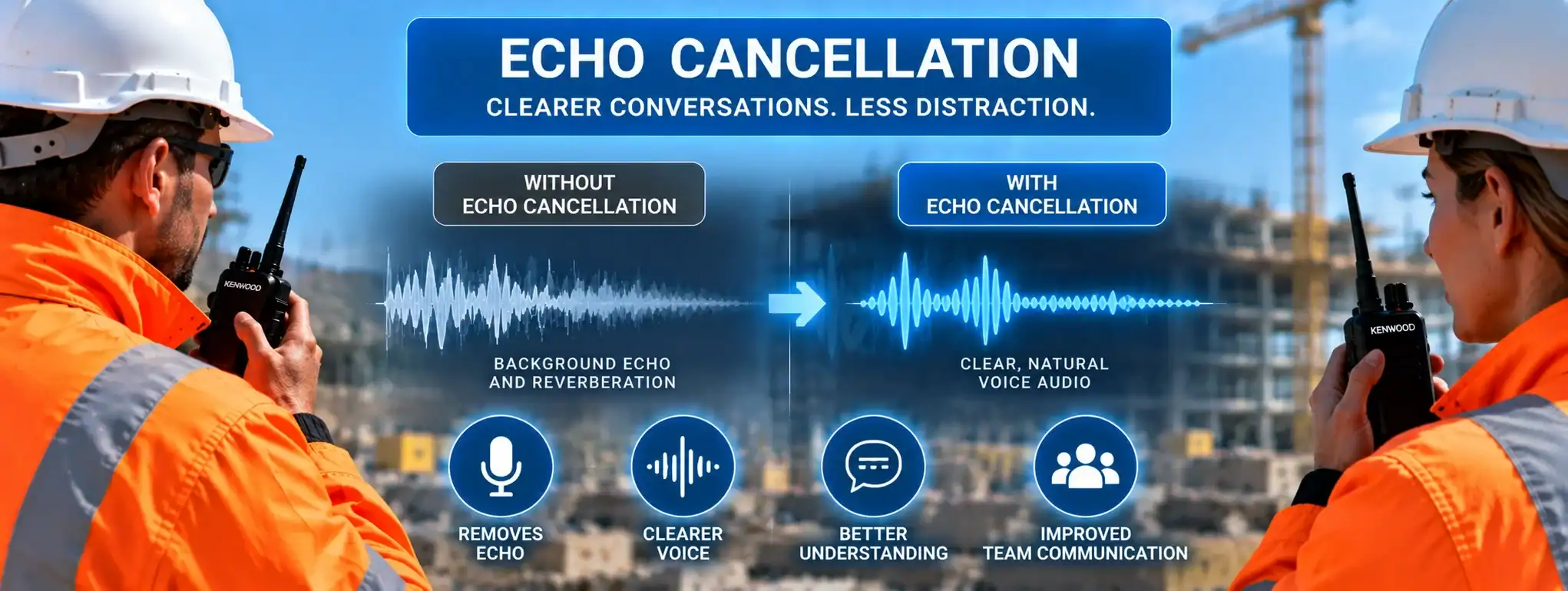
Echo Cancellation
Echo Cancellation is a digital audio-processing technology used to reduce or remove unwanted echoes from two-way radio and other voice communication systems. It helps prevent a user’s voice, or audio from a loudspeaker, from being picked up by a microphone and transmitted back into the communication system.
Echo can make conversations difficult to understand and may result in the same voice being heard more than once, sometimes with a noticeable delay.
Echo Cancellation is particularly useful in hands-free, vehicle-mounted, control-room and networked communication systems where microphones and speakers can be positioned close together.
How does Echo Cancellation work?
Echo Cancellation uses digital signal processing to identify audio that has been reproduced by a speaker and subsequently picked up by a microphone.
The system has access to the audio being played through the speaker. It compares that audio with the signal arriving at the microphone and attempts to identify the portion that represents the speaker’s output.
It can then reduce that component from the microphone signal before the remaining audio is transmitted.
A simplified process is:
Incoming audio → speaker → microphone → echo detected → echo reduced → transmitted audio
The processing takes place rapidly so that the user normally hears a natural conversation without having to adjust the system manually.
Acoustic echo
Acoustic echo occurs when sound from a loudspeaker is picked up again by a nearby microphone.
For example, if a radio’s incoming audio is played through a loudspeaker while the microphone is active, some of that audio can be picked up by the microphone.
The receiving system may then hear the original audio again as an echo.
The problem can be particularly noticeable when speakers are loud or microphones and speakers are positioned close together.
Echo Cancellation and two-way radio
Echo Cancellation can be useful in two-way radio systems that use hands-free or speakerphone-style communication.
A conventional handheld radio normally has a simple arrangement where the user presses the Push-to-Talk (PTT)Push-to-Talk (PTT) is the button or control used to activate a two-way radio's transmitter. Press it to speak and release it to listen. button and speaks directly into the radio microphone.
More complex systems may use separate microphones and speakers, increasing the possibility of acoustic feedback and echo.
Echo Cancellation can help manage this problem.
Echo Cancellation and hands-free communication
Hands-free radio communication can create conditions where the microphone remains active while audio is being played through a nearby speaker.
Without suitable echo control, the microphone can pick up the incoming communication and retransmit it.
Echo Cancellation attempts to prevent this unwanted loop.
This can improve the quality of hands-free communication in suitable radio systems.
Echo Cancellation and full-duplex communication
Echo Cancellation is particularly important in full-duplex communication systems.
In full-duplex communication, both parties can transmit and receive at the same time.
Because the local speaker can be playing the other person’s voice while the local microphone is active, there is a greater opportunity for the microphone to pick up the speaker output.
Echo Cancellation helps separate the wanted microphone audio from the unwanted acoustic echo.
Echo Cancellation vs half-duplex radio
Traditional professional two-way radio is generally half-duplexHalf-Duplex allows two-way communication in both directions, but users normally take turns transmitting. It is the standard operating method for most Push-to-Talk professional two-way radio systems..
The user presses the PTT button to transmit and normally listens when the button is released.
Because the microphone is not normally transmitting while incoming audio is being played, acoustic echo is less of a problem.
However, echo can still occur in radio systems that incorporate hands-free operationHands-Free Operation allows two-way radio users to communicate without holding the radio or continuously pressing its PTT button, using features such as VOX, headsets or remote PTT controls., vehicle installations, dispatch systems, conferencing or network-connected communications.
Echo Cancellation and dispatch systems
Professional Dispatch systems can use microphones and speakers in a control room.
A dispatcher may need to listen to radio traffic through a loudspeaker while speaking through a nearby microphone.
If the microphone picks up the speaker audio, unwanted echo can be introduced into the transmitted communication.
Echo Cancellation can help prevent this.
Echo Cancellation and control rooms
Control rooms often contain multiple audio sources, speakers, microphones and radio channels.
Echo Cancellation can help maintain clear communications where operators need to speak while listening to incoming audio.
It can be particularly useful when radio communications are integrated with other communication systems.
Echo Cancellation and radio-over-IP
Radio systems connected over IP networks can introduce additional audio-processing requirements.
Radio over IP (RoIP) systems may connect radios to remote dispatch positions, control rooms or other locations.
Where audio is played through speakers and captured by microphones, Echo Cancellation can help prevent the local audio from being sent back through the networkA Network is a connected system of radios, equipment and infrastructure that allows users to communicate across a defined area. Radio networks can range from simple radio-to-radio systems to large multi-site networks..
Echo Cancellation and cloud dispatch
Cloud-based dispatch systems can provide communication between radio users and remote operators.
Where a dispatcher uses a computer, headsetA radio headset combines a microphone and speaker or earpiece, allowing two-way radio users to communicate conveniently while keeping the radio away from their face or using hands-free operation., microphone or speaker to communicate with radio users, echo can occur if the microphone picks up audio from the computer’s speakers.
Echo Cancellation can reduce this unwanted feedback.
The exact technology used depends on the dispatch platform.
Echo Cancellation and vehicle radios
Vehicle-mounted communication systems can present particular echo challenges.
A vehicle installation may contain:
- Radio
- External speaker
- Microphone
- Hands-free controls
- Other communication equipment
The microphone can pick up audio from the vehicle speaker, particularly when the speaker volume is high.
Echo Cancellation can help improve communication quality in suitable installations.
Echo Cancellation and speaker volume
High speaker volume can increase the amount of sound picked up by a nearby microphone.
Echo Cancellation can reduce the resulting echo, but it is not a substitute for good system design.
Correct positioning of microphones and speakers, appropriate volume levels and suitable acoustic design can all reduce echo before digital processing is required.
Echo Cancellation and microphone placement
Microphone placement is an important part of controlling echo.
Increasing the physical separation between a microphone and speaker can reduce the amount of speaker audio reaching the microphone.
Directional microphones can also help by concentrating their sensitivity towards the intended speaker and reducing unwanted sounds from other directions.
Echo Cancellation can then provide additional digital processing.
Echo Cancellation and Digital Signal Processing
Echo Cancellation relies on Digital Signal Processing (DSP).
The processor analyses the audio signals and uses an adaptive algorithm to estimate the acoustic echo.
Because the acoustic environment can change, the system may continuously adapt its estimate.
For example, changes in speaker volume, microphone position or the surrounding environment can alter the acoustic path between the speaker and microphone.
Adaptive echo cancellation
Many modern echo-cancellation systems use adaptive filtering.
An adaptive filter continually adjusts its characteristics to model the path taken by the speaker’s sound before it reaches the microphone.
The system can therefore respond to changes in the acoustic environment.
This is particularly useful in vehicles and other environments where conditions can change during operation.
Echo Cancellation and background noise
Echo Cancellation and Digital Noise SuppressionDigital Noise Suppression uses digital audio processing in a two-way radio to reduce unwanted background noise and improve speech clarity, particularly in noisy working environments. are related but perform different functions.
Echo Cancellation attempts to remove audio that has travelled from a speaker back into a microphone.
Noise Suppression attempts to reduce unwanted environmental sounds such as machinery, traffic or wind.
A communication system may use both technologies together.
Echo Cancellation and feedback
Echo Cancellation should also be distinguished from audio feedback.
Feedback occurs when amplified sound from a speaker is repeatedly picked up by a microphone and re-amplified, potentially producing a high-pitched or rapidly escalating sound.
Echo is generally a delayed repetition of audio.
A system can experience echo without producing the continuous howl associated with feedback.
Echo Cancellation and radio audio quality
Effective Echo Cancellation can improve speech intelligibility by preventing unwanted repeated audio from being transmitted.
Without echo control, users may hear:
- Repeated speech
- Delayed speech
- Distorted audio
- Feedback
- Unwanted background audio
Reducing these effects can make communications more natural and easier to understand.
Echo Cancellation and digital radio
Echo Cancellation can be incorporated into digital radio equipment and associated communication systems.
It is an audio-processing feature rather than a defining characteristic of a particular radio standard.
For example, a DMR (Digital Mobile RadioA Mobile Radio is a two-way radio designed to be installed in a vehicle. It normally uses the vehicle's power supply and an external antenna to provide reliable communication while travelling or working in the field.) system may incorporate echo-control technology within compatible equipment or connected communication infrastructureRadio infrastructure is the equipment and supporting systems behind a professional two-way radio network, including repeaters, antennas, base stations, network connections, power systems and dispatch equipment..
Not every DMR radio necessarily provides Echo Cancellation.
Echo Cancellation and analogue radio
Echo Cancellation can also be used with analogue radioAnalogue radio uses continuously varying radio signals to transmit voice communication. It remains widely used for reliable two-way communication across business, industry, events, security and other applications. systems where suitable audio-processing equipment is installed.
The radio transmissionTransmission is the process of sending voice, data or signalling from a radio using a radio-frequency signal to another radio, repeater or communication system. itself does not have to be digital for the microphone audio to be processed digitally before transmission.
This means that Echo Cancellation is primarily an audio-system feature rather than an indication that the underlying radio transmission is digital.
Echo Cancellation and smartphones or VoIP
Echo Cancellation is widely used in other communication technologies, including:
- Voice over IP
- Video conferencing
- Mobile phones
- Hands-free telephone systems
- Intercom systems
The underlying principle is similar: prevent audio reproduced locally from being picked up and transmitted back to the other participant.
The specific implementation varies between technologies.
Echo Cancellation limitations
Echo Cancellation cannot necessarily remove every form of unwanted audio.
It works best when the system can identify the audio being reproduced through its own speaker.
Unexpected noises, rapidly changing acoustic environments or severe distortion can make echo more difficult to identify.
Good microphone and speaker placement remains important even when sophisticated echo-cancellation technology is available.
Echo Cancellation and radio system design
When designing a professional communication system, Echo Cancellation should be considered alongside:
- Microphone selection
- Speaker positioning
- Speaker volume
- Acoustic environment
- Radio configuration
- Audio processing
- Dispatch equipment
- Network architecture
The best results normally come from combining appropriate hardware design with suitable digital audio processing.
Echo Cancellation and DCS
DCS can consider Echo Cancellation where a radio systemA Radio System is a complete communication solution comprising two-way radios and, where required, equipment such as repeaters, antennas, base stations, mobile radios and network infrastructure. includes hands-free communication, control-room equipment, vehicle installations, dispatch or other applications where microphones and speakers operate together.
The appropriate solution depends on the radio equipment, installation and communication requirements.
When your team needs dependable communications without buying equipment, reliable radio hire offers a flexible solution.