
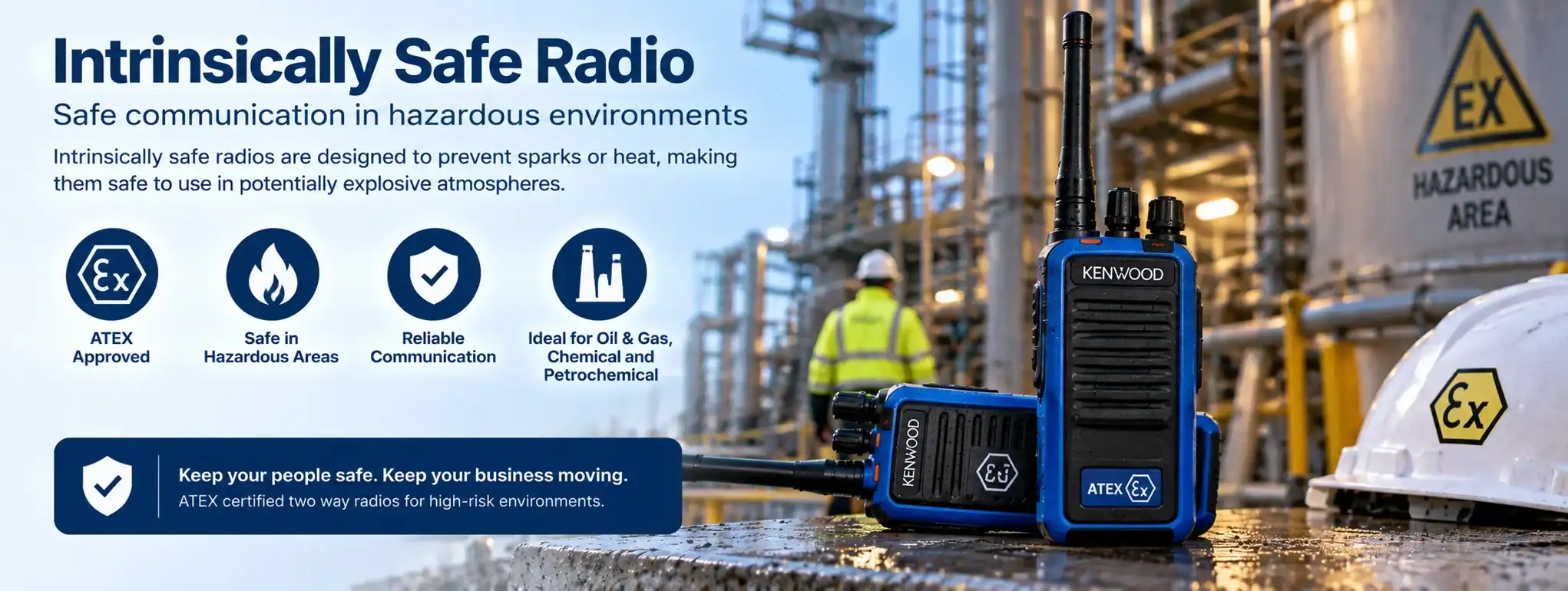
Intrinsically Safe Radio
An Intrinsically Safe Radio is a two-way radio designed and certified for use in environments where flammable gases, vapours, liquids, dusts or other potentially explosive substances may be present.
Intrinsically safe equipment is designed so that it does not produce enough electrical or thermal energy, under specified conditions, to ignite a hazardous atmosphere.
These radios are commonly used in industries where there is a risk of explosion, including oil and gas, chemical processing, manufacturing, pharmaceuticals and certain industrial environments.
What does intrinsically safe mean?
“Intrinsically safe” describes a specific approach to preventing ignition.
The radio is designed so that electrical circuits, components and stored energy are controlled to remain within defined safety limits.
This means that, even under specified fault conditions, the equipment is designed to prevent an ignition-capable spark or excessive temperature from occurring.
Intrinsically safe equipment must be appropriately certified for the environment in which it is to be used.
Intrinsically Safe Radio vs standard radio
A standard two-way radio should not be used in a hazardous area simply because it appears rugged or has a high IP Rating.
A standard radio may contain electrical components capable of producing sparks or temperatures that could ignite a flammable atmosphere.
An intrinsically safe radio is specifically designed and certified for appropriate hazardous-area applications.
Intrinsically Safe Radio and ATEX
In the UK and Europe, intrinsically safe radios may be certified under the ATEX framework when intended for use in potentially explosive atmospheres.
ATEX certification identifies the equipment’s suitability for specified hazardous environments.
The exact certification marking and equipment category determine where the radio can be used.
ATEX certification
An ATEX-certified radio is assessed against requirements relating to equipment intended for potentially explosive atmospheres.
The certification identifies the conditions and hazardous environments for which the equipment has been approved.
Users must ensure that the radio’s certification matches the actual hazardous area.
An ATEX radioAn ATEX radio is a certified two-way radio designed for use in potentially explosive atmospheres, with protection against becoming an ignition source in specified hazardous areas. should therefore not simply be selected because it carries an ATEX marking; the complete certification details need to be checked.
Intrinsically Safe Radio and hazardous areas
Hazardous areas are locations where an explosive atmosphere may occur because of:
- Flammable gases
- Vapours
- Flammable liquids
- Combustible dust
- Other potentially explosive substances
Examples can include:
- Oil and gas facilities
- Chemical plants
- Refineries
- Fuel storage areas
- Pharmaceutical manufacturing
- Paint facilities
- Grain processing
- Certain manufacturing environments
The classification of the area determines the equipment that can safely be used.
Gas and vapour environments
Some hazardous areas contain potentially explosive mixtures of gas or vapour and air.
Intrinsically safe radios intended for these environments must have appropriate certification for the relevant hazardous-area classification.
Different gases and vapours can have different ignition characteristics, so certification requirements matter.
Dust environments
Explosive atmospheres can also be created by combustible dust.
Examples can include certain:
- Grain-processing environments
- Food-production facilities
- Chemical manufacturing processes
- Pharmaceutical facilities
- Powder-handling operations
A radio certified for gas hazards is not automatically suitable for every combustible-dust environment.
The equipment certification must match the specific hazard.
Hazardous-area zones
Hazardous areas can be divided into zones according to the likelihood and duration of an explosive atmosphere being present.
For gas and vapour hazards, commonly used classifications include:
- ZoneA Zone is a group of programmed radio channels or talk groups organised within a two-way radio. Zones make it easier for users to find and switch between different communication services. 0
- Zone 1
- Zone 2
For combustible dust, classifications include:
- Zone 20
- Zone 21
- Zone 22
The appropriate radio certification depends on the zone and other characteristics of the hazardous environment.
Intrinsically Safe Radio and Zone 0
Zone 0 is an area where an explosive gas or vapour atmosphere is present continuously, for long periods or frequently.
Equipment used in Zone 0 requires an appropriate level of protection and certification.
The specific radio certification must be checked before use.
Intrinsically Safe Radio and Zone 1
Zone 1 is an area where an explosive gas or vapour atmosphere is likely to occur occasionally during normal operation.
Radios used in these areas require appropriate hazardous-area certification.
Intrinsically Safe Radio and Zone 2
Zone 2 is an area where an explosive gas or vapour atmosphere is not likely to occur during normal operation but, if it does occur, will exist only for a short period.
The radio must still have appropriate certification for Zone 2 use.
Equipment groups and gas groups
Hazardous-area certification can also identify the types of environments and substances for which equipment is suitable.
Different gas groups have different ignition characteristics.
A radio certified for one classification should not automatically be assumed to be suitable for another.
The complete certification should therefore be checked.
Temperature class
Intrinsically safe equipment can also have a specified temperature class.
The temperature class relates to the maximum surface temperature the equipment can reach under defined conditions.
This is important because a hot equipment surface can potentially ignite a flammable atmosphere even without producing a spark.
Intrinsically Safe Radio and batteries
The battery is an important part of an intrinsically safe radio system.
A certified radio may require a specific approved battery.
Users should not substitute an ordinary battery simply because it physically fits the radio.
Using an incorrect battery or accessory can invalidate the equipment’s hazardous-area approval.
Intrinsically Safe Radio accessories
Accessories can also be subject to hazardous-area certification.
Examples include:
- Speaker microphones
- Earpieces
- Headsets
- Remote PTTs
- Batteries
- Chargers
An intrinsically safe radio does not automatically make every accessory safe for use in a hazardous area.
Only approved accessories suitable for the relevant certification should be used.
Intrinsically Safe Radio and charging
Charging arrangements require particular attention.
A radio may need to be removed from the hazardous area before charging, depending on its certification and the manufacturer’s instructions.
Specialist charging equipment may also be available for particular certified systems.
The manufacturer’s approved charging arrangements must be followed.
Intrinsically Safe Radio and IP rating
An intrinsically safe radio may also have an IP Rating.
These are two different specifications.
IP rating describes protection against ingress such as dust and water.
Intrinsic safety certification addresses protection against ignition in specified hazardous environments.
A radio can therefore have a high IP rating without being intrinsically safe.
Intrinsically Safe Radio and explosion-proof equipment
“Explosion-proof” and “intrinsically safe” are not necessarily interchangeable terms.
They describe different protection concepts and certification approaches.
When selecting equipment for a hazardous area, the required protection method should be determined from the area’s classification and applicable requirements.
Intrinsically Safe Radio and standard batteries
Standard batteries should not be used on an intrinsically safe radio unless they are specifically approved for that radio and certification.
Changing the battery can affect the radio’s certified safety characteristics.
This is why hazardous-area radios often have dedicated approved batteries.
Intrinsically Safe Radio and repairs
Repairs to intrinsically safe equipment must be handled carefully.
Opening or modifying certified equipment can affect its safety characteristics and certification.
Repairs should be carried out according to the manufacturer’s approved procedures and, where required, by appropriately authorised service personnel.
Intrinsically Safe Radio and modifications
Users should not modify an intrinsically safe radio or its accessories.
Examples of potentially problematic modifications include:
- Changing antennas
- Fitting non-approved batteries
- Altering internal components
- Using non-approved accessories
- Modifying the enclosure
Such changes can affect the equipment’s certification.
Intrinsically Safe Radio and antennas
The antennaAn antenna transmits and receives radio-frequency signals, allowing a two-way radio to communicate. Antenna type, frequency, height and location can all affect radio performance and coverage. is part of the radio systemA Radio System is a complete communication solution comprising two-way radios and, where required, equipment such as repeaters, antennas, base stations, mobile radios and network infrastructure. and may be subject to certification requirements.
Users should use the antenna specified or approved for the intrinsically safe radio.
A standard replacement antenna should not automatically be assumed to retain the radio’s hazardous-area approval.
Intrinsically Safe Radio and maintenance
Regular inspection is particularly important for radios used in hazardous areas.
Checks can include:
- Housing condition
- Battery condition
- Seals
- ConnectorsAn antenna transmits and receives radio-frequency signals, allowing a two-way radio to communicate. Antenna type, frequency, height and location can all affect radio performance and coverage.
- Approved accessories
- Antenna condition
- Labels and certification markings
Damaged equipment should be removed from service until it has been assessed appropriately.
Intrinsically Safe Radio and radio hire
Radio HireRadio Hire is the temporary rental of two-way radios and related communication equipment for events, projects and operational requirements, providing professional communication without purchasing the equipment. can provide an option for organisations that need certified radio equipment for temporary operations in hazardous environments.
Before supplying equipment, the hazardous-area requirements should be established.
This can include:
- Zone classification
- Gas or dust hazard
- Equipment group
- Temperature class
- Required certification
- Approved accessories
- Operating environment
The radio supplied must be suitable for the specific hazardous area.
Intrinsically Safe Radio for oil and gas
Oil and gas facilities can contain areas where flammable gases or vapours may be present.
Intrinsically safe radios can provide communication for workers operating in appropriately classified areas.
The radio’s certification must match the hazardous-area requirements of the facility.
Intrinsically Safe Radio for chemical plants
Chemical processing facilities can contain flammable gases, vapours, liquids and combustible materials.
Intrinsically safe communication equipment can be used where the relevant hazardous-area certification requirements are met.
Intrinsically Safe Radio for manufacturing
Some manufacturing processes can create potentially explosive atmospheres.
This can occur through the presence of flammable substances, gases, vapours or combustible dust.
The requirement for intrinsically safe radios depends on the specific process and hazardous-area classification.
Intrinsically Safe Radio for pharmaceuticals
Certain pharmaceutical manufacturing and processing environments can contain combustible powders or other hazardous materials.
Where a hazardous area has been identified, communication equipment must meet the relevant certification requirements.
Intrinsically Safe Radio for food production
Some food-processing environments can contain combustible dust, particularly where powders or fine particles are handled.
The requirement for intrinsically safe equipment depends on the site’s hazardous-area assessment.
Intrinsically Safe Radio for agriculture
Agricultural environments can contain combustible dust and other potentially hazardous materials.
However, not every agricultural environment is a hazardous area.
The need for intrinsically safe equipment should be determined from the specific site assessment and applicable classification.
Intrinsically Safe Radio and emergency communications
Communication can be particularly important in hazardous environments because workers may need to report problems or raise an emergency quickly.
Where supported, intrinsically safe radios can provide features such as:
- Emergency ButtonAn Emergency Button is a dedicated two-way radio control that allows users to quickly send an emergency alert to a dispatcher, control room or authorised radio users.
- Emergency AlarmAn Emergency Alarm allows a two-way radio user to quickly alert a dispatcher, control room or other authorised users that assistance may be required.
- Emergency CallAn Emergency Call is a priority two-way radio function that allows a user to quickly request assistance and, on supported systems, establish an urgent voice communication with a dispatcher or control room.
- Lone WorkerA Lone Worker is someone who works without direct supervision or immediate assistance nearby. Compatible two-way radios can provide safety features such as timed check-ins, emergency alerts and GPS location.
- Man-Down
The availability of these functions depends on the radio model and system configuration.
Intrinsically Safe Radio and lone worker
Lone Worker functionality can provide an additional safety feature for personnel working alone in hazardous environments.
A compatible radio can monitor activity and raise an alert if configured conditions are met.
The radio system should form part of a wider lone-worker safety procedure rather than being relied upon as the sole safety measure.
Intrinsically Safe Radio and man-down
Man-Down functionality can detect certain situations where a radio remains at an unusual angle or is inactive for a configured period.
Where supported, the radio can generate an alert.
This can provide an additional means of raising an alarm if a worker becomes incapacitated.
Intrinsically Safe Radio and emergency button
An Emergency Button allows a radio user to raise an emergency alert quickly.
On a compatible system, the alert can be sent to other radios or a control or dispatch system.
The emergency function should be tested as part of system commissioning.
Intrinsically Safe Radio and radio communications
Intrinsic safety does not determine radio range or coverageRadio Coverage is the geographical area in which a two-way radio system can provide reliable communication. Coverage depends on the radios, antennas, frequency, terrain, buildings and system infrastructure..
A hazardous-area radio still requires an appropriate radio system to provide the necessary communication coverage.
This can involve:
- Repeaters
- Antennas
- Base stations
- NetworkA Network is a connected system of radios, equipment and infrastructure that allows users to communicate across a defined area. Radio networks can range from simple radio-to-radio systems to large multi-site networks. infrastructureRadio infrastructure is the equipment and supporting systems behind a professional two-way radio network, including repeaters, antennas, base stations, network connections, power systems and dispatch equipment.
- Dispatch systems
The communication design and hazardous-area requirements should be considered separately.
Intrinsically Safe Radio and repeaters
Repeaters used within hazardous areas may themselves need suitable certification.
In many installations, radio infrastructure is positioned outside the hazardous area while the intrinsically safe handheld radios are used within it.
The correct arrangement depends on the site’s hazardous-area assessment and system design.
Intrinsically Safe Radio and control rooms
A control room can provide central monitoring and communication with workers using intrinsically safe radios.
This can be particularly useful where emergency alerts, lone-worker functionality or incident managementIncident Management is the process of coordinating people, communications and resources during an incident. Two-way radios can provide rapid communication between teams, control rooms and responders. procedures are in place.
Intrinsically Safe Radio and incident management
Intrinsically safe radios can form part of an Incident Management communication system in hazardous environments.
They can allow authorised workers and control personnel to exchange information while using equipment appropriate to the hazardous-area requirements.
Intrinsically Safe Radio certification
Certification should always be checked against the actual intended application.
Important information can include:
- Certification standard
- Equipment category
- Zone
- Gas or dust group
- Temperature class
- Ambient temperature range
- Approved battery
- Approved accessories
The certification marking and manufacturer’s documentation should be consulted before the radio is used in a hazardous area.
Intrinsically Safe Radio limitations
An intrinsically safe radio is not automatically suitable for every hazardous environment.
Certification can be limited by:
- Hazardous-area zone
- Gas or dust classification
- Temperature class
- Ambient temperature
- Approved accessories
- Battery type
- Equipment category
The correct radio must therefore be selected for the specific environment.
Choosing an Intrinsically Safe Radio
Before selecting a radio, establish:
- The hazardous-area classification.
- Whether the hazard involves gas, vapour or dust.
- The required equipment category.
- The applicable gas or dust group.
- The required temperature class.
- Environmental conditions such as water and dust exposure.
- Required communication coverage.
- Required emergency and safety features.
- Which batteries and accessories are approved.
This information allows the radio system to be specified correctly.
Intrinsically Safe Radio and DCS
DCS can supply professional two-way radio equipment for applications where hazardous-area communication is required.
Where intrinsically safe or ATEX-certified equipment is necessary, the radio, battery and accessories must be selected according to the site’s specific hazardous-area requirements.
DCS can help identify the appropriate communication equipment and system configuration for the operating environment.
For businesses operating in hazardous or potentially explosive environments, DCS 2 Way Radio supplies ATEX and intrinsically safe two way radios for a range of industrial applications, with equipment available for purchase or hire.