
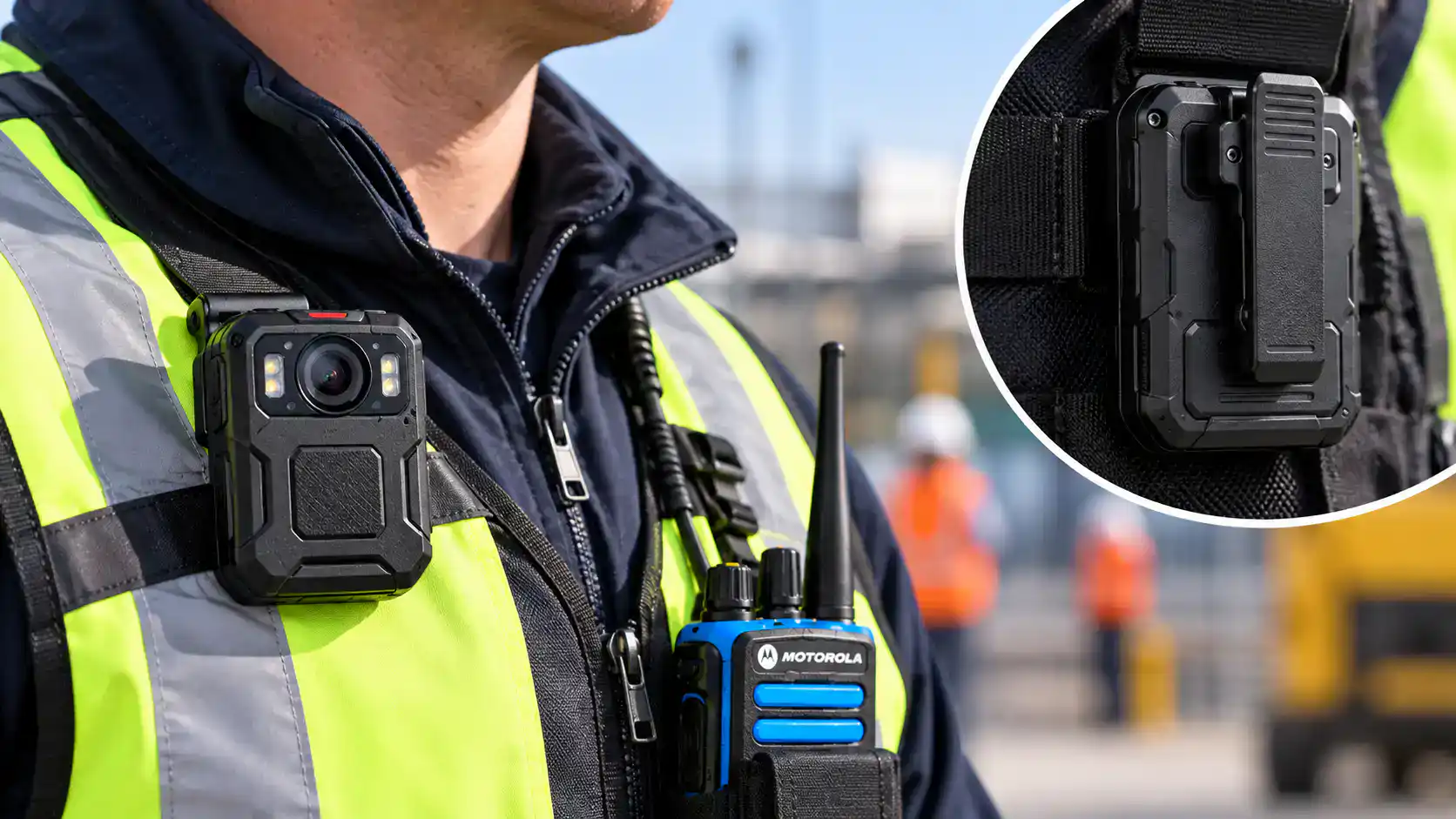
Body-Worn Camera
A body-worn camera (BWC) is a small camera designed to be worn on a person’s clothing, uniform or equipment to record video, and often audio, from the user’s perspective.
Body-worn cameras are commonly used by police, security personnel, enforcement officers, transport staff, healthcare workers, retail teams and other professionals where recording interactions or incidents can provide an evidential, accountability or security benefit.
Modern body-worn cameras can include features such as high-definition video recording, audio recording, pre-event recording, GPS, secure storage, wireless connectivity and docking or charging systems. The features available vary between manufacturers and models.
How does a body-worn camera work?
A body-worn camera uses an integrated camera and microphone to capture video and audio while it is being worn.
The camera normally stores recordings internally. Depending on the model, recordings may later be transferred to a computer, docking station or secure management system.
Some professional systems provide additional controls designed to protect recorded evidence, restrict access and maintain an audit trail showing when recordings have been accessed or transferred.
The camera may be operated manually by the wearer, although some professional systems can also support automatic activation or integration with other equipment.
Body-worn cameras and two-way radios
Body-worn cameras and two-way radios are separate technologies, but they can be used together as part of a wider communication and security system.
For example, a security officer may carry a two-way radio for immediate communication with colleagues while wearing a body-worn camera to record incidents or interactions.
Some professional radio and body-camera systems can provide integration between the devices. Depending on the equipment, this can include features such as automatic camera activation when a radio emergency function is triggered, wireless connectivity or centralised management.
The exact integration capabilities depend on the manufacturer and equipment being used.
Why are body-worn cameras used?
Body-worn cameras can provide an objective visual record of incidents and interactions.
Potential uses include:
- Recording incidents and confrontations
- Providing evidence for investigations
- Supporting incident reporting
- Improving accountability
- Protecting staff and members of the public
- Recording events from the user’s perspective
- Providing a record of interactions with customers or members of the public
A body-worn camera is not simply a security camera. Because it is worn by an individual, the recording can move with the user and capture events from their position.
Body-worn cameras for security
Body-worn cameras are widely used in security applications.
Security officers may encounter incidents where a record of what happened can be useful for subsequent investigation or reporting. A visible camera can also form part of an organisation’s wider approach to incident managementIncident Management is the process of coordinating people, communications and resources during an incident. Two-way radios can provide rapid communication between teams, control rooms and responders..
Where body-worn cameras are used by security staff, organisations should establish appropriate policies covering when cameras should be activated, how recordings are stored and who is permitted to access them.
Body-worn cameras and evidence
Professional body-worn camera systems can be designed to preserve recordings as evidence.
Features may include secure storage, controlled access, encryptionEncryption protects two-way radio communications by converting voice or data into a secure form that can only be understood by authorised radios with the correct encryption capability and keys., audit trails and systems for transferring recordings without unnecessarily altering the original evidence.
The importance of these features depends on the intended use of the recordings. Where footage may be required for an investigation or legal process, appropriate procedures should be established for handling, storing and retaining recordings.
Body-worn camera audio
Many body-worn cameras record audio as well as video.
Audio can provide important context that may not be apparent from the visual recording alone.
However, audio recording introduces additional privacy and data-protection considerations. Organisations should ensure that their use of body-worn cameras complies with applicable legal and organisational requirements.
Body-worn camera activation
A body-worn camera can generally be activated by the wearer when recording is required.
Some professional systems provide additional activation methods. Depending on the equipment, a camera may be configured to start recording automatically in response to events such as removing it from a docking station, pressing an emergency buttonAn Emergency Button is a dedicated two-way radio control that allows users to quickly send an emergency alert to a dispatcher, control room or authorised radio users. or receiving a signal from another connected device.
Some systems can also use visual or audible indicators to show that recording is taking place.
Automatic activation can help reduce the possibility of a user forgetting to start recording, but it should be configured according to the organisation’s operational and privacy requirements.
Body-worn cameras and privacy
Body-worn cameras can capture people, conversations and locations that the wearer encounters during normal work.
This means that their use requires appropriate consideration of privacy and data protection.
Organisations using body-worn cameras should have clear policies covering matters such as:
- When recording is appropriate
- When recording should stop
- How people are informed where appropriate
- How recordings are stored
- Who can access recordings
- How long recordings are retained
- How recordings are securely deleted
- How footage is used or disclosed
The applicable requirements depend on the organisation, location and purpose for which the camera is being used.
Body-worn cameras and GDPR
In the UK, organisations using body-worn cameras may need to consider UK data-protection law, including the UK GDPR and Data Protection Act 2018, where recordings contain information relating to identifiable individuals.
The specific legal obligations depend on how the cameras are being used and the organisation’s role.
For this reason, body-worn camera deployment should include appropriate privacy and data-protection procedures rather than treating the camera simply as another piece of recording equipment.
Body-worn cameras in two-way radio systems
Body-worn cameras can complement two-way radio communication particularly well in security and public-facing operations.
A radio provides immediate voice communication between members of a team, while the camera can create a visual and audio record of events.
For example:
Two-way radio → immediate team communication
Body-worn camera → recording of an incident or interaction
Using both technologies together can provide an organisation with both real-time communication and recorded evidence.
Body-worn cameras and emergency functions
Some professional body-worn camera systems can integrate with emergency or lone-worker functions.
For example, an organisation may configure equipment so that an emergency activation on one device triggers an event on another connected device or alerts a control system.
The precise functionality varies significantly between manufacturers, so integration should be assessed based on the equipment and communication system being used.
Body-worn cameras for events
Body-worn cameras can also be used by security and stewarding teams at events.
They can provide a record of incidents while allowing staff to remain mobile around the venue. When combined with two-way radios, event teams can communicate immediately with colleagues while also recording incidents where appropriate.
As with other applications, the organisation operating the cameras should establish suitable policies for activation, storage, access and retention.
Body-worn camera battery life
Battery life is an important consideration because the camera needs sufficient powerAn antenna transmits and receives radio-frequency signals, allowing a two-way radio to communicate. Antenna type, frequency, height and location can all affect radio performance and coverage. to operate throughout the user’s working period.
Actual operating time depends on factors such as recording resolution, frame rate, display use, wireless connectivity, GPS and other functions.
Professional systems may use charging docks or docking stations that charge the cameras and can also transfer recordings to a central management system.
Body-worn camera storage and management
Body-worn cameras store video and audio recordings either internally or through an associated management system.
Professional deployments may use dedicated evidence-management software to control how recordings are transferred, stored, accessed and retained.
This can provide organisations with greater control over sensitive recordings than simply copying video files manually from a consumer camera.
Choosing a body-worn camera
Important considerations when selecting a body-worn camera include:
- Video quality
- Audio quality
- Battery life
- Storage capacity
- Recording duration
- Activation method
- Low-light performance
- Durability
- Weather resistance
- Mounting options
- Data security
- Evidence-management facilities
- Wireless connectivity
- Integration with existing communication systems
The most suitable camera depends on the environment and the purpose for which recordings are required.
Body-worn cameras and DCS
Body-worn cameras can form part of a wider communication and security solution alongside professional two-way radios.
For organisations such as security companies, event operators and other teams requiring both immediate radio communication and incident recording, the two technologies can complement each other.
DCS can advise on suitable two-way radio equipment and, where appropriate, how radio communications can work alongside body-worn camera solutions.