Event Radio Hire
Event Radio HireRadio Hire is the temporary rental of two-way radios and related communication equipment for events, projects and operational requirements, providing professional communication without purchasing the equipment. is the temporary supply of professional two-way radios and associated communication equipment for events, allowing organisers, security teams, production crews, stewards and other staff to communicate quickly and reliably throughout an event.
Hiring radios can provide a dedicated communication system without requiring an organisation to purchase and maintain a permanent fleet of equipment. A hire package can include handheld radios, batteries, chargers, earpieces, headsets, speaker microphones, repeaters and other accessories depending on the size, location and operational requirements of the event.
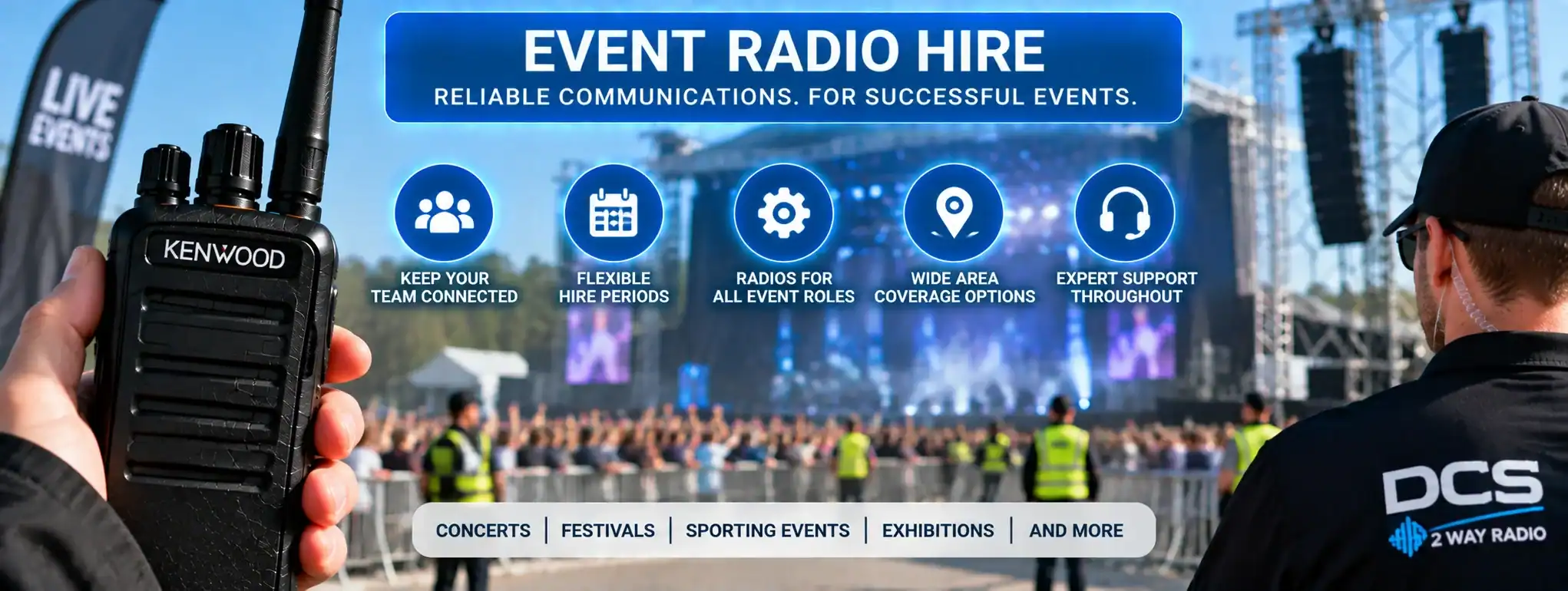
Event Radio Hire is commonly used for festivals, concerts, sporting events, conferences, exhibitions, corporate events, outdoor events and temporary security operations.
How does Event Radio Hire work?
A typical event radio hire service involves selecting suitable equipment, configuring the radios for the event and supplying the equipment for the required period.
A typical process is:
Event requirements → Radio systemA Radio System is a complete communication solution comprising two-way radios and, where required, equipment such as repeaters, antennas, base stations, mobile radios and network infrastructure. design → Radio programming → Equipment delivery → User deployment → Event operation → Equipment return
The radio system can be configured before the event so that different teams can communicate using dedicated channels or Talkgroups.
For larger or more complex events, additional infrastructureRadio infrastructure is the equipment and supporting systems behind a professional two-way radio network, including repeaters, antennas, base stations, network connections, power systems and dispatch equipment. such as a RepeaterA Repeater receives a two-way radio transmission and retransmits it, usually from an elevated location, to extend the coverage and reliability of a radio communication system. may be required to improve coverageRadio Coverage is the geographical area in which a two-way radio system can provide reliable communication. Coverage depends on the radios, antennas, frequency, terrain, buildings and system infrastructure..
Why hire two-way radios for an event?
Professional two-way radios provide instant communication without requiring users to dial telephone numbers or depend on individual mobile-phone calls.
They can allow event teams to communicate efficiently when many people need to share information at the same time.
Typical advantages include:
- Instant Push-to-Talk communication
- Group communication
- Dedicated channels
- Wide-area coverage
- Centralised communication
- Hands-free operationHands-Free Operation allows two-way radio users to communicate without holding the radio or continuously pressing its PTT button, using features such as VOX, headsets or remote PTT controls.
- Robust equipment
- Reduced reliance on mobile-phone networks
The appropriate system depends on the event and the environment in which it is being operated.
Who uses radios at events?
Different event teams can use radios for different operational purposes.
Common users include:
- Event management
- Security teams
- Stewards
- Production crews
- Stage management
- Medical teams
- Site management
- Traffic management
- Car parking teams
- Catering management
- Facilities teams
- Maintenance staff
- Venue operations
Each team can be given its own communication channelA two-way radio channel is a programmed set of communication settings, typically including frequency and signalling, that allows compatible radios to communicate with one another. or talkgroup where required.
Event radio channels
A hire radio system can be configured with multiple channels so that different teams can communicate separately.
For example:
Channel 1 — Event Control
Channel 2 — Security
Channel 3 — Production
Channel 4 — Stewards
Channel 5 — Medical
This can reduce unnecessary radio traffic and allow teams to focus on the communications relevant to their responsibilities.
The number and arrangement of channels will depend on the event.
Event radio talkgroups
On digital radio systems, Talkgroups can provide a structured way of separating communications.
A large event may have several operational groups while allowing authorised personnel to communicate across the wider system when necessary.
Talkgroup configuration can also allow event control to communicate with multiple teams.
Event Radio Hire and coverage
Reliable coverage is one of the most important considerations when hiring radios for an event.
Coverage can be affected by:
- Event size
- BuildingsAn antenna transmits and receives radio-frequency signals, allowing a two-way radio to communicate. Antenna type, frequency, height and location can all affect radio performance and coverage.
- Terrain
- Construction materials
- Underground areas
- Crowd density
- Temporary structures
- Distance between users
- Radio frequencies
- Radio infrastructure
Coverage should ideally be assessed before the event, particularly where communication is safety-critical.
Event Radio Hire and repeaters
A Repeater can extend the effective coverage of a professional radio system.
The repeater receives a transmissionTransmission is the process of sending voice, data or signalling from a radio using a radio-frequency signal to another radio, repeater or communication system. from one radio and retransmits it, allowing communications to travel over a greater area than may be possible using handheld radios alone.
Repeaters can be particularly useful for:
- Large outdoor events
- Multi-building venues
- Festivals
- Race circuits
- Large sporting venues
- Events spread across multiple areas
The requirement for a repeater depends on the physical environment and required coverage.
Event Radio Hire for large events
Large events may involve hundreds of staff working across extensive areas.
A more structured radio system may therefore be required, potentially incorporating:
- Multiple talkgroups
- Repeaters
- Dispatch positions
- Radio management
- Spare batteries
- Charging facilities
- Headsets and earpieces
- Vehicle radios
The system can be designed around the event’s operational structure.
Event Radio Hire for festivals
Festivals often cover large outdoor areas and can involve security, production, site management, medical teams and event control.
Professional radio hire can provide a common communication platform across these teams.
A repeater may be required where the event site is large or has difficult terrain.
Event Radio Hire for concerts
Concerts and live music events can require close coordination between production, security, stage management and venue operations.
Radios allow staff to communicate without interrupting their work to make telephone calls.
Headsets and earpieces can also be useful where discreet communication is required.
Event Radio Hire for sporting events
Sporting events can involve teams operating around a stadium, circuit, course or wider venue.
Radio users may include security, stewards, medical teams, officials, production staff and event management.
Where an event covers a large geographical area, radio coverage should be assessed carefully.
Event Radio Hire for conferences and exhibitions
Conferences and exhibitions often require communication between venue management, security, technical teams and event organisers.
Compact professional radios and discreet earpieces can be suitable where staff need to communicate while working among attendees.
Event Radio Hire for corporate events
Corporate events may require temporary communications for organisers, venue teams, security and production staff.
Hiring avoids the need for the organisation to purchase a permanent radio fleet for an occasional event.
Event Radio Hire and security
Security teams often require rapid group communication.
A security team can use a dedicated radio channel or talkgroup while maintaining access to event control.
Emergency functions may also be available on compatible professional radios.
Event Radio Hire and event control
Event Control can act as the central communication point for the event.
A dispatcher or control-room operator can coordinate different teams and respond to important communications.
For larger events, a Dispatch Console or computer-based dispatch system can provide additional control and visibility.
Event Radio Hire and emergency communications
Professional radios can provide emergency communication features where supported by the selected equipment.
These can include:
- Emergency ButtonAn Emergency Button is a dedicated two-way radio control that allows users to quickly send an emergency alert to a dispatcher, control room or authorised radio users.
- Emergency AlarmAn Emergency Alarm allows a two-way radio user to quickly alert a dispatcher, control room or other authorised users that assistance may be required.
- Emergency CallAn Emergency Call is a priority two-way radio function that allows a user to quickly request assistance and, on supported systems, establish an urgent voice communication with a dispatcher or control room.
- Man DownMan Down is a safety feature on some professional two-way radios that can detect a possible fall or unusual radio position and automatically raise an alert if the user does not respond.
- Lone WorkerA Lone Worker is someone who works without direct supervision or immediate assistance nearby. Compatible two-way radios can provide safety features such as timed check-ins, emergency alerts and GPS location.
- Priority communications
The exact functions available depend on the radio system.
Emergency features should be configured and tested before the event and incorporated into the event’s established emergency procedures.
Event Radio Hire and discreet communication
Security and event personnel may need to communicate without disturbing visitors or drawing attention to the conversation.
Accessories such as Earpieces, surveillance-style headsets and remote speaker microphones can provide more discreet communication.
The appropriate accessory depends on the user’s role and environment.
Event Radio Hire and hands-free operation
Some event staff need to communicate while carrying equipment or performing other tasks.
Compatible accessories can provide hands-free or easier-to-operate communication.
For example, a remote speaker microphoneA Speaker Microphone is a two-way radio accessory combining a microphone, loudspeaker and usually a Push-to-Talk button, allowing convenient radio operation without handling the radio itself. can allow the user to operate the radio without removing it from their belt.
Event Radio Hire and batteries
Radio hire packages normally need to include sufficient battery capacity for the operational period.
Depending on the event, additional batteries or charging facilities may be required.
For long events, spare batteries can allow radios to remain operational throughout extended shifts.
Event Radio Hire and charging
Large radio deployments may require centralised charging facilities.
Charging Docks or multi-unit chargers can be used to charge several radios or batteries at once.
The charging arrangements should be planned around staff shifts and the length of the event.
Event Radio Hire and radio programming
Before deployment, radios can be programmed according to the event’s communication requirements.
Programming can determine:
- Channels
- Talkgroups
- Radio IDs
- Emergency functions
- Scan settings
- EncryptionEncryption protects two-way radio communications by converting voice or data into a secure form that can only be understood by authorised radios with the correct encryption capability and keys., where required
- Button functions
- Audio settings
Pre-programming means users can normally operate the radios without needing to configure them themselves.
Event Radio Hire and radio identification
Digital radios can have individual Radio IDs.
These allow the radio system to distinguish between individual devices.
Where supported by the system, this can help event control identify which radio is transmitting or has generated an emergency alert.
Event Radio Hire and encryption
Where sensitive communications require additional protection, compatible professional radios can support Encryption.
This can be useful for security or other operational communications where unauthorised listening is a concern.
Encryption must be configured consistently across the radios that need to communicate.
Event Radio Hire and vehicle communications
Large events can require communication with vehicles operating around the site.
Vehicle-mounted mobile radios can provide an alternative to handheld radios for drivers and operational vehicles.
They can be particularly useful where vehicles operate over a large area or where external antennas can improve radio performance.
Event Radio Hire and base stations
A Base StationA base station is a fixed two-way radio installed at a permanent location, allowing an operator to communicate with handheld or mobile radios across a site or operating area. can provide a fixed radio position at event control or another operational location.
It can allow staff in the control room to communicate with mobile radioA Mobile Radio is a two-way radio designed to be installed in a vehicle. It normally uses the vehicle's power supply and an external antenna to provide reliable communication while travelling or working in the field. users without relying on a handheld radio.
Base stations can form part of larger temporary event communication systems.
Event Radio Hire and dispatch
A professional Dispatch system can provide event control with a central point for managing radio communications.
Depending on the system, dispatch can provide features such as:
- Individual and group calling
- Radio identification
- GPS location
- Emergency alerts
- Call recordingCall Recording is a two-way radio feature or system function that captures and stores radio communications for later playback, review, incident investigation or record keeping.
- Channel management
These capabilities are generally more relevant to larger or more complex events.
Event Radio Hire and GPS
Compatible radios can provide GPS location information.
For events where staff need to be located quickly, this can help event control determine the approximate position of a radio user.
GPS performance can vary, particularly indoors or in areas where satellite signals are obstructed.
Event Radio Hire and indoor venues
Large indoor venues can present their own radio coverage challenges.
Concrete structures, steelwork, basements and other building features can affect radio signals.
A site surveyA Site Survey is an assessment of a location to determine whether a two-way radio system will provide the required coverage, reliability and performance. or coverage test can help determine whether additional infrastructure is required.
Event Radio Hire and outdoor events
Outdoor events can cover significant areas and may include temporary structures, vehicles and changing terrain.
The required radio system should be assessed against the actual event site rather than relying solely on theoretical radio range.
Event Radio Hire and temporary infrastructure
Temporary events can require temporary radio infrastructure.
Depending on the site, this may include:
- Repeaters
- Antennas
- Base stations
- Charging stations
- Dispatch equipment
- Vehicle-mounted radios
The infrastructure can be deployed for the duration of the event and removed afterwards.
Event Radio Hire and radio range
There is no single guaranteed range for a professional two-way radio.
Actual coverage depends on the equipment, frequencyAn antenna transmits and receives radio-frequency signals, allowing a two-way radio to communicate. Antenna type, frequency, height and location can all affect radio performance and coverage., antennaAn antenna transmits and receives radio-frequency signals, allowing a two-way radio to communicate. Antenna type, frequency, height and location can all affect radio performance and coverage., terrain, buildings, interferenceRadio interference occurs when unwanted radio-frequency signals or electrical noise disrupt two-way radio communications, causing distorted audio, broken transmissions, reduced coverage or loss of communication. and whether a repeater is being used.
For this reason, event radio systems should be specified according to required coverage rather than advertised maximum range.
Event Radio Hire and licensing
Professional radio frequencies in the UK are subject to regulatory requirements.
Depending on the equipment and frequencyFrequency is the number of cycles a radio wave completes each second, measured in Hertz. In two-way radio, frequency determines where a transmission operates within the radio spectrum. being used, the event may require the appropriate Business Radio LicenceA Business Radio Licence is an Ofcom authorisation allowing professional two-way radios to use specified frequencies and operating conditions for business communications in the UK. or another suitable authorisation.
The licensing requirements depend on the radio system and operating frequencies.
Event Radio Hire and PMR446
PMR446 radios operate under specific licence-exempt conditions in the UK and Europe.
They can be suitable for some small-scale applications.
However, PMR446 has limitations compared with professional licensed radioA Licensed Radio is a two-way radio operated under an appropriate radio licence. Licensed systems can provide greater control over frequencies, coverage and infrastructure than licence-free radio services such as PMR446. systems, including restrictions on powerAn antenna transmits and receives radio-frequency signals, allowing a two-way radio to communicate. Antenna type, frequency, height and location can all affect radio performance and coverage., frequencies and equipment.
For larger events or where reliable coverage is important, a professional licensed radio system may be more appropriate.
Event Radio Hire and radio checks
Radios should be checked before being issued to event personnel.
A pre-event check can confirm:
- Correct programming
- Battery condition
- Channel operation
- Audio quality
- Coverage
- Accessories
- Emergency functions
- Repeater operation
This can identify problems before the event begins.
Event Radio Hire and user training
Even when radios are straightforward to operate, users should receive a basic briefing.
Training can cover:
- How to switch the radio on
- Channel selection
- Push-to-Talk operation
- Radio etiquette
- Emergency functions
- Charging and battery procedures
- Use of accessories
- What to do if communication fails
A short briefing can significantly improve the effectiveness of the radio system.
Event radio etiquette
Radio users should follow agreed communication procedures.
This may include:
- Keeping transmissions brief
- Identifying the person being called
- Waiting for a response
- Avoiding unnecessary transmissions
- Using the correct channel
- Keeping emergency channels clear
- Following event-control instructions
Good radio discipline becomes increasingly important as the number of users increases.
Event Radio Hire and radio management
Large deployments require effective management of the equipment.
This can include keeping track of:
- Radio numbers
- Users
- Batteries
- Chargers
- Accessories
- Spare equipment
- Radios issued to different teams
Clear equipment management can reduce the risk of radios being lost or unavailable when required.
Event Radio Hire and spare equipment
Events can benefit from having spare radios, batteries and accessories available.
Equipment can be damaged, lost or require replacement during a busy event.
The number of spares required depends on the size and operational importance of the radio deployment.
Event Radio Hire and weather
Outdoor events can expose radio equipment to rain, dust and other environmental conditions.
The appropriate radio should therefore be selected according to the operating environment.
Where radios will be exposed to difficult conditions, appropriate ingress protection and ruggedisation should be considered.
Event Radio Hire and temporary staff
Events often rely on temporary or seasonal staff who may have limited experience with professional radios.
A simple channel structure, clear labelling and basic user briefing can make the system easier to operate.
Radios can be pre-programmed so that users do not need to make technical adjustments.
Event Radio Hire planning
Radio requirements should ideally be considered during the event-planning process.
Important questions include:
- How many users require radios?
- Which teams need to communicate?
- How large is the site?
- Is the event indoors, outdoors or both?
- Are there multiple buildings?
- Is a repeater required?
- Are emergency functions needed?
- Are discreet accessories required?
- Are radios required for vehicles?
- Does the system need encryption?
- Who will manage event control?
These factors determine the appropriate radio system.
Event Radio Hire limitations
Hiring radios does not automatically guarantee coverage across an event site.
Radio performance depends on the equipment, frequencies, infrastructure and physical environment.
For larger or safety-critical events, a proper assessment and coverage test should be carried out before deployment.
Event Radio Hire and DCS
DCS can provide temporary professional two-way radio systems for events, including radios, accessories and supporting infrastructure where required.
Systems can be configured for individual event teams and can incorporate features such as repeaters, emergency functions, dispatch, GPS and encryption where supported by the selected equipment.
The appropriate system depends on the event size, venue, number of users and communication requirements.
Looking for dependable communications for your team? You can arrange radio hire from DCS for events, projects and temporary operations.