
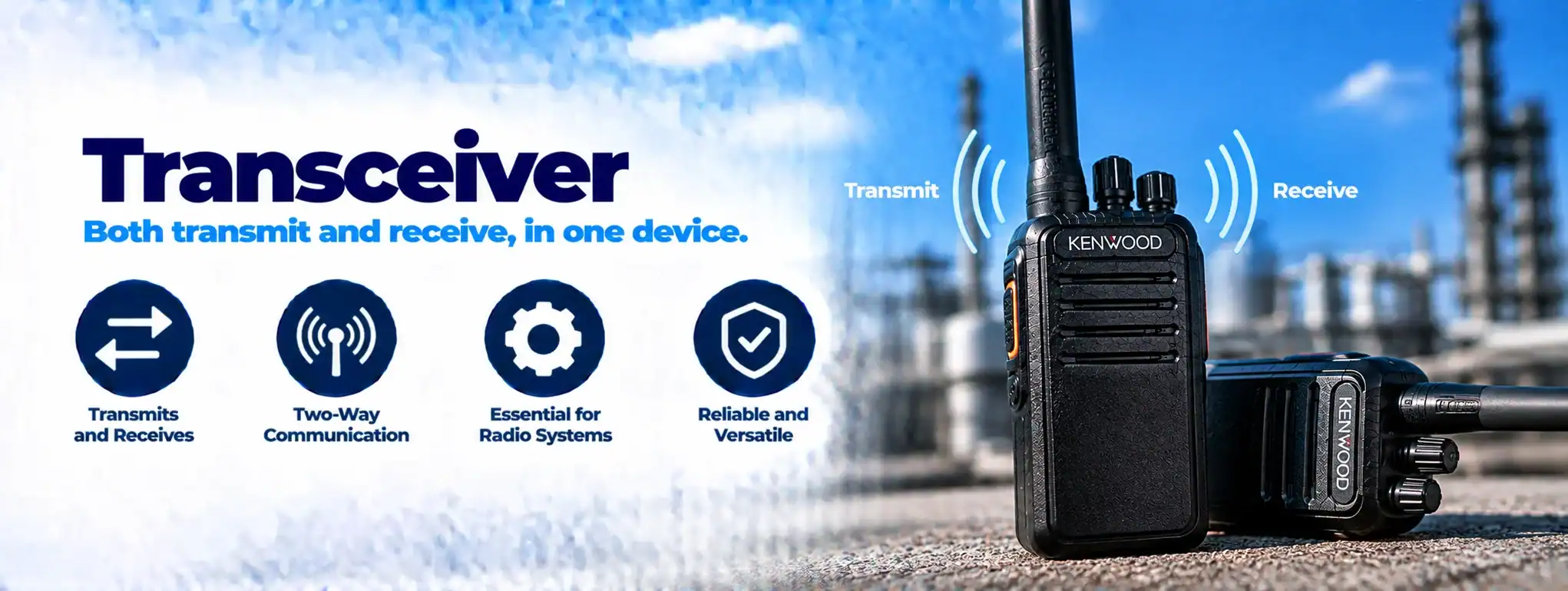
Transceiver
A Transceiver is an electronic device that combines a Transmitter and a ReceiverA Receiver is the part of a two-way radio that detects and processes incoming radio signals, converting them into audible voice or usable data for the user. in a single unit. In two-way radio, a transceiver allows a radio to both transmit and receive radio signals.
The word “transceiver” is formed from transmitter and receiver.
Most professional two-way radios are transceivers because they allow users to communicate in both directions.
What does a transceiver do?
A transceiver performs two main functions:
Transmit: Converts audio or data into a radio-frequency signal and sends it through the antennaAn antenna transmits and receives radio-frequency signals, allowing a two-way radio to communicate. Antenna type, frequency, height and location can all affect radio performance and coverage..
Receive: Captures a radio-frequency signal through the antenna and converts it into audio or data that the user can understand.
A typical two-way radio therefore works as:
User speaks → Transceiver transmits → Other radio receives
and:
Other radio transmits → Transceiver receives → User hears
Transceiver vs transmitter
A Transmitter only sends radio signals.
A Transceiver can both send and receive.
For example:
Transmitter: Sends a radio signal.
Receiver: Receives a radio signal.
Transceiver: Sends and receives radio signals.
This makes the transceiver the standard arrangement for two-way radio communications.
Transceiver vs receiver
A receiver is designed to receive radio signals but does not transmit.
A transceiver contains both receiving and transmitting circuitry.
A standard handheld two-way radio is therefore a transceiver rather than simply a receiver.
Transceiver in a two-way radio
A professional two-way radio contains a transceiver that handles the radio-frequency communication between the user and the wider radio systemA Radio System is a complete communication solution comprising two-way radios and, where required, equipment such as repeaters, antennas, base stations, mobile radios and network infrastructure..
The radio may also contain:
- Microphone
- Speaker
- Antenna
- Battery
- Display
- Controls
- Digital processing
- EncryptionEncryption protects two-way radio communications by converting voice or data into a secure form that can only be understood by authorised radios with the correct encryption capability and keys. functions
- GPS receiver
- Data functions
The transceiver is the part responsible for the core transmit and receive functions.
How a radio transceiver transmits
When the user presses the Push-to-Talk (PTT)Push-to-Talk (PTT) is the button or control used to activate a two-way radio's transmitter. Press it to speak and release it to listen. button and speaks, the transceiver:
- Receives the user’s audio through the microphone.
- Processes the audio.
- Modulates it onto a radio-frequency carrier.
- Amplifies the signal.
- Sends it through the antenna.
In a digital radio, the voice is first converted into a digital representation before being transmitted according to the relevant digital radio standard.
How a radio transceiver receives
When receiving a transmissionTransmission is the process of sending voice, data or signalling from a radio using a radio-frequency signal to another radio, repeater or communication system., the transceiver:
- Receives the RF signal through the antenna.
- Selects the required frequencyAn antenna transmits and receives radio-frequency signals, allowing a two-way radio to communicate. Antenna type, frequency, height and location can all affect radio performance and coverage..
- Filters unwanted signals.
- Demodulates or decodes the transmission.
- Processes the recovered audio or data.
- Sends audio to the speaker or information to the display/system.
Transceiver and antenna
The transceiver is connected to an Antenna, which converts electrical signals into radio waves during transmission and captures radio-frequency energy during reception.
Many handheld radios use a single antenna for both transmitting and receiving.
The transceiver switches between the transmit and receive paths as required.
Transceiver and half duplex
Most professional push-to-talk radios operate in Half-DuplexHalf-Duplex allows two-way communication in both directions, but users normally take turns transmitting. It is the standard operating method for most Push-to-Talk professional two-way radio systems. mode.
This means the radio normally either transmits or receives at a particular time.
The user presses PTT to transmit and releases it to listen.
The transceiver manages this switching automatically.
Transceiver and full duplex
A transceiver can also be designed for Full-Duplex operation, where transmission and reception can occur simultaneously.
However, conventional professional two-way radios used for push-to-talk communications normally operate in half-duplex mode.
Transceiver and simplex
In SimplexSimplex is a method of two-way radio communication where radios transmit and receive on the same frequency, communicating directly without a repeater. operation, two compatible transceivers communicate directly with one another without a repeaterA Repeater receives a two-way radio transmission and retransmits it, usually from an elevated location, to extend the coverage and reliability of a radio communication system..
For example:
Radio A → Radio B
Radio A transmits while Radio B receives.
When Radio B responds, their roles reverse.
Transceiver and repeater systems
In a repeater-based system, the user’s transceiver communicates with the Repeater.
The repeater receives the transmission and retransmits it, allowing other radios to receive the communication.
For example:
Radio A → Repeater → Radio B
The radios used by the users are transceivers.
Transceiver and base stations
A Base StationA base station is a fixed two-way radio installed at a permanent location, allowing an operator to communicate with handheld or mobile radios across a site or operating area. normally contains radio equipment capable of transmitting and receiving.
The distinction is primarily about how and where the equipment is deployed rather than whether it has transmit and receive capability.
A base station can therefore contain a transceiver.
Transceiver and mobile radios
A Mobile RadioA Mobile Radio is a two-way radio designed to be installed in a vehicle. It normally uses the vehicle's power supply and an external antenna to provide reliable communication while travelling or working in the field. installed in a vehicle is normally a transceiver.
It can transmit to other radios or infrastructureRadio infrastructure is the equipment and supporting systems behind a professional two-way radio network, including repeaters, antennas, base stations, network connections, power systems and dispatch equipment. and receive their communications.
Vehicle-mounted transceivers can often use an external antenna mounted on the vehicle.
Transceiver and portable radios
A handheld Portable RadioA Portable Radio is a battery-powered two-way radio designed to be carried and operated by an individual, providing mobile communication for professional and operational users. is normally a compact transceiver.
It combines the transmitter and receiver with the controls, battery, microphone, speaker and antenna required for mobile operation.
Transceiver and subscriber units
A Subscriber UnitA Subscriber Unit is a two-way radio device used by an individual or vehicle to access and communicate through a radio system. It can be a portable or mobile radio. can contain a transceiver.
The subscriber unit is the end-user device within the radio system, while the transceiver describes its ability to transmit and receive.
These terms therefore describe different aspects of the equipment.
Transceiver and DMR
A DMR (Digital Mobile Radio) handset is a digital transceiver.
It transmits and receives digital radio signals using the DMR standard.
DMR transceivers can support functions such as:
- Group calls
- Private calls
- Talk groups
- Data
- GPS
- Emergency signalling
- Text messaging
- Encryption, where supported
Transceiver and TDMA
DMR transceivers use Time Division Multiple Access (TDMA)Time Division Multiple Access (TDMA) is a technology that divides a radio channel into time slots, allowing multiple users or conversations to share the same frequency. DMR uses two time slots within a 12.5 kHz channel. to share a 12.5 kHz channelA two-way radio channel is a programmed set of communication settings, typically including frequency and signalling, that allows compatible radios to communicate with one another. using two time slots.
The transceiver synchronises its transmissions and reception with the relevant time slot.
This allows multiple logical communications to share the same RF channel.
Transceiver and analogue radio
Analogue two-way radios also contain transceiver circuitry.
The transceiver transmits an analogue-modulated RF signal and receives and demodulates compatible analogue signals.
Transceiver and digital radio
Digital transceivers convert information into digital signals for transmission and decode received digital signals.
Digital processing can provide functions such as:
- Error correction
- Digital voice
- Data communication
- Radio identification
- Group addressing
- Encryption
- GPS
The exact functions depend on the radio technology and model.
Transceiver and RF
The transceiver operates within a defined Radio Frequency (RF)Radio Frequency (RF) refers to electromagnetic waves used to transmit voice and data wirelessly. Two-way radios use RF signals to communicate between radios, repeaters and other system infrastructure. range.
Its transmitter generates RF energy at the configured frequencyFrequency is the number of cycles a radio wave completes each second, measured in Hertz. In two-way radio, frequency determines where a transmission operates within the radio spectrum., while its receiver detects signals within the appropriate frequency range.
The radio’s frequency capability depends on its design and configuration.
Transceiver and frequency
A transceiver can normally be programmed or configured to operate on one or more authorised frequencies or channels within its supported frequency range.
The radio must operate within the frequencies and technical conditions permitted by the relevant regulatory arrangements.
Transceiver and power output
The transmitter section of a transceiver determines how much RF powerAn antenna transmits and receives radio-frequency signals, allowing a two-way radio to communicate. Antenna type, frequency, height and location can all affect radio performance and coverage. is produced.
Power OutputPower Output is the amount of radio-frequency energy produced by a two-way radio's transmitter, normally measured in watts. It is one factor affecting coverage, alongside frequency, antenna, terrain and other conditions. is normally specified in watts.
Higher power does not automatically mean greater range because coverageRadio Coverage is the geographical area in which a two-way radio system can provide reliable communication. Coverage depends on the radios, antennas, frequency, terrain, buildings and system infrastructure. is also affected by:
- Antenna
- Terrain
- BuildingsAn antenna transmits and receives radio-frequency signals, allowing a two-way radio to communicate. Antenna type, frequency, height and location can all affect radio performance and coverage.
- Frequency
- Receiver sensitivity
- InterferenceRadio interference occurs when unwanted radio-frequency signals or electrical noise disrupt two-way radio communications, causing distorted audio, broken transmissions, reduced coverage or loss of communication.
- Antenna height
Transceiver and receiver sensitivity
The receiver section of a transceiver has a sensitivity specification indicating how weak a signal it can detect while maintaining the required performance.
Good receiver performance can be important in areas with weak or difficult radio coverage.
Transceiver and selectivity
Receiver selectivity is the ability to distinguish the desired signal from signals on nearby frequencies.
Good selectivity can help reduce the effect of unwanted signals and interference.
Transceiver and interference
The transceiver can be affected by Interference from other RF sources.
Interference can affect either the transmitter, receiver or both.
Good frequency planning, antenna installation and system design can reduce the risk of interference.
Transceiver and modulation
The transmitter section uses ModulationAnalogue radio uses continuously varying radio signals to transmit voice communication. It remains widely used for reliable two-way communication across business, industry, events, security and other applications. to place information onto an RF carrier.
Different radio technologies use different modulation techniques.
Analogue and digital systems therefore process and transmit information differently.
Transceiver and bandwidth
The transceiver operates within a defined channel bandwidth.
For example, professional radio systems may use narrowbandNarrowband describes a radio communication system that uses a relatively small amount of frequency spectrum to transmit information. It is widely used in professional two-way radio to make efficient use of available radio channels. channels designed to make efficient use of available spectrumSpectrum is the range of radio frequencies used for wireless communication. Two-way radios operate within specific parts of the radio spectrum, subject to frequency allocation and licensing requirements..
The transmitter and receiver must be configured appropriately for the channel being used.
Transceiver and narrowband
A Narrowband transceiver is designed to operate within relatively narrow RF channels.
Narrowband radio technology allows more channels to be accommodated within a limited amount of spectrum.
Transceiver and encryption
A digital transceiver may support Encryption to protect communications from unauthorised interception.
Encryption is performed by compatible radio and system equipment.
Not every transceiver supports encryption, and the available methods vary between systems.
Transceiver and GPS
Some professional transceivers contain an integrated GPS receiver.
This allows the radio to determine its position and, where supported, transmit the location through the radio networkA Network is a connected system of radios, equipment and infrastructure that allows users to communicate across a defined area. Radio networks can range from simple radio-to-radio systems to large multi-site networks..
GPS is a separate receiving function from the radio transceiver itself.
Transceiver and telemetry
A digital transceiver can potentially transmit TelemetryTelemetry is the automatic collection and transmission of information from a remote device, vehicle, machine or radio to another location for monitoring, analysis or control. and other data alongside voice communications.
For example, a radio could send:
- GPS position
- Status information
- Emergency alerts
- Equipment data
The available functions depend on the radio and communication system.
Transceiver and talk groups
Digital transceivers can be programmed with Talk Groups.
The user selects a group and presses PTT to communicate with the other radios assigned to that group.
The transceiver handles the required RF and digital signalling.
Transceiver and private calls
Compatible digital transceivers can support Private Calls between individual radio IDs.
This allows one user to communicate directly with another user without transmitting to an entire talk groupA Talk Group is a predefined group of users or radios within a two-way radio system that share a common communication group, allowing teams to communicate without involving other users..
Transceiver and scan lists
A transceiver can be programmed with a Scan ListA Scan List is a programmed collection of channels or talkgroups that a two-way radio monitors automatically when its scanning function is enabled. containing multiple channels or talk groups.
The receiver section monitors the configured channels according to the radio’s programming.
Transceiver and emergency functions
Professional transceivers may include emergency functions such as:
- Emergency buttonAn Emergency Button is a dedicated two-way radio control that allows users to quickly send an emergency alert to a dispatcher, control room or authorised radio users.
- Man DownMan Down is a safety feature on some professional two-way radios that can detect a possible fall or unusual radio position and automatically raise an alert if the user does not respond.
- Lone WorkerA Lone Worker is someone who works without direct supervision or immediate assistance nearby. Compatible two-way radios can provide safety features such as timed check-ins, emergency alerts and GPS location.
- Priority communications
- Emergency alerts
These features may use the transceiver to transmit an automatic or user-activated alert.
Transceiver and rugged radios
Professional Rugged Radios are designed for demanding working environments.
The transceiver is housed within the radio’s protective casing, which may provide resistance to:
- Dust
- Water
- Impact
- Vibration
The level of protection depends on the individual radio.
Transceiver and IP rating
The Ingress Protection (IP) RatingAn Ingress Protection (IP) Rating indicates how well electrical equipment, including two-way radios, is protected against dust, solid objects and water. Higher ratings provide greater protection. indicates the level of protection provided against solid particles and water under defined test conditions.
This is particularly relevant when selecting transceivers for outdoor, industrial or wet environments.
Transceiver and intrinsically safe radios
An Intrinsically Safe RadioAn Intrinsically Safe Radio is a two-way radio designed and certified for use in specified hazardous areas where flammable gases, vapours or combustible dust could create a risk of explosion. contains specially designed and certified circuitry for use in specified hazardous environments.
The certification applies to the complete approved equipment and its permitted accessories, not simply to the transceiver in isolation.
Transceiver and battery
Portable transceivers rely on rechargeable batteries to power their transmitter, receiver and other electronics.
Common battery technology includes Lithium-Ion.
Battery life depends on factors such as:
- Transmit time
- Receive time
- Standby time
- Power output
- Features in use
- Battery capacity
Transceiver and accessories
A transceiver can be connected to accessories such as:
- Remote Speaker Microphones
- Headsets
- Earpieces
- External antennas
- Chargers
- Programming cables
The available accessories depend on the radio model.
Transceiver and programming
A professional radio transceiver is normally programmed with the settings required for its intended system.
These can include:
- Frequencies
- Channels
- Talk groups
- Radio ID
- Power levels
- Scan lists
- Signalling
- Emergency functions
- Encryption settings
Programming should be carried out using appropriate manufacturer software and equipment.
Transceiver and OTAP
Some digital radio systems support Over-the-Air Programming (OTAP)Over-the-Air Programming (OTAP) allows compatible two-way radios to be configured or updated remotely through a radio network, reducing the need to physically connect each radio to a programming computer..
Where supported, configuration changes can be transmitted to compatible transceivers remotely.
This can reduce the need to physically connect every radio to a programming computer.
Transceiver and radio licensing
The fact that a device is a transceiver does not determine whether it requires a radio licence.
Some radios operate on licence-free services such as PMR446, while professional systems may operate on licensed frequencies.
In the UK, licensed radioA Licensed Radio is a two-way radio operated under an appropriate radio licence. Licensed systems can provide greater control over frequencies, coverage and infrastructure than licence-free radio services such as PMR446. use is regulated by OfcomOfcom (Office of Communications) is the UK's communications regulator. For two-way radio users, Ofcom manages and regulates access to radio spectrum and the use of radio frequencies in the UK..
Transceiver and radio hire
Professional Radio HireRadio Hire is the temporary rental of two-way radios and related communication equipment for events, projects and operational requirements, providing professional communication without purchasing the equipment. normally involves supplying transceiver equipment that has already been configured for the required communication system.
A hire system might include:
- Portable transceivers
- Mobile transceivers
- Repeaters
- Base stations
- Batteries
- Chargers
- Speaker microphones
The equipment can be programmed into appropriate channels and talk groups before deployment.
Transceiver and system design
When specifying transceivers for a radio system, the equipment should be matched to the application.
Consider:
- Portable or mobile operation.
- Required coverage.
- Frequency band.
- Analogue or digital technology.
- Power output.
- Battery life.
- Ruggedness.
- IP rating.
- Required accessories.
- Emergency features.
- GPS and data requirements.
- Licensing requirements.
- Compatibility with existing infrastructure.
Transceiver limitations
A transceiver does not automatically provide:
- Extended radio coverage
- Repeater functionality
- Network connectivity
- GPS tracking
- Encryption
- InteroperabilityInteroperability is the ability of different communication systems, devices or organisations to work together and exchange information. In two-way radio, it can connect different radio networks, technologies or users through compatible systems or gateways.
These capabilities depend on the equipment and the wider radio system.
Why transceivers matter
The transceiver is the core transmit-and-receive component of a two-way radio.
It allows a radio user to send and receive communications, whether operating directly with another radio or through infrastructure such as repeaters and radio networks.
In professional radio systems, the transceiver works together with antennas, batteries, controls and system infrastructure to provide reliable two-way communications.
Transceiver and DCS
DCS can supply professional portable and mobile radio transceivers for applications including security, construction, events, transport, hospitality, agriculture and industrial operations.
The appropriate transceiver depends on the required coverage, radio technology, working environment and features needed by the user.