Time Division Multiple Access (TDMA)
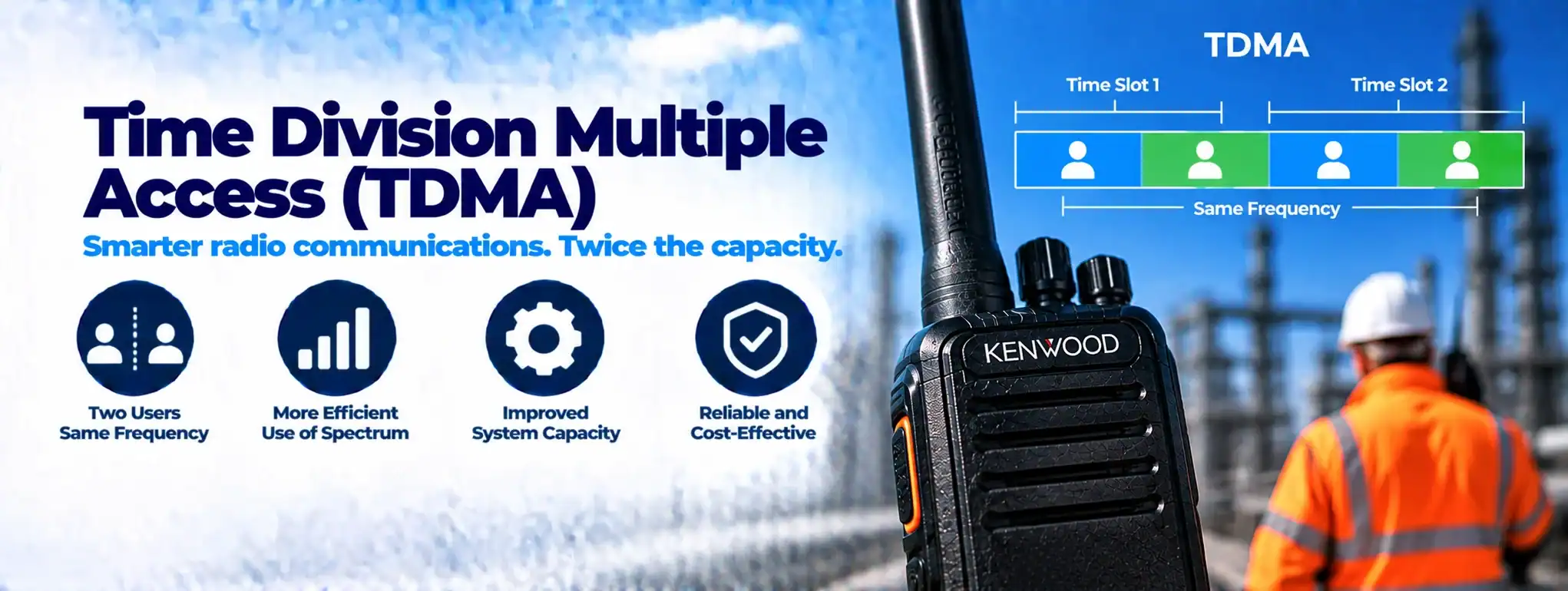
Time Division Multiple Access (TDMA) is a radio communication technology that allows multiple users to share the same radio-frequency channelA two-way radio channel is a programmed set of communication settings, typically including frequency and signalling, that allows compatible radios to communicate with one another. by dividing the available transmissionTransmission is the process of sending voice, data or signalling from a radio using a radio-frequency signal to another radio, repeater or communication system. time into separate time slots.
In professional two-way radio, TDMA is used by digital radio technologies such as DMR (Digital Mobile RadioA Mobile Radio is a two-way radio designed to be installed in a vehicle. It normally uses the vehicle's power supply and an external antenna to provide reliable communication while travelling or working in the field.) to make more efficient use of available radio spectrumSpectrum is the range of radio frequencies used for wireless communication. Two-way radios operate within specific parts of the radio spectrum, subject to frequency allocation and licensing requirements..
Instead of multiple users transmitting continuously on separate frequencies, TDMA allows transmissions to take turns using precisely timed portions of the same channel.
How does TDMA work?
TDMA divides a radio channel into repeating time slots.
For example:
Time Slot 1 → User or call
Time Slot 2 → User or call
The slots alternate rapidly, so to the users the communication appears continuous.
The radio systemA Radio System is a complete communication solution comprising two-way radios and, where required, equipment such as repeaters, antennas, base stations, mobile radios and network infrastructure. synchronises transmissions so that different users occupy their allocated time slots.
TDMA and DMR
TDMA is a fundamental part of DMR.
DMR uses two time slots within a 12.5 kHz channel.
This allows two logical communication paths to share the same physical RF channel, subject to the system’s configuration and traffic requirements.
For example:
12.5 kHz RF channel
→ Time Slot 1
→ Time Slot 2
This is one of the key ways DMR makes efficient use of radio spectrum.
Why does DMR use TDMA?
One of the main advantages of TDMA in DMR is improved Spectrum Efficiency.
Rather than requiring a separate 12.5 kHz RF channel for every simultaneous communication path, two conversations can share one 12.5 kHz channel by using different time slots.
This can provide additional communication capacity without requiring an additional RF channel.
TDMA and radio channels
A physical radio channel has a defined frequencyAn antenna transmits and receives radio-frequency signals, allowing a two-way radio to communicate. Antenna type, frequency, height and location can all affect radio performance and coverage. and bandwidth.
TDMA divides access to that channel by time.
This means that frequencyFrequency is the number of cycles a radio wave completes each second, measured in Hertz. In two-way radio, frequency determines where a transmission operates within the radio spectrum. and time are being used as two different dimensions of radio-resource management.
Frequency → Determines where the signal operates
Bandwidth → Determines how much spectrum it occupies
TDMA → Determines when users transmit
TDMA time slots
A Time Slot is a defined period during which a particular transmission is permitted to use the RF channel.
In a two-slot DMR system, the two slots repeatedly alternate.
The radio equipment handles the timing automatically, so the user normally does not need to think about the individual transmissions.
TDMA and simultaneous conversations
TDMA can make two conversations appear to happen simultaneously on the same RF channel.
Technically, the transmissions are taking place at different times.
The rapid alternation between time slots makes this practical for two-way voice communications.
TDMA and spectrum efficiency
TDMA improves the efficient use of available spectrum by allowing multiple communication paths to share the same RF channel.
This can be particularly valuable where spectrum availability is limited or where many users need access to a radio system.
TDMA and capacity
TDMA can increase the number of logical communication paths available from a given RF channel.
For DMR, two time slots are available on a 12.5 kHz channel.
However, TDMA does not provide unlimited capacity. The actual number of simultaneous users a system can support depends on the number of RF channels, repeaters, sites, time slots and overall system architecture.
TDMA and DMR repeaters
A DMR repeaterA Repeater receives a two-way radio transmission and retransmits it, usually from an elevated location, to extend the coverage and reliability of a radio communication system. can provide two logical communication paths using the two DMR time slots available on a 12.5 kHz RF channel.
For example:
Time Slot 1 → Security
Time Slot 2 → Operations
The exact allocation depends on how the system is programmed.
TDMA and talk groups
Talk Groups can be associated with particular TDMA time slots in a DMR system.
For example:
Time Slot 1 → Security Talk GroupA Talk Group is a predefined group of users or radios within a two-way radio system that share a common communication group, allowing teams to communicate without involving other users.
Time Slot 2 → Maintenance Talk Group
This allows different operational groups to share the same physical RF channel.
A talk group and a time slot are separate concepts, however. The system configuration determines how they are related.
TDMA and simplex
DMR TDMA can also be used in direct radio-to-radio configurations, although the specific operation differs from repeater-based systems.
The capabilities depend on the DMR tier and equipment being used.
TDMA and conventional radio
Traditional analogue two-way radio does not normally use TDMA in the same way as DMR.
Analogue systems generally use continuous access to a channel during a transmission.
Digital radio technologies can divide channel access into precisely controlled time slots.
TDMA and analogue radio
TDMA is fundamentally a digital access technique.
An analogue radioAnalogue radio uses continuously varying radio signals to transmit voice communication. It remains widely used for reliable two-way communication across business, industry, events, security and other applications. system can use other forms of channel-sharing technology, but DMR’s two-slot TDMA implementation is a digital feature.
TDMA and digital radio
TDMA is particularly useful in digital radio because the system can precisely synchronise when each radio transmits.
Digital signalling allows the networkA Network is a connected system of radios, equipment and infrastructure that allows users to communicate across a defined area. Radio networks can range from simple radio-to-radio systems to large multi-site networks. to coordinate the time slots and reconstruct the transmitted information at the receiving radio.
TDMA and Push-to-Talk
When a user presses the Push-to-Talk (PTT)Push-to-Talk (PTT) is the button or control used to activate a two-way radio's transmitter. Press it to speak and release it to listen. button, the radio requests or uses the appropriate communication resource.
In a DMR system, the transmission is then placed into the appropriate TDMA time slot.
The user experiences this simply as pressing PTT and speaking.
TDMA and full duplex
TDMA should not be confused with Full DuplexFull Duplex allows two-way radio users to transmit and receive simultaneously, providing a continuous, telephone-style conversation rather than requiring users to take turns using Push-to-Talk. communication.
TDMA divides access to a channel by time.
Full duplexduplex, duplex radio, duplex communication, duplex frequencies, duplex operation, duplex spacing, frequency offset, repeater duplex, duplex repeater, full duplex, half duplex, radio repeater allows simultaneous transmission and reception through separate communication paths.
A DMR radio using TDMA is still normally a Half-DuplexHalf-Duplex allows two-way communication in both directions, but users normally take turns transmitting. It is the standard operating method for most Push-to-Talk professional two-way radio systems. push-to-talk radio.
TDMA and half duplex
Most professional DMR handheld radios operate in half-duplex mode.
The user presses PTT to transmit and releases it to receive.
TDMA determines how the radio system shares the RF channel during those transmissions.
TDMA and pseudo trunking
Pseudo TrunkingPseudo Trunking is a feature on some professional digital radio systems that allows multiple communication groups to share available radio resources more efficiently, without requiring a full trunked radio network. can use TDMA time slots more efficiently.
Rather than permanently leaving a time slot unused because a particular talk group is inactive, compatible systems can dynamically use available capacity for another communication.
This can improve utilisation of the available RF resources.
TDMA and trunked radio
TDMA can also form part of more sophisticated trunked radio systems.
A trunked network can dynamically allocate available radio resources to users and talk groups.
TDMA provides one method of dividing those resources.
TDMA and trunking are therefore related technologies but are not the same thing.
TDMA and frequency division multiple access
Frequency Division Multiple Access (FDMA) separates users by frequency.
For example:
User A → Frequency 1
User B → Frequency 2
TDMA instead separates users by time:
User A → Time Slot 1
User B → Time Slot 2
Both approaches can be used to allow multiple users to share communication resources.
TDMA vs FDMA
| Feature | TDMA | FDMA |
|---|---|---|
| Separation method | Time | Frequency |
| Users share | Same RF channel | Different frequencies |
| DMR | Yes | Not the standard DMR access method |
| Spectrum use | Time-separated | Frequency-separated |
| Key principle | Who transmits when | Who transmits where |
TDMA and 12.5 kHz channels
A major feature of DMR is its ability to provide two TDMA time slots within a 12.5 kHz channel.
This allows DMR to provide two logical voice paths while maintaining a 12.5 kHz channel spacing.
This is an important distinction between channel bandwidth and communication capacity.
TDMA and channel bandwidth
TDMA does not necessarily reduce the RF bandwidth of the channel itself.
In DMR, the channel remains 12.5 kHz wide while the available transmission time is divided into two slots.
This provides additional logical capacity within the existing channel bandwidth.
TDMA and spectrum licensing
TDMA does not remove the need for appropriate spectrum licensing.
If the DMR system operates on licensed business-radio frequencies, the required OfcomOfcom (Office of Communications) is the UK's communications regulator. For two-way radio users, Ofcom manages and regulates access to radio spectrum and the use of radio frequencies in the UK. licence and conditions still apply.
TDMA improves the efficiency of the radio technology; it does not make a licensed frequency licence-free.
TDMA and Ofcom
In the UK, Ofcom manages the radio spectrum.
A DMR system using licensed spectrum must operate within the conditions of the relevant licence.
The use of TDMA does not change those regulatory requirements.
TDMA and radio interference
TDMA can help make efficient use of available spectrum, but it does not eliminate RF interferenceRadio interference occurs when unwanted radio-frequency signals or electrical noise disrupt two-way radio communications, causing distorted audio, broken transmissions, reduced coverage or loss of communication..
Interference can still affect a DMR system if unwanted signals affect the operating frequency.
Good frequency planning and a suitable Site SurveyA Site Survey is an assessment of a location to determine whether a two-way radio system will provide the required coverage, reliability and performance. remain important.
TDMA and coverage
TDMA does not automatically increase the physical range of a radio.
CoverageRadio Coverage is the geographical area in which a two-way radio system can provide reliable communication. Coverage depends on the radios, antennas, frequency, terrain, buildings and system infrastructure. is affected by:
- Frequency
- Transmitter powerAn antenna transmits and receives radio-frequency signals, allowing a two-way radio to communicate. Antenna type, frequency, height and location can all affect radio performance and coverage.
- AntennaAn antenna transmits and receives radio-frequency signals, allowing a two-way radio to communicate. Antenna type, frequency, height and location can all affect radio performance and coverage.
- Antenna height
- Terrain
- BuildingsAn antenna transmits and receives radio-frequency signals, allowing a two-way radio to communicate. Antenna type, frequency, height and location can all affect radio performance and coverage.
- ReceiverA Receiver is the part of a two-way radio that detects and processes incoming radio signals, converting them into audible voice or usable data for the user. sensitivity
- Interference
TDMA primarily concerns how users share the available RF channel.
TDMA and repeater capacity
A DMR repeater operating with two TDMA time slots can provide two logical communication paths on one RF channel.
For a busy system, additional channels or repeaters may still be required.
TDMA and radio system design
When designing a DMR system, TDMA capacity should be considered alongside:
- Number of users
- Talk groups
- Expected call traffic
- Number of channels
- Number of repeaters
- Coverage requirements
- Multi-site requirements
- Network infrastructureRadio infrastructure is the equipment and supporting systems behind a professional two-way radio network, including repeaters, antennas, base stations, network connections, power systems and dispatch equipment.
The number of radios alone does not determine the required capacity.
TDMA and multi-site systems
TDMA can be used in multi-site DMR systems.
Each site can provide its own RF resources, while network infrastructure can connect the sites.
Site A → DMR repeater
Site B → DMR repeater
IP network → Links the sites
TDMA operates within the radio channels at each site.
TDMA and IP Site Connect
IP Site ConnectIP Site Connect links compatible DMR radio sites using an IP network, allowing selected radio communications to be shared between separate buildings, facilities or geographical locations. can connect compatible DMR repeaters over an IP network.
The connected sites can share selected talk groups, allowing users at different locations to communicate.
TDMA continues to provide the two-slot RF access mechanism at each DMR site.
TDMA and roaming
RoamingRoaming allows a compatible two-way radio to move between different radio sites or coverage areas, automatically selecting an appropriate site as the user moves. allows compatible radios to move between coverage areas and select another suitable radio site.
Where supported, a radio can maintain access to configured talk groups while moving between sites.
TDMA is the underlying channel-access mechanism at the DMR sites.
TDMA and subscriber units
A Subscriber UnitA Subscriber Unit is a two-way radio device used by an individual or vehicle to access and communicate through a radio system. It can be a portable or mobile radio. such as a DMR handheld or mobile radio uses the configured TDMA resources when communicating through the system.
The radio handles the timing automatically.
TDMA and portable radios
Portable DMR radios can use TDMA to communicate efficiently over the available RF channel.
The user does not manually select individual TDMA transmission intervals during normal operation.
TDMA and mobile radios
Vehicle-mounted DMR mobile radios can also use TDMA.
The same two-slot principle applies to compatible DMR equipment regardless of whether the subscriber unit is portable or mobile.
TDMA and talk group planning
When configuring a DMR system, talk groups can be assigned to appropriate time slots.
Careful planning can prevent unnecessary contention and make the best use of available system capacity.
TDMA and radio hire
Professional Radio HireRadio Hire is the temporary rental of two-way radios and related communication equipment for events, projects and operational requirements, providing professional communication without purchasing the equipment. systems using DMR can take advantage of TDMA to provide multiple communication groups using a limited number of RF channels.
For example, a temporary event system might use:
Time Slot 1 → Security
Time Slot 2 → Event Operations
This can help maximise available radio capacity.
TDMA and event communications
Large events may have many teams that need separate communication groups.
TDMA can help a DMR system support multiple operational groups efficiently.
However, the system still needs to be designed around the expected number and duration of simultaneous calls.
TDMA and security communications
Security teams can use separate DMR talk groups while sharing the underlying radio infrastructure.
TDMA allows the system to make efficient use of its available RF resources.
TDMA and construction
Construction sites can use DMR systems with TDMA to support different operational groups such as:
- Site management
- Plant
- Security
- Contractors
- Operations
The exact configuration depends on the site’s communication requirements.
TDMA and telemetry
DMR systems can carry data as well as voice.
Where supported, TDMA resources can be used for data applications such as TelemetryTelemetry is the automatic collection and transmission of information from a remote device, vehicle, machine or radio to another location for monitoring, analysis or control., GPS information and status messages.
The available data capacity is subject to the system’s configuration.
TDMA and GPS
GPS information transmitted by a DMR radio uses the radio system’s available data resources.
TDMA can provide the underlying mechanism for sharing those resources between users.
TDMA and emergency calls
Emergency communications can be given priority in some professional radio systems.
The exact behaviour depends on the radio technology and system configuration.
TDMA itself does not automatically make an emergency callAn Emergency Call is a priority two-way radio function that allows a user to quickly request assistance and, on supported systems, establish an urgent voice communication with a dispatcher or control room. higher priority.
TDMA and Quality of Service
Quality of Service (QoS)Quality of Service (QoS) is the management and prioritisation of network traffic to help important communications receive suitable bandwidth, latency and reliability, particularly on IP-based systems. refers to how communication resources are managed to achieve required performance.
In networked digital radio systems, QoS can be relevant to voice, data and control traffic.
TDMA provides structured access to the RF channel but is only one part of overall system performance.
TDMA and latency
Because transmissions occur within defined time slots, TDMA introduces a controlled timing structure.
For normal DMR voice communication, this is designed to operate transparently to the user.
System architecture, network links and traffic can introduce additional latencyLatency is the delay between a radio transmission being sent and the resulting voice or data being received. It can be introduced by digital processing, repeaters, IP networks, gateways and cloud systems..
TDMA and battery life
TDMA can allow a radio transmitter to be active for only part of the transmission period rather than continuously transmitting throughout the entire communication.
This can contribute to efficient use of the radio’s transmitter and potentially improve battery efficiency compared with continuously transmitting systems.
Actual battery life depends on the radio, duty cycle, power level and usage.
TDMA and encryption
EncryptionEncryption protects two-way radio communications by converting voice or data into a secure form that can only be understood by authorised radios with the correct encryption capability and keys. can be used with compatible digital radio systems using TDMA.
TDMA determines how the RF channel is shared; encryption protects the communication content.
These are separate functions.
TDMA and interoperability
Two radios using the same broad frequency range are not necessarily interoperable.
For direct communication, the radios need compatible technology and configuration, including the relevant DMR parameters where applicable.
TDMA limitations
TDMA does not:
- Increase radio range by itself.
- Eliminate interference.
- Replace a repeater.
- Make a radio full duplex.
- Automatically provide encryption.
- Remove licensing requirements.
- Create unlimited system capacity.
Its primary purpose is to allow multiple communications to share available radio resources efficiently.
Why TDMA matters
TDMA is an important technology in professional digital radio because it allows multiple communication paths to share the same RF channel through precisely timed transmissions.
In DMR, two TDMA time slots within a 12.5 kHz channel provide a practical way to increase logical communication capacity while making efficient use of the available radio spectrum.
TDMA and DCS
DCS can supply and configure professional DMR systems that use TDMA technology.
For organisations with multiple teams or high communication requirements, TDMA can help make efficient use of available radio channels while supporting separate talk groups and operational communications.