Pseudo Trunking
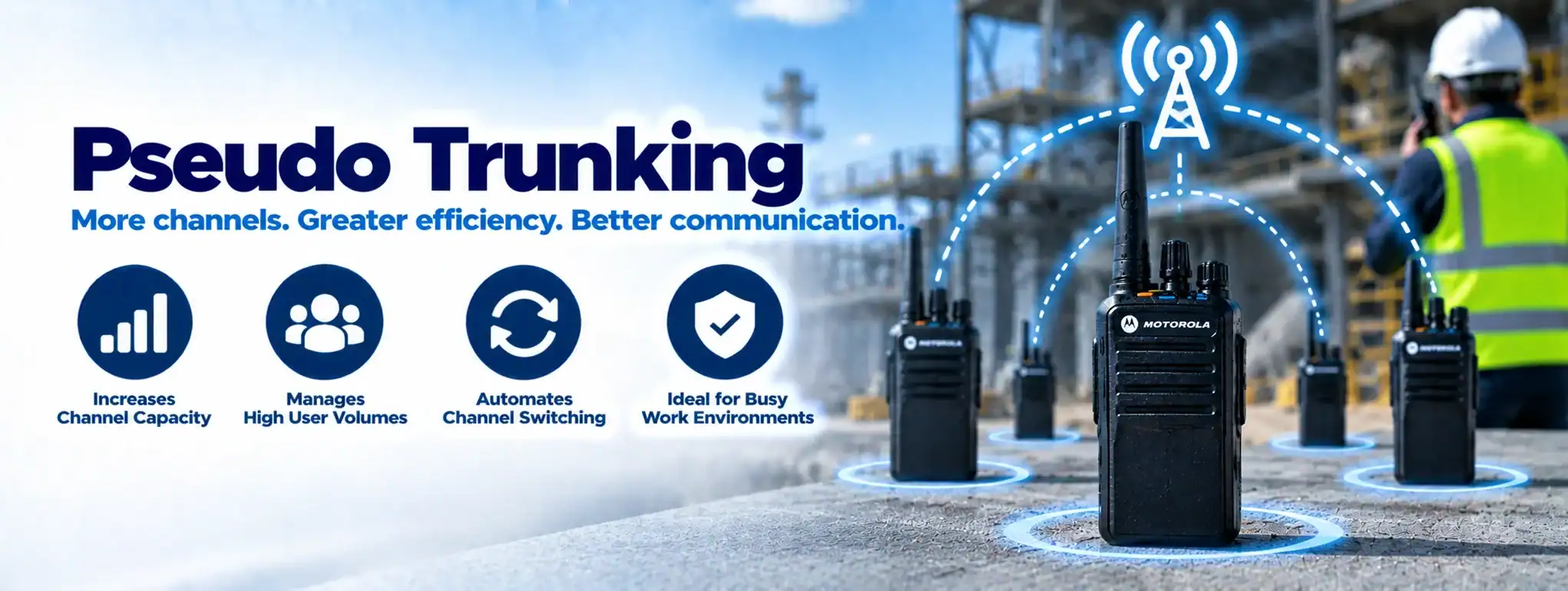
Pseudo Trunking is a feature available on some professional digital two-way radio systems that allows multiple communication groups to share a limited number of radio channels more efficiently.
Unlike a full Trunked Radio system, pseudo trunking does not normally use a central networkA Network is a connected system of radios, equipment and infrastructure that allows users to communicate across a defined area. Radio networks can range from simple radio-to-radio systems to large multi-site networks. to dynamically allocate frequencies or channels. Instead, compatible radios and repeaters use programmed channel-sharing techniques to make better use of available radio resources.
Pseudo trunking can therefore provide some of the benefits of trunking on a simpler radio systemA Radio System is a complete communication solution comprising two-way radios and, where required, equipment such as repeaters, antennas, base stations, mobile radios and network infrastructure..
What is pseudo trunking?
In a conventional radio system, different groups may be assigned separate channels.
For example:
ChannelA two-way radio channel is a programmed set of communication settings, typically including frequency and signalling, that allows compatible radios to communicate with one another. 1 → Security
Channel 2 → Maintenance
Channel 3 → Operations
If Security is not using Channel 1, that radio resource may sit unused even though another group is busy.
Pseudo trunking can allow compatible groups to share available channels more efficiently.
How pseudo trunking works
The exact method varies between manufacturers and radio technologies.
In a typical system, the radios monitor available channels and use an available resource for a conversation.
The system can then return the channel to the available pool when the communication finishes.
This allows multiple groups to share a smaller number of channels.
Pseudo trunking vs conventional radio
A conventional system may permanently associate each group with a particular channel.
For example:
Operations → Channel 1
Security → Channel 2
With pseudo trunking:
Operations + Security → Shared Channel Resources
The system can make better use of channels when traffic levels vary between groups.
Pseudo trunking vs full trunking
Pseudo trunking and full trunking are not the same.
Pseudo Trunking:
- Typically simpler
- Can use existing conventional radio infrastructureRadio infrastructure is the equipment and supporting systems behind a professional two-way radio network, including repeaters, antennas, base stations, network connections, power systems and dispatch equipment.
- Allows compatible groups to share channels
- Usually requires fewer system resources
- Does not provide all the capabilities of a full trunked network
Full Trunking:
- Uses a managed radio network
- Dynamically allocates communication resources
- Can support larger numbers of users
- Can provide advanced priority and network-management functions
Pseudo trunking is therefore better understood as a channel-efficiency feature rather than a complete trunked radio network.
Pseudo trunking and DMR
Pseudo trunking is particularly associated with some Digital Mobile Radio (DMR)Digital Mobile Radio (DMR) is an ETSI digital radio standard for professional two-way communications, supporting voice, group calling, data and other features on compatible radio systems. systems.
DMR systems can use multiple logical communication groups over a limited number of physical radio resources.
The exact pseudo-trunking implementation depends on the manufacturer and equipment.
Pseudo trunking and DMR repeaters
A DMR RepeaterA Repeater receives a two-way radio transmission and retransmits it, usually from an elevated location, to extend the coverage and reliability of a radio communication system. can provide the infrastructure needed for compatible pseudo-trunking functionality.
For example:
Multiple Talkgroups → Shared Repeater Resources
The repeater and radios must support the relevant feature.
Not every DMR repeater provides pseudo trunking.
Pseudo trunking and talkgroups
A Talkgroup is a defined group of users who share a communication channel or logical communication resource.
Pseudo trunking can allow several talkgroups to share available physical radio resources.
For example:
Talkgroup A → Operations
Talkgroup B → Security
Talkgroup C → Maintenance
The system can allocate available resources according to the current communication requirements.
Pseudo trunking and time slots
DMR uses Time Division Multiple Access (TDMA)Time Division Multiple Access (TDMA) is a technology that divides a radio channel into time slots, allowing multiple users or conversations to share the same frequency. DMR uses two time slots within a 12.5 kHz channel..
A DMR repeater can provide two logical time slots on a single 12.5 kHz radio-frequency channel.
Pseudo trunking can use these available resources more efficiently, depending on the implementation.
This can allow multiple conversations to share the available radio capacity.
Pseudo trunking and channel efficiency
The main advantage of pseudo trunking is improved utilisation of available radio resources.
If one group is busy while another group is quiet, shared resources can potentially be used by the busy group rather than remaining permanently assigned to the quiet group.
Pseudo trunking and capacity
Pseudo trunking can increase the practical efficiency of a radio system, but it does not create unlimited capacity.
There are still physical limitations on:
- Number of channels
- Number of time slots
- Repeater capacity
- Simultaneous conversations
- System configuration
If too many users attempt to communicate simultaneously, the available resources can still become congested.
Pseudo trunking and busy systems
Pseudo trunking can be particularly useful when communication demand varies throughout the working day.
For example, a site may normally have several teams but only one or two teams may be communicating at any given moment.
Sharing the available radio resources can reduce wasted capacity.
Pseudo trunking and priority calls
Some systems can combine channel-sharing features with Priority CallPriority Call is a two-way radio feature that gives important or authorised communications higher priority than routine radio traffic, helping urgent messages access the system when channels are busy. functionality.
Priority communication may receive preferential access to available resources where supported.
The exact behaviour depends on the radio manufacturer and system configuration.
Pseudo trunking and emergency calls
Emergency communication can have priority over routine communications on compatible systems.
An Emergency CallAn Emergency Call is a priority two-way radio function that allows a user to quickly request assistance and, on supported systems, establish an urgent voice communication with a dispatcher or control room. may therefore be given preferential access to available radio resources.
However, pseudo trunking itself does not automatically make a call an emergency or guarantee priority.
Pseudo trunking and private calls
Private CallPrivate Call is a two-way radio feature that allows one radio user to communicate directly with another individual radio user rather than making the conversation part of a general group call. functionality can be available alongside pseudo trunking on compatible digital radio systems.
The system can manage individual and group communications according to its configuration.
Pseudo trunking and group calls
Group calls are one of the main applications for pseudo-trunking systems.
Different teams can operate as separate talkgroups while sharing the available physical radio resources.
Pseudo trunking and conventional radio
Pseudo trunking can provide some additional resource-sharing capabilities without requiring the full infrastructure of a trunked network.
This can make it attractive to organisations that want greater efficiency while retaining a relatively straightforward radio system.
Pseudo trunking and trunked radio
A full trunked system normally includes more sophisticated network control.
For example:
Radio → Trunking Infrastructure → Assigned Channel → Radio
The network determines which communication resource is assigned.
Pseudo trunking is generally less sophisticated and relies on compatible radio and repeater behaviour rather than a complete trunking controller.
Pseudo trunking and infrastructure
A pseudo-trunking system can require less infrastructure than a full trunked network.
Depending on the system, it may consist of:
- Portable radios
- Mobile radios
- DMR repeater
- AntennaAn antenna transmits and receives radio-frequency signals, allowing a two-way radio to communicate. Antenna type, frequency, height and location can all affect radio performance and coverage. system
- Programming software
Larger systems may require additional infrastructure.
Pseudo trunking and radio programming
Pseudo trunking normally requires specific configuration in the radio’s CodeplugA Codeplug is the configuration data programmed into a two-way radio that defines its channels, frequencies, talkgroups, radio ID and other operating features..
An engineer may need to configure:
- Channels
- Talkgroups
- Time slots
- Radio IDs
- Repeater parameters
- Scan settings
- Priority settings
The exact requirements depend on the manufacturer.
Pseudo trunking and programming cables
A Programming CableA Programming Cable connects a two-way radio to a computer so compatible programming software can configure, update or service the radio's settings. can be used to configure compatible radios for pseudo-trunking operation.
The appropriate manufacturer programming software and equipment are required.
Pseudo trunking and radio coverage
Pseudo trunking does not increase the physical coverageRadio Coverage is the geographical area in which a two-way radio system can provide reliable communication. Coverage depends on the radios, antennas, frequency, terrain, buildings and system infrastructure. of a radio system.
Coverage still depends on factors such as:
- FrequencyAn antenna transmits and receives radio-frequency signals, allowing a two-way radio to communicate. Antenna type, frequency, height and location can all affect radio performance and coverage.
- Antenna
- Transmitter powerAn antenna transmits and receives radio-frequency signals, allowing a two-way radio to communicate. Antenna type, frequency, height and location can all affect radio performance and coverage.
- Terrain
- BuildingsAn antenna transmits and receives radio-frequency signals, allowing a two-way radio to communicate. Antenna type, frequency, height and location can all affect radio performance and coverage.
- Repeater location
A Dead SpotA Dead Spot is an area where two-way radio communication is weak, unreliable or unavailable. Dead spots can be caused by buildings, terrain, distance, interference or inadequate radio coverage. remains a dead spot regardless of whether the system uses pseudo trunking.
Pseudo trunking and radio hire
Pseudo trunking can be useful in professional Radio HireRadio Hire is the temporary rental of two-way radios and related communication equipment for events, projects and operational requirements, providing professional communication without purchasing the equipment. systems where several operational groups need to share a limited number of radio resources.
For example, at a large event:
Security + Production + Operations
could potentially share available DMR resources while maintaining separate talkgroups.
The supplied radios and repeater must support the required functionality.
Pseudo trunking for events
Events can have variable communication requirements.
For example, security may be extremely busy during periods of high visitor activity, while production traffic may be relatively quiet.
Shared radio resources can potentially make more efficient use of the available system capacity.
Pseudo trunking for construction
A construction site may have several teams using separate talkgroups.
Pseudo trunking can allow the available radio resources to be shared rather than permanently dedicating a separate resource to each team.
Pseudo trunking for security
Security organisations can use separate communication groups for:
- Security officers
- Supervisors
- Control room
- Management
Where supported, pseudo trunking can help make more efficient use of the available radio capacity.
Pseudo trunking for transport
Transport operations can have different groups for drivers, dispatch and maintenance.
Shared radio resources can help accommodate varying communication demand between those groups.
Pseudo trunking for hospitality
Hotels, venues and large facilities can use separate talkgroups for different departments while sharing available radio resources.
For example:
Security
Maintenance
Operations
Management
Pseudo trunking and encryption
Compatible digital radio systems can support EncryptionEncryption protects two-way radio communications by converting voice or data into a secure form that can only be understood by authorised radios with the correct encryption capability and keys. alongside pseudo trunking.
Encryption protects the content of a communication, while pseudo trunking manages the use of radio resources.
They are separate functions.
Pseudo trunking and GPS
Compatible radios may also support GPS (Global Positioning System)GPS is a satellite-based positioning system that allows compatible two-way radios to determine their location. GPS data can support tracking, dispatch, fleet management and Geo-Fencing. alongside pseudo trunking.
GPS provides location information and does not directly control how radio channels are shared.
Pseudo trunking and dispatch
A Dispatch system can be used alongside pseudo trunking where supported.
Dispatchers may communicate with different talkgroups while the underlying radio system manages available resources.
The exact functionality depends on the radio infrastructure.
Pseudo trunking and multi-site systems
Pseudo trunking can form part of a wider radio system, but it should not be confused with full multi-site trunking.
Connecting several sites requires additional network infrastructure and system design.
Pseudo trunking and interoperability
Different manufacturers can implement channel-sharing functions differently.
InteroperabilityInteroperability is the ability of different communication systems, devices or organisations to work together and exchange information. In two-way radio, it can connect different radio networks, technologies or users through compatible systems or gateways. should therefore be checked carefully before combining equipment from different manufacturers.
Compatible DMR equipment does not necessarily mean that every proprietary pseudo-trunking feature will operate across different manufacturers.
Pseudo trunking limitations
Pseudo trunking is not suitable for every radio application.
Limitations can include:
- Manufacturer-specific implementation
- Limited capacity
- Requirement for compatible radios
- Requirement for compatible repeaters
- More complex programming
- Limited functionality compared with full trunking
- Possible incompatibility between manufacturers
A proper system assessment should be carried out before selecting the technology.
Pseudo trunking and licensing
In the UK, professional radio systems may require an appropriate Ofcom Business Radio LicenceAn Ofcom Business Radio Licence authorises businesses and organisations in the UK to use specified radio frequencies for professional two-way radio communication, subject to the licence conditions..
Pseudo trunking does not remove the need to comply with applicable spectrumSpectrum is the range of radio frequencies used for wireless communication. Two-way radios operate within specific parts of the radio spectrum, subject to frequency allocation and licensing requirements. and licensing requirements.
The radio system must operate within the conditions of its authorisation.
Pseudo trunking and PMR446
Pseudo trunking should not be confused with the licence-free PMR446 service.
PMR446 equipment is subject to specific technical restrictions.
Professional DMR systems using pseudo trunking may operate under different regulatory arrangements.
Pseudo trunking and system design
When considering pseudo trunking, a radio system designer should assess:
- Number of users.
- Number of talkgroups.
- Expected traffic levels.
- Required coverage.
- Number of simultaneous conversations.
- Repeater capacity.
- DMR compatibility.
- Emergency requirements.
- Licensing.
- Future expansion.
Pseudo trunking vs full trunking — summary
| Feature | Pseudo Trunking | Full Trunking |
|---|---|---|
| Shared radio resources | Yes | Yes |
| Dynamic resource allocation | Limited / implementation dependent | Yes |
| Dedicated trunking infrastructure | Usually not required | Required |
| Complexity | Lower | Higher |
| Scalability | Limited | High |
| DMR compatibility | Common in some systems | Common |
| Multi-site capability | System dependent | Strong |
| Advanced network control | Limited | Extensive |
Pseudo trunking and DCS
DCS can advise on whether a conventional, pseudo-trunked or fully trunked radio systemA Trunked Radio System automatically shares and allocates available radio channels between users and talk groups, allowing many users to make efficient use of a limited number of radio resources. is appropriate for your operation.
Pseudo trunking can be a useful option where an organisation needs to make better use of limited DMR radio resources without the complexity and infrastructure requirements of a full trunked network.
The correct solution depends on the number of users, required talkgroups, expected traffic, coverage, repeater requirements and future expansion.