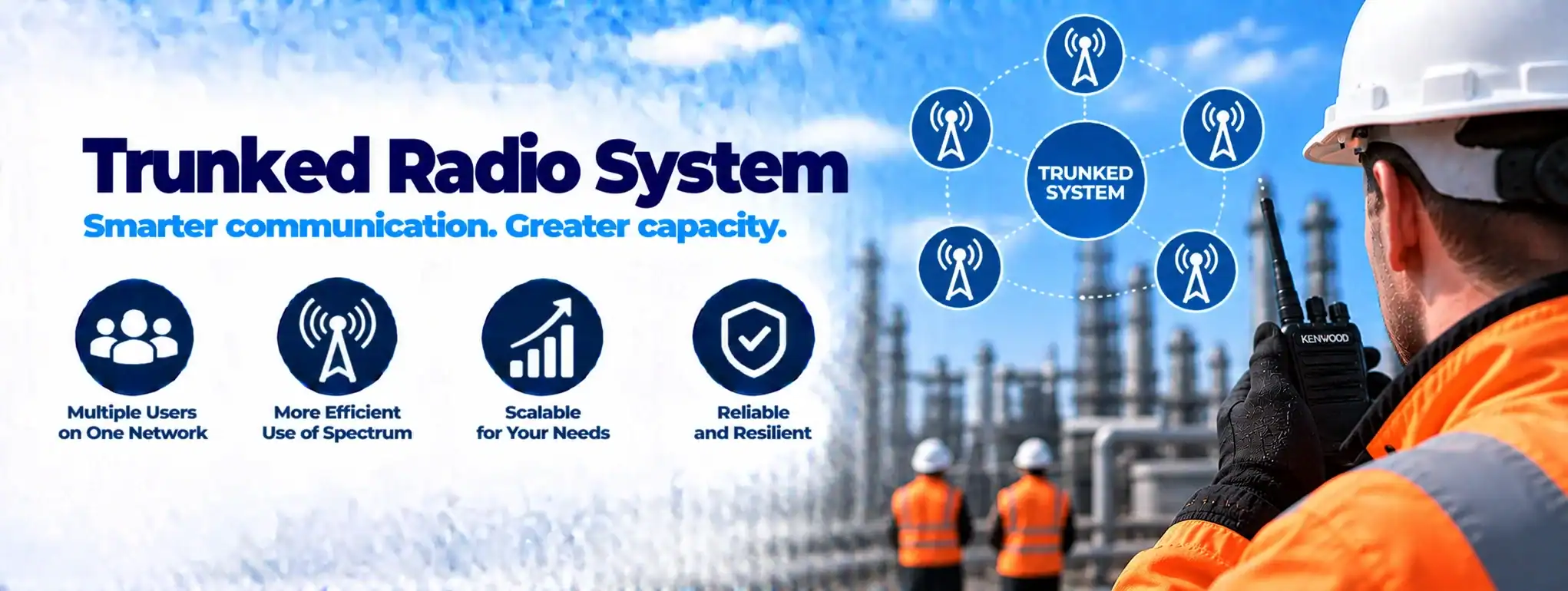
Trunked Radio System
A Trunked Radio SystemA Radio System is a complete communication solution comprising two-way radios and, where required, equipment such as repeaters, antennas, base stations, mobile radios and network infrastructure. is a radio communication system that automatically manages and allocates available radio channels or other communication resources between users and groups.
Instead of assigning a dedicated frequencyAn antenna transmits and receives radio-frequency signals, allowing a two-way radio to communicate. Antenna type, frequency, height and location can all affect radio performance and coverage. to each user or team, a trunked system maintains a shared pool of radio resources and dynamically assigns an available resource when a user makes a call.
This allows a large number of users to share a limited number of frequencies efficiently.
How does a trunked radio system work?
In a conventional radio system, users are normally assigned specific channels.
In a trunked system, users select a communication group and the system automatically determines which available radio resource should be used.
For example:
User presses PTT → System requests a resource → Available channelA two-way radio channel is a programmed set of communication settings, typically including frequency and signalling, that allows compatible radios to communicate with one another. allocated → Communication takes place
When the communication finishes, the resource becomes available for another user or group.
Trunking vs conventional radio
The key difference is how radio resources are managed.
Conventional radio:
User → Assigned channel → Communication
Trunked radio:
User → Talk GroupA Talk Group is a predefined group of users or radios within a two-way radio system that share a common communication group, allowing teams to communicate without involving other users. → System controller → Available channel → Communication
Trunking allows the system to share radio resources dynamically.
Trunked radio and talk groups
Talk Groups are central to many trunked radio systems.
Users select a talk group rather than manually selecting the underlying radio frequencyFrequency is the number of cycles a radio wave completes each second, measured in Hertz. In two-way radio, frequency determines where a transmission operates within the radio spectrum..
For example:
- Security
- Operations
- Maintenance
- Management
- Emergency
The trunked system then allocates the necessary radio resources when a call is initiated.
Talk Group ID
Each talk group normally has a unique identifier.
A Talk Group ID (TGID) allows the system to determine which users should receive a particular group communication.
The TGID is a logical identifier and is separate from the physical radio frequency.
Trunked radio and radio channels
A trunked system uses a pool of available radio channels.
When a call is requested, the system assigns an available channel or time slot.
Once the call ends, the resource can be returned to the shared pool.
Trunked radio and control channels
Many trunked systems use a Control Channel to carry signalling and system-management information.
The control channel can tell radios which communication resource has been assigned to a particular call.
The exact architecture varies between trunked radio technologies.
Trunked radio and system controller
A trunked system requires some method of managing radio resources.
A controller or networkA Network is a connected system of radios, equipment and infrastructure that allows users to communicate across a defined area. Radio networks can range from simple radio-to-radio systems to large multi-site networks. infrastructureRadio infrastructure is the equipment and supporting systems behind a professional two-way radio network, including repeaters, antennas, base stations, network connections, power systems and dispatch equipment. can determine:
- Which channel is available
- Which talk group is requesting access
- Which radios should receive the call
- Whether the call has priority
- When a resource can be released
This automated management is what distinguishes trunking from a simple conventional channel arrangement.
Trunked radio and spectrum efficiency
One of the main advantages of trunking is efficient use of radio spectrumSpectrum is the range of radio frequencies used for wireless communication. Two-way radios operate within specific parts of the radio spectrum, subject to frequency allocation and licensing requirements..
A conventional system may leave channels unused when their assigned users are not communicating.
A trunked system can make those resources available to other users when required.
This improves overall utilisation of the available radio capacity.
Trunked radio and capacity
Trunking does not create unlimited capacity.
The system still has a finite number of radio channels, time slots or other communication resources.
However, because those resources are shared dynamically, a trunked system can support more users than a conventional system with the same number of resources, particularly when individual users have intermittent communication requirements.
Trunked radio and busy systems
Trunking is particularly useful when many users need access to a radio system but do not all need to communicate continuously.
For example, a large organisation may have hundreds of users divided into multiple talk groups.
It would be inefficient to permanently dedicate a separate radio channel to every group.
Trunked radio and call queuing
If all available radio resources are occupied, a trunked system can place a call request into a queue or provide a busy indication.
Some systems support Queue CallQueue Call is a radio-system feature that can place a communication request in a queue when the required channel or network resource is temporarily unavailable, allowing it to proceed when a resource becomes free. or similar functionality.
The exact behaviour depends on the system design.
Trunked radio and priority calls
Professional trunked systems can support Priority CallPriority Call is a two-way radio feature that gives important or authorised communications higher priority than routine radio traffic, helping urgent messages access the system when channels are busy. functions.
Higher-priority users or calls can be given preferential access to available radio resources.
Emergency communications can also receive priority in appropriately configured systems.
Trunked radio and emergency calls
Emergency calls can be given priority over routine communications in many professional trunked systems.
Depending on the system, an emergency request can cause the network to allocate a resource even when normal capacity is heavily used.
The exact priority mechanism varies by technology.
Trunked radio and private calls
Trunked systems can support Private Calls between individual radio users.
The network allocates the required radio resources and directs the communication to the intended radio.
Trunked radio and group calls
Group calls are one of the most common uses of trunked radio.
A user selects a talk group and presses PTT.
The network then assigns the necessary resource and delivers the call to members of that group.
Trunked radio and all calls
Some trunked systems support an All Call function.
This can allow an authorised user or dispatcher to communicate with a broad group of radios.
The exact scope depends on the system configuration.
Trunked radio and DMR
Digital Mobile Radio (DMR)Digital Mobile Radio (DMR) is an ETSI digital radio standard for professional two-way communications, supporting voice, group calling, data and other features on compatible radio systems. systems can be designed with trunking capabilities.
DMR Tier III is a standardised trunked radio system designed for professional and business users.
DMR trunking allows radio resources to be managed dynamically rather than relying solely on fixed channel assignments.
DMR Tier III
DMR Tier III provides trunked operation within the DMR standard.
It supports features such as:
- Individual calls
- Group calls
- Data
- Control signalling
- Dynamic channel allocation
- Trunked operation
It is intended for larger and more sophisticated professional radio systems.
Trunked radio and DMR Tier II
DMR Tier II is generally used for conventional digital radio operation.
It can use two TDMA time slots within a 12.5 kHz channel but does not provide the same standardised trunking architecture as DMR Tier III.
This distinction is important when specifying a DMR system.
Trunked radio and TDMA
Time Division Multiple Access (TDMA)Time Division Multiple Access (TDMA) is a technology that divides a radio channel into time slots, allowing multiple users or conversations to share the same frequency. DMR uses two time slots within a 12.5 kHz channel. and trunking are different technologies.
TDMA divides access to a radio channel by time.
Trunking manages and allocates available communication resources between users.
They can be used together.
For example, DMR uses two TDMA time slots within a 12.5 kHz channel, while a trunked DMR system can dynamically allocate available resources to calls.
Trunked radio and pseudo trunking
Pseudo TrunkingPseudo Trunking is a feature on some professional digital radio systems that allows multiple communication groups to share available radio resources more efficiently, without requiring a full trunked radio network. is a simpler method of making more efficient use of available DMR time slots.
It should not be confused with a full trunked radio system.
Pseudo trunking can improve utilisation of available time slots but does not provide the complete network-management capabilities of a trunked system such as DMR Tier III.
Trunked radio and conventional repeaters
A conventional RepeaterA Repeater receives a two-way radio transmission and retransmits it, usually from an elevated location, to extend the coverage and reliability of a radio communication system. normally provides one or more fixed communication paths.
Users select the relevant channel and communicate through that repeater.
A trunked system uses network intelligence to allocate resources dynamically.
Trunked radio and repeaters
Trunked radio systems can still use repeater sites and radio infrastructure.
The difference is that the network controls how those radio resources are allocated.
A trunked system can therefore contain:
- Repeaters
- Antennas
- Controllers
- Network connections
- Control channels
- Subscriber units
- Dispatch systems
Trunked radio and subscriber units
A Subscriber UnitA Subscriber Unit is a two-way radio device used by an individual or vehicle to access and communicate through a radio system. It can be a portable or mobile radio. is the end-user radio.
In a trunked system, the subscriber unit communicates with the network and follows the system’s instructions regarding which radio resource to use.
The user normally sees talk groups rather than the underlying channel allocation.
Trunked radio and portable radios
Handheld Portable Radios can operate as subscriber units on trunked systems.
The user selects a talk group and presses PTT.
The network manages the underlying radio resources automatically.
Trunked radio and mobile radios
Vehicle-mounted Mobile Radios can also operate on trunked systems.
This is useful for fleets where drivers need access to several operational groups without manually managing individual frequencies.
Trunked radio and control rooms
A control room can manage multiple talk groups through a Dispatch console.
A dispatcher can communicate with:
- Individual radios
- Talk groups
- Multiple operational teams
- Emergency groups
The network handles the underlying resource allocation.
Trunked radio and dispatch
A trunked system can provide dispatchers with centralised control of radio communications.
Depending on the system, dispatch software may provide:
- Group calling
- Private calling
- Emergency alerts
- Radio status
- GPS location
- Call management
- Talk-group selection
Trunked radio and GPS
Compatible radios can transmit GPS location information through a trunked network.
A control room can potentially display the locations of vehicles or personnel.
GPS tracking is a separate application from the trunking function itself.
Trunked radio and telemetry
Trunked radio systems can support TelemetryTelemetry is the automatic collection and transmission of information from a remote device, vehicle, machine or radio to another location for monitoring, analysis or control. and other data services where the technology and infrastructure permit.
Data can include:
- Location
- Status
- Alarms
- Equipment information
- Short messages
Trunked radio and encryption
Professional trunked radio systems can support EncryptionEncryption protects two-way radio communications by converting voice or data into a secure form that can only be understood by authorised radios with the correct encryption capability and keys..
Encryption protects the content of communications, while trunking controls how radio resources are allocated.
These are separate system functions.
Trunked radio and interoperability
InteroperabilityInteroperability is the ability of different communication systems, devices or organisations to work together and exchange information. In two-way radio, it can connect different radio networks, technologies or users through compatible systems or gateways. depends on the radio standards, system configuration and network architecture.
Different trunked systems cannot necessarily communicate directly with one another.
Gateways or integrated communication platforms can sometimes connect otherwise separate systems.
Trunked radio and roaming
Large trunked systems can provide coverageRadio Coverage is the geographical area in which a two-way radio system can provide reliable communication. Coverage depends on the radios, antennas, frequency, terrain, buildings and system infrastructure. across multiple radio sites.
Compatible subscriber units can Roam between sites while maintaining access to the appropriate talk groups.
The network manages the radio resources as the user moves between coverage areas.
Trunked radio and multi-site systems
A trunked network can span multiple geographical locations.
For example:
Site A → Network → Site B → Network → Site C
Users can potentially communicate across the entire system while the network manages the underlying radio resources.
Trunked radio and IP networks
Modern trunked systems can use IP networks to connect radio sites and system components.
IP connectivity can carry:
- Voice
- Signalling
- Data
- Control information
- System-management traffic
Trunked radio and IP Site Connect
IP Site ConnectIP Site Connect links compatible DMR radio sites using an IP network, allowing selected radio communications to be shared between separate buildings, facilities or geographical locations. is a specific DMR feature used to connect compatible repeater sites over an IP network.
It should not be confused with full DMR Tier III trunking.
IP Site Connect can provide multi-site connectivity, while DMR Tier III provides a standardised trunked architecture.
Trunked radio and wide-area coverage
Trunking is particularly useful for organisations requiring communications over large areas.
Applications can include:
- Transport
- Utilities
- Public services
- Large industrial sites
- Logistics
- Security
- Large events
Trunked radio and security
Security organisations can use trunked systems to manage communications between multiple operational teams.
For example:
Security Talk Group
Control Talk Group
Emergency Talk Group
The network can dynamically allocate available resources as users communicate.
Trunked radio and transport
Transport operators can use trunked radio for communications between:
- Drivers
- Dispatchers
- Control rooms
- Depot staff
- Supervisors
Multiple operational groups can share the same radio infrastructure.
Trunked radio and utilities
Utility companies often operate across wide geographical areas.
Trunked radio can provide a structured communications network for field workers, supervisors and control rooms.
Trunked radio and industrial sites
Large industrial operations can use trunked systems to coordinate multiple teams.
Separate talk groups can be created for:
- Operations
- Maintenance
- Security
- Emergency response
- Management
Trunked radio and events
Large events can have many teams requiring different communication groups.
A trunked system can allow those groups to share a common radio infrastructure while keeping their communications logically separated.
Trunked radio and radio hire
For large temporary operations, professional Radio HireRadio Hire is the temporary rental of two-way radios and related communication equipment for events, projects and operational requirements, providing professional communication without purchasing the equipment. providers can deploy systems using trunking or other advanced radio architectures where required.
Trunking can be useful when a temporary operation has:
- Large numbers of users
- Multiple teams
- High communication traffic
- Multiple locations
- A requirement for centralised control
A smaller event may not require a trunked system.
Trunked radio and licence requirements
Trunking does not make a radio system licence-free.
If the system uses licensed business-radio spectrum in the UK, the appropriate OfcomOfcom (Office of Communications) is the UK's communications regulator. For two-way radio users, Ofcom manages and regulates access to radio spectrum and the use of radio frequencies in the UK. licence requirements still apply.
The system must operate within the technical and regulatory conditions of the licence.
Trunked radio and spectrum
Trunking can make more efficient use of the available radio spectrum by dynamically sharing channels between users.
This can reduce the amount of spectrum required to support a given user population compared with permanently assigning separate channels to each group.
Trunked radio and frequency planning
Although trunking improves resource utilisation, careful frequency planning remains essential.
A system must have sufficient radio resources to handle expected traffic.
Frequency planning should also consider:
- InterferenceRadio interference occurs when unwanted radio-frequency signals or electrical noise disrupt two-way radio communications, causing distorted audio, broken transmissions, reduced coverage or loss of communication.
- Coverage
- Adjacent systems
- Site locations
- AntennaAn antenna transmits and receives radio-frequency signals, allowing a two-way radio to communicate. Antenna type, frequency, height and location can all affect radio performance and coverage. arrangements
Trunked radio and coverage
Trunking does not automatically increase radio range.
Coverage depends on the radio infrastructure, including:
- Frequencies
- Antennas
- Transmitter powerAn antenna transmits and receives radio-frequency signals, allowing a two-way radio to communicate. Antenna type, frequency, height and location can all affect radio performance and coverage.
- Site locations
- Terrain
- BuildingsAn antenna transmits and receives radio-frequency signals, allowing a two-way radio to communicate. Antenna type, frequency, height and location can all affect radio performance and coverage.
- Repeaters
A Site SurveyA Site Survey is an assessment of a location to determine whether a two-way radio system will provide the required coverage, reliability and performance. can help determine the infrastructure required.
Trunked radio and system capacity
The capacity of a trunked system depends on:
- Number of channels
- Number of sites
- Traffic levels
- Number of simultaneous calls
- Talk-group configuration
- Time slots
- Network architecture
A larger number of registered radios does not necessarily mean all radios can communicate simultaneously.
Trunked radio and call traffic
Trunking works particularly well when users have intermittent communication requirements.
If every user were transmitting continuously, the shared pool of resources would quickly become saturated.
System capacity should therefore be designed around expected traffic patterns.
Trunked radio and latency
A trunked call may involve additional signalling before the communication resource is allocated.
This can introduce a small amount of call setup delay compared with a simple conventional radio channel.
Modern systems are designed to keep this delay low enough for normal operational use.
Trunked radio and quality of service
Quality of Service (QoS)Quality of Service (QoS) is the management and prioritisation of network traffic to help important communications receive suitable bandwidth, latency and reliability, particularly on IP-based systems. can be used to manage the performance and priority of communications within a networked radio system.
Priority and emergency traffic can receive preferential treatment where supported.
Trunked radio and queue calls
When all available resources are occupied, some trunked systems can queue call requests.
This allows the system to manage congestion rather than simply allowing every new call attempt to fail immediately.
Trunked radio and priority
Priority levels can be assigned to users, talk groups or calls.
This allows important communications to receive access to limited resources ahead of lower-priority traffic.
Trunked radio and emergency priority
Emergency communications can be given the highest priority in appropriately configured systems.
This can be particularly important for organisations where communications must continue during periods of heavy radio traffic.
Trunked radio limitations
A trunked radio system does not:
- Create unlimited radio capacity.
- Automatically improve coverage.
- Eliminate interference.
- Guarantee interoperability.
- Make communications private.
- Remove licensing requirements.
It is primarily a method of managing shared radio resources efficiently.
When is a trunked radio system appropriate?
Trunking is most useful when an organisation has:
- A large number of radio users.
- Multiple operational teams.
- High or variable communication traffic.
- Multiple sites.
- A requirement for centralised resource management.
- A need for priority or emergency communications.
Smaller operations may be better served by a conventional radio system.
Trunked radio system design
A professional trunked system should be designed around the organisation’s operational requirements.
Consider:
- Number of users.
- Number of talk groups.
- Expected simultaneous calls.
- Coverage area.
- Number of sites.
- Available frequencies.
- Repeater infrastructure.
- Data requirements.
- GPS requirements.
- Emergency communications.
- Dispatch requirements.
- Interoperability.
- Licensing.
- Future expansion.
Trunked radio vs talk groups
A talk group is a logical communication group.
Trunking is the method used by the network to manage the radio resources required by those groups.
They are complementary concepts rather than alternatives.
Trunked radio vs TDMA
TDMA divides access to a channel by time.
Trunking dynamically allocates available communication resources.
A system can use both technologies at the same time.
Trunked radio vs pseudo trunking
Pseudo trunking is a simpler mechanism for improving utilisation of available DMR time slots.
A full trunked radio system provides much more comprehensive resource management, including dynamic channel allocation and system control.
Trunked radio and DCS
DCS can design and supply professional radio systems for larger organisations where conventional radio channels may not provide sufficient capacity or operational flexibility.
Where appropriate, a trunked architecture can provide structured talk groups, centralised resource management, multi-site communications and priority handling.
The correct solution depends on the number of users, coverage requirements, traffic levels and operational structure.