
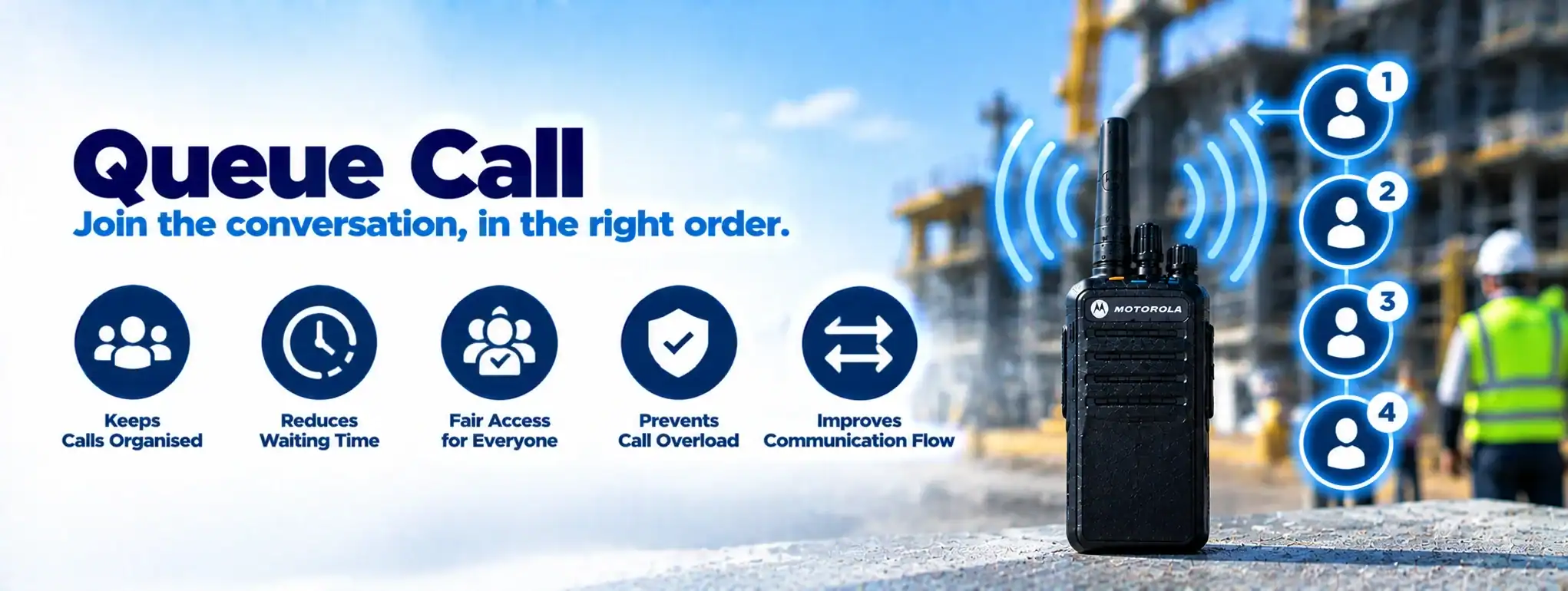
Queue Call
Queue Call is a radio communication feature that allows a call or communication request to be placed in a queue when the required communication resource is temporarily unavailable. Instead of the request being immediately rejected, the system can retain it and attempt to establish the call when the necessary resource becomes available.
Queue Call functionality is generally associated with more advanced digital, trunked or networked communication systems. The exact operation varies between radio manufacturers and system architectures.
What is a Queue Call?
A Queue Call occurs when a user requests a communication but the system cannot immediately provide the required channelA two-way radio channel is a programmed set of communication settings, typically including frequency and signalling, that allows compatible radios to communicate with one another., time slot or other communication resource.
For example:
User presses PTT → Resource unavailable → Call placed in queue → Resource becomes available → Call proceeds
This can help manage periods when many users are attempting to communicate simultaneously.
Why is Queue Call useful?
Queue Call can be useful on busy communication systems where demand occasionally exceeds the immediately available capacity.
It can help:
- Reduce failed call attempts
- Manage busy periods
- Make better use of available resources
- Prioritise important communications
- Provide users with an indication that their request is being handled
The exact behaviour depends on the system.
Queue Call and trunked radio
Queue Call is particularly relevant to Trunked Radio systems.
A trunked system dynamically allocates communication resources to users.
If all suitable resources are currently occupied, the system may place a new call request into a queue rather than immediately denying access.
For example:
Radio A → Channel 1
Radio B → Channel 2
Radio C → Call request → Queue
When a resource becomes available, the system can allocate it to Radio C according to its configured rules.
Queue Call and DMR
Compatible Digital Mobile Radio (DMR)Digital Mobile Radio (DMR) is an ETSI digital radio standard for professional two-way communications, supporting voice, group calling, data and other features on compatible radio systems. systems can provide call-management features that may include queuing, depending on the manufacturer, repeaterA Repeater receives a two-way radio transmission and retransmits it, usually from an elevated location, to extend the coverage and reliability of a radio communication system., controller and networkA Network is a connected system of radios, equipment and infrastructure that allows users to communicate across a defined area. Radio networks can range from simple radio-to-radio systems to large multi-site networks. architecture.
Queue behaviour is not an inherent feature of every DMR system.
The specific equipment and system configuration should therefore be checked.
Queue Call and conventional radio
Basic conventional radio systems normally do not provide sophisticated call queuing.
If all users are sharing a conventional channel, a user may simply have to wait until the channel becomes free before transmitting.
For example:
Channel Busy → User waits → Channel becomes available → User transmits
This is different from an automated Queue Call system.
Queue Call and channel capacity
The need for queuing is closely related to system capacity.
If a system has limited communication resources and many users attempt to communicate at the same time, some calls may have to wait.
A Queue Call mechanism can manage these requests.
However, queuing does not create additional capacity.
Queue Call and talkgroups
A Talkgroup allows a defined group of radio users to communicate.
In a busy trunked system, multiple talkgroups may compete for available communication resources.
Queue Call functionality can help manage calls when resources are temporarily unavailable.
Queue Call and priority
Not every queued call necessarily has the same importance.
Some professional communication systems can assign different priorities to users or calls.
For example:
Emergency CallAn Emergency Call is a priority two-way radio function that allows a user to quickly request assistance and, on supported systems, establish an urgent voice communication with a dispatcher or control room. → Highest Priority
Priority CallPriority Call is a two-way radio feature that gives important or authorised communications higher priority than routine radio traffic, helping urgent messages access the system when channels are busy. → High Priority
Routine Call → Normal Priority
A queued communication can then be handled according to the system’s priority rules.
Queue Call and Priority Call
Priority Call and Queue Call are related but different functions.
A Priority Call determines how important a communication is relative to other traffic.
Queue Call determines what happens when a communication resource is not immediately available.
A high-priority call may therefore move ahead of lower-priority calls in a queue where the system supports this functionality.
Queue Call and emergency communication
Emergency communications can receive special treatment on compatible systems.
For example, an Emergency Call may be given priority over routine queued calls.
This can be important in systems used for security, public safety, transport and other operational environments.
The exact emergency behaviour depends on the system configuration.
Queue Call and dispatch
A Dispatch system can manage communication requests across a large radio network.
Where queuing is supported, the system can manage multiple requests while allocating available resources according to configured priorities.
This can be useful in busy control rooms.
Queue Call and control rooms
Control rooms can have many simultaneous communication requirements.
For example:
- Security teams
- Supervisors
- Mobile workers
- Emergency communications
- Dispatchers
A queue mechanism can help prevent the system from simply rejecting every request when all communication resources are temporarily occupied.
Queue Call and network capacity
Queue Call can be particularly useful where network capacity varies according to demand.
A system may have sufficient resources most of the time but experience short periods of congestion.
Queuing can help manage these temporary peaks.
Queue Call and congestion
Network Congestion occurs when demand for communication resources exceeds what is immediately available.
A queue can provide controlled management of this congestion.
For example:
Available Capacity → 3 calls
Call Requests → 5
Result → 3 calls proceed, 2 are queued
The actual behaviour varies considerably between systems.
Queue Call and latency
A queued call introduces a delay because the communication cannot start immediately.
This is an important consideration for operationally critical communications.
A system should therefore provide appropriate priority mechanisms where immediate access is essential.
Queue Call and emergency priority
A well-designed professional communication system should distinguish between routine and emergency traffic where required.
An emergency communication should not necessarily wait behind ordinary calls simply because those calls were requested first.
Compatible systems can use priority mechanisms to address this.
Queue Call and radio users
The radio may provide an indication when a call has been queued.
Depending on the equipment, this could be communicated through:
- Display message
- Audible tone
- Indicator
- Vibration
- Other user notification
The available indication depends on the radio model.
Queue Call and radio displays
Digital radios can display information about the status of a communication request.
For example, the radio may indicate that:
- The channel is busy
- The call is queued
- The call has been granted
- The call has failed
The terminology used by the manufacturer may differ.
Queue Call and PTT
On a push-to-talk system, a Queue Call may be initiated when the user presses Push-to-Talk (PTT)Push-to-Talk (PTT) is the button or control used to activate a two-way radio's transmitter. Press it to speak and release it to listen. but the required communication resource is unavailable.
The user may then receive an indication that the request is waiting.
Queue Call and full duplex
Queue Call can theoretically apply to communication systems supporting different call types, but the feature is primarily associated with systems where communication resources are managed centrally.
It should not be assumed that a particular radio supports queuing simply because it supports Full DuplexFull Duplex allows two-way radio users to transmit and receive simultaneously, providing a continuous, telephone-style conversation rather than requiring users to take turns using Push-to-Talk. or Half-DuplexHalf-Duplex allows two-way communication in both directions, but users normally take turns transmitting. It is the standard operating method for most Push-to-Talk professional two-way radio systems. operation.
Queue Call and private calls
A queued request may be associated with an individual Private CallPrivate Call is a two-way radio feature that allows one radio user to communicate directly with another individual radio user rather than making the conversation part of a general group call. or group communication, depending on the system.
The system determines whether a suitable communication resource is available.
Queue Call and group calls
Group communications can generate significant resource demand because multiple users may need access to the same communication session.
Queuing can help manage requests when system capacity is temporarily exhausted.
Queue Call and radio networks
In larger radio networks, queue management can form part of the overall network-control architecture.
This can include:
- Resource allocation
- Call priority
- Talkgroup management
- Emergency handling
- Network capacity management
- Dispatch
Queue Call and multi-site radio
In a multi-site radio systemA Radio System is a complete communication solution comprising two-way radios and, where required, equipment such as repeaters, antennas, base stations, mobile radios and network infrastructure., calls may require communication resources across more than one location.
Network controllers can manage available resources and, where supported, queue requests when necessary.
Queue Call and IP networks
Networked radio systems can use IP infrastructureRadio infrastructure is the equipment and supporting systems behind a professional two-way radio network, including repeaters, antennas, base stations, network connections, power systems and dispatch equipment. to connect radio sites.
Where calls are managed through network controllers or servers, queuing can form part of the overall call-management process.
The underlying IP network must still provide adequate performance.
Queue Call and Quality of Service
Quality of Service (QoS)Quality of Service (QoS) is the management and prioritisation of network traffic to help important communications receive suitable bandwidth, latency and reliability, particularly on IP-based systems. can help prioritise time-sensitive traffic across IP networks.
QoS and Queue Call address different aspects of communication management.
QoS: Manages network traffic priority.
Queue Call: Manages calls waiting for communication resources.
Both can be used within a sophisticated networked communication system.
Queue Call and radio hire
Queue Call functionality is generally more relevant to larger professional radio systems than basic short-term radio hireRadio Hire is the temporary rental of two-way radios and related communication equipment for events, projects and operational requirements, providing professional communication without purchasing the equipment. systems.
However, a hired radio system operating on a managed trunked or networked service may include call queuing where supported by the underlying system.
Queue Call for events
Large events can experience periods of high communication demand.
For example, security, production and event-management teams may all attempt to communicate at the same time.
A managed communication system can use prioritisation and queuing to handle periods of increased demand.
Queue Call for security
Security operations may require multiple teams to communicate simultaneously.
Priority and queue management can help ensure that important communications receive appropriate access to limited system resources.
Queue Call for transport
Transport networks can experience periods where many drivers need to contact a control room at once.
A managed radio system can use call priority and resource management to handle this demand.
Queue Call for utilities
Utility organisations may have geographically distributed workers communicating with a central control operation.
During incidents, communication demand can increase sharply.
Call queuing and prioritisation can help manage increased traffic where supported.
Queue Call and system capacity planning
The presence of a Queue Call feature does not remove the need for capacity planning.
System designers should consider:
- Number of users
- Number of talkgroups
- Expected traffic
- Peak communication periods
- Number of simultaneous calls
- Emergency requirements
- Required response times
- Available channels or time slots
Queue Call limitations
Queue Call has limitations.
It cannot:
- Create additional radio spectrumSpectrum is the range of radio frequencies used for wireless communication. Two-way radios operate within specific parts of the radio spectrum, subject to frequency allocation and licensing requirements.
- Increase the number of physical channels
- Eliminate network congestion
- Guarantee immediate communication
- Replace appropriate system capacity planning
A call may still fail if the system remains unavailable or if the request exceeds configured limits.
Queue Call and radio system design
Whether Queue Call is appropriate depends on the scale and type of communication system.
A small business using a few radios on a conventional channel may have little need for automated call queuing.
A large organisation with many users, multiple talkgroups and a trunked network may benefit considerably from sophisticated resource and priority management.
Queue Call and DCS
DCS can advise on professional radio systems according to the number of users, required coverageRadio Coverage is the geographical area in which a two-way radio system can provide reliable communication. Coverage depends on the radios, antennas, frequency, terrain, buildings and system infrastructure., communication traffic and operational priorities.
For larger or more complex systems, features such as call prioritisation, resource management and queuing may form part of the overall system design.