
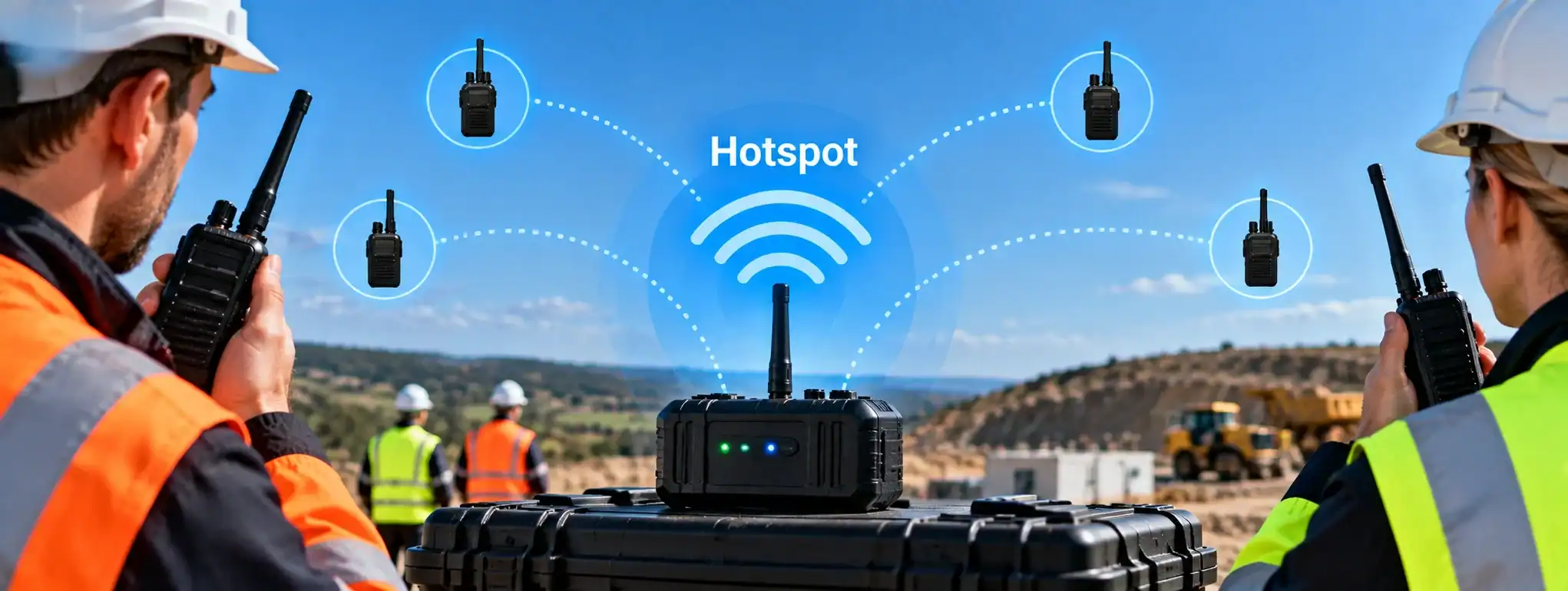
Hotspot
Hotspot is a radio or networkA Network is a connected system of radios, equipment and infrastructure that allows users to communicate across a defined area. Radio networks can range from simple radio-to-radio systems to large multi-site networks. device that provides a connection between a two-way radio systemA Radio System is a complete communication solution comprising two-way radios and, where required, equipment such as repeaters, antennas, base stations, mobile radios and network infrastructure. and another communication network, allowing radio users to communicate beyond the normal range of their local radio system.
In two-way radio terminology, the term Hotspot can refer to different types of equipment or configurations depending on the radio technology being used. It may provide a connection between a radio network and an IP network, internet service or another radio system.
A hotspot can therefore act as a bridge between otherwise separate communication environments.
How does a radio Hotspot work?
A hotspot receives communication from one system and passes it to another connected system.
A simplified example is:
Two-way radio → Hotspot → Network / Internet → Remote radio system
This can allow users in different locations to communicate even when they are outside the direct radio coverageRadio Coverage is the geographical area in which a two-way radio system can provide reliable communication. Coverage depends on the radios, antennas, frequency, terrain, buildings and system infrastructure. of one another.
The exact method depends on the radio technology and hotspot equipment.
Hotspot and radio coverage
A hotspot can extend the practical reach of a radio communication system by providing a network connection between locations.
However, a hotspot does not necessarily increase the RF range of the radio itself.
Instead, it can provide an alternative communication path where the local radio signal is unavailable.
For example, a radio user may be outside the coverage of a local repeaterA Repeater receives a two-way radio transmission and retransmits it, usually from an elevated location, to extend the coverage and reliability of a radio communication system. but able to communicate through a network-connected hotspot.
Hotspot and internet connectivity
Some radio hotspots use an internet or IP connection to link radio communications between locations.
The hotspot can provide a connection between the radio system and a remote server or network.
This allows communications to travel over an IP network rather than relying entirely on a direct radio-frequency path.
A suitable network connection is therefore required for systems that depend on internet connectivity.
Hotspot and IP networks
An IP network allows devices to exchange data using Internet Protocol.
A radio hotspot can act as an interface between the radio system and an IP network.
This can allow radio voice or signalling information to be transported between geographically separated locations.
Hotspot and DMR
Hotspots are commonly associated with some DMR (Digital Mobile RadioA Mobile Radio is a two-way radio designed to be installed in a vehicle. It normally uses the vehicle's power supply and an external antenna to provide reliable communication while travelling or working in the field.) applications.
A DMR hotspot can provide a connection between a local radio and a digital network, potentially allowing communication with other radios or systems connected to that network.
The exact capabilities depend on the hotspot, radio technology and network service being used.
Not every DMR radio system requires or supports a hotspot.
Hotspot and repeaters
A hotspot and a Repeater can both provide ways of extending communication, but they operate differently.
A repeater normally receives a radio transmissionTransmission is the process of sending voice, data or signalling from a radio using a radio-frequency signal to another radio, repeater or communication system. and retransmits it over radio frequencyAn antenna transmits and receives radio-frequency signals, allowing a two-way radio to communicate. Antenna type, frequency, height and location can all affect radio performance and coverage. to extend local RF coverage.
A hotspot can connect radio communications to an IP or other network.
In simplified terms:
Repeater: Radio → RF → Radio
Hotspot: Radio → Network → Radio
Some systems can use both technologies together.
Hotspot and gateway
A Gateway provides a connection between different communication networks or technologies.
A hotspot can perform a gateway-like function by connecting a radio system to an IP network.
The terms can overlap, but their precise meaning depends on the radio technology and system architecture.
Hotspot and Internet Radio
Some radio systems use the internet to connect users in different geographical areas.
A hotspot can provide the local interface between the radio and this network.
This can make it possible for a user with a compatible radio to communicate with another user who is many miles away.
Hotspot and wide-area radio
A hotspot can form part of a Wide-Area Radio system.
Instead of relying solely on the range of an individual repeater or radio site, communications can be transported over an IP network between geographically separated locations.
This can allow radio users in different towns, regions or countries to participate in the same communication system where the technology and network support it.
Hotspot and radio networks
A hotspot can be used as one component of a larger radio network.
For example:
Radio user → Local Hotspot → IP Network → Remote Radio Network
This type of architecture can connect otherwise separate radio systems.
Hotspot and talkgroups
Digital radio hotspots may provide access to Talkgroups on a compatible network.
A user can select an appropriate talkgroup on the radio, and the hotspot can pass the communication to the connected network.
The available talkgroups depend on the particular system and network configuration.
Hotspot and individual calls
Some digital radio systems can use hotspots to support individual radio communications across an IP network.
This allows a specific radio user to communicate with another authorised user through the connected system.
The availability of individual calling depends on the radio technology and network.
Hotspot and Push-to-Talk
Hotspot-connected radio systems can still use conventional Push-to-Talk (PTT)Push-to-Talk (PTT) is the button or control used to activate a two-way radio's transmitter. Press it to speak and release it to listen. operation.
The user presses the PTT button on the radio, and the communication is passed through the hotspot and connected network.
The fact that the communication travels over an IP network does not necessarily change the user’s radio interface.
Hotspot and digital radio
Hotspots are particularly associated with digital radio because digital voice and data can be transported through IP-based networks.
The radio system converts the user’s voice into the appropriate digital format, and the hotspot provides the connection to the wider network.
The exact process varies between technologies.
Hotspot and analogue radio
Hotspot-type gateway systems can also be used with some analogue radioAnalogue radio uses continuously varying radio signals to transmit voice communication. It remains widely used for reliable two-way communication across business, industry, events, security and other applications. technologies.
However, the equipment and network architecture required will differ from digital radio applications.
An analogue radio cannot simply connect to an arbitrary digital hotspot without suitable conversion and interface equipment.
Hotspot and cloud systems
Some modern radio systems use cloud-based services to connect geographically separated radio users.
A hotspot or network gateway can provide the connection between the local radio and the cloud platform.
This can allow centralised management, dispatch and communication across multiple locations.
Hotspot and Cloud Dispatch
A Cloud DispatchCloud Dispatch is a cloud-based radio management and communication system that allows authorised dispatchers to communicate with, monitor and manage two-way radio users through an internet-connected platform. platform can potentially use network-connected radio gateways or hotspots to connect radio users to a central dispatch environment.
A dispatcher may then be able to communicate with users across different geographical areas.
The exact architecture depends on the radio system and dispatch platform.
Hotspot and Cloud Management
Cloud ManagementCloud Management uses an online platform to remotely manage and monitor compatible two-way radios, users, devices and communication settings from a central location. allows administrators to manage compatible radio systems through network-based software.
Where a hotspot is part of the system, administrators may be able to configure or monitor aspects of the connected radio network remotely.
The management capabilities depend on the equipment and software.
Hotspot and GPS
A network-connected hotspot can potentially carry GPS or other location information from compatible radios to a remote system.
For example, a GPS-enabled radio may determine its location and send that information through the hotspot to a dispatch or management platform.
The hotspot itself does not normally determine the radio’s GPS position.
Hotspot and Geo-Fencing
Where GPS location information is available, a connected system may use it for Geo-FencingGeo-Fencing uses GPS and a virtual geographical boundary to identify when a radio user or tracked device enters or leaves a defined area, triggering alerts or other actions where supported..
For example:
GPS-enabled radio → Hotspot → Network → Geo-Fencing system
The system can then determine whether the radio has entered or left a predefined geographical area.
Hotspot and encryption
A hotspot can transport encrypted digital radio communications where the connected radio system and network support this arrangement.
The hotspot does not automatically provide EncryptionEncryption protects two-way radio communications by converting voice or data into a secure form that can only be understood by authorised radios with the correct encryption capability and keys..
Encryption must be implemented by the appropriate radio system or communication platform.
Hotspot and radio licensing
The use of a hotspot does not automatically remove the need to comply with applicable radio licensing requirements.
The radio equipment may still operate on licensed frequencies or licence-exempt frequencies depending on the system.
Network connectivity and radio-frequency operation are separate considerations.
Hotspot and PMR446
A hotspot should not automatically be assumed to be permitted or appropriate for PMR446 equipment.
PMR446 is designed as a licence-exempt short-range radio service with specific technical conditions.
Connecting PMR446 radios to external networks can alter the nature of the system and may not comply with the applicable conditions.
The regulatory requirements should therefore be checked before connecting radio equipment to a networked hotspot.
Hotspot and business radio
Professional business-radio systems can use network-connected gateways or similar technology to provide wider-area communications.
The appropriate solution depends on the radio technology, frequencyFrequency is the number of cycles a radio wave completes each second, measured in Hertz. In two-way radio, frequency determines where a transmission operates within the radio spectrum. licence, network requirements and operational objectives.
A hotspot is not necessarily required for a conventional business-radio system.
Hotspot and radio hire
Hotspots can potentially form part of specialist temporary radio systems where wider-area or network-connected communications are required.
For example, a temporary operation with teams working across separate locations may use network connectivity to link radio communications.
This is more specialised than a standard local Radio HireRadio Hire is the temporary rental of two-way radios and related communication equipment for events, projects and operational requirements, providing professional communication without purchasing the equipment. deployment.
Hotspot and events
Large events sometimes require communication between teams operating in different areas or venues.
A network-connected radio solution can potentially link these locations.
For example, event control at one location could communicate with a remote team through a network-connected radio gateway or hotspot.
Hotspot and security
Security organisations operating across multiple sites may use network-connected radio systems to link geographically separated teams.
This can provide a common communication structure without requiring every location to have direct RF coverage of every other location.
Hotspot and transport
Transport organisations can use network-connected radio architecture to connect vehicles, depots and control centres over larger geographical areas.
A hotspot or gateway can provide one part of the connection between local radio users and the wider communication network.
Hotspot and construction
Construction projects operating across large or geographically separated areas may benefit from network-connected radio systems.
A hotspot can potentially connect local radio users to a wider network where direct radio coverage between sites is not practical.
Hotspot and Failover
A hotspot can sometimes provide an alternative communication path if the primary radio network is unavailable.
However, a hotspot relying on the same network infrastructureRadio infrastructure is the equipment and supporting systems behind a professional two-way radio network, including repeaters, antennas, base stations, network connections, power systems and dispatch equipment. as the primary system does not necessarily provide true FailoverFailover allows a two-way radio system to switch to backup equipment, infrastructure or communication routes when the primary system fails, helping maintain communications..
A resilient system should consider whether the backup communication path is genuinely independent.
Hotspot and network reliability
Because some hotspots rely on an IP or internet connection, the quality of that connection can affect communications.
Potential factors include:
- Network availability
- Internet connection quality
- LatencyLatency is the delay between a radio transmission being sent and the resulting voice or data being received. It can be introduced by digital processing, repeaters, IP networks, gateways and cloud systems.
- Packet loss
- Bandwidth
- Server availability
- Local powerAn antenna transmits and receives radio-frequency signals, allowing a two-way radio to communicate. Antenna type, frequency, height and location can all affect radio performance and coverage. supply
For operationally important systems, these dependencies should be considered during system design.
Hotspot and latency
Communications travelling through an IP network can experience some delay.
The amount of delay depends on the network, hotspot, servers and other infrastructure involved.
Small amounts of latency may be acceptable for normal radio communication, but excessive delay can make conversations difficult.
Hotspot and audio quality
Digital voice transported through a network can maintain good audio quality where the radio and network are properly configured.
However, poor connectivity or network problems can result in:
- Delayed audio
- Interrupted audio
- Dropped communications
- Reduced reliability
The underlying radio system and network both contribute to the overall performance.
Hotspot and power
A hotspot requires a power source.
Unlike a handheld radio, a permanently installed hotspot may be designed to operate continuously from mains power or another fixed power supply.
For critical applications, the power supply should be considered as part of the system’s resilience.
Hotspot limitations
A hotspot is not a universal solution for extending radio communications.
Limitations can include:
- Dependence on network connectivity
- Additional equipment
- Configuration requirements
- Potential latency
- Power requirements
- Compatibility limitations
- Cybersecurity considerations
- Dependence on external network services
The hotspot must be compatible with the radio technology and network being used.
Hotspot vs repeater
The distinction can be summarised as:
| Feature | Hotspot | Repeater |
|---|---|---|
| Main purpose | Connects radio to another network | Extends RF coverage |
| Primary connection | IP/network | Radio frequency |
| Extends local RF coverage | Not normally | Yes |
| Internet may be required | Often | Not necessarily |
| Can link distant locations | Yes, where supported | Usually through additional networked sites |
| Common use | Network-connected digital radio | Local or wide-area RF coverage |
Some systems can combine hotspots, gateways and repeaters.
Hotspot vs mobile phone
A hotspot-connected radio system may use an IP network in a similar way to other internet-based communications, but it remains part of a radio communication system.
The user can continue to use the radio’s Push-to-Talk interface and radio-specific features where supported.
This can provide the operational advantages of radio while using network connectivity to link distant locations.
Hotspot and system design
When considering a hotspot-based radio system, organisations should assess:
- Radio technology
- Compatible hotspot equipment
- Required coverage
- Network availability
- Internet connectivity
- Number of users
- Talkgroups
- Individual calling
- GPS requirements
- Dispatch requirements
- Encryption
- Power supply
- Resilience
- Licensing requirements
- Cybersecurity
The hotspot should be treated as part of the complete communication system rather than as a standalone range extender.
Hotspot and DCS
DCS can advise on professional radio systems where network connectivity is required to link users, sites or communication infrastructure.
Where appropriate, network-connected radio gateways or hotspot technology can form part of a wider radio, dispatch or multi-site communication solution.
The correct architecture depends on the radio technology, coverage requirements and operational needs.