
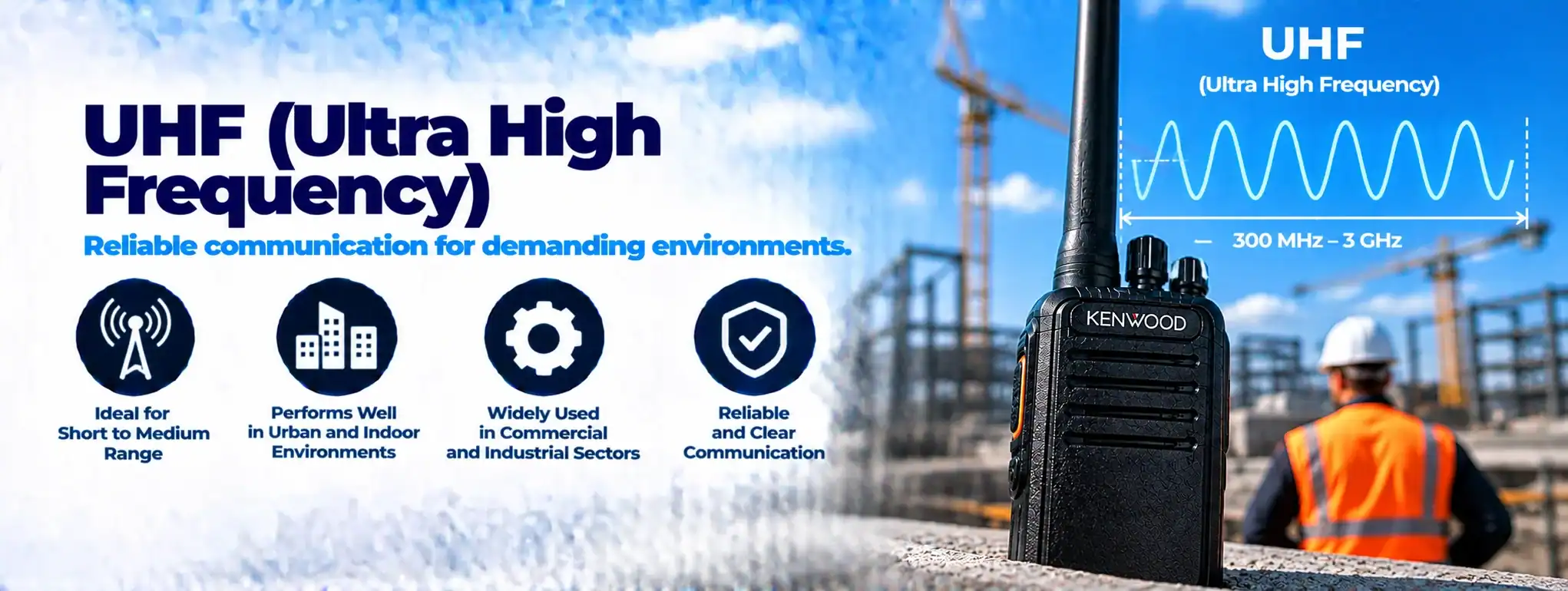
UHF (Ultra High Frequency)
UHF (Ultra High FrequencyAn antenna transmits and receives radio-frequency signals, allowing a two-way radio to communicate. Antenna type, frequency, height and location can all affect radio performance and coverage.) is a range of radio frequencies from 300 MHz to 3 GHz. In professional two-way radio, UHF is commonly used for business and commercial communications, particularly where radios need to operate inside buildingsAn antenna transmits and receives radio-frequency signals, allowing a two-way radio to communicate. Antenna type, frequency, height and location can all affect radio performance and coverage., around urban areas or across sites with significant physical obstructions.
UHF two-way radios are widely used in sectors such as construction, security, hospitality, transport, manufacturing, events and facilities management.
What does UHF mean?
UHF stands for Ultra High FrequencyFrequency is the number of cycles a radio wave completes each second, measured in Hertz. In two-way radio, frequency determines where a transmission operates within the radio spectrum..
The UHF frequency range extends from:
300 MHz → 3 GHz
Professional two-way radio normally uses only a small portion of this wider range.
Common business-radio frequencies in the UK include UHF channels around the 400 MHz range, subject to the applicable licensing and frequency allocation.
UHF vs VHF
UHF and VHF (Very High Frequency)VHF (Very High Frequency) is the 30 MHz to 300 MHz radio-frequency range. VHF two-way radios are widely used for professional communications across outdoor, rural and open areas. are both widely used for two-way radio, but their characteristics differ.
| Feature | UHF | VHF |
|---|---|---|
| Frequency range | 300 MHz–3 GHz | 30–300 MHz |
| Typical professional radio use | Buildings, urban areas, general business | Outdoor and wider-area applications |
| Penetration into buildings | Generally better | Generally poorer |
| AntennaAn antenna transmits and receives radio-frequency signals, allowing a two-way radio to communicate. Antenna type, frequency, height and location can all affect radio performance and coverage. size | Smaller | Larger |
| Common business-radio bands | Around 400 MHz | Around 150–170 MHz |
The best choice depends on the environment rather than simply choosing the higher frequency.
UHF two-way radio
A UHF two-way radio uses frequencies within the UHF range to transmit and receive communications.
Professional UHF radios are available as:
- Handheld portable radios
- Vehicle-mounted mobile radios
- Base stations
- Repeaters
- Digital radios
- Analogue radios
UHF portable radios
UHF is particularly common in handheld Portable Radios.
The shorter wavelength allows UHF antennas to be relatively compact, making them practical for small professional handheld radios.
UHF mobile radios
Vehicle-mounted Mobile Radios can also operate on UHF frequencies.
These radios normally use an external vehicle antenna, which can provide better RF performance than the small antenna fitted to a handheld radio.
UHF base stations
A UHF Base StationA base station is a fixed two-way radio installed at a permanent location, allowing an operator to communicate with handheld or mobile radios across a site or operating area. can provide communications from a fixed location.
A suitable external antenna can be installed at an elevated position to improve coverageRadio Coverage is the geographical area in which a two-way radio system can provide reliable communication. Coverage depends on the radios, antennas, frequency, terrain, buildings and system infrastructure..
UHF repeaters
A RepeaterA Repeater receives a two-way radio transmission and retransmits it, usually from an elevated location, to extend the coverage and reliability of a radio communication system. can significantly extend the effective coverage of a UHF radio systemA Radio System is a complete communication solution comprising two-way radios and, where required, equipment such as repeaters, antennas, base stations, mobile radios and network infrastructure..
The repeater receives a transmissionTransmission is the process of sending voice, data or signalling from a radio using a radio-frequency signal to another radio, repeater or communication system. from one radio and retransmits it so that other radios can receive it.
For example:
Radio A → UHF Repeater → Radio B
A repeater is particularly useful where direct radio-to-radio coverage is insufficient.
UHF and buildings
One of the main reasons UHF is widely used for professional radio is its ability to work effectively in many built-up environments.
UHF signals can generally penetrate buildings better than VHF signals, although the actual performance depends heavily on the building’s construction.
Concrete, steel, reinforced structures, underground areas and coated glass can all affect radio coverage.
UHF and urban environments
UHF can be well suited to urban environments where there are many buildings and other obstructions.
It is commonly used by organisations operating in:
- Offices
- Hotels
- Retail premises
- Warehouses
- Shopping centres
- Construction sites
- Industrial facilities
- Event venues
UHF and outdoor coverage
UHF can also provide excellent outdoor coverage.
However, the assumption that VHF is always better outdoors and UHF is always better indoors is too simplistic.
Actual performance depends on frequency, antenna, powerAn antenna transmits and receives radio-frequency signals, allowing a two-way radio to communicate. Antenna type, frequency, height and location can all affect radio performance and coverage., terrain, obstructions and system design.
UHF and range
UHF does not have a fixed or guaranteed range.
A UHF radio may communicate over anything from a relatively short distance inside a building to many kilometres through a properly designed repeater system.
Range depends on:
- Transmitter power
- Antenna
- Antenna height
- Terrain
- Buildings
- Frequency
- ReceiverA Receiver is the part of a two-way radio that detects and processes incoming radio signals, converting them into audible voice or usable data for the user. sensitivity
- InterferenceRadio interference occurs when unwanted radio-frequency signals or electrical noise disrupt two-way radio communications, causing distorted audio, broken transmissions, reduced coverage or loss of communication.
- Repeater infrastructureRadio infrastructure is the equipment and supporting systems behind a professional two-way radio network, including repeaters, antennas, base stations, network connections, power systems and dispatch equipment.
UHF and line of sight
At UHF frequencies, radio propagation is often strongly influenced by line-of-sight conditions.
Obstructions can reduce signal strength or create areas of poor coverage.
Elevating a repeater antenna can therefore make a substantial difference to coverage.
UHF and wavelength
UHF frequencies have relatively short wavelengths.
For example, a 400 MHz signal has a wavelength of approximately 75 cm.
This shorter wavelength allows compact antennas to be used in handheld radios.
UHF antenna size
Because UHF has shorter wavelengths than VHF, UHF antennas can be physically smaller.
This is useful for handheld radios where a long antenna could be inconvenient.
Antenna design remains critical to radio performance, however.
UHF antenna performance
The antenna must be suitable for the radio’s operating frequency.
An antenna designed for a different frequency range may provide poor performance and can potentially cause problems with the transmitter.
Professional radio systems should use antennas specified for the radio and frequency being used.
UHF and radio frequency
UHF is a classification of Radio Frequency (RF)Radio Frequency (RF) refers to electromagnetic waves used to transmit voice and data wirelessly. Two-way radios use RF signals to communicate between radios, repeaters and other system infrastructure..
It is not a particular radio technology.
Both analogue and digital radio systems can operate on UHF frequencies.
UHF analogue radio
Analogue two-way radios can operate on UHF.
Analogue UHF systems transmit voice using analogue modulationAnalogue radio uses continuously varying radio signals to transmit voice communication. It remains widely used for reliable two-way communication across business, industry, events, security and other applications..
They remain suitable for many straightforward business-radio applications.
UHF digital radio
Digital radio technologies such as DMR (Digital Mobile RadioA Mobile Radio is a two-way radio designed to be installed in a vehicle. It normally uses the vehicle's power supply and an external antenna to provide reliable communication while travelling or working in the field.) can operate on UHF.
A UHF DMR system combines the propagation characteristics of UHF with digital radio features such as:
- Talk groups
- Private calls
- Data
- GPS
- Emergency signalling
- EncryptionEncryption protects two-way radio communications by converting voice or data into a secure form that can only be understood by authorised radios with the correct encryption capability and keys., where supported
- TDMA
UHF and DMR
DMR is not a frequency band.
DMR equipment can operate in different frequency ranges, including UHF.
Therefore:
UHF = frequency range
DMR = digital radio technology
A radio can therefore be described as a UHF DMR radio.
UHF and TDMA
DMR UHF radios can use Time Division Multiple Access (TDMA)Time Division Multiple Access (TDMA) is a technology that divides a radio channel into time slots, allowing multiple users or conversations to share the same frequency. DMR uses two time slots within a 12.5 kHz channel..
DMR uses two time slots within a 12.5 kHz channelA two-way radio channel is a programmed set of communication settings, typically including frequency and signalling, that allows compatible radios to communicate with one another..
This allows two logical communication paths to share the same RF channel, subject to system configuration.
UHF and narrowband
Professional UHF systems can use NarrowbandNarrowband describes a radio communication system that uses a relatively small amount of frequency spectrum to transmit information. It is widely used in professional two-way radio to make efficient use of available radio channels. channel arrangements.
Narrowband operation allows more radio channels to fit into a limited amount of spectrumSpectrum is the range of radio frequencies used for wireless communication. Two-way radios operate within specific parts of the radio spectrum, subject to frequency allocation and licensing requirements..
The exact channel spacing depends on the radio service and regulatory arrangements.
UHF and spectrum
UHF is part of the electromagnetic spectrum.
It is shared by many different services, including:
- Two-way radio
- Television
- Mobile communications
- Wireless systems
- Aviation and other specialised services
Specific frequencies are allocated to different services.
UHF and Ofcom
In the UK, OfcomOfcom (Office of Communications) is the UK's communications regulator. For two-way radio users, Ofcom manages and regulates access to radio spectrum and the use of radio frequencies in the UK. manages the use of radio spectrum.
Professional business-radio users must operate within the appropriate frequency and licensing arrangements.
The fact that a radio is UHF does not by itself determine whether it is licence-free.
UHF business radio
Businesses can use licensed UHF frequencies for professional two-way radio communications.
An Ofcom Business Radio LicenceAn Ofcom Business Radio Licence authorises businesses and organisations in the UK to use specified radio frequencies for professional two-way radio communication, subject to the licence conditions. can provide authorised access to suitable business-radio frequencies subject to its conditions.
UHF licence-free radio
Some licence-free radioA Licence-Free Radio is a two-way radio that can be used without an individual radio licence when it complies with the applicable licence-exempt rules. In the UK, PMR446 is the main licence-free radio service. services operate within the UHF range.
PMR446, for example, operates in the UHF region.
PMR446 is subject to specific technical requirements, including restrictions on equipment and power.
UHF and PMR446
PMR446 operates around 446 MHz and is designed for short-range licence-free communications.
It is commonly used for straightforward communications where a licensed professional radio system is not required.
Professional business-radio systems can also use UHF frequencies around this region, but they are not necessarily PMR446.
UHF licensed radio
Licensed UHF radio can provide access to frequencies and equipment more suitable for professional applications requiring greater coverage, capacity or system control.
Licensed systems can use:
- Higher-power equipment where permitted
- External antennas
- Repeaters
- Multiple channels
- Professional digital technologies
The specific capabilities depend on the licence and system.
UHF and power output
UHF radio performance is affected by Power OutputPower Output is the amount of radio-frequency energy produced by a two-way radio's transmitter, normally measured in watts. It is one factor affecting coverage, alongside frequency, antenna, terrain and other conditions., normally measured in watts.
Increasing power can improve signal strength in some circumstancesAn antenna transmits and receives radio-frequency signals, allowing a two-way radio to communicate. Antenna type, frequency, height and location can all affect radio performance and coverage. but does not automatically double or otherwise proportionally increase range.
Antenna performance and system design are equally important.
UHF and interference
UHF systems can experience Interference from other radio services and RF sources.
Careful frequency planning can help minimise interference.
In licensed systems, the assigned frequency and operating conditions are selected to support reliable communications.
UHF and receiver sensitivity
A UHF receiver must detect relatively weak signals while rejecting unwanted signals.
Receiver sensitivity and selectivity are important factors when evaluating professional UHF radio equipment.
UHF and RSSI
RSSI (Received Signal Strength Indicator)RSSI (Received Signal Strength Indicator) is a measurement of the strength of a radio signal received by a two-way radio or other wireless device, commonly used to assess coverage and diagnose reception problems. can provide an indication of the strength of a received UHF signal.
RSSI can be useful when investigating coverage or diagnosing radio-system performance.
A stronger RSSI reading does not necessarily mean better voice quality if significant interference is present.
UHF and site surveys
A Site SurveyA Site Survey is an assessment of a location to determine whether a two-way radio system will provide the required coverage, reliability and performance. can be used to assess UHF coverage before installing a professional radio system.
This can identify:
- Dead spots
- Weak-signal areas
- Suitable repeater locations
- Antenna positions
- Building-related coverage problems
- Potential interference
UHF and repeaters
For larger sites, a UHF repeater can provide substantially greater coverage than direct radio-to-radio operation.
The repeater can be installed at a strategically selected location, often at an elevated position.
UHF multi-site systems
Large organisations can use multiple UHF radio sites connected through suitable networkA Network is a connected system of radios, equipment and infrastructure that allows users to communicate across a defined area. Radio networks can range from simple radio-to-radio systems to large multi-site networks. infrastructure.
This can provide coverage across:
- Multiple buildings
- Industrial estates
- Large campuses
- Transport networks
- Geographically separated sites
UHF and IP Site Connect
Compatible DMR repeaters can use IP Site ConnectIP Site Connect links compatible DMR radio sites using an IP network, allowing selected radio communications to be shared between separate buildings, facilities or geographical locations. to connect radio sites over an IP network.
This can allow selected communications to be shared between UHF radio sites.
UHF and roaming
Multi-site radio systems can support RoamingRoaming allows a compatible two-way radio to move between different radio sites or coverage areas, automatically selecting an appropriate site as the user moves., allowing compatible radios to move between coverage areas.
The radio can select an appropriate site according to the system’s configuration.
UHF and trunked radio
UHF can be used for Trunked Radio Systems.
Trunking allows a pool of radio resources to be shared dynamically between users and talk groups.
This can be particularly useful for large organisations with many users and high communication requirements.
UHF and DMR Tier III
DMR Tier III provides standardised trunked DMR operation.
A UHF DMR Tier III system can therefore combine:
UHF frequencies + DMR digital technology + trunking
This can provide a sophisticated professional radio network.
UHF and talk groups
Digital UHF radio systems can be configured with multiple Talk Groups.
For example:
- Security
- Operations
- Maintenance
- Management
- Emergency
The exact number of talk groups depends on the radio system.
UHF and security
UHF is widely suited to security communications because many security operations take place in buildings, urban areas and large sites.
Security teams can use handheld UHF radios to communicate between personnel and control rooms.
UHF and construction
UHF radios can be useful on construction sites where buildings, machinery, steel structures and other obstacles can affect radio propagation.
A repeater may be required for larger or more complex sites.
UHF and hospitality
Hotels, restaurants, venues and hospitality operations frequently use UHF radios because staff often need to communicate between different floors, rooms and service areas.
UHF and events
UHF radios can provide reliable short- and medium-range communications for event teams.
A professional event system can include:
- Handheld UHF radios
- Repeaters
- Talk groups
- Headsets
- Remote speaker microphones
- Control-room communications
UHF and transport
UHF can be used for communications within transport facilities such as:
- Depots
- Warehouses
- Stations
- Airports
- Distribution centres
Large transport operations may use repeaters or multi-site systems to provide wider coverage.
UHF and industrial environments
Industrial environments can present significant RF challenges because of metal structures, machinery and enclosed areas.
A UHF site survey can determine whether the required coverage can be achieved and whether repeaters or additional infrastructure are necessary.
UHF and agriculture
UHF can be used for agricultural communications, particularly where radios need to operate around buildings, yards and machinery.
For very large open rural areas, VHF may sometimes provide advantages, depending on the system design.
UHF and radio hire
UHF radios are commonly available as professional Radio HireRadio Hire is the temporary rental of two-way radios and related communication equipment for events, projects and operational requirements, providing professional communication without purchasing the equipment. equipment.
A hire system can be configured for temporary requirements such as:
- Events
- Construction projects
- Security operations
- Festivals
- Hospitality
- Film and television production
- Temporary sites
The radios can be programmed with appropriate channels or talk groups before deployment.
UHF and rugged radios
Professional UHF handheld radios are available in rugged designs for demanding environments.
Depending on the model, features can include:
- Impact resistance
- Water resistance
- Dust protection
- High-capacity batteries
- Emergency functions
- IP-rated construction
UHF and intrinsically safe radios
Specialist UHF radios are available in Intrinsically Safe versions for specified hazardous environments.
These radios must have the appropriate certification for the intended environment.
UHF and battery life
UHF portable radios are powered by rechargeable batteries.
Battery performance depends on:
- Battery capacity
- Transmit power
- Transmit duty cycle
- Receive time
- Standby time
- Radio features
UHF itself does not determine battery life.
UHF and coverage planning
Choosing UHF should be based on the actual environment rather than frequency alone.
A professional coverage assessment should consider:
- Building construction.
- Site size.
- Terrain.
- Required range.
- Number of users.
- Antenna locations.
- Repeater requirements.
- Frequency availability.
- Interference.
- Required system capacity.
UHF limitations
UHF is not automatically the best choice for every radio application.
Its performance can be affected by:
- Terrain
- Buildings
- Distance
- Interference
- Antenna position
- Power output
- Frequency selection
- System design
VHF may be preferable in some large rural or open-area applications.
Does UHF travel further than VHF?
There is no simple rule that UHF always travels further or less far than VHF.
At the same transmitter power and under comparable conditions, VHF can have propagation advantages in some open environments, while UHF can perform better around buildings and urban obstacles.
The best frequency band depends on the application and environment.
UHF and wavelength
UHF signals have shorter wavelengths than VHF signals.
This contributes to their ability to use smaller antennas and affects how they interact with buildings, terrain and other objects.
UHF and line-of-sight coverage
Because UHF wavelengths are relatively short, obstructions can have a significant effect on signal propagation.
This makes antenna height and repeater location important when designing a UHF system.
UHF and system design
A professional UHF radio system should be designed around the actual operating environment.
A typical system might include:
UHF Portable Radios → UHF Repeater → Network → Control/Dispatch
The exact architecture depends on the operational requirements.
UHF and DCS
DCS can supply professional UHF two-way radio systems for organisations requiring reliable communications across buildings, sites and operational areas.
Depending on the application, a DCS UHF system can include portable radios, mobile radios, repeaters, accessories and wider network infrastructure.