
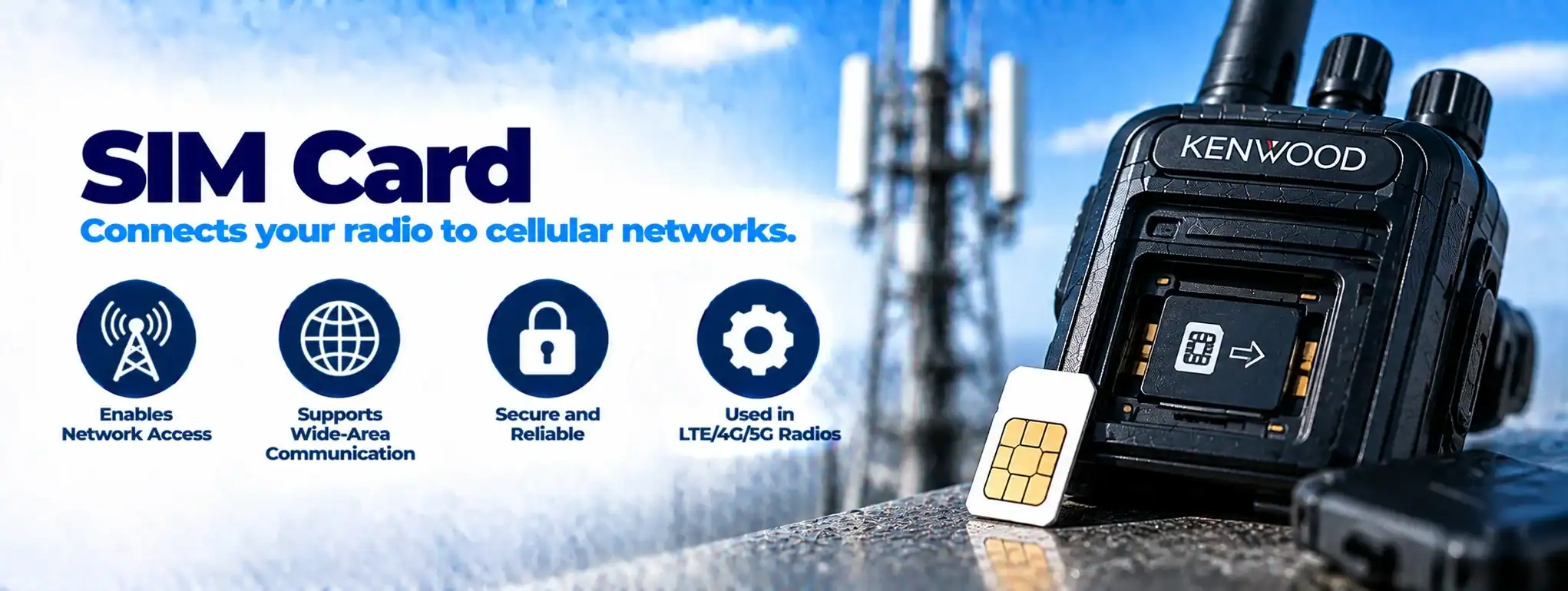
SIM Card
A SIM Card (Subscriber Identity Module) is a small electronic card or embedded module used by cellular devices to identify and authenticate the device or subscriber on a mobile networkA Network is a connected system of radios, equipment and infrastructure that allows users to communicate across a defined area. Radio networks can range from simple radio-to-radio systems to large multi-site networks..
In radio communications, SIM cards are particularly relevant to Push-to-Talk over Cellular (PoC)Push-to-Talk over Cellular (PoC) provides radio-style push-to-talk communication over cellular or IP networks, allowing users to communicate across wide areas where suitable network connectivity is available. and other cellular-based communication systems. Instead of communicating directly over dedicated radio frequencies, these systems use mobile networks such as 4G or 5G to transport voice and data.
What does a SIM card do?
A SIM card provides the cellular network with information used to identify and authenticate a subscriber or mobile service.
Depending on the service, a SIM can be used to provide:
- Network authentication
- Subscriber identification
- Cellular connectivity
- Mobile data access
- Voice services
- SMS services
The SIM does not itself provide radio coverageRadio Coverage is the geographical area in which a two-way radio system can provide reliable communication. Coverage depends on the radios, antennas, frequency, terrain, buildings and system infrastructure.. Coverage comes from the mobile network to which the SIM connects.
SIM cards in two-way radios
Traditional professional two-way radios do not normally require a SIM card.
A conventional radio communicates directly with another radio, repeaterA Repeater receives a two-way radio transmission and retransmits it, usually from an elevated location, to extend the coverage and reliability of a radio communication system. or radio network using radio frequencies.
By contrast, a cellular-based radio or PoC device uses a mobile network and therefore normally requires a SIM or eSIM with an appropriate mobile-data service.
SIM card and Push-to-Talk over Cellular
SIM cards are commonly used in Push-to-Talk over Cellular (PoC) devices.
A PoC radio can use a mobile network to connect users over much greater distances than conventional direct radio communication.
A simplified arrangement is:
PoC Radio → Mobile Network → PoC Platform → Other PoC Radios
The SIM provides the cellular connectivity needed for the device to communicate with the network.
SIM card and mobile networks
A SIM-equipped radio can potentially operate wherever its mobile network provides suitable coverage.
Depending on the service, this may include:
- 4G
- 5G
- 3G where still supported
- Other supported cellular technologies
The available network depends on the SIM provider, device and location.
SIM card and radio range
A SIM card does not increase the RF range of a conventional two-way radio.
Instead, it allows a compatible device to use a cellular network.
This means PoC communication can potentially operate across cities, regions or countries where suitable cellular coverage and service are available.
SIM card and coverage
PoC communication depends on the availability of the relevant cellular network.
If there is no suitable mobile coverage, a cellular-based radio may not be able to communicate.
This is an important difference from conventional radio systems, which can continue to operate independently of mobile networks.
SIM card and data
PoC radios use mobile data to transport communications and other information.
Depending on the system, data can be used for:
- Push-to-talk voice
- GPS location
- Messaging
- Job information
- Status updates
- Images
- Other application data
The amount of data consumed depends on the device and service.
SIM card and GPS
A SIM card can provide the cellular connectivity needed for a PoC device to send GPS (Global Positioning System)GPS is a satellite-based positioning system that allows compatible two-way radios to determine their location. GPS data can support tracking, dispatch, fleet management and Geo-Fencing. location information to a server or management platform.
The SIM itself does not determine the radio’s GPS position.
Instead:
GPS → Determines location
SIM/mobile network → Transmits location data
SIM card and fleet management
PoC devices with SIM connectivity can support Fleet ManagementFleet Management is the process of managing a two-way radio fleet, including equipment, users, programming, maintenance, firmware, security and radio system configuration. and workforce-management applications.
For example, a control platform may receive the location of authorised devices and display them on a map.
This can support:
- Vehicle tracking
- Workforce coordination
- Job allocation
- Route monitoring
- Operational management
SIM card and lone worker
A cellular-connected device can support Lone WorkerA Lone Worker is someone who works without direct supervision or immediate assistance nearby. Compatible two-way radios can provide safety features such as timed check-ins, emergency alerts and GPS location. applications where mobile coverage is available.
Location, status and emergency information can potentially be transmitted to a monitoring platform.
The exact functionality depends on the PoC service.
SIM card and emergency alerts
PoC devices can use cellular connectivity to transmit emergency alerts to other users or a control platform.
For example:
Emergency buttonAn Emergency Button is a dedicated two-way radio control that allows users to quickly send an emergency alert to a dispatcher, control room or authorised radio users. pressed → Cellular network → Control platform → Alert
The reliability of this function depends on cellular coverage, device configuration and the underlying service.
SIM card and roaming
Some SIM services support RoamingRoaming allows a compatible two-way radio to move between different radio sites or coverage areas, automatically selecting an appropriate site as the user moves., allowing a device to connect to different mobile networks when outside its primary network.
This can be useful for users who operate across different geographical areas.
International roaming availability and charges depend on the SIM provider and service agreement.
SIM card and multi-network connectivity
Some professional PoC services use SIMs that can access more than one mobile network.
This can help improve connectivity in areas where coverage varies between network operators.
The availability of multi-network SIMs depends on the service provider.
SIM card and eSIM
An eSIM (Embedded SIM) performs the same basic subscriber-identification function without requiring a removable physical SIM card.
The eSIM is built into the device.
Depending on the equipment, an eSIM can simplify provisioning and allow mobile-network profiles to be managed electronically.
Physical SIM vs eSIM
| Physical SIM | eSIM |
|---|---|
| Removable card | Embedded in device |
| Physically inserted | Electronically provisioned |
| Can be moved between compatible devices | Usually managed through the device |
| Common in older and current cellular equipment | Increasingly common in newer equipment |
The appropriate option depends on the device and cellular service.
SIM card sizes
Traditional physical SIM cards have been produced in several sizes, including:
- Standard SIM
- Micro SIM
- Nano SIM
Modern devices commonly use the smaller Nano SIM format.
The required SIM size depends on the device.
SIM card and IMEI
The IMEI (International Mobile Equipment Identity) identifies the cellular device.
The SIM identifies the subscriber or mobile service.
In simplified terms:
IMEI → Device identity
SIM → Subscriber/mobile service identity
These are separate identifiers.
SIM card and mobile data plans
A SIM used in a PoC radio normally requires an appropriate mobile service or data plan.
The service may be supplied as:
- Monthly contract
- Business data plan
- Shared data allowance
- Multi-network service
- Managed IoT/M2M connectivity
The appropriate arrangement depends on the number of devices and expected usage.
SIM card and PoC radio hire
SIM-equipped PoC radios can be supplied as part of Radio HireRadio Hire is the temporary rental of two-way radios and related communication equipment for events, projects and operational requirements, providing professional communication without purchasing the equipment. services.
This can be useful for temporary operations where users need wide-area communications without installing a dedicated radio repeater system.
Typical applications include:
- Events
- Security
- Construction
- Logistics
- Transport
- Temporary operations
SIM card and conventional radio hire
Traditional UHF or VHF radio hire systems generally do not require SIM cards.
A conventional radio can communicate using its programmed radio frequencies.
If a hired device is a PoC radio, however, cellular connectivity and an appropriate SIM or eSIM service may be required.
SIM card and radio licensing
A SIM card does not determine whether a radio requires an OfcomOfcom (Office of Communications) is the UK's communications regulator. For two-way radio users, Ofcom manages and regulates access to radio spectrum and the use of radio frequencies in the UK. radio licence.
Traditional licensed two-way radios operate under radio-frequency authorisation.
A PoC device using a cellular network operates differently because its connectivity is provided through the mobile network.
The regulatory and service arrangements therefore depend on the technology being used.
SIM card and Ofcom
Ofcom regulates radio spectrumSpectrum is the range of radio frequencies used for wireless communication. Two-way radios operate within specific parts of the radio spectrum, subject to frequency allocation and licensing requirements. and communications services in the UK.
A SIM card itself is not a substitute for a radio licence where a licensed radio-frequency service is being used.
PoC and cellular services operate through the relevant mobile network arrangements.
SIM card and encryption
Cellular networks and PoC platforms can incorporate security measures to protect communications.
However, having a SIM card does not automatically mean that radio communications are encrypted end-to-end.
The security architecture depends on the PoC platform, application and service provider.
SIM card and private calls
PoC systems can support individual or Private CallPrivate Call is a two-way radio feature that allows one radio user to communicate directly with another individual radio user rather than making the conversation part of a general group call. functionality.
A user can potentially communicate with another specific user through the PoC platform.
The SIM provides the network connection, while the PoC application or platform manages the communication.
SIM card and group calls
PoC systems can also provide Group Calling.
For example:
Security Group → Multiple security users
The cellular network transports the communication while the PoC platform manages the group.
SIM card and latency
Cellular-based radio communication can introduce network latencyLatency is the delay between a radio transmission being sent and the resulting voice or data being received. It can be introduced by digital processing, repeaters, IP networks, gateways and cloud systems..
Latency is the delay between transmissionTransmission is the process of sending voice, data or signalling from a radio using a radio-frequency signal to another radio, repeater or communication system. and reception.
It can vary depending on:
- Mobile network conditions
- Network congestion
- Signal quality
- Data routing
- PoC platform
- Device
Dedicated radio systems can have different latency characteristics.
SIM card and network failure
A cellular PoC system depends on the mobile network.
If the network becomes unavailable, the device may lose its ability to communicate through the PoC service.
For critical operations, organisations should consider whether a conventional radio systemA Radio System is a complete communication solution comprising two-way radios and, where required, equipment such as repeaters, antennas, base stations, mobile radios and network infrastructure. or another backup communication method is appropriate.
SIM card and Wi-Fi
Some PoC devices can also use Wi-FiWi-Fi is a wireless networking technology that connects compatible devices to a local or wider network. In radio systems, it can support programming, updates, data services and IP-based communications. for connectivity where supported.
This can provide an alternative connection when suitable Wi-Fi is available.
The device and PoC application determine whether cellular and Wi-Fi connectivity can be used.
SIM card and hybrid communication
A Hybrid CommunicationHybrid Communication combines two or more communication technologies, such as two-way radio, DMR, cellular, Wi-Fi or IP networks, allowing different systems or users to communicate through a common platform. system can combine conventional radio with cellular or other communication technologies.
For example:
UHF/DMR Radio + PoC
This can provide different communication options depending on the operational requirement.
SIM card and radio networks
A cellular-based radio system relies on a mobile data network and PoC platform rather than a conventional radio repeater network.
This can simplify deployment for some applications but introduces dependence on cellular infrastructureRadio infrastructure is the equipment and supporting systems behind a professional two-way radio network, including repeaters, antennas, base stations, network connections, power systems and dispatch equipment..
SIM card and control rooms
PoC systems can connect cellular radios to a central management or dispatch platform.
A control room can potentially communicate with field users and monitor information such as:
- User status
- Location
- Group membership
- Calls
- Messages
The available functionality depends on the platform.
SIM card and job tracking
Some PoC systems integrate communications with workforce-management applications.
A connected device can transmit information associated with a job or worker.
This can support Job TrackingJob Tracking is the process of monitoring the progress, status and, where supported, location of a job or field worker from assignment through to completion, often using GPS, radio and dispatch systems. and operational coordination.
SIM card and geo-fencing
Where GPS and location services are supported, a PoC system can use Geo-FencingGeo-Fencing uses GPS and a virtual geographical boundary to identify when a radio user or tracked device enters or leaves a defined area, triggering alerts or other actions where supported..
For example, a system could identify when a device enters or leaves a defined geographical area.
The SIM provides the mobile connectivity used to transmit the location information.
SIM card security
SIM cards contain information used to authenticate a subscriber with a mobile network.
They may also have security features designed to prevent unauthorised use.
However, SIM security should not be confused with the security of the entire communication system.
SIM PIN
A physical SIM may have a SIM PIN that helps protect the SIM from unauthorised use if it is removed and inserted into another device.
Whether a SIM PIN is enabled depends on the SIM and service configuration.
SIM card replacement
If a physical SIM is damaged or lost, it can normally be replaced by the mobile or connectivity provider.
The replacement process depends on the provider and service.
For managed PoC systems, SIM provisioning may be handled centrally.
SIM card and radio programming
A SIM card is generally separate from the radio’s radio-frequency programming.
The radio’s channels, frequencies, talkgroups and other settings are normally configured through the device’s programming system.
The SIM provides cellular network authentication and connectivity.
SIM card limitations
A SIM card does not:
- Automatically increase radio range
- Replace a radio repeater in a conventional radio system
- Guarantee mobile coverage
- Guarantee uninterrupted communications
- Automatically encrypt communications
- Turn a conventional radio into a cellular radio
The device must be designed to use cellular connectivity.
Choosing a SIM for PoC radios
When selecting cellular connectivity for PoC radios, consider:
- Mobile coverage.
- Network availability.
- Data requirements.
- Number of devices.
- Geographic operating area.
- Roaming requirements.
- Multi-network support.
- eSIM availability.
- Contract and data costs.
- Reliability requirements.
- Control-platform compatibility.
- Backup communication requirements.
SIM card and DCS
DCS can supply compatible PoC and cellular-based communication solutions where SIM or eSIM connectivity is appropriate.
For organisations requiring wide-area communications, cellular connectivity can complement or provide an alternative to conventional two-way radio systems, depending on coverage and operational requirements.