Frequency Deviation
FrequencyAn antenna transmits and receives radio-frequency signals, allowing a two-way radio to communicate. Antenna type, frequency, height and location can all affect radio performance and coverage. deviation is the amount by which the
frequencyFrequency is the number of cycles a radio wave completes each second, measured in Hertz. In two-way radio, frequency determines where a transmission operates within the radio spectrum. of a radio signal moves above or below its centre frequency when information is transmitted using
Frequency ModulationAnalogue radio uses continuously varying radio signals to transmit voice communication. It remains widely used for reliable two-way communication across business, industry, events, security and other applications. (FM).
In a professional two-way
radio systemA Radio System is a complete communication solution comprising two-way radios and, where required, equipment such as repeaters, antennas, base stations, mobile radios and network infrastructure., frequency deviation is an important part of how an FM signal is transmitted and received. The correct deviation is determined by the radio system and
channelA two-way radio channel is a programmed set of communication settings, typically including frequency and signalling, that allows compatible radios to communicate with one another. configuration and must be compatible with the equipment being used.
What is frequency deviation?
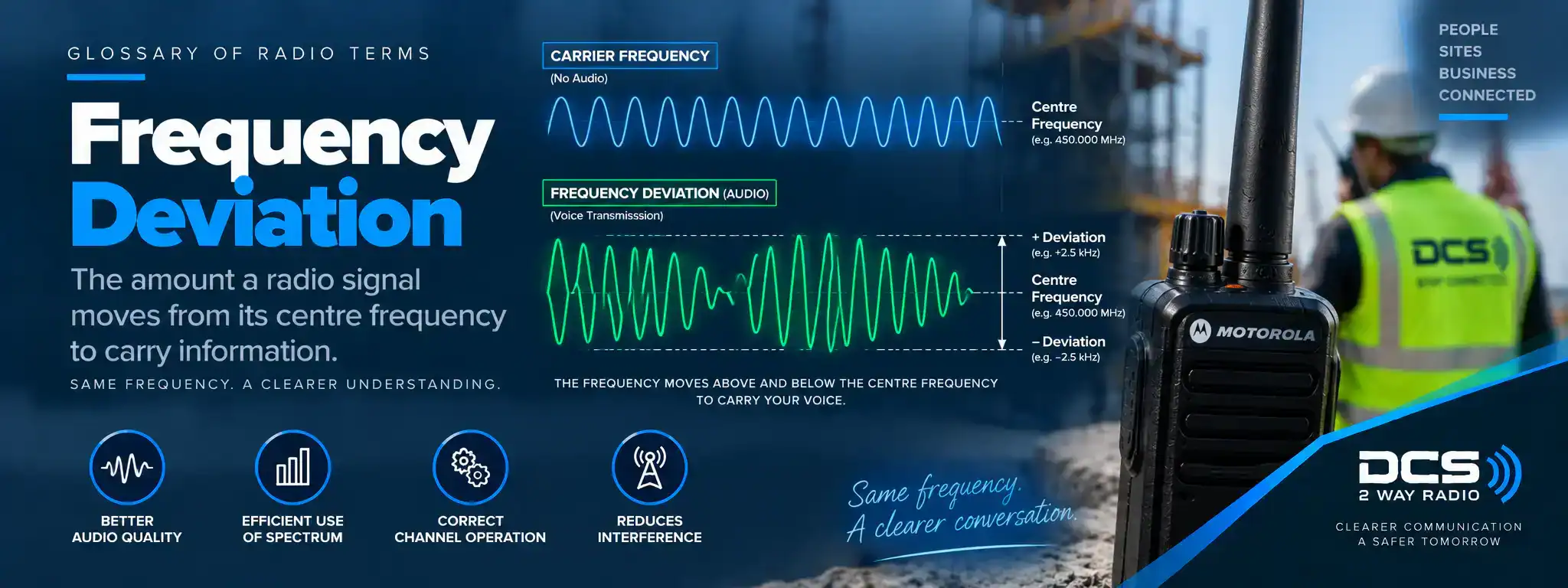
An FM transmitter sends a carrier signal at a particular centre frequency. When voice or other information is transmitted, the frequency of the carrier varies above and below that centre frequency.
The difference between the centre frequency and the furthest point the signal reaches is known as the
frequency deviation.
For example, if a transmitter has a centre frequency of 450 MHz and its signal deviates by ±2.5 kHz, the frequency moves between 449.9975 MHz and 450.0025 MHz during modulation.
The deviation is therefore expressed as a frequency measurement, normally in
kilohertz (kHz).
Why is frequency deviation important?
Frequency deviation affects how an FM radio signal occupies the available radio
spectrumSpectrum is the range of radio frequencies used for wireless communication. Two-way radios operate within specific parts of the radio spectrum, subject to frequency allocation and licensing requirements..
If the deviation is too high, the transmitted signal can occupy more bandwidth than intended and may interfere with adjacent channels.
If the deviation is too low, the received audio may have reduced quality or volume.
Correct frequency deviation is therefore important for maintaining compatibility, audio quality and efficient use of radio spectrum.
Frequency deviation and FM
Frequency deviation is directly associated with
FM (Frequency Modulation).
In FM, the information being transmitted causes the carrier frequency to change while its amplitude remains substantially constant.
The amount of frequency change depends on the characteristics of the transmitted signal and the configured deviation of the radio system.
Frequency deviation is therefore one of the fundamental characteristics of an analogue FM radio
transmissionTransmission is the process of sending voice, data or signalling from a radio using a radio-frequency signal to another radio, repeater or communication system..
Frequency deviation and two-way radio
Professional analogue two-way radios are normally configured to operate within specific technical parameters.
These parameters can include:
- Centre frequency
- Channel bandwidth
- Frequency deviation
- Transmit powerAn antenna transmits and receives radio-frequency signals, allowing a two-way radio to communicate. Antenna type, frequency, height and location can all affect radio performance and coverage.
- ReceiverA Receiver is the part of a two-way radio that detects and processes incoming radio signals, converting them into audible voice or usable data for the user. sensitivity
- CTCSS or DCS signalling
- AntennaAn antenna transmits and receives radio-frequency signals, allowing a two-way radio to communicate. Antenna type, frequency, height and location can all affect radio performance and coverage. configuration
Correct configuration ensures that radios transmit and receive signals as intended.
Wideband and narrowband deviation
Frequency deviation is closely related to the channel bandwidth used by a radio system.
Historically, many professional two-way radio systems used wider channel bandwidths and greater frequency deviation. Modern radio systems increasingly use narrower channel configurations to make more efficient use of limited radio spectrum.
In the UK, the specific channel and licensing requirements determine the appropriate radio configuration.
The terms
wideband and
narrowbandNarrowband describes a radio communication system that uses a relatively small amount of frequency spectrum to transmit information. It is widely used in professional two-way radio to make efficient use of available radio channels. describe different radio channel arrangements and should not be confused simply with the strength or range of a radio signal.
Frequency deviation and channel spacing
Radio frequencies are organised into channels so that multiple users can operate without causing unacceptable
interferenceRadio interference occurs when unwanted radio-frequency signals or electrical noise disrupt two-way radio communications, causing distorted audio, broken transmissions, reduced coverage or loss of communication. to one another.
The relationship between channel spacing, occupied bandwidth and frequency deviation is therefore important.
A radio transmitting with excessive deviation can extend further into neighbouring channels, potentially causing interference.
Correctly configured equipment helps maintain separation between adjacent radio channels.
Frequency deviation and audio
The audio signal being transmitted affects the instantaneous frequency of an FM carrier.
As the amplitude of the audio signal changes, the frequency of the carrier varies around its centre frequency.
The radio receiver detects these frequency changes and converts them back into an audio signal.
This is how speech transmitted using FM becomes audible to the receiving radio.
Maximum frequency deviation
A radio system normally has a specified maximum frequency deviation.
The transmitter should remain within the permitted deviation for the relevant radio standard and channel configuration.
Excessive deviation can cause a signal to occupy more spectrum than intended and may result in interference with nearby channels.
Professional radio equipment is therefore normally programmed and tested to operate within the appropriate limits.
Frequency deviation and radio interference
Incorrect frequency deviation can contribute to interference between radio users.
If a transmitter deviates beyond the intended limits, its signal may encroach into adjacent channels. This can make other radio users experience unwanted noise or degraded communications.
However, interference can have many other causes, including other transmitters, electrical equipment, poor antenna installations, weak signals and unsuitable frequency planning.
Frequency deviation is therefore only one factor to consider when investigating radio interference.
Frequency deviation and digital radio
Frequency deviation is particularly associated with analogue FM, but digital radio systems can also use frequency-shift-based modulation techniques.
For example,
DMR (Digital Mobile RadioA Mobile Radio is a two-way radio designed to be installed in a vehicle. It normally uses the vehicle's power supply and an external antenna to provide reliable communication while travelling or working in the field.) uses
4FSK (Four-Level Frequency Shift Keying) to represent digital information through controlled frequency changes.
The terminology and technical parameters are different from conventional analogue FM deviation, so frequency deviation should not automatically be applied to every digital radio system in the same way.
Frequency deviation and DMR
DMR uses 4FSK modulation rather than conventional analogue voice FM.
Digital information is represented using different frequency shifts, allowing the transmitter to send digital symbols to the receiving radio.
DMR also uses
TDMA (Time Division Multiple Access) to divide the radio channel into time slots, allowing two logical communication paths to share a single 12.5 kHz physical channel.
This illustrates how modulation, frequency characteristics and channel configuration work together within a digital radio system.
Frequency deviation and radio testing
Radio engineers can measure frequency deviation using appropriate test equipment.
Testing can confirm that a transmitter is operating within the expected parameters and that its signal is not unnecessarily occupying additional spectrum.
This can be particularly important when installing, maintaining or troubleshooting professional radio systems.
Frequency deviation and radio programming
Frequency deviation can be determined by the configuration of the radio system and the relevant radio standard.
Users should not normally change technical radio settings without understanding the requirements of the system and licence.
Incorrect programming can result in poor communications, compatibility problems or interference with other radio users.
Frequency deviation and UK radio licensing
In the UK,
business radioBusiness Radio refers to professional two-way radio systems used by businesses and organisations for instant communication, often using licensed frequencies and equipment designed for commercial use. systems operate under rules set by
OfcomOfcom (Office of Communications) is the UK's communications regulator. For two-way radio users, Ofcom manages and regulates access to radio spectrum and the use of radio frequencies in the UK., with the appropriate licence and technical parameters depending on the type of radio service being used.
The radio equipment needs to be configured to operate within the permitted frequency and technical characteristics of the relevant service.
This is particularly important for professional systems using licensed frequencies.
Frequency deviation and radio hire
For organisations using
two-way radio hireRadio Hire is the temporary rental of two-way radios and related communication equipment for events, projects and operational requirements, providing professional communication without purchasing the equipment., the equipment supplied can be configured for the intended application and radio system.
This helps ensure that the radios operate using compatible channels and settings for the particular site or event.
For temporary projects, events, construction sites and logistics operations, correctly configured equipment is important because multiple radios may need to communicate reliably across the same system.
Frequency deviation and DCS 2 Way Radio
At DCS 2 Way Radio, radio equipment and communication systems need to be configured around the operational requirements of each customer.
Frequency deviation is one of the technical characteristics that can affect the performance and compatibility of an analogue FM radio system. Alongside frequency, bandwidth, antennas, power,
coverageRadio Coverage is the geographical area in which a two-way radio system can provide reliable communication. Coverage depends on the radios, antennas, frequency, terrain, buildings and system infrastructure. and other system parameters, it forms part of the overall radio configuration.
For organisations requiring dependable two-way communications, professional system design and correct radio programming help ensure that equipment operates as intended.
Related radio terms
- Modulation
- Frequency
- Radio Frequency (RF)Radio Frequency (RF) refers to electromagnetic waves used to transmit voice and data wirelessly. Two-way radios use RF signals to communicate between radios, repeaters and other system infrastructure.
- FM (Frequency Modulation)
- Bandwidth
- Narrowband
- Interference
- Receiver
- TransceiverA Transceiver combines a transmitter and receiver in one device, allowing a two-way radio to both send and receive radio signals.
- Digital Mobile Radio (DMR)Digital Mobile Radio (DMR) is an ETSI digital radio standard for professional two-way communications, supporting voice, group calling, data and other features on compatible radio systems.
- 4FSK (Four-Level Frequency Shift Keying)
- TDMA (Time Division Multiple Access)
- CTCSS (Continuous Tone-Coded SquelchAnalogue radio uses continuously varying radio signals to transmit voice communication. It remains widely used for reliable two-way communication across business, industry, events, security and other applications. System)
- DCS (Digital-Coded Squelch)
- Channel
- Ofcom
- Ofcom Business Radio LicenceAn Ofcom Business Radio Licence authorises businesses and organisations in the UK to use specified radio frequencies for professional two-way radio communication, subject to the licence conditions.
- Radio Programming
- Radio System
- Radio Hire