
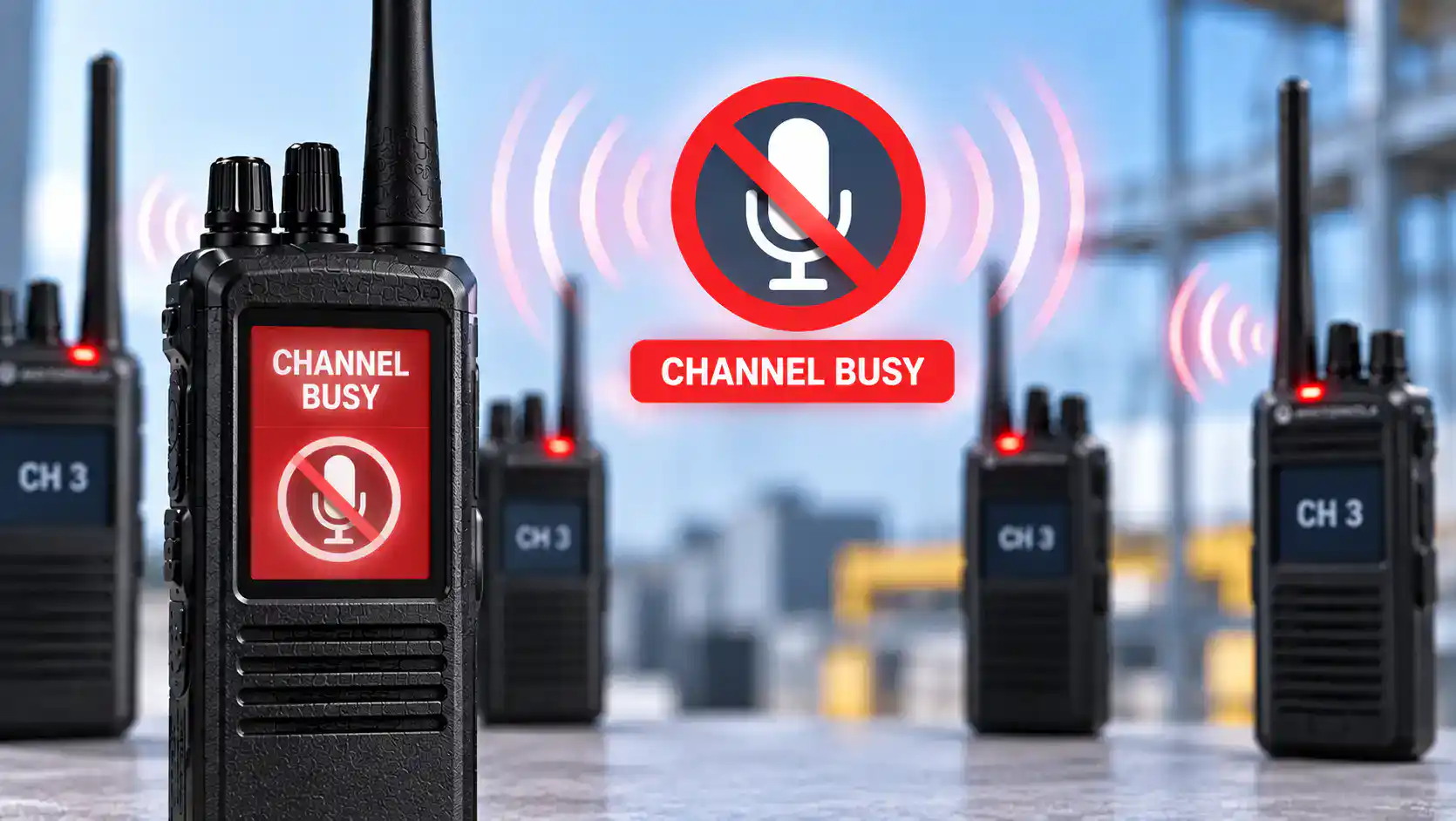
Busy Channel Lockout (BCL)
Busy ChannelA two-way radio channel is a programmed set of communication settings, typically including frequency and signalling, that allows compatible radios to communicate with one another. Lockout (BCL) is a feature found on some two-way radios that prevents the radio from transmitting when the selected channel is already being used by another radio.
The purpose of BCL is to reduce the risk of one user transmitting over another user’s communication. When the radio detects that the channel is occupied, the transmit function is temporarily blocked until the channel becomes available.
Busy Channel Lockout is particularly useful on shared radio channels where several users or teams need to communicate without accidentally talking over one another.
How does Busy Channel Lockout work?
When a user presses the Push-to-Talk (PTT)Push-to-Talk (PTT) is the button or control used to activate a two-way radio's transmitter. Press it to speak and release it to listen. button, the radio checks whether the selected channel is already occupied.
If the channel is clear, the radio can transmit normally.
If another radio is already transmitting, BCL prevents the user’s radio from transmitting. Depending on the radio model and programming, the user may hear an alert tone or see an indicator showing that the channel is busy.
Once the other transmissionTransmission is the process of sending voice, data or signalling from a radio using a radio-frequency signal to another radio, repeater or communication system. has finished and the channel becomes clear, the user can press PTT and transmit.
A simplified example is:
Channel clear → PTT pressed → radio transmits
Channel busy → PTT pressed → transmission blocked
Why is Busy Channel Lockout used?
BCL helps prevent users from unintentionally transmitting at the same time as another radio user.
Without BCL, two users can potentially transmit simultaneously. Their signals may interfere with each other, meaning that neither transmission can be heard clearly by the other members of the group.
By preventing transmission while the channel is occupied, BCL can help maintain clearer and more orderly radio communications.
Busy Channel Lockout and shared channels
BCL is particularly useful where multiple users share the same radio channel.
For example, a security team may have several radios operating on one channel. If one security officer is already speaking, BCL can prevent another user from immediately transmitting over that conversation.
This is especially useful on busy channels where several people regularly communicate.
Busy Channel Lockout and radio systems
BCL can be used on both analogue and digital two-way radio systems, although the way the feature operates depends on the radio technology and manufacturer.
The radio may determine whether a channel is busy by detecting an active radio signal or, on some systems, by using information available from the digital radio systemA Radio System is a complete communication solution comprising two-way radios and, where required, equipment such as repeaters, antennas, base stations, mobile radios and network infrastructure..
The precise behaviour and configuration options vary between radio models.
Busy Channel Lockout and CTCSS/DCS
Busy Channel Lockout can interact with other radio signalling features such as CTCSS and DCS.
CTCSS and DCS can be used to control which transmissions a radio responds to or opens its speaker for. BCL, however, is concerned with whether the radio is permitted to transmit when the channel is occupied.
The exact way a radio determines whether a channel is busy depends on its programming and technical design.
It is therefore possible for a radio to detect a signal on the frequencyAn antenna transmits and receives radio-frequency signals, allowing a two-way radio to communicate. Antenna type, frequency, height and location can all affect radio performance and coverage. even when the transmission is not intended for its particular user group.
Busy Channel Lockout and digital radio
On digital radio systems such as DMR, channel access can be controlled using digital signalling and the system’s defined channel structure.
Depending on the equipment and configuration, BCL or an equivalent channel-busy function can prevent a radio from transmitting when another user is already using the relevant radio resource.
Digital radio systems can provide additional mechanisms for managing channel access, particularly on more complex multi-user systems.
Busy Channel Lockout vs Talkaround
BCL should not be confused with Talkaround.
Talkaround allows radios that normally communicate through a repeaterA Repeater receives a two-way radio transmission and retransmits it, usually from an elevated location, to extend the coverage and reliability of a radio communication system. to communicate directly with one another by bypassing the repeater.
BCL is a channel-access feature that prevents a radio from transmitting when the radio considers the channel to be occupied.
They perform different functions, although both may form part of the programming of a professional radio system.
Can Busy Channel Lockout be disabled?
Whether BCL can be enabled, disabled or configured depends on the radio model and programming software.
Professional two-way radios can often have features such as BCL configured by the supplier or radio programmer.
In some applications, disabling BCL may be appropriate, while in others it may be preferable to keep it enabled to reduce accidental interferenceRadio interference occurs when unwanted radio-frequency signals or electrical noise disrupt two-way radio communications, causing distorted audio, broken transmissions, reduced coverage or loss of communication. between users.
The correct configuration depends on how the radio system is being operated.
Busy Channel Lockout and radio interference
BCL can help reduce one particular type of interference: users transmitting simultaneously on the same channel.
However, BCL cannot prevent all forms of radio interference.
For example, a radio may be unable to detect another transmission reliably because of signal strength, interference, propagation conditions or other technical factors.
BCL should therefore be considered one part of effective radio system design rather than a complete solution to radio interference.
Busy Channel Lockout in professional radio hire
BCL can be useful when hiring radios for events, construction projects, security operations and other situations where many users share the same channels.
A radio hireRadio Hire is the temporary rental of two-way radios and related communication equipment for events, projects and operational requirements, providing professional communication without purchasing the equipment. company can configure channels and features according to the requirements of the particular operation.
For example, a busy event may have several teams sharing radio channels. BCL can help reduce the possibility of one team accidentally transmitting over another team’s conversation.
Busy Channel Lockout and radio programming
BCL is normally configured as part of the radio’s programming.
The programming can determine how the radio behaves when the selected channel is detected as busy.
Because the exact implementation varies between manufacturers and models, BCL should be configured according to the radio manufacturer’s specifications and the requirements of the radio system.
Busy Channel Lockout and DCS
A properly configured BCL function can form part of a wider radio system designed to provide reliable and disciplined communications.
When supplying or programming professional two-way radios, the appropriate channel-access features should be considered alongside channel allocation, CTCSS/DCS, digital signalling, repeaters and other system settings.
DCS can advise on radio programming and system configuration where businesses need multiple users to share radio channels effectively.
Need experienced support as well as reliable equipment? Hire radios from the experts at DCS for a complete communication solution.