
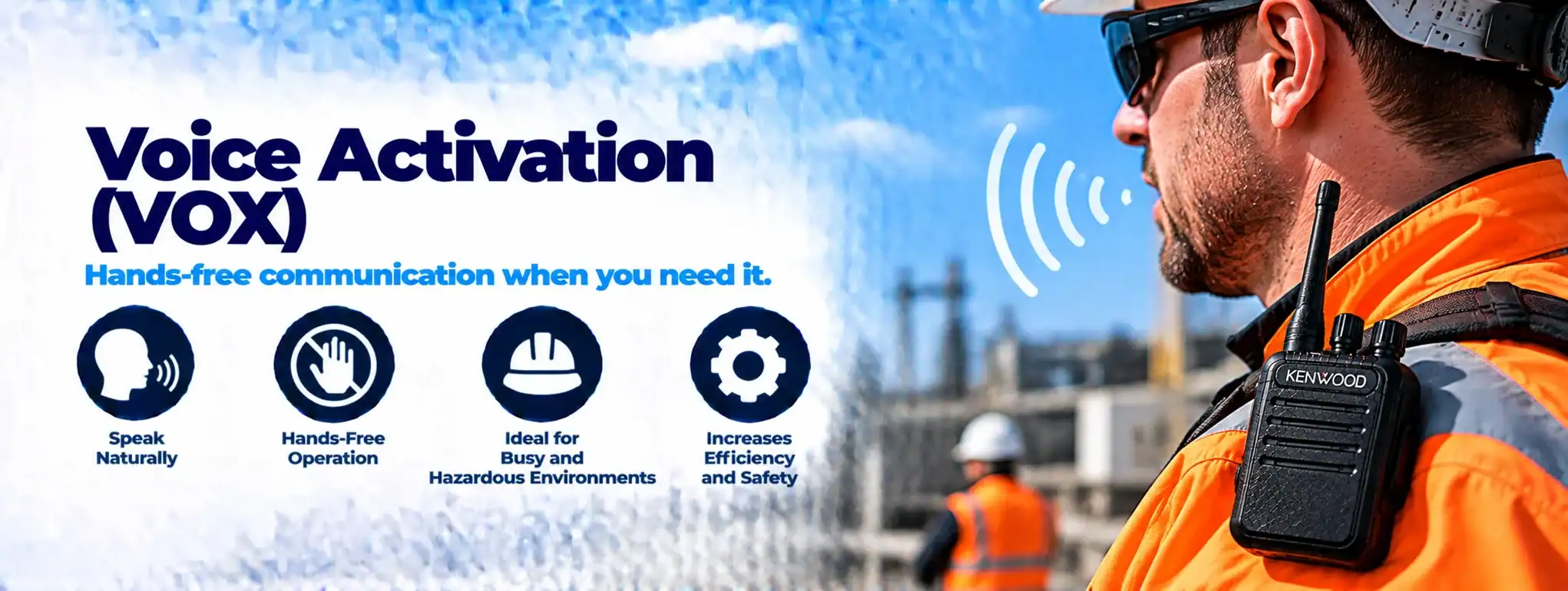
Voice Activation (VOX)
Voice Activation (VOX) is a feature that allows a two-way radio to transmit automatically when it detects the user’s voice, without requiring the Push-to-Talk (PTT)Push-to-Talk (PTT) is the button or control used to activate a two-way radio's transmitter. Press it to speak and release it to listen. button to be pressed.
VOX can be useful when a radio user needs to communicate while keeping both hands free. It is commonly used with compatible headsets, earpieces and microphones.
What does VOX mean?
VOX stands for Voice Operated Exchange or Voice-Operated Transmit, depending on the terminology used by the manufacturer.
In practical two-way radio use, VOX means that the radio’s transmitter is activated when the microphone detects speech above a configured threshold.
Instead of:
Press PTT → Speak → Release PTT
the user can:
Speak → Radio transmits automatically
How does VOX work?
A VOX-enabled radio monitors the microphone for sound.
When the detected audio reaches the configured activation level, the radio switches into transmit mode.
When the user stops speaking, the radio returns to receive or standby mode after a short delay.
The basic process is:
Voice detected → VOX activates transmitter → Speech transmitted → Voice stops → Transmitter stops
VOX sensitivity
VOX sensitivity determines how easily the radio responds to sound.
A high-sensitivity setting can allow quieter speech to activate the transmitter.
A lower sensitivity setting requires a louder sound before transmissionTransmission is the process of sending voice, data or signalling from a radio using a radio-frequency signal to another radio, repeater or communication system. begins.
The correct setting depends on the user’s environment and equipment.
VOX activation level
The activation threshold determines how much sound is required to trigger transmission.
If the threshold is too low, unwanted background noise can activate the radio.
If it is too high, normal speech may fail to activate the transmitter reliably.
VOX and background noise
Background noise is one of the main considerations when using VOX.
Machinery, vehicles, wind, crowds and other sounds can accidentally activate the transmitter.
VOX is therefore generally more effective in relatively controlled environments or when used with a suitable headsetA radio headset combines a microphone and speaker or earpiece, allowing two-way radio users to communicate conveniently while keeping the radio away from their face or using hands-free operation. and microphone.
VOX and headsets
VOX is commonly used with radio Headsets.
A headset positions the microphone close to the user’s mouth, helping the radio distinguish speech from surrounding noise.
Compatible headsets can be particularly useful for users who need to keep their hands free.
VOX and earpieces
An earpieceAn earpiece is a two-way radio audio accessory that lets users hear radio communications discreetly, often with a microphone and Push-to-Talk button for transmitting. can be used with compatible VOX-enabled radios.
Depending on the equipment, the microphone may be integrated into the earpiece, headset or connecting accessory.
VOX and hands-free communication
The main advantage of VOX is hands-free operationHands-Free Operation allows two-way radio users to communicate without holding the radio or continuously pressing its PTT button, using features such as VOX, headsets or remote PTT controls..
It can be useful where the user needs to operate equipment, handle tools or perform another task while communicating.
Examples include:
- Construction
- Warehousing
- Manufacturing
- Hospitality
- Events
- Security
- Film and television production
- Logistics
VOX vs Push-to-Talk
VOX and PTT provide different methods of activating the transmitter.
PTT:
User presses button → Radio transmits
VOX:
User speaks → Radio automatically transmits
PTT gives the user more precise control over when transmission begins.
VOX provides greater convenience where hands-free operation is important.
Advantages of VOX
VOX can provide:
- Hands-free operation
- Convenient communication
- Faster access to transmission
- Reduced need to operate the radio manually
- Useful operation with compatible headsets
Limitations of VOX
VOX can also have disadvantages.
These include:
- Background noise triggering transmissions
- Parts of the first word potentially being missed
- Reduced control over when the radio transmits
- Additional configuration requirements
- Less suitability for very noisy environments
For many professional applications, PTT remains preferable when precise control of transmissions is important.
VOX and first-word clipping
A VOX radio needs to detect the user’s voice before it starts transmitting.
As a result, the beginning of a word can sometimes be missed.
This is known as Voice Clipping or First-Word Clipping.
Users can reduce the problem by allowing a short pause before speaking or by adjusting the VOX settings where the radio permits it.
VOX delay
Some radios provide a VOX hang time or delay.
After the user stops speaking, the transmitter remains active for a short period before returning to receive mode.
This prevents the radio from repeatedly switching between transmit and receive during normal pauses in speech.
VOX and radio transmit time
Because VOX automatically activates the transmitter, users need to be aware of how much time the radio spends transmitting.
Long or unnecessary transmissions can:
- Reduce battery life
- Increase radio traffic
- Reduce available system capacity
This is particularly relevant on busy professional radio systems.
VOX and battery life
Transmission normally consumes more battery powerAn antenna transmits and receives radio-frequency signals, allowing a two-way radio to communicate. Antenna type, frequency, height and location can all affect radio performance and coverage. than standby operation.
VOX can therefore affect battery life if background sounds repeatedly activate the transmitter or if users transmit for extended periods.
VOX and digital radio
VOX can be available on some Digital Mobile Radio (DMR)Digital Mobile Radio (DMR) is an ETSI digital radio standard for professional two-way communications, supporting voice, group calling, data and other features on compatible radio systems. and other professional digital radios.
The feature is implemented by the radio rather than being a defining characteristic of digital radio itself.
Availability and configuration vary between models.
VOX and analogue radio
VOX can also be available on analogue two-way radios.
The feature is independent of whether the underlying radio systemA Radio System is a complete communication solution comprising two-way radios and, where required, equipment such as repeaters, antennas, base stations, mobile radios and network infrastructure. uses analogue or digital transmission.
VOX and portable radios
VOX is particularly useful on handheld Portable Radios because users can communicate without reaching for the radio’s PTT button.
A compatible headset is often used for improved voice detection.
VOX and mobile radios
Some vehicle-mounted or fixed radio installations can support VOX, although the feature is more commonly associated with handheld radios and hands-free accessories.
VOX and remote speaker microphones
A Remote Speaker Microphone (RSM)A Remote Speaker Microphone (RSM) is an external radio accessory combining a microphone, speaker and Push-to-Talk button, allowing users to operate a two-way radio without handling the radio itself. may provide a PTT button and microphone positioned away from the main radio.
Some accessories can support VOX or hands-free operation where compatible.
VOX and noisy environments
VOX may not be the best choice in environments with continuous high background noise.
Examples include:
- Heavy construction
- Manufacturing machinery
- Airports
- Busy transport environments
- Outdoor events with loud music
- Industrial plants
In these environments, PTT or a carefully selected noise-resistant headset may provide more reliable operation.
VOX and noise cancellation
Noise CancellationNoise Cancellation is technology used in two-way radios and communication equipment to reduce unwanted background noise and make speech easier to hear, particularly in noisy working environments. can help reduce unwanted background sound captured by the microphone.
However, noise cancellation does not guarantee that VOX will ignore all background noise.
The microphone, headset, VOX sensitivity and surrounding environment all influence performance.
VOX and safety
Hands-free communication can be useful where the user needs to keep both hands available for operational tasks.
However, VOX should not be assumed to make an activity safe or compliant with workplace or vehicle-safety requirements.
Users should follow the relevant safety procedures for their working environment.
VOX and vehicles
VOX can potentially be useful for users working inside or around vehicles.
However, vehicle noise can cause unwanted activation, particularly with open microphones.
A suitable microphone and correctly adjusted VOX sensitivity can improve performance.
VOX and lone workers
VOX is separate from Lone WorkerA Lone Worker is someone who works without direct supervision or immediate assistance nearby. Compatible two-way radios can provide safety features such as timed check-ins, emergency alerts and GPS location. functionality.
A lone worker system may use a radio to send alerts or status information, while VOX simply controls how voice transmissions are activated.
VOX and Man Down
VOX and Man DownMan Down is a safety feature on some professional two-way radios that can detect a possible fall or unusual radio position and automatically raise an alert if the user does not respond. are also separate features.
VOX automatically activates transmission in response to detected speech.
Man Down detects a specified condition, such as a radio being held at an abnormal angle for a configured period, and can initiate an alert where supported.
VOX and emergency communications
VOX should not normally be relied upon as a replacement for a dedicated emergency buttonAn Emergency Button is a dedicated two-way radio control that allows users to quickly send an emergency alert to a dispatcher, control room or authorised radio users..
Emergency communications require deliberate and reliable activation, particularly in safety-critical situations.
The appropriate emergency functionality depends on the radio system.
VOX and privacy
VOX does not provide additional communication privacy.
It simply controls when the radio transmits.
If a radio system requires secure communications, separate security features such as encryptionEncryption protects two-way radio communications by converting voice or data into a secure form that can only be understood by authorised radios with the correct encryption capability and keys. may be required.
VOX and encryption
Encryption protects the content of supported radio communications.
VOX controls transmitter activation.
The two functions are independent and can potentially be used together.
VOX and talk groups
If a VOX-enabled radio is operating on a Talk GroupA Talk Group is a predefined group of users or radios within a two-way radio system that share a common communication group, allowing teams to communicate without involving other users., speech detected by the microphone can initiate a transmission to that group.
The normal talk-group configuration still determines which users receive the communication.
VOX and private calls
On radios supporting Private Calls, VOX can potentially activate the transmitter for the individual call.
The availability and behaviour depend on the radio and system.
VOX and repeater systems
A VOX transmission can use a RepeaterA Repeater receives a two-way radio transmission and retransmits it, usually from an elevated location, to extend the coverage and reliability of a radio communication system. in the same way as a manually activated transmission, provided the radio and repeater system are configured appropriately.
The repeater receives and retransmits the radio’s signal.
VOX and trunked radio
VOX can potentially be used on compatible Trunked Radio Systems.
When speech activates the transmitter, the radio requests the necessary communication resource from the trunked system.
The exact behaviour depends on the equipment and networkA Network is a connected system of radios, equipment and infrastructure that allows users to communicate across a defined area. Radio networks can range from simple radio-to-radio systems to large multi-site networks..
VOX and radio programming
VOX settings may be configured within the radio’s programming.
Depending on the model, settings can include:
- VOX enabled/disabled
- VOX sensitivity
- VOX delay
- Channel-specific VOX settings
- Accessory-specific settings
Not every radio provides all of these options.
VOX and accessories
VOX performance depends heavily on the microphone and accessory being used.
A suitable professional headset can provide better results than the radio’s built-in microphone, particularly in environments with background noise.
VOX and radio hire
VOX-enabled radios can be supplied as part of a professional Radio HireRadio Hire is the temporary rental of two-way radios and related communication equipment for events, projects and operational requirements, providing professional communication without purchasing the equipment. package where hands-free communication is required.
Before hiring, the customer should specify the working environment and whether headsets or other accessories are required.
VOX for events
VOX can be useful for event staff who need to communicate while carrying equipment or performing operational tasks.
However, event environments can be noisy, so VOX settings and microphone choice should be tested before deployment.
VOX for security
Security personnel may use VOX with discreet or hands-free accessories where appropriate.
For environments where accidental transmissions could cause problems, PTT may provide better control.
VOX for hospitality
VOX can be useful in hospitality environments where staff need to communicate while carrying trays, equipment or supplies.
A suitable headset can make hands-free operation more practical.
VOX for construction
Construction environments can be challenging for VOX because of machinery and background noise.
PTT is often preferable where the user needs precise control over transmissions, although suitable VOX equipment can be effective in specific applications.
VOX for warehousing
VOX can be useful for warehouse workers who need to communicate while handling goods.
Headsets with suitable microphones can help reduce unwanted activation from machinery and surrounding activity.
VOX and professional radio systems
VOX is a useful radio feature rather than a separate radio technology.
It can be incorporated into a wider professional radio system containing:
Portable Radios + Headsets + Repeaters + Talk Groups + Dispatch
The suitability of VOX depends on how the radios are being used and the surrounding environment.
Choosing VOX
VOX is worth considering when:
- Hands-free operation is important.
- Users regularly need both hands for work.
- A suitable headset can be used.
- Background noise is manageable.
- Automatic transmission is acceptable.
PTT may be preferable when:
- The environment is very noisy.
- Accidental transmissions must be avoided.
- Users need precise transmission control.
- Communications are safety-critical.
VOX and DCS
DCS can supply professional two-way radios and compatible accessories for applications where hands-free communication is required.
Where VOX is appropriate, the radio, headset and microphone can be selected and configured for the user’s working environment.