
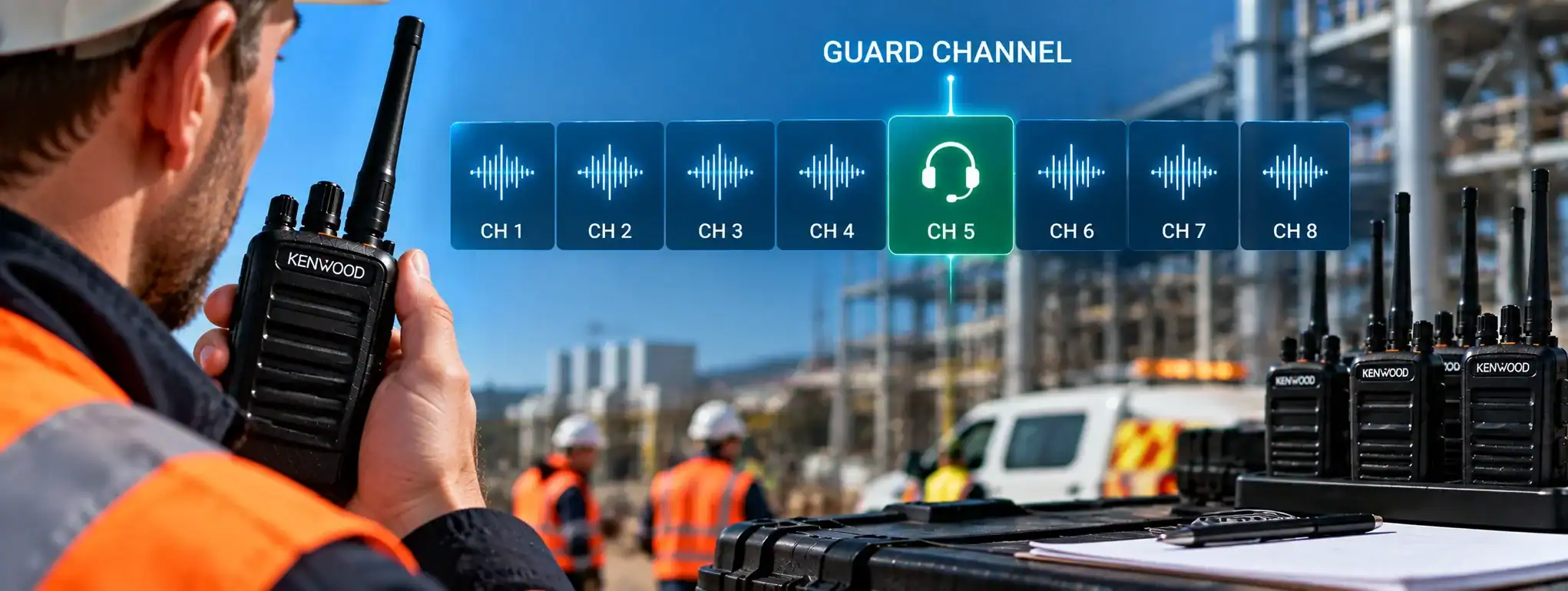
Guard Channel
Guard ChannelA two-way radio channel is a programmed set of communication settings, typically including frequency and signalling, that allows compatible radios to communicate with one another. is a designated radio channel that is continuously monitored for important, priority or emergency communications. It provides a known communication channel that users or control personnel can monitor so that urgent messages can be received without relying on users being on the correct operational channel.
The term is used in different ways depending on the radio systemA Radio System is a complete communication solution comprising two-way radios and, where required, equipment such as repeaters, antennas, base stations, mobile radios and network infrastructure.. In some systems, a Guard Channel is specifically reserved for emergency or priority traffic. In others, it may refer to a channel that is continuously monitored by a radio, dispatcher or control room.
A Guard Channel is therefore a system-design and operational concept, rather than a feature that is implemented identically on every two-way radio.
How does a Guard Channel work?
A radio system can designate one channel as the Guard Channel while other channels are used for normal operational communications.
For example:
Channel 1 — General Operations
Channel 2 — Security
Channel 3 — Maintenance
Channel 4 — Guard / Emergency
Users can communicate normally on their assigned channels while the Guard Channel remains available for priority communications.
The exact behaviour depends on the radio system and how it has been programmed.
Why use a Guard Channel?
A Guard Channel provides a common point of contact for important communications.
It can be useful where users need to be able to receive a priority message regardless of which operational channel they are currently using.
Potential applications include:
- Emergency communications
- Security operations
- Transport operations
- Large events
- Industrial sites
- Multi-team operations
- Control-room communications
Guard Channel and emergency communications
A Guard Channel can provide a dedicated route for emergency or priority communications.
For example, an organisation may instruct users to switch to the Guard Channel when an incident occurs.
Alternatively, a compatible radio system may monitor the Guard Channel automatically.
A Guard Channel does not itself make a communication an emergency callAn Emergency Call is a priority two-way radio function that allows a user to quickly request assistance and, on supported systems, establish an urgent voice communication with a dispatcher or control room.. Emergency functions such as an Emergency ButtonAn Emergency Button is a dedicated two-way radio control that allows users to quickly send an emergency alert to a dispatcher, control room or authorised radio users., Emergency AlarmAn Emergency Alarm allows a two-way radio user to quickly alert a dispatcher, control room or other authorised users that assistance may be required. or Emergency Call are separate radio features.
Guard Channel and priority communications
A Guard Channel can be used to provide a recognised channel for priority messages.
This can help prevent important communications from becoming lost among routine operational traffic.
The system may also use priority or emergency signalling to give certain transmissions precedence over normal communications.
The precise behaviour depends on the radio technology and system configuration.
Guard Channel and Channel Scan
A radio may use Channel ScanChannel Scan is a two-way radio feature that automatically monitors multiple programmed channels for activity, allowing users to hear communications without manually switching between channels. to monitor more than one channel.
In some systems, a designated Guard Channel can be included as a priority or monitored channel within the scan configuration.
For example:
Operational Channel → Guard Channel → Operational Channel → Guard Channel
The radio checks the programmed channels for activity according to its scanning configuration.
Not every radio gives a particular channel special Guard Channel status.
Guard Channel and Priority Scan
Some professional radios support Priority Scan, allowing one or more channels to receive preferential treatment while the radio scans other channels.
A Guard Channel can potentially be configured as a priority channel where the radio supports this function.
This can help ensure that important communications are detected while the user is monitoring other channels.
Guard Channel and DMR
Professional DMR (Digital Mobile RadioA Mobile Radio is a two-way radio designed to be installed in a vehicle. It normally uses the vehicle's power supply and an external antenna to provide reliable communication while travelling or working in the field.) systems can provide priority and emergency communication features, but the term Guard Channel is not a universal DMR feature.
A DMR system may use a designated talkgroup, channel or emergency configuration to provide a similar operational function.
The exact implementation depends on the manufacturer and system architecture.
Guard Channel and Talkgroups
In a digital radio system, the equivalent of a Guard Channel may be implemented using a Talkgroup.
For example, a system might designate an Emergency or Control talkgroup that users can access for priority communications.
The terminology varies between radio technologies.
A Guard Channel therefore does not necessarily mean a specific physical radio frequencyAn antenna transmits and receives radio-frequency signals, allowing a two-way radio to communicate. Antenna type, frequency, height and location can all affect radio performance and coverage..
Guard Channel and frequency
A Guard Channel can be associated with a particular radio frequencyFrequency is the number of cycles a radio wave completes each second, measured in Hertz. In two-way radio, frequency determines where a transmission operates within the radio spectrum., but the term describes its operational purpose, not simply the frequency itself.
In an analogue system, it may be a programmed radio channel using a specific frequency.
In a digital system, it may be associated with a talkgroup or other logical communication channel.
Guard Channel and repeater systems
A Guard Channel can operate through a RepeaterA Repeater receives a two-way radio transmission and retransmits it, usually from an elevated location, to extend the coverage and reliability of a radio communication system. where the radio system is designed to provide wider-area coverageRadio Coverage is the geographical area in which a two-way radio system can provide reliable communication. Coverage depends on the radios, antennas, frequency, terrain, buildings and system infrastructure..
This can allow users across a large site or geographical area to access the same priority communication channel.
The repeater infrastructureRadio infrastructure is the equipment and supporting systems behind a professional two-way radio network, including repeaters, antennas, base stations, network connections, power systems and dispatch equipment. must be available for the Guard Channel to provide its intended coverage.
Guard Channel and simplex operation
A Guard Channel can also be configured as a SimplexSimplex is a method of two-way radio communication where radios transmit and receive on the same frequency, communicating directly without a repeater. channel where users communicate directly without a repeater.
This can provide a dedicated communication channel for a small group or local area.
However, simplex coverage is generally more dependent on the position of the radios, surrounding environment and operating conditions.
Guard Channel and duplex operation
A Guard Channel can also operate through a duplexduplex, duplex radio, duplex communication, duplex frequencies, duplex operation, duplex spacing, frequency offset, repeater duplex, duplex repeater, full duplex, half duplex, radio repeater or repeater-based system.
In this arrangement, radios may transmit to the repeater on one frequency and receive the repeater’s signal on another.
The user experience can still be conventional Push-to-Talk communication.
Guard Channel and control rooms
Control rooms can continuously monitor a designated Guard Channel.
This provides a known channel through which field personnel can contact control when an urgent situation occurs.
The control room may also be able to transmit priority messages to users on the Guard Channel.
Guard Channel and Dispatch
A Dispatch system can provide centralised monitoring of designated radio channels or talkgroups.
Where supported, a dispatcher may be able to monitor the Guard Channel alongside normal operational communications.
Dispatch systems can also provide additional features such as recording, user identification and emergency alerts.
Guard Channel and radio users
Users need to understand how the Guard Channel is intended to be used.
Operational procedures may specify:
- When to use the Guard Channel
- Who should monitor it
- What constitutes priority traffic
- How emergency communications should be initiated
- When users should return to their normal channel
A Guard Channel is most effective when supported by clear radio procedures.
Guard Channel and emergency procedures
A Guard Channel should form part of an organisation’s wider emergency communication procedure rather than being relied upon by itself.
For example, an emergency procedure might specify:
- Activate the radio’s emergency function where appropriate.
- Communicate the nature of the emergency.
- Use the designated Guard or Emergency Channel if instructed.
- Follow instructions from control personnel.
- Return to the operational channel when authorised.
The actual procedure should reflect the organisation’s communication system.
Guard Channel and security operations
Security teams can use a designated Guard Channel to maintain a common communication route for urgent incidents.
For example, security officers may use separate operational channels for different areas while maintaining access to a central security or control channel.
This can be particularly useful at large sites where multiple teams operate simultaneously.
Guard Channel and events
Large events can use a designated Guard Channel for communications between event control and operational teams.
For example, an event may have separate channels for:
- Security
- Stewards
- Medical
- Production
- Transport
- Event Control
A Guard or Emergency channel can provide a common route for priority communications where the system supports it.
Guard Channel and transport
Transport organisations can designate a channel for priority communication between drivers, supervisors and control.
This can provide a recognised communication route for incidents or operational problems.
The channel may be monitored continuously or included in the radio’s scanning configuration.
Guard Channel and industrial sites
Industrial and manufacturing sites can use multiple radio channels for different operational teams.
A Guard Channel can provide a common communication route for urgent site-wide communications.
This can be particularly useful where personnel are spread across different areas of a large site.
Guard Channel and construction
Large construction sites may have separate radio channels for different contractors or teams.
A designated Guard Channel can provide a common route for site management or emergency communications.
The usefulness of the arrangement depends on the coverage and radio infrastructure available across the site.
Guard Channel and radio hire
A Guard Channel can be incorporated into temporary Event Radio HireEvent Radio Hire provides temporary professional two-way radios and communication equipment for events, helping organisers, security, production and other teams stay connected. systems where required.
For example, a large event could have several operational channels with a designated control or emergency channel.
The radios can be programmed so that users have access to the appropriate channels and scanning arrangements.
Guard Channel and channel programming
A Guard Channel is normally established through radio programming.
The programming may determine:
- Which channel is designated as the Guard Channel
- Which users can access it
- Whether it is included in scanning
- Whether it has priority status
- Which emergency functions are associated with it
- Whether it operates through a repeater
The exact options depend on the radio equipment.
Guard Channel and Busy Channel Lockout
Busy Channel Lockout (BCL)Busy Channel Lockout (BCL) is a two-way radio feature that prevents transmission when the selected channel is already being used, helping avoid users talking over one another. can affect how users transmit on a shared Guard Channel.
Where BCL is enabled, a radio may prevent a user from transmitting while another compatible transmissionTransmission is the process of sending voice, data or signalling from a radio using a radio-frequency signal to another radio, repeater or communication system. is already in progress.
This can help reduce users accidentally transmitting over an existing priority message.
However, emergency and priority configurations can behave differently depending on the radio system.
Guard Channel and encryption
A Guard Channel can use EncryptionEncryption protects two-way radio communications by converting voice or data into a secure form that can only be understood by authorised radios with the correct encryption capability and keys. where supported by the radio system.
If the communications are intended to be confidential, the Guard Channel can be configured with appropriate security settings.
Encryption and Guard Channel functionality are separate features.
Guard Channel and radio licensing
The frequency used for a Guard Channel must be authorised for the intended radio service.
A Guard Channel is not exempt from applicable radio licensing requirements simply because it is used for emergency or priority communications.
The relevant licensing conditions depend on the radio system and frequency being used.
Guard Channel limitations
A Guard Channel does not guarantee that an emergency message will always be received.
Its effectiveness depends on:
- Radio coverage
- Repeater availability
- NetworkA Network is a connected system of radios, equipment and infrastructure that allows users to communicate across a defined area. Radio networks can range from simple radio-to-radio systems to large multi-site networks. infrastructure
- Radio battery condition
- Correct programming
- User procedures
- Channel congestion
- Equipment condition
A system should therefore be designed and tested around the actual operating environment.
Guard Channel and coverage
The Guard Channel needs adequate coverage if it is intended to provide site-wide or area-wide emergency communications.
If the Guard Channel relies on a repeater, failure of that repeater could affect communications.
For critical applications, the wider radio system may therefore require appropriate resilience or FailoverFailover allows a two-way radio system to switch to backup equipment, infrastructure or communication routes when the primary system fails, helping maintain communications. arrangements.
Guard Channel testing
A designated Guard Channel should be tested as part of the radio system’s commissioning and maintenance procedures.
Testing can confirm:
- Radio access
- Coverage
- Audio quality
- Scanning behaviour
- Priority operation
- Emergency functionality
- Repeater operation
- Dispatch monitoring
Testing should be performed according to the requirements of the radio system and organisation.
Guard Channel vs Emergency Channel
The terms Guard Channel and Emergency Channel are sometimes used interchangeably, but they do not necessarily mean exactly the same thing.
A Guard Channel is generally a designated monitored or priority communication channel.
An Emergency Channel is specifically intended for emergency communications.
An organisation may use the same channel for both purposes, but this is a system-design decision rather than a universal definition.
Guard Channel vs Priority Channel
A Priority Channel is a channel that receives preferential treatment within a radio’s scanning or communication configuration.
A Guard Channel may be configured as a Priority Channel, but the two terms describe different concepts.
Guard refers primarily to the operational purpose, while priority refers to how the radio system handles or monitors the channel.
Guard Channel vs Talkgroup
A Guard Channel is a general operational concept.
A Talkgroup is a logical communication group used in digital radio systems.
A DMR system may implement the function of a Guard Channel using a designated talkgroup rather than a channel in the traditional analogue sense.
Guard Channel and system design
When implementing a Guard Channel, organisations should consider:
- Who needs access
- Who needs to monitor it
- Whether it should be scanned
- Whether it should have priority status
- Whether it requires a repeater
- Required coverage
- Emergency procedures
- Channel congestion
- Encryption
- Radio licensing
- Backup communications
The Guard Channel should be designed as part of the complete communication system.
Guard Channel and DCS
DCS can configure professional two-way radio systems with designated operational, control and emergency communication channels where appropriate.
For larger sites and events, a Guard Channel or equivalent priority communication route can be incorporated into the radio programming and system design.
The appropriate arrangement depends on the radio technology, coverage requirements and operational procedures.