
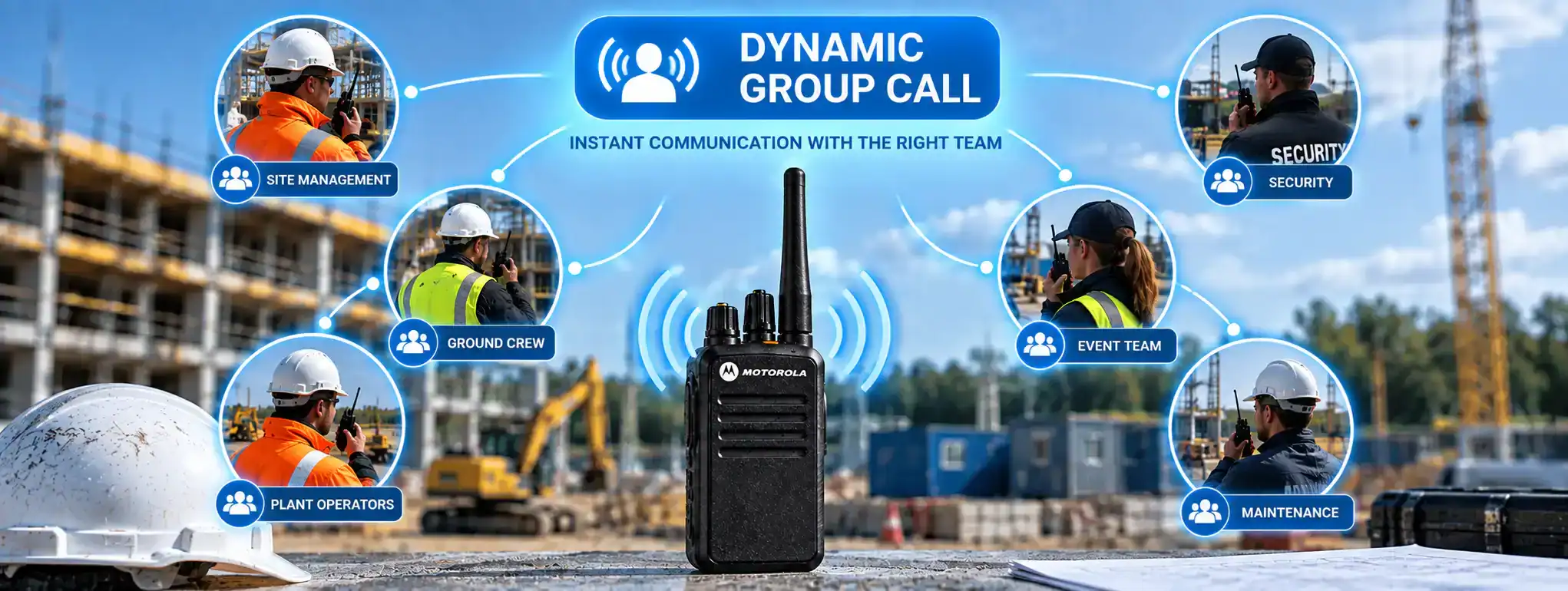
Dynamic Group Call
Dynamic Group Call is a digital two-way radio feature that allows a temporary communication group to be created or assigned without permanently programming every radio into that group. It enables selected radio users to be brought together for a specific conversation, task or incident.
Dynamic Group Calling is particularly useful in larger professional radio systems where users may need to communicate with different teams at different times.
Instead of permanently assigning a radio to one fixed talkgroup, the system can dynamically allocate or associate radios with a temporary group according to operational requirements.
The exact terminology and functionality varies between radio manufacturers and radio networkA Network is a connected system of radios, equipment and infrastructure that allows users to communicate across a defined area. Radio networks can range from simple radio-to-radio systems to large multi-site networks. technologies.
How does Dynamic Group Call work?
A Dynamic Group Call is normally controlled by the radio systemA Radio System is a complete communication solution comprising two-way radios and, where required, equipment such as repeaters, antennas, base stations, mobile radios and network infrastructure. rather than being created solely by the individual radio user.
A system administrator, dispatcher or authorised user can select a number of radios and assign them to a temporary communication group.
A simplified process is:
Select radios → Create/assign temporary group → Users communicate → Group is released
The radios can then communicate using the dynamically assigned group.
Once the task has finished, the group can be removed or the radios can return to their normal communication groups.
Dynamic Group Call vs fixed talkgroups
A traditional Talkgroup is normally programmed into the radio as part of its configuration.
For example, a radio might permanently contain:
- Security
- Operations
- Maintenance
- Management
A Dynamic Group Call provides greater flexibility because a temporary group can be created for a particular requirement.
For example:
Security + Operations + Maintenance → Incident Group
Once the incident has been dealt with, the users can return to their normal groups.
Dynamic Group Call and DMR
Dynamic Group Calling can be supported by some DMR (Digital Mobile RadioA Mobile Radio is a two-way radio designed to be installed in a vehicle. It normally uses the vehicle's power supply and an external antenna to provide reliable communication while travelling or working in the field.) systems, depending on the manufacturer, network architecture and system configuration.
DMR already provides group communication through programmed talkgroups. More advanced systems can provide mechanisms for dynamically assigning radios to temporary groups.
Dynamic group functionality should therefore not be assumed to be available on every DMR radio.
Dynamic Group Call and trunked radio
Dynamic Group Calling is particularly suited to trunked radio systems.
A trunked system manages radio resources centrally and can dynamically allocate channels or other resources to users.
This makes it possible to create temporary communication groups without requiring every radio to be manually reprogrammed.
The precise implementation depends on the trunked radio technology and network.
Dynamic Group Call and radio dispatch
A Dispatch operator can use Dynamic Group Calling to bring selected users together quickly.
For example, a dispatcher managing a large site might need to create a temporary group containing:
- Security Supervisor
- Maintenance Team
- Site Manager
- Control Room
The dispatcher can establish the temporary group so that everyone involved in the situation can communicate without disrupting the organisation’s normal talkgroups.
Dynamic Group Call for incidents
Dynamic Group Calling can be particularly useful during incidents.
A normal radio system may have separate groups for different departments. During an incident, people from several departments may need to communicate directly with each other.
A temporary group can bring the relevant users together without requiring permanent changes to the radio system.
For example:
Security + Medical + Event Control → Incident Group
Once the incident is resolved, the users can return to their normal groups.
Dynamic Group Call for events
Large events often involve many teams with different responsibilities.
Dynamic groups can allow selected users to communicate together for a specific situation without changing the normal structure of the radio system.
For example, a production manager could temporarily create a group containing personnel responsible for a particular stage or area.
This can make radio communications more flexible as the event develops.
Dynamic Group Call for security
Security operations can benefit from temporary communication groups when responding to incidents.
A security control room could bring together selected guards, supervisors and other relevant personnel for a particular incident.
The rest of the security organisation can continue using its normal communication groups.
This helps prevent unnecessary radio traffic from being heard by users who are not involved in the incident.
Dynamic Group Call and large organisations
Dynamic Group Calling can be valuable where an organisation has many users and departments.
A large organisation may have permanent groups such as:
- Security
- Facilities
- Engineering
- Transport
- Management
Dynamic groups allow users from these different departments to be temporarily combined when required.
This avoids having to create a permanent talkgroup for every possible combination of users.
Dynamic Group Call and radio programming
Unlike a permanently programmed talkgroup, a Dynamic Group Call can be assigned by the radio system while the radio is operating.
This can reduce the need for administrators to manually reprogramme individual radios whenever operational requirements change.
However, the radio equipment and network must support the relevant dynamic-group functionality.
Dynamic Group Call and Radio IDs
Digital radio systems normally identify individual radios using a unique Radio ID or equivalent identifier.
The system can use these identities to determine which radios should participate in a Dynamic Group Call.
This allows a dispatcher or network controller to select individual users rather than simply addressing an entire pre-programmed group.
Dynamic Group Call and individual calls
Dynamic Group Calling is different from an Individual Call.
An Individual Call connects one radio with another specific radio.
A Dynamic Group Call brings several selected radios together into a temporary communication group.
For example:
Individual Call: Radio A ↔ Radio B
Dynamic Group Call: Radio A + Radio B + Radio C + Radio D
Dynamic Group Call and normal group calls
A conventional Group Call normally uses a predefined talkgroup.
A Dynamic Group Call creates or assigns a group dynamically for a particular purpose.
The distinction is therefore primarily about how the communication group is established and managed.
Both can provide communication between multiple radio users.
Dynamic Group Call and radio channels
A Dynamic Group Call may use radio resources allocated by the system rather than requiring users to manually select a dedicated physical channelA two-way radio channel is a programmed set of communication settings, typically including frequency and signalling, that allows compatible radios to communicate with one another..
On a trunked system, the network can allocate the necessary resources automatically.
On other systems, the implementation may be different.
The user may therefore experience the feature simply as selecting or joining a group while the system handles the underlying radio resources.
Dynamic Group Call and spectrum efficiency
Dynamic group communication can contribute to efficient use of radio resources on systems capable of dynamically allocating channels.
Rather than permanently reserving a channel for every possible communication group, the network can allocate resources when they are required.
This is one of the advantages of more sophisticated trunked radio architectures.
Dynamic Group Call and emergency communications
Dynamic groups can be useful during emergency situations where several teams need to coordinate quickly.
A dispatcher may be able to establish a temporary group containing the personnel directly involved.
However, emergency functionality varies considerably between radio systems and should be specifically designed and tested rather than assumed.
Dynamic Group Call and control rooms
In a control-room environment, Dynamic Group Calling can provide dispatchers with greater control over radio communications.
A dispatcher can potentially:
- Select users
- Create a temporary group
- Assign users to the group
- Monitor the conversation
- Remove users
- End the temporary group
The precise functions available depend on the dispatch platform and radio network.
Dynamic Group Call and roaming
Dynamic Group Calling can be used in systems where users move between different radio coverageRadio Coverage is the geographical area in which a two-way radio system can provide reliable communication. Coverage depends on the radios, antennas, frequency, terrain, buildings and system infrastructure. areas, provided the underlying network supports the required functionality.
For larger networks, the system may maintain the group communication as users move between sites.
The exact behaviour depends on the network architecture and configuration.
Dynamic Group Call and cloud dispatch
Some modern radio systems provide group-management functions through cloud-based dispatch platforms.
An authorised dispatcher can manage users and communication groups through software rather than relying entirely on the physical radio.
This can be particularly useful for organisations operating across multiple locations.
Dynamic Group Call limitations
Dynamic Group Calling is not a standard feature on every two-way radio.
Its availability depends on:
- Radio technology
- Radio model
- Network architecture
- Dispatch software
- System configuration
- Licensing
- Manufacturer support
A radio may support standard group calls without supporting dynamic groups.
Dynamic Group Call and radio hire
Dynamic Group Calling can be useful for larger temporary radio systems where teams and responsibilities may change during an event or project.
For example, an event control room may need to temporarily bring together security personnel from several areas to deal with an incident.
Where supported, the radio system can provide this flexibility without permanently changing the radios’ standard configuration.
Dynamic Group Call vs reprogramming
One of the main advantages of Dynamic Group Calling is that it can reduce the need for manual radio reprogramming.
If a new communication group is required for a short period, users do not necessarily need to return their radios to an engineer for programming.
The system can make the temporary assignment dynamically.
This is particularly useful in large fleets where manually changing individual radios would be impractical.
Dynamic Group Call and operational flexibility
Dynamic Group Calling allows radio communications to reflect the way an organisation is actually operating at a particular moment.
Permanent groups can remain unchanged while temporary groups are created around:
- Incidents
- Projects
- Events
- Maintenance tasks
- Security operations
- Management requirements
This can make complex radio networks easier to manage.
Dynamic Group Call and DCS
DCS can design professional radio systems around the communication structure of an organisation.
Where a customer requires temporary or dynamically managed communication groups, suitable digital radio, trunked radio or dispatch solutions can be considered, subject to the capabilities of the chosen equipment and network.