
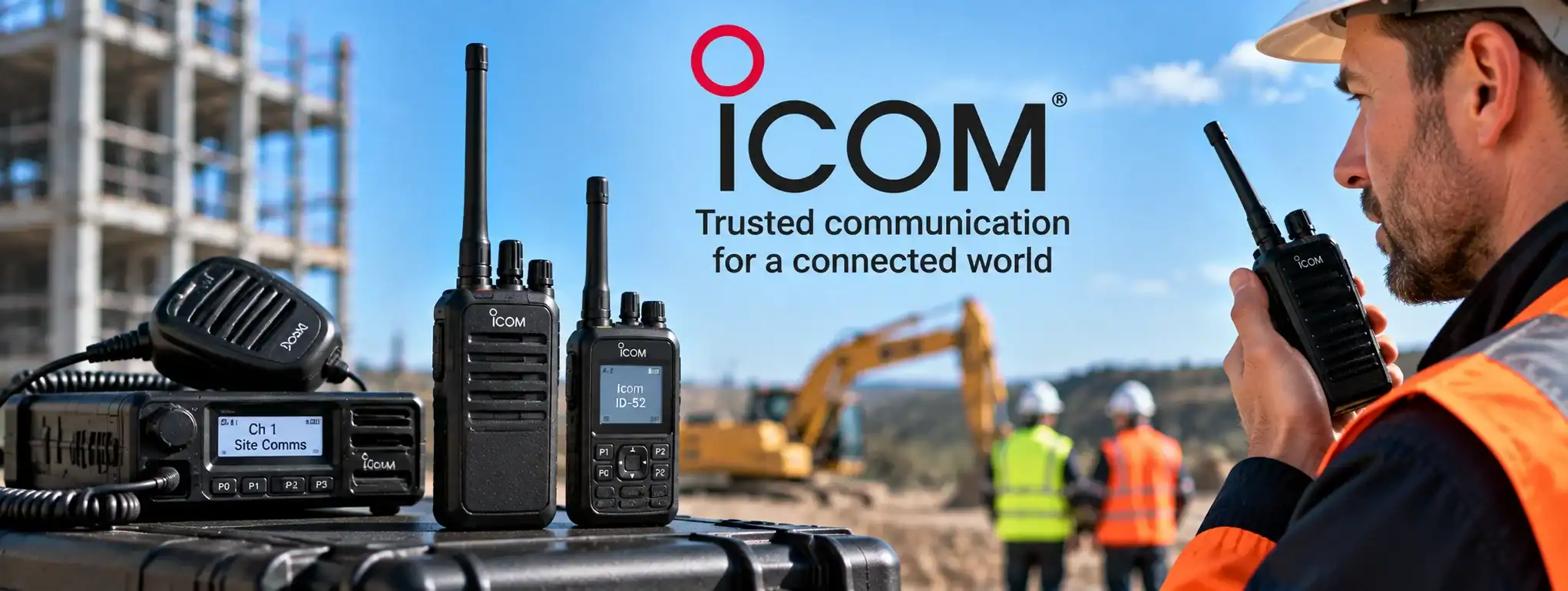
Icom
Icom is a Japanese manufacturer of radio communication equipment, including professional two-way radios, digital radio systems, marine radios, aviation radios, amateur radio equipment and related communication accessories.
Icom products are used across a wide range of commercial, industrial, public-service and recreational applications. In the professional two-way radio market, Icom produces both analogue and digital radio equipment, including systems based on IDAS digital radio technology and dPMR.
Icom is particularly well known for manufacturing rugged radioA Rugged Radio is a two-way radio designed to withstand demanding working environments, with features such as impact resistance and protection against dust, water and other environmental conditions. equipment designed for demanding environments and specialist communication applications.
Icom two-way radios
Icom produces a range of handheld, mobile and fixed radio equipment.
Professional Icom two-way radios can be used for applications including:
- Security
- Construction
- Events
- Hospitality
- Transport
- Manufacturing
- Utilities
- Marine operations
- Education
- General business communications
The appropriate model depends on the required frequencyAn antenna transmits and receives radio-frequency signals, allowing a two-way radio to communicate. Antenna type, frequency, height and location can all affect radio performance and coverage. band, coverageRadio Coverage is the geographical area in which a two-way radio system can provide reliable communication. Coverage depends on the radios, antennas, frequency, terrain, buildings and system infrastructure., operating environment and system requirements.
Icom analogue radios
Icom manufactures conventional analogue two-way radios for professional applications.
Analogue radios transmit voice using an analogue radioAnalogue radio uses continuously varying radio signals to transmit voice communication. It remains widely used for reliable two-way communication across business, industry, events, security and other applications. signal and can operate either directly between compatible radios or through suitable repeaterA Repeater receives a two-way radio transmission and retransmits it, usually from an elevated location, to extend the coverage and reliability of a radio communication system. infrastructureRadio infrastructure is the equipment and supporting systems behind a professional two-way radio network, including repeaters, antennas, base stations, network connections, power systems and dispatch equipment..
Icom’s analogue equipment can include features such as:
- Multiple channels
- CTCSS and DCS
- ChannelA two-way radio channel is a programmed set of communication settings, typically including frequency and signalling, that allows compatible radios to communicate with one another. scanning
- Emergency functions
- Programmable buttons
- VOX
- Audio accessories
- Repeater operation
The exact features depend on the individual model.
Icom digital radios
Icom also manufactures digital two-way radios.
Digital radio converts voice into a digital signal before transmissionTransmission is the process of sending voice, data or signalling from a radio using a radio-frequency signal to another radio, repeater or communication system., allowing additional features and more efficient use of the available radio systemA Radio System is a complete communication solution comprising two-way radios and, where required, equipment such as repeaters, antennas, base stations, mobile radios and network infrastructure..
Icom has developed digital products using technologies including IDAS and dPMR.
Icom IDAS
IDAS (Icom Digital Advanced System) is Icom’s digital radio technology.
IDAS is based on the NXDN digital radio protocol and is designed for professional two-way radio communication.
IDAS systems can provide features such as:
- Digital voice
- Individual calling
- Group calling
- Digital signalling
- Data communication
- Emergency functions
- EncryptionEncryption protects two-way radio communications by converting voice or data into a secure form that can only be understood by authorised radios with the correct encryption capability and keys. where supported
- Repeater operation
The exact functionality depends on the equipment and system configuration.
Icom dPMR
Icom also produces equipment supporting dPMR (digital Private Mobile RadioA Mobile Radio is a two-way radio designed to be installed in a vehicle. It normally uses the vehicle's power supply and an external antenna to provide reliable communication while travelling or working in the field.) technology.
dPMR is a digital radio standard designed for professional and commercial communications.
It uses FDMA technology and can support features such as digital voice, individual and group calling, signalling and other professional radio functions where implemented by the equipment.
Icom NXDN
Icom’s IDAS technology is associated with the NXDN digital radio protocol.
NXDN is a digital radio technology developed for professional and commercial radio communication.
Icom and other manufacturers have produced equipment based on the NXDN standard.
This can provide interoperabilityInteroperability is the ability of different communication systems, devices or organisations to work together and exchange information. In two-way radio, it can connect different radio networks, technologies or users through compatible systems or gateways. between compatible equipment where the relevant technical specifications and system configuration are supported.
Icom PMR446 radios
Icom produces licence-exempt PMR446 radios for short-range communication in the UK and Europe.
PMR446 radios operate within the designated PMR446 frequencyFrequency is the number of cycles a radio wave completes each second, measured in Hertz. In two-way radio, frequency determines where a transmission operates within the radio spectrum. allocation and are subject to the applicable technical restrictions.
They can be useful for short-range communication in environments such as:
- Events
- Hospitality
- Retail
- Warehousing
- Leisure
- Small sites
PMR446 is different from licensed professional business radioBusiness Radio refers to professional two-way radio systems used by businesses and organisations for instant communication, often using licensed frequencies and equipment designed for commercial use. because of its specific frequency, powerAn antenna transmits and receives radio-frequency signals, allowing a two-way radio to communicate. Antenna type, frequency, height and location can all affect radio performance and coverage. and equipment restrictions.
Icom business radios
Icom produces professional radios designed for business users.
Depending on the model, these radios can provide features such as:
- Multiple channels
- Group communication
- Emergency alerts
- Channel scanning
- VOX
- Encryption
- Lone workerA Lone Worker is someone who works without direct supervision or immediate assistance nearby. Compatible two-way radios can provide safety features such as timed check-ins, emergency alerts and GPS location. functions
- Man-down functions
- GPS
- Digital signalling
Not every Icom radio provides every feature.
Icom handheld radios
Icom manufactures portable handheld two-way radios designed to be carried and operated by individual users.
Handheld radios are available in different frequency bands and configurations.
Features can include:
- Push-to-Talk
- Channel selection
- Programmable buttons
- Display
- Keypad
- Emergency buttonAn Emergency Button is a dedicated two-way radio control that allows users to quickly send an emergency alert to a dispatcher, control room or authorised radio users.
- Battery operation
- Audio accessoryAn audio accessory is an external device such as a speaker microphone, earpiece or headset that connects to a two-way radio to improve or adapt how users send and receive audio. connections
The appropriate model depends on the intended application.
Icom mobile radios
Icom also manufactures mobile radios designed for installation in vehicles.
Mobile radios generally have higher available power and larger external antennas than handheld radios, although actual performance depends on the equipment and installation.
They can be used in:
- Vehicles
- Fleets
- Agricultural machinery
- Transport
- Security vehicles
- Utility vehicles
- Industrial applications
Icom base stations
Some Icom radios can be installed as fixed Base Stations.
A base stationA base station is a fixed two-way radio installed at a permanent location, allowing an operator to communicate with handheld or mobile radios across a site or operating area. can provide a central communication point for a radio system.
It can be connected to an appropriate external antennaAn antenna transmits and receives radio-frequency signals, allowing a two-way radio to communicate. Antenna type, frequency, height and location can all affect radio performance and coverage. and, where required, other radio infrastructure.
Icom repeaters
Icom manufactures radio repeaters designed to extend the coverage of compatible radio systems.
A repeater receives a transmission from a radio and retransmits it so that users can communicate over a greater area.
Icom repeaters are available for different radio technologies and frequency bands.
The repeater must be compatible with the radios and configured correctly for the intended system.
Icom radio coverage
The coverage achieved by an Icom radio depends on more than the radio itself.
Factors can include:
- Frequency
- Transmit power
- Antenna
- Antenna height
- Terrain
- BuildingsAn antenna transmits and receives radio-frequency signals, allowing a two-way radio to communicate. Antenna type, frequency, height and location can all affect radio performance and coverage.
- InterferenceRadio interference occurs when unwanted radio-frequency signals or electrical noise disrupt two-way radio communications, causing distorted audio, broken transmissions, reduced coverage or loss of communication.
- Radio sensitivity
- Repeater infrastructure
A more powerful radio does not automatically guarantee greater usable coverage.
Icom antennas
Icom radios use antennas appropriate to their frequency band and equipment design.
An antenna is an important part of the radio system because it transmits and receives the RF signal.
For fixed or vehicle installations, an external antenna may provide different performance from the compact antenna used on a handheld radio.
Icom batteries
Portable Icom radios use rechargeable batteries designed for their specific models.
Battery capacity affects how long a radio can operate between charges.
Radio usage, transmit time, receive time, temperature and battery condition can all affect actual operating time.
Icom charging systems
Icom provides charging equipment for compatible radios and batteries.
Depending on the model, charging options can include:
- Single chargers
- Desktop chargers
- Multi-unit charging systems
- Battery chargers
- Vehicle charging solutions
The correct charger must be compatible with the specific battery and radio.
Icom audio accessories
Icom radios can be used with compatible Audio Accessories.
These can include:
- Speaker microphones
- Earpieces
- Headsets
- Remote PTT controls
- Covert accessories
- Other specialist audio equipment
The connector and electrical specifications must match the radio.
Icom headsets
Compatible Icom headsets can provide hands-free or specialist communication.
Depending on the equipment, users may be able to combine a headsetA radio headset combines a microphone and speaker or earpiece, allowing two-way radio users to communicate conveniently while keeping the radio away from their face or using hands-free operation. with:
- VOX
- Remote PTT
- EarpieceAn earpiece is a two-way radio audio accessory that lets users hear radio communications discreetly, often with a microphone and Push-to-Talk button for transmitting.
- Noise-reduction equipment
This can be particularly useful in noisy or operational environments.
Icom encryption
Some professional Icom radios provide encryption or voice scrambling functions.
Encryption is used to help protect radio communications from unauthorised interception.
The security level and encryption method depend on the specific Icom equipment.
Encryption capabilities should not be assumed to be identical across all Icom radios.
Icom emergency functions
Professional Icom radios can provide emergency communication features on compatible models.
These can include:
- Emergency alarms
- Emergency buttons
- Man-down
- Lone worker
- Priority signalling
The exact emergency functions vary between models and system configurations.
Icom lone worker
Some Icom professional radios support Lone Worker functionality.
A lone-worker function can require the radio user to periodically interact with the radio.
If the expected interaction does not occur, the radio can initiate an alert according to its programmed configuration.
This can provide an additional safety feature for workers operating alone.
Icom man-down
Some Icom radios support Man-Down functionality.
A compatible radio can detect an abnormal orientation or lack of movement and initiate an alert according to its configuration.
This can be useful for workers operating in potentially hazardous environments.
The exact detection method and response depend on the specific radio model.
Icom GPS
Some professional Icom radios include GPS functionality.
A GPS-equipped radio can determine its geographical location and, where supported by the system, transmit location information to another device or management platform.
GPS availability varies between models.
Icom channel scanning
Icom radios can provide Channel ScanChannel Scan is a two-way radio feature that automatically monitors multiple programmed channels for activity, allowing users to hear communications without manually switching between channels. functionality on compatible models.
Scanning allows a radio to monitor multiple programmed channels and stop when activity is detected.
Some models also support priority scanning or other advanced scanning configurations.
Icom DCS and CTCSS
Icom radios can support signalling systems such as CTCSS and DCS on compatible models.
These systems help control which transmissions open the receiving radio’s squelchAnalogue radio uses continuously varying radio signals to transmit voice communication. It remains widely used for reliable two-way communication across business, industry, events, security and other applications..
They do not provide encryption and do not prevent other users with compatible equipment from potentially receiving the underlying transmission.
Icom DMR
Icom is not primarily a DMR manufacturer.
Icom’s professional digital radio products have historically focused on technologies such as IDAS/NXDN and dPMR rather than DMR (Digital Mobile Radio).
This distinction is important when selecting radios because Icom digital radios are not automatically compatible with DMR systems.
Icom and TETRA
Icom’s professional radio portfolio is distinct from manufacturers whose primary focus includes TETRA public-safety and mission-critical systems.
Organisations requiring TETRA should ensure that the selected equipment supports the required TETRA standard and infrastructure.
An Icom professional digital radio should not be assumed to be TETRA-compatible.
Icom and PoC
Icom also has products and solutions that can incorporate network-based communication technologies depending on the product range.
PoC (Push-to-Talk over Cellular) uses cellular or IP networks rather than conventional RF radio as the primary communication path.
Compatibility between an Icom radio and a PoC platform depends on the specific products and gateway or networkA Network is a connected system of radios, equipment and infrastructure that allows users to communicate across a defined area. Radio networks can range from simple radio-to-radio systems to large multi-site networks. solution involved.
Icom and IP networks
Some Icom radio systems can use IP networking to connect radio infrastructure across different locations.
IP connectivity can allow radio sites, repeaters or control systems to communicate across a network.
This can create wider-area communication systems without requiring every location to be within direct RF range.
Icom repeaters and IP networking
Compatible Icom repeater systems can be linked through IP networks where the equipment supports the required configuration.
This can allow multiple radio sites to form part of a wider communication network.
For example:
Radio → Local Repeater → IP Network → Remote Repeater → Radio
This can provide communication across geographically separated locations.
Icom and dispatch
Compatible Icom systems can be integrated with Dispatch and control-room applications.
A dispatch system can provide centralised management of radio communications and, depending on the system, functions such as:
- User management
- Group calling
- Individual calling
- Recording
- Location information
- Emergency alerts
The available functions depend on the specific radio infrastructure and software.
Icom and radio recording
Where supported by the communication system, Icom radio communications can be integrated with recording equipment or software.
Radio recording can be useful for:
- Security operations
- Control rooms
- Transport
- Incident investigation
- Operational records
Recording functionality is generally a system-level feature rather than an inherent feature of every Icom radio.
Icom and radio licensing
The licensing requirements for an Icom radio depend on the frequency, radio service and operating conditions.
Professional business radios operating on licensed frequencies require the appropriate authorisation.
Icom also manufactures equipment for licence-exempt services such as PMR446.
The fact that a radio is manufactured by Icom does not determine whether a licence is required.
Icom and Business Radio Licences
Icom professional radios can operate under the UK’s Business Radio licensing framework where the equipment and frequency configuration meet the applicable requirements.
The specific licence and operating conditions depend on the radio service being used.
The radio should be programmed and operated in accordance with the relevant licence conditions.
Icom radio programming
Icom radios are programmed using manufacturer-specific software and configuration tools appropriate to the radio model.
Programming can determine settings such as:
- Frequencies
- Channels
- CTCSS
- DCS
- Transmit power
- Scan lists
- Emergency functions
- Digital settings
- Buttons
- Signalling
The exact programming options vary between models.
Icom codeplug
The configuration data programmed into a professional radio is commonly referred to as a CodeplugA Codeplug is the configuration data programmed into a two-way radio that defines its channels, frequencies, talkgroups, radio ID and other operating features., although terminology varies between manufacturers.
The configuration can contain the radio’s channels, frequencies, signalling and other operational settings.
An Icom radio’s programming must be appropriate for the radio model and intended system.
Icom and radio hire
Icom radios can be used in temporary Radio HireRadio Hire is the temporary rental of two-way radios and related communication equipment for events, projects and operational requirements, providing professional communication without purchasing the equipment. deployments where the specific equipment meets the requirements of the application.
For example, compatible Icom radios can be configured for temporary event communications, site operations or other short-term requirements.
The radio system should be configured with appropriate channels, accessories and licensing arrangements.
Icom for events
Icom radios can be used for event communication where the selected model and system provide the required coverage and functionality.
Potential applications include:
- Event security
- Production
- Stewarding
- Venue operations
- Traffic management
- Event control
For larger events, repeaters or other infrastructure may be required to achieve suitable coverage.
Icom for security
Professional Icom radios can be used by security personnel for communication across sites and facilities.
Depending on the model, accessories such as discreet earpieces and remote PTT controls can be used for more convenient or discreet operation.
Icom for construction
Icom professional radios can be used on construction sites for communication between workers, supervisors and site management.
The appropriate equipment should take account of:
- Coverage
- Noise
- Durability
- Weather exposure
- Battery life
- Required accessories
- Licensing
Icom for industrial applications
Icom manufactures rugged radio equipment suitable for various industrial environments.
The appropriate model depends on environmental conditions and whether specialist certifications, such as ATEX, are required.
An ordinary Icom professional radio should not be assumed to be suitable for use in a hazardous or potentially explosive atmosphere.
Icom ATEX radios
Icom manufactures specialist radio equipment for hazardous environments, including equipment designed to meet relevant ATEX requirements where applicable.
ATEX-certified radios are specifically designed and certified for defined hazardous environments.
The certification applies to the specific equipment and conditions for which it has been approved.
Icom waterproof radios
Some Icom handheld radios are designed to provide resistance to water and dust.
Environmental protection is normally expressed using an IP rating.
The actual protection level varies between models, and an IP rating should always be checked against the conditions in which the radio will be used.
Icom marine radios
Icom is particularly well known for its marine communication equipment.
Its marine products include VHF radios designed for communication between vessels, shore stations and other marine users.
Marine radioA Marine Radio is a two-way radio designed for communication between vessels, shore stations and marine operations. Marine VHF radios are widely used for operational and safety communication on the water. equipment operates under different regulatory and operational requirements from ordinary business radio.
Icom aviation radios
Icom also manufactures aviation communication equipment, including radios designed for aviation VHF communications.
Aviation radios are designed for the specific frequencies and operating requirements used for airband communications.
They are distinct from ordinary business two-way radios.
Icom amateur radios
Icom has a long-standing presence in the amateur radio market.
Its products include handheld, mobile and base-station amateur radio equipment.
Amateur radio equipment is designed for licensed amateur-radio operators and supports a much wider range of radio applications than conventional business communications.
Icom as a radio manufacturer
Icom is an established manufacturer with a broad portfolio covering professional, marine, aviation and amateur radio.
For business users, the important consideration is not simply the brand but whether the particular Icom radio provides the required:
- Frequency
- Radio technology
- Coverage
- Durability
- Battery capacity
- Accessories
- Emergency features
- Licensing compatibility
- System interoperability
Different Icom models are designed for different applications.
Icom vs DMR radios
Icom should not be treated as synonymous with DMR.
Many professional digital radio manufacturers use DMR, while Icom’s digital portfolio has included technologies such as IDAS/NXDN and dPMR.
When replacing or expanding an existing radio fleet, the digital protocol must therefore be checked carefully.
A radio using one digital standard will not automatically communicate with equipment using another.
Icom and interoperability
Interoperability between Icom equipment and radios from other manufacturers depends on the radio technology and standards involved.
Analogue radios can often interoperate where they share compatible frequencies and signalling configurations.
Digital interoperability is more dependent on the specific digital standard, protocol and system configuration.
Selecting an Icom radio
When selecting an Icom radio, organisations should consider:
- Required frequency band
- Analogue or digital operation
- Digital protocol
- Coverage
- Repeater requirements
- Number of users
- Battery requirements
- Environmental conditions
- ATEX requirements
- Audio accessories
- GPS
- Emergency functions
- Encryption
- Licensing
- Interoperability
- Future expansion
Selecting the correct model is more important than simply selecting a particular manufacturer.
Icom and DCS
DCS can supply and configure compatible Icom two-way radio equipment for suitable professional applications.
Icom radios can provide a practical solution for businesses requiring reliable Push-to-Talk communication, with different models available for conventional analogue, digital and specialist radio applications.
The appropriate Icom equipment depends on the operating environment, required coverage, radio technology and licensing requirements.