User ID
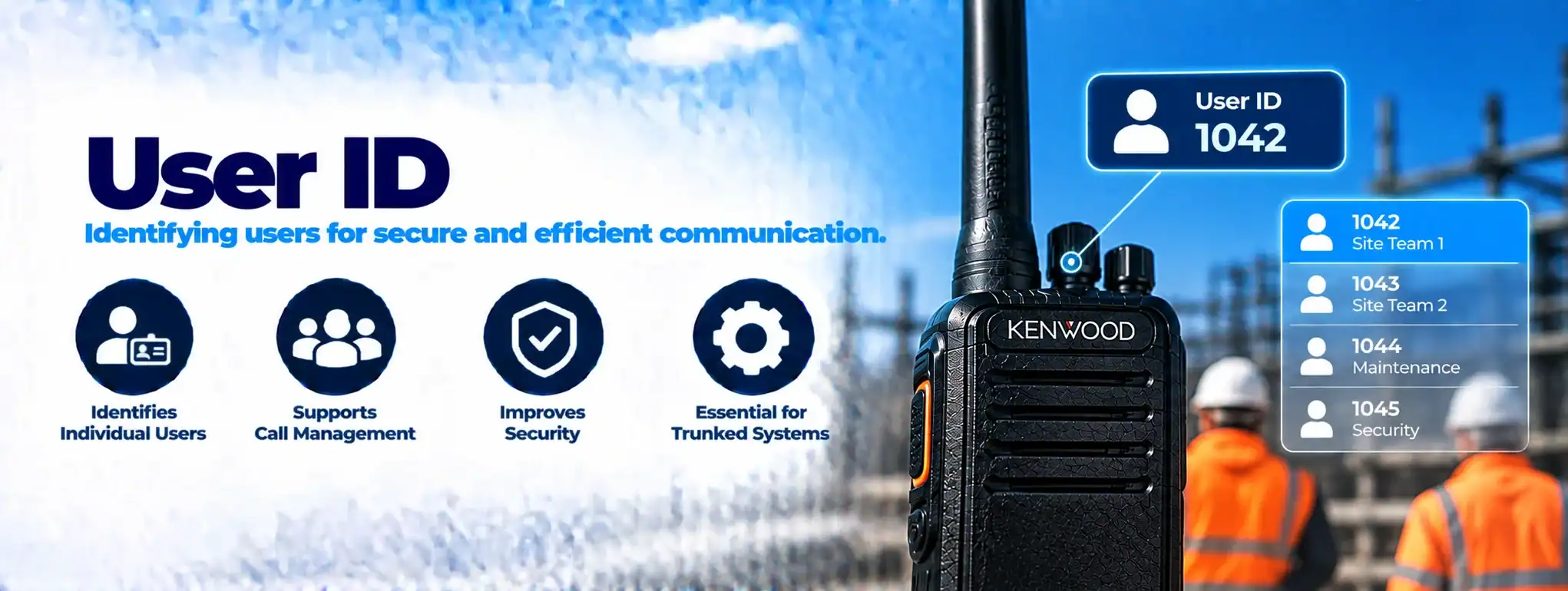
A User ID (User Identification) is a unique identifier assigned to a user, radio or subscriber within a communication system. In professional two-way radio, a User ID allows the system to identify individual radios and associate communications or system functions with the correct user.
In digital radio systems such as DMR (Digital Mobile RadioA Mobile Radio is a two-way radio designed to be installed in a vehicle. It normally uses the vehicle's power supply and an external antenna to provide reliable communication while travelling or working in the field.), each radio can be assigned a unique radio ID. This allows the system to distinguish one radio from another when making calls, sending data or generating alerts.
What is a User ID?
A User ID is essentially an identity assigned within a system.
For example:
Radio A → User ID 1001
Radio B → User ID 1002
The radio systemA Radio System is a complete communication solution comprising two-way radios and, where required, equipment such as repeaters, antennas, base stations, mobile radios and network infrastructure. can use these identifiers to determine which radio is transmitting or which radio should receive a particular communication.
User ID in two-way radio
In professional digital two-way radio, a User ID can be associated with an individual radio or user.
The ID can be used for functions such as:
- Individual calls
- Private calls
- Radio identification
- Emergency alerts
- GPS reporting
- Text messaging
- Status messages
- Dispatch systems
The exact functions available depend on the radio technology and system.
User ID and DMR
DMR radios use a unique Radio ID to identify individual subscriber units.
The Radio ID is programmed into the radio and is used by the DMR system when communicating with other radios.
For example:
Radio 1 → ID 123456
Radio 2 → ID 123457
When Radio 1 makes an individual call to Radio 2, the system uses the relevant IDs to identify the source and destination.
User ID vs Radio ID
The terms User ID and Radio ID are sometimes used interchangeably, but they can describe slightly different things.
Radio ID: Identifies the radio or subscriber device.
User ID: May identify the person or account using a wider communication system.
In some systems, the user and radio have a direct one-to-one relationship. In others, a user can operate multiple devices or a radio can be reassigned to different users.
User ID and subscriber units
A Subscriber UnitA Subscriber Unit is a two-way radio device used by an individual or vehicle to access and communicate through a radio system. It can be a portable or mobile radio. is an end-user radio such as a handheld or mobile radio.
The system can assign an identity to the subscriber unit so that it can be recognised on the networkA Network is a connected system of radios, equipment and infrastructure that allows users to communicate across a defined area. Radio networks can range from simple radio-to-radio systems to large multi-site networks..
This identity is used for system management and communications.
User ID and individual calls
A digital radio system can use individual IDs to establish a one-to-one call.
For example:
User ID 1001 → User ID 1002
Only the intended recipient’s compatible radio is addressed by the call.
This is commonly known as a Private CallPrivate Call is a two-way radio feature that allows one radio user to communicate directly with another individual radio user rather than making the conversation part of a general group call. in DMR terminology.
User ID and group calls
Group calls work differently.
A group call is directed to a Talk GroupA Talk Group is a predefined group of users or radios within a two-way radio system that share a common communication group, allowing teams to communicate without involving other users. rather than a single User ID.
For example:
User ID 1001 → Security Talk Group
All authorised radios monitoring that talk group can receive the transmissionTransmission is the process of sending voice, data or signalling from a radio using a radio-frequency signal to another radio, repeater or communication system..
The User ID can still identify which radio initiated the call.
User ID and talk groups
A User ID identifies an individual radio or user.
A Talk Group identifies a logical group of users.
For example:
User ID → Individual radio
Talk Group → Security team
These identifiers perform different functions within a digital radio system.
User ID and radio identification
A radio system can use User IDs to identify the source of transmissions.
This can allow a dispatcher to see which radio is making a call or sending a status message.
The exact information displayed depends on the radio and dispatch system.
User ID and dispatch systems
In a control room or dispatch environment, User IDs can help operators identify individual radios.
A dispatch application may display:
- Radio ID
- User name
- Call status
- Talk group
- GPS location
- Emergency status
The relationship between the displayed name and the underlying User ID is configured within the system.
User ID and GPS tracking
Compatible digital radio systems can associate GPS information with an individual radio ID.
For example:
Radio ID → GPS position → Dispatch system
This allows a control room to determine which radio has reported a particular location.
User ID and emergency alerts
When a radio generates an emergency alert, its User ID or Radio ID can be included in the signalling.
This allows the system to identify which radio has raised the alert.
For example:
Emergency buttonAn Emergency Button is a dedicated two-way radio control that allows users to quickly send an emergency alert to a dispatcher, control room or authorised radio users. pressed → Radio ID transmitted → Control room receives alert
This can be particularly useful in systems supporting Lone WorkerA Lone Worker is someone who works without direct supervision or immediate assistance nearby. Compatible two-way radios can provide safety features such as timed check-ins, emergency alerts and GPS location. or Man DownMan Down is a safety feature on some professional two-way radios that can detect a possible fall or unusual radio position and automatically raise an alert if the user does not respond. functions.
User ID and status messages
Digital radios can transmit status information associated with their User ID.
Examples can include:
- Available
- Busy
- At site
- Emergency
- Request assistance
The available status functions depend on the radio system.
User ID and text messaging
Some digital radio systems support text messaging.
A message can be associated with the User ID of the sending radio and directed to another individual radio or group.
User ID and encryption
User IDs are separate from EncryptionEncryption protects two-way radio communications by converting voice or data into a secure form that can only be understood by authorised radios with the correct encryption capability and keys..
A User ID identifies the radio or user within the system.
Encryption protects the content of communications.
Having a User ID does not make a communication secure or private by itself.
User ID and radio programming
The User ID or Radio ID is normally programmed into the radio during configuration.
Other programmed settings can include:
- Channels
- Frequencies
- Talk Groups
- Scan Lists
- PowerAn antenna transmits and receives radio-frequency signals, allowing a two-way radio to communicate. Antenna type, frequency, height and location can all affect radio performance and coverage. levels
- Emergency functions
- Encryption settings
Incorrect or duplicate radio IDs can cause problems with individual calling and system operation.
User ID and duplicate IDs
Each radio should normally have a unique ID within the relevant radio system.
If two radios are accidentally programmed with the same ID, the system may not be able to distinguish them correctly.
This can cause problems with:
- Private calls
- Radio identification
- GPS reporting
- Status messages
- Dispatch records
User ID and radio hire
For professional Radio HireRadio Hire is the temporary rental of two-way radios and related communication equipment for events, projects and operational requirements, providing professional communication without purchasing the equipment., radios may be programmed with unique IDs before being issued to users.
The hire provider can maintain a record linking each radio to its assigned operational role or user.
For temporary operations, this can make it easier to identify radios and manage communications.
User ID and radio fleet management
Organisations with large numbers of radios can use IDs to manage their radio fleet.
For example:
1001 → Site Manager
1002 → Security Supervisor
1003 → Maintenance
The actual allocation depends on the organisation’s system.
User ID and radio asset management
A User ID is not necessarily the same as an equipment serial number or asset number.
A radio can have several identifiers.
For example:
Serial Number → Identifies the physical equipment
Asset Number → Identifies the organisation’s asset record
Radio ID/User ID → Identifies the radio within the communication system
These identifiers serve different purposes.
User ID and serial number
A radio’s serial number is normally assigned by the manufacturer.
The User ID or Radio ID is normally assigned as part of system configuration.
Replacing a radio does not necessarily mean the same physical device keeps the same serial number, but an organisation may choose to assign the replacement radio the same operational identity.
User ID and radio ownership
A User ID does not necessarily indicate ownership of a radio.
It is primarily a system identifier.
An organisation may reassign a radio to another employee while retaining or changing its system identity depending on how the radio fleet is managed.
User ID and interoperability
User IDs are generally meaningful within the relevant radio system.
A User ID from one radio network does not automatically work on another unrelated network.
Compatible standards, system configuration and addressing are required.
User ID and DMR systems
In DMR, Radio IDs are particularly important for individual addressing.
A DMR system can use the ID to distinguish between individual subscriber units and establish individual calls.
The exact ID structure and management depend on the DMR system being used.
User ID and DMR private calls
A DMR Private Call uses the destination radio’s individual ID.
For example:
Radio A — ID 1001
calls:
Radio B — ID 1002
The system uses the destination ID to direct the call.
User ID and DMR group calls
A DMR Group Call uses a Talk Group ID.
The radio’s individual Radio ID identifies the originating subscriber, while the Talk Group ID identifies the intended group.
This distinction is important when configuring a DMR system.
User ID and trunked radio
In a Trunked Radio SystemA Trunked Radio System automatically shares and allocates available radio channels between users and talk groups, allowing many users to make efficient use of a limited number of radio resources., individual user or radio IDs can be used alongside talk groups.
The system can identify individual subscriber units while dynamically allocating radio resources for calls.
User ID and roaming
In a multi-site system, a radio can retain its configured identity while RoamingRoaming allows a compatible two-way radio to move between different radio sites or coverage areas, automatically selecting an appropriate site as the user moves. between sites.
The network can continue to recognise the subscriber as it moves between coverageRadio Coverage is the geographical area in which a two-way radio system can provide reliable communication. Coverage depends on the radios, antennas, frequency, terrain, buildings and system infrastructure. areas.
User ID and IP Site Connect
In systems using IP Site ConnectIP Site Connect links compatible DMR radio sites using an IP network, allowing selected radio communications to be shared between separate buildings, facilities or geographical locations., compatible DMR sites can share communications over an IP network.
Radio IDs can be used to identify individual radios across the connected system.
User ID and network management
Radio IDs can help system administrators manage the network.
They can be used when:
- Adding radios
- Removing radios
- Assigning permissions
- Configuring talk groups
- Troubleshooting calls
- Monitoring system activity
User ID and permissions
Some digital radio systems can associate permissions or services with individual radio IDs.
For example, one radio may be authorised to access particular talk groups or make certain types of calls.
The exact capabilities depend on the system.
User ID and priority
A radio’s identity can be associated with a priority level in some professional systems.
This can allow certain users or radios to receive preferential access to communication resources.
User ID and emergency priority
An emergency alert associated with a User ID can allow a control room to identify the specific radio requiring assistance.
In appropriately configured systems, emergency communications can also receive higher priority.
User ID and security
User IDs can improve accountability by allowing a system to associate communications and events with particular radios.
However, an ID alone is not an authentication or security mechanism.
Additional security controls may be required where communications are sensitive.
User ID and logging
Digital radio systems can record events associated with radio IDs.
Depending on the system, logs may include:
- Call activity
- Emergency alerts
- GPS reports
- Status messages
- System events
This can be useful for operational management and troubleshooting.
User ID and control rooms
A control room can use User IDs to distinguish individual radios operating across an organisation.
For example:
Radio ID 101 → Security Officer
Radio ID 102 → Supervisor
Radio ID 103 → Control Room
The displayed names are normally configured by the system administrator.
User ID and lone workers
For systems supporting Lone Worker functions, identifying the radio that generated an alert is particularly important.
The User ID or Radio ID can help the control room determine which worker or radio requires attention.
User ID and Man Down
A Man Down alert can be associated with the ID of the radio that generated it.
This allows the system to identify the relevant radio when an automatic emergency transmission is initiated.
User ID and GPS location
When GPS reporting is enabled, the system can associate a reported location with the radio’s ID.
This allows location information to be displayed against the appropriate radio or user.
User ID limitations
A User ID does not by itself:
- Increase radio range.
- Improve audio quality.
- Provide encryption.
- Create a talk group.
- Provide GPS.
- Provide trunking.
- Make a radio licence-free.
It is primarily an identification and addressing mechanism.
User ID and licensing
A User ID does not replace a radio licence.
If a radio operates on licensed business-radio frequencies, the appropriate licensing requirements still apply.
In the UK, business radioBusiness Radio refers to professional two-way radio systems used by businesses and organisations for instant communication, often using licensed frequencies and equipment designed for commercial use. spectrumSpectrum is the range of radio frequencies used for wireless communication. Two-way radios operate within specific parts of the radio spectrum, subject to frequency allocation and licensing requirements. is regulated by OfcomOfcom (Office of Communications) is the UK's communications regulator. For two-way radio users, Ofcom manages and regulates access to radio spectrum and the use of radio frequencies in the UK..
User ID and DCS
DCS can configure professional digital radio systems with appropriately assigned radio IDs and talk groups.
For larger radio fleets, structured ID management can make it easier to identify users, manage communications and support control-room operations.