
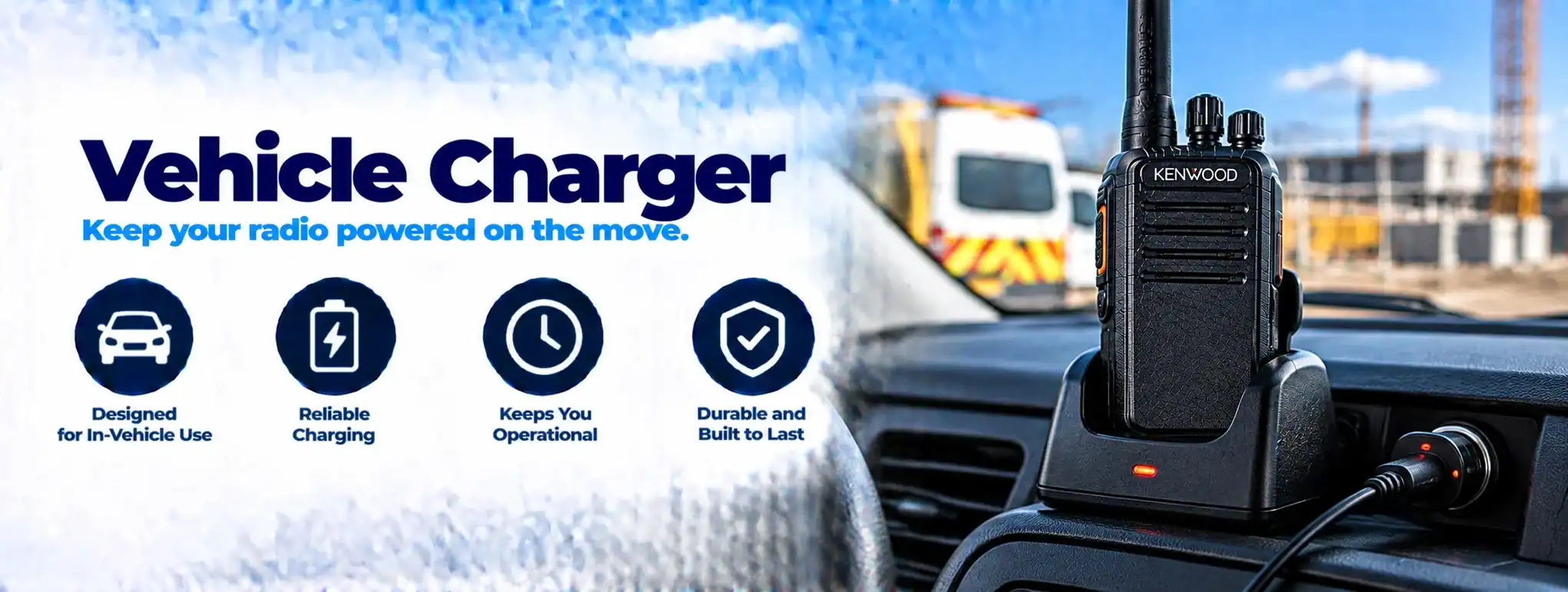
Vehicle Charger
A Vehicle Charger is a charger designed to recharge the battery of a portable two-way radio while the radio is being used or transported in a vehicle. Vehicle chargers are commonly used by mobile workers who spend significant amounts of time travelling between locations and need to keep their radio ready for use.
A vehicle charger can provide a convenient way to maintain radio battery levels without requiring access to a mains-powered charging station.
How does a vehicle charger work?
A vehicle charger connects the radio or its battery to the vehicle’s electrical supply.
Depending on the design, it may connect through:
- A vehicle powerAn antenna transmits and receives radio-frequency signals, allowing a two-way radio to communicate. Antenna type, frequency, height and location can all affect radio performance and coverage. socket.
- A USB connection.
- A dedicated charging cradle.
- A fixed vehicle installation.
The charger converts the vehicle’s electrical supply into the appropriate charging voltage and current for the radio battery.
Vehicle charger for two-way radios
Professional two-way radio manufacturers offer vehicle charging solutions for compatible portable radios.
The charger must be designed for the specific radio or battery type being used.
A charger designed for one radio model should not automatically be assumed to be compatible with another.
Vehicle charging cradle
A Vehicle Charging Cradle holds the radio securely while charging.
The radio is placed into the cradle, which provides electrical contacts for charging.
A cradle can be permanently mounted within a vehicle, making it suitable for users who regularly operate from the same vehicle.
Vehicle charger vs battery charger
A standard Battery Charger is normally designed for use at a fixed location, such as an office, depot or control room.
A vehicle charger allows charging while travelling or working away from a fixed location.
Both perform the same basic function but are designed for different operating environments.
Vehicle charger and radio batteries
Vehicle chargers can be used with rechargeable radio batteries such as Lithium-Ion (Li-Ion) batteries, provided the charger is specifically compatible with the battery and radio.
The charger should use the correct charging profile for the battery chemistry.
Vehicle charger and battery life
Correct charging is important for maintaining battery performance.
Using a manufacturer-approved or compatible charger helps ensure that the battery receives the appropriate charging characteristics.
Battery life is also affected by:
- Radio usage.
- Transmit time.
- Temperature.
- Battery age.
- Charging cycles.
- Storage conditions.
Vehicle charger and transmit time
Frequent radio transmissions can increase battery consumption.
For users who spend long periods in vehicles, a vehicle charger can help maintain battery availability throughout the working day.
This can be particularly useful for:
- Security personnel.
- Transport workers.
- Field engineers.
- Utility workers.
- Construction teams.
- Event staff.
- Emergency-response teams.
Vehicle charger and mobile workers
A vehicle charger is particularly useful when workers move between sites and cannot regularly return to a fixed charging station.
For example:
Worker → Vehicle → Next job → Vehicle charging
The radio can remain available for communication while the battery is maintained during travel or other suitable periods.
Vehicle charger and fleet vehicles
Organisations operating fleets can install vehicle charging cradles in selected vehicles.
This can help ensure that radios assigned to vehicles are ready for use at the start of each shift.
Vehicle charger installation
Vehicle chargers can be portable or permanently installed.
A permanent installation may provide a more secure and reliable solution for vehicles that are routinely assigned to radio users.
Installation should take account of:
- Vehicle power supply.
- Charger specifications.
- Mounting position.
- Cable routing.
- Radio accessibility.
- Driver safety.
- Vehicle operating conditions.
Vehicle charger and vehicle power
The charger draws power from the vehicle’s electrical system.
Depending on the charger, this may be through a vehicle accessory socket or a dedicated electrical connection.
The charger’s specifications should be checked to ensure compatibility with the vehicle supply.
Vehicle charger and ignition
Some permanently installed charging systems can be configured to operate with the vehicle ignition or electrical system.
The exact behaviour depends on the charger and installation.
A professional installation can help prevent unnecessary battery drain when the vehicle is parked.
Vehicle charger and radio operation
Some vehicle charging cradles allow the radio to remain operational while charging.
Whether the radio can transmit and receive normally while charging depends on the radio, charger and installation.
Vehicle charger and external antennas
A vehicle charger only charges the radio battery; it does not automatically improve radio range.
A vehicle-mounted radio antennaAn antenna transmits and receives radio-frequency signals, allowing a two-way radio to communicate. Antenna type, frequency, height and location can all affect radio performance and coverage. is a separate component.
A portable radioA Portable Radio is a battery-powered two-way radio designed to be carried and operated by an individual, providing mobile communication for professional and operational users. can potentially be connected to an appropriate external antenna using compatible equipment, but this depends on the radio and installation.
Vehicle charger and mobile radios
A Mobile RadioA Mobile Radio is a two-way radio designed to be installed in a vehicle. It normally uses the vehicle's power supply and an external antenna to provide reliable communication while travelling or working in the field. is normally powered directly from the vehicle’s electrical system rather than using a removable portable-radio battery.
A vehicle charger is therefore primarily associated with portable radios rather than conventional vehicle-mounted mobile radios.
Vehicle charger and radio hire
Vehicle chargers can be supplied as part of a professional Radio HireRadio Hire is the temporary rental of two-way radios and related communication equipment for events, projects and operational requirements, providing professional communication without purchasing the equipment. package where users need to operate handheld radios from vehicles.
They can be particularly useful for temporary projects where workers spend significant time travelling between locations.
Vehicle charger and long shifts
For long shifts, vehicle charging can help reduce the risk of a portable radio running out of battery.
A user can place the radio into the charger during suitable periods when the radio is not required.
Vehicle charger and spare batteries
Vehicle charging can be combined with Spare Batteries.
For critical operations, a spare battery provides an alternative power source if the primary battery becomes depleted or needs to be removed from service.
Vehicle charger and charging docks
A fleet may use a combination of:
- Office charging docks.
- Multi-unit chargers.
- Vehicle chargers.
- Spare batteries.
This allows radios to be charged according to how and where they are used.
Vehicle charger and charging management
For organisations with large radio fleets, charging arrangements should be considered as part of overall radio management.
The organisation may need to determine:
- Which vehicles require charging.
- Which radio models are being used.
- How many radios need charging.
- When radios are normally available for charging.
- Whether permanent installation is appropriate.
- Whether spare batteries are required.
Vehicle charger and safety
Vehicle chargers should be installed and used according to the manufacturer’s instructions.
Charging equipment should not obstruct:
- Vehicle controls.
- Driver visibility.
- Airbags.
- Pedestrian access.
- Seat adjustment.
- Emergency equipment.
Cables should also be routed securely to prevent them becoming a trip or snag hazard.
Vehicle charger and temperature
Vehicle interiors can experience high and low temperatures.
Extreme temperatures can affect rechargeable batteries and charging performance.
The radio and charger should therefore be operated within the temperature limits specified by the manufacturer.
Vehicle charger and rugged radios
Professional Rugged Radios designed for demanding environments may have vehicle charging accessories available.
The charging equipment should still be matched to the specific radio and battery.
Vehicle charger and intrinsically safe radios
Specialist Intrinsically Safe Radios may have specific charging requirements.
Only charging equipment approved for the particular intrinsically safe radioAn Intrinsically Safe Radio is a two-way radio designed and certified for use in specified hazardous areas where flammable gases, vapours or combustible dust could create a risk of explosion. and battery system should be used.
Vehicle charger and USB charging
Some modern radios may support USB charging.
However, USB connectivity does not automatically mean that any USB charger or vehicle USB socket is suitable.
The manufacturer’s charging requirements should always be checked.
Vehicle charger and charging speed
Charging speed depends on the charger, battery capacity, charging technology and radio model.
A higher-output vehicle supply does not necessarily mean the radio will charge faster, because the radio’s charging circuitry controls the charging process.
Vehicle charger and battery protection
Modern radio batteries and charging systems can incorporate protection against conditions such as:
- Overcharging.
- Excessive temperature.
- Incorrect charging conditions.
The exact protection features depend on the battery and charger.
Vehicle charger limitations
A vehicle charger does not:
- Increase radio transmissionTransmission is the process of sending voice, data or signalling from a radio using a radio-frequency signal to another radio, repeater or communication system. range.
- Improve radio reception.
- Increase transmitter power.
- Replace a radio battery.
- Turn a portable radio into a mobile radio.
- Improve coverageRadio Coverage is the geographical area in which a two-way radio system can provide reliable communication. Coverage depends on the radios, antennas, frequency, terrain, buildings and system infrastructure..
Its primary purpose is to keep a compatible rechargeable radio battery charged.
Choosing a vehicle charger
When selecting a vehicle charger, consider:
- Radio manufacturer.
- Radio model.
- Battery type.
- Charging compatibility.
- Vehicle power supply.
- Mounting requirements.
- Portable or permanent installation.
- Number of radios.
- Working environment.
Vehicle charger and professional radio systems
For professional radio users, charging equipment is an important part of maintaining radio availability.
A well-planned system can combine vehicle chargers, fixed charging stations and spare batteries so that radios remain ready for use throughout the working day.
Vehicle charger and DCS
DCS can supply compatible charging accessories for professional two-way radio systems, including vehicle charging solutions where required.
The correct charger depends on the radio model, battery and vehicle installation.