
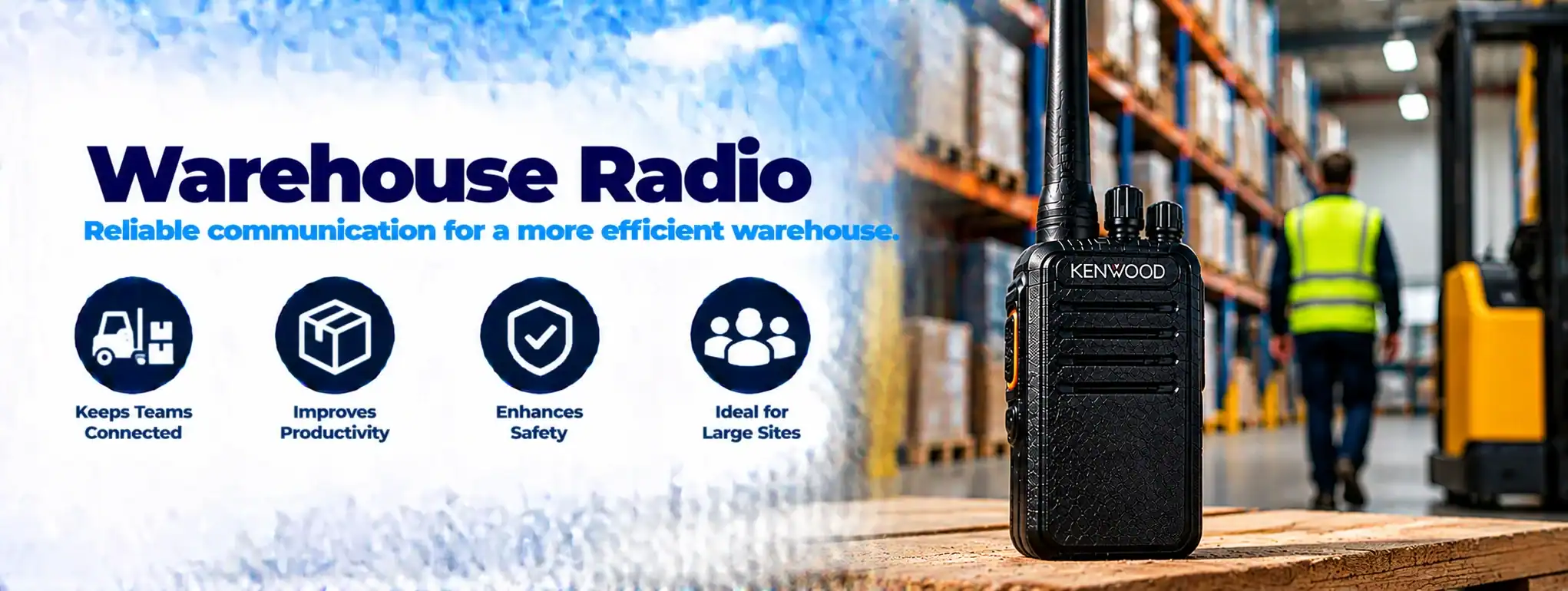
Warehouse Radio
A Warehouse Radio is a two-way radio systemA Radio System is a complete communication solution comprising two-way radios and, where required, equipment such as repeaters, antennas, base stations, mobile radios and network infrastructure. designed to provide reliable communication between warehouse staff, supervisors, drivers and other personnel working within a warehouse or distribution facility. Warehouse radios allow teams to communicate instantly without relying on mobile-phone networks.
A professional warehouse radio system can improve coordination between different areas of a facility, including loading bays, storage areas, offices, yards and goods-in and goods-out operations.
What is a warehouse radio?
A warehouse radio is normally a professional handheld Two-Way Radio configured for use within a warehouse or distribution environment.
Depending on the size and layout of the facility, a warehouse radio system can include:
- Portable radios
- Headsets
- Speaker microphones
- Vehicle-mounted radios
- Repeaters
- Base stations
- Multiple channels or talk groups
- Charging stations
- Emergency features
How do warehouse radios work?
Warehouse radios communicate using radio frequencies allocated to the radio system.
A user presses the Push-to-Talk (PTT)Push-to-Talk (PTT) is the button or control used to activate a two-way radio's transmitter. Press it to speak and release it to listen. button and speaks into the radio. Other radios configured to the same channelA two-way radio channel is a programmed set of communication settings, typically including frequency and signalling, that allows compatible radios to communicate with one another. or talk groupA Talk Group is a predefined group of users or radios within a two-way radio system that share a common communication group, allowing teams to communicate without involving other users. receive the transmissionTransmission is the process of sending voice, data or signalling from a radio using a radio-frequency signal to another radio, repeater or communication system..
For a larger warehouse, a RepeaterA Repeater receives a two-way radio transmission and retransmits it, usually from an elevated location, to extend the coverage and reliability of a radio communication system. can be installed to improve coverageRadio Coverage is the geographical area in which a two-way radio system can provide reliable communication. Coverage depends on the radios, antennas, frequency, terrain, buildings and system infrastructure. across the building and surrounding areas.
Warehouse radio communication
Two-way radios provide instant communication between warehouse employees.
Common communications include:
- Requesting stock
- Coordinating deliveries
- Calling supervisors
- Reporting equipment problems
- Coordinating loading and unloading
- Managing vehicle movements
- Responding to incidents
This can reduce the need for staff to leave their work area to communicate with colleagues.
Warehouse radio channels
A warehouse radio system can be configured with multiple channels.
For example:
- Warehouse Operations
- Goods In
- Goods Out
- Loading Bay
- Maintenance
- Security
- Management
The exact channel structure depends on the organisation’s requirements.
Warehouse radio talk groups
Digital warehouse radio systems can use Talk Groups instead of traditional channel-based communication.
This allows different teams to have dedicated communication groups while sharing the same underlying radio infrastructureRadio infrastructure is the equipment and supporting systems behind a professional two-way radio network, including repeaters, antennas, base stations, network connections, power systems and dispatch equipment..
For example:
Talk Group 1 → Warehouse Operations
Talk Group 2 → Transport
Talk Group 3 → Maintenance
Talk Group 4 → Security
Warehouse radio coverage
Warehouse buildingsAn antenna transmits and receives radio-frequency signals, allowing a two-way radio to communicate. Antenna type, frequency, height and location can all affect radio performance and coverage. can present challenging radio environments.
Coverage can be affected by:
- Steel racking
- Concrete walls
- Metal structures
- Machinery
- Building height
- Multiple floors
- Underground areas
- External yards
- Building layout
A professional Site SurveyA Site Survey is an assessment of a location to determine whether a two-way radio system will provide the required coverage, reliability and performance. can determine whether direct radio-to-radio coverage is sufficient or whether additional infrastructure is required.
Warehouse radio repeater
A repeater can extend radio coverage throughout a large warehouse.
For example:
Portable RadioA Portable Radio is a battery-powered two-way radio designed to be carried and operated by an individual, providing mobile communication for professional and operational users. → Repeater → Portable Radio
The repeater receives the transmission and retransmits it, allowing radios to communicate across areas where direct radio communication may otherwise be unreliable.
Warehouse radio dead spots
A dead spotA Dead Spot is an area where two-way radio communication is weak, unreliable or unavailable. Dead spots can be caused by buildings, terrain, distance, interference or inadequate radio coverage. is an area where radio coverage is weak or unavailable.
Dead spots can occur behind dense structures, inside certain parts of a building or in areas surrounded by metal and reinforced concrete.
A site survey can identify these areas and help determine how coverage can be improved.
Warehouse radio and UHF
UHF (Ultra High Frequency)UHF (Ultra High Frequency) is the 300 MHz to 3 GHz radio-frequency range. UHF two-way radios are widely used for professional communications, particularly in buildings and urban environments. radios are commonly considered for warehouse applications.
UHF can perform well in many indoor environments and can be suitable where radio signals need to pass through walls, floors and other building structures.
The actual performance depends on the building and system design.
Warehouse radio and VHF
VHF (Very High Frequency)VHF (Very High Frequency) is the 30 MHz to 300 MHz radio-frequency range. VHF two-way radios are widely used for professional communications across outdoor, rural and open areas. radios can also be used for warehouse operations, particularly where the radio system needs to cover large outdoor yards or surrounding open areas.
The appropriate frequencyAn antenna transmits and receives radio-frequency signals, allowing a two-way radio to communicate. Antenna type, frequency, height and location can all affect radio performance and coverage. band should be selected according to the complete operating environment.
Warehouse radio range
There is no fixed range for warehouse radios.
Actual coverage depends on:
- Building construction
- Radio frequencyFrequency is the number of cycles a radio wave completes each second, measured in Hertz. In two-way radio, frequency determines where a transmission operates within the radio spectrum.
- Transmitter powerAn antenna transmits and receives radio-frequency signals, allowing a two-way radio to communicate. Antenna type, frequency, height and location can all affect radio performance and coverage.
- AntennaAn antenna transmits and receives radio-frequency signals, allowing a two-way radio to communicate. Antenna type, frequency, height and location can all affect radio performance and coverage. position
- Repeater infrastructure
- Number of floors
- Racking
- InterferenceRadio interference occurs when unwanted radio-frequency signals or electrical noise disrupt two-way radio communications, causing distorted audio, broken transmissions, reduced coverage or loss of communication.
- Radio sensitivity
A professional radio system should be designed around the actual warehouse rather than relying on an advertised maximum range.
Warehouse radio headsets
Headsets can make warehouse radios easier to use where workers need both hands available.
A headsetA radio headset combines a microphone and speaker or earpiece, allowing two-way radio users to communicate conveniently while keeping the radio away from their face or using hands-free operation. can allow a worker to hear radio communications while carrying out tasks such as:
- Picking
- Packing
- Loading
- Stock handling
- Equipment operation
Warehouse radio earpieces
An earpieceAn earpiece is a two-way radio audio accessory that lets users hear radio communications discreetly, often with a microphone and Push-to-Talk button for transmitting. can provide a more discreet method of receiving radio communications.
This can be useful for supervisors, security personnel or employees who need to hear communications without using the radio’s main speaker.
Warehouse radio speaker microphone
A Speaker MicrophoneA Speaker Microphone is a two-way radio accessory combining a microphone, loudspeaker and usually a Push-to-Talk button, allowing convenient radio operation without handling the radio itself. or Remote Speaker Microphone (RSM)A Remote Speaker Microphone (RSM) is an external radio accessory combining a microphone, speaker and Push-to-Talk button, allowing users to operate a two-way radio without handling the radio itself. provides convenient access to the radio’s microphone and speaker.
The accessory can be clipped to clothing, allowing the radio itself to remain attached to a belt or other equipment.
Warehouse radio hands-free operation
Some radios and accessories support Voice Activation (VOX)Voice Activation (VOX) allows a two-way radio to transmit automatically when it detects speech, providing hands-free communication without pressing the Push-to-Talk (PTT) button..
VOX allows the radio to transmit automatically when speech is detected.
This can be useful for specific warehouse tasks where workers need both hands available.
However, warehouse environments can be noisy, so VOX should be tested carefully before being used operationally.
Warehouse radio noise cancellation
Noise CancellationNoise Cancellation is technology used in two-way radios and communication equipment to reduce unwanted background noise and make speech easier to hear, particularly in noisy working environments. can help improve speech intelligibility in warehouses where machinery, forklifts and other equipment create significant background noise.
The effectiveness depends on the radio, microphone and surrounding environment.
Warehouse radio for forklift drivers
Warehouse radios can be used by forklift and other vehicle operators to communicate with colleagues.
A suitable headset, earpiece or hands-free accessory may be appropriate depending on the vehicle and working environment.
Radio use must always comply with the organisation’s workplace and vehicle-safety procedures.
Warehouse radio for forklift communication
Forklift operators may need to communicate with:
- Warehouse supervisors
- Loading teams
- Goods-in staff
- Goods-out staff
- Transport teams
- Maintenance
- Security
Two-way radio can provide immediate communication without requiring a driver to leave the vehicle.
Warehouse radio for goods in
Warehouse radios can help coordinate goods-in operations.
For example, staff can quickly notify colleagues that:
- A delivery has arrived.
- A bay is available.
- A vehicle needs assistance.
- Goods require checking.
- A supervisor is required.
Warehouse radio for goods out
Radio communication can help coordinate picking, staging and dispatch operations.
Staff can communicate with loading teams and supervisors as goods move through the warehouse.
Warehouse radio for loading bays
Loading bays can be busy environments where rapid communication is important.
Radios can allow warehouse staff to coordinate:
- Vehicle movements
- Loading operations
- Bay allocation
- Delivery arrivals
- Dispatch
- Safety issues
Warehouse radio and stock management
Two-way radios can support warehouse operations by allowing staff to communicate quickly about stock locations and movements.
The radio itself does not replace a warehouse management system, but it can provide the communication layer between workers using that system.
Warehouse radio and job tracking
Some advanced digital radio systems can integrate communications with other operational systems.
Depending on the technology, radios can support data services that complement Job TrackingJob Tracking is the process of monitoring the progress, status and, where supported, location of a job or field worker from assignment through to completion, often using GPS, radio and dispatch systems. and other workflow applications.
Warehouse radio and job tickets
Where a radio system is integrated with operational software, workers may be able to receive or communicate information associated with Job Tickets.
The exact functionality depends on the radio networkA Network is a connected system of radios, equipment and infrastructure that allows users to communicate across a defined area. Radio networks can range from simple radio-to-radio systems to large multi-site networks. and software integration.
Warehouse radio and warehouse management systems
Two-way radio can complement a Warehouse Management System (WMS).
For example:
WMS → Task assigned → Worker communicates by radio → Task completed
The radio provides instant voice communication while the WMS manages inventory and workflow information.
Warehouse radio and smartphones
Radios can provide an alternative to smartphones for operational communication.
Unlike a smartphone, a conventional radio provides instant push-to-talk communication without requiring users to make a telephone call.
Radios can also be easier to operate with gloves or in environments where smartphones are unsuitable.
Warehouse radio vs mobile phone
A warehouse radio provides instant group communication with the press of a button.
A mobile phone normally requires a call or message to be initiated through a cellular network.
For operational teams who need frequent short communications, two-way radio can be more practical.
Warehouse radio and PoC
Push-to-Talk over Cellular (PoC)Push-to-Talk over Cellular (PoC) provides radio-style push-to-talk communication over cellular or IP networks, allowing users to communicate across wide areas where suitable network connectivity is available. systems can provide walkie-talkie-style communication using cellular or Wi-FiWi-Fi is a wireless networking technology that connects compatible devices to a local or wider network. In radio systems, it can support programming, updates, data services and IP-based communications. networks.
PoC can be useful where communication is required across multiple warehouses or geographically separated sites.
A conventional radio system may be preferable where local radio coverage is required independently of public cellular networks.
Warehouse radio multi-site communication
Organisations operating multiple warehouses can connect compatible radio sites using network infrastructure.
This can allow selected teams to communicate between geographically separated facilities.
Warehouse radio and IP Site Connect
Compatible DMR systems can use IP Site ConnectIP Site Connect links compatible DMR radio sites using an IP network, allowing selected radio communications to be shared between separate buildings, facilities or geographical locations. to connect radio sites over an IP network.
This can allow communications between radios operating at different warehouse locations.
Warehouse radio and roaming
A multi-site radio system can support RoamingRoaming allows a compatible two-way radio to move between different radio sites or coverage areas, automatically selecting an appropriate site as the user moves., allowing compatible radios to move between coverage areas while maintaining access to the required radio services.
This can be useful for organisations with multiple connected warehouses or distribution sites.
Warehouse radio and emergency communications
Professional warehouse radios can provide emergency communication features.
Depending on the radio and system, these may include:
- Emergency buttonAn Emergency Button is a dedicated two-way radio control that allows users to quickly send an emergency alert to a dispatcher, control room or authorised radio users.
- Priority CallPriority Call is a two-way radio feature that gives important or authorised communications higher priority than routine radio traffic, helping urgent messages access the system when channels are busy.
- Man DownMan Down is a safety feature on some professional two-way radios that can detect a possible fall or unusual radio position and automatically raise an alert if the user does not respond.
- Lone WorkerA Lone Worker is someone who works without direct supervision or immediate assistance nearby. Compatible two-way radios can provide safety features such as timed check-ins, emergency alerts and GPS location.
- Remote monitoring
- Control-room alerts
These features should be configured and tested as part of the overall safety and communication system.
Warehouse radio Man Down
A radio supporting Man Down can detect a configured abnormal orientation or condition and initiate an alert.
This can provide an additional safety feature for workers operating in areas where assistance may be required.
Warehouse radio Lone Worker
Lone Worker functionality can be useful where employees work alone or in isolated areas of a warehouse or distribution facility.
Depending on the system, the radio can prompt the user for a response or automatically generate an alert when configured conditions are met.
Warehouse radio emergency button
A dedicated emergency button can allow a worker to quickly send an alert to other radios or a control room.
The exact emergency functionality depends on the radio system and configuration.
Warehouse radio security
Security teams can use radios to communicate with warehouse staff, supervisors and control rooms.
Separate security talk groups can be configured on compatible digital systems.
Warehouse radio access control
Radio communication can complement access-control operations by allowing security staff to communicate immediately about visitors, deliveries or security incidents.
The radio itself does not provide physical access control.
Warehouse radio maintenance
Maintenance teams can use radios to coordinate repairs and respond quickly to equipment faults.
A dedicated maintenance channel or talk group can prevent routine maintenance traffic from interfering with operational communications.
Warehouse radio battery management
Warehouse radios need to remain charged throughout the working day.
A charging system may include:
- Desktop chargers
- Multi-unit chargers
- Spare batteries
- Vehicle chargers
- Charging stations
Battery requirements depend on radio usage and shift patterns.
Warehouse radio charging stations
A multi-unit charging station can charge several radios simultaneously.
This can be particularly useful where radios are issued at the start of each shift and returned at the end.
Warehouse radio durability
Warehouses can be demanding environments for electronic equipment.
Professional radios may be designed with protection against:
- Dust
- Water
- Impact
- Vibration
- Repeated daily use
The appropriate protection level depends on the radio model.
Rugged warehouse radios
Rugged Radios can be appropriate where radios are exposed to impacts, dust, moisture or heavy operational use.
The radio should be selected according to the actual working conditions.
Intrinsically Safe warehouse radios
Some warehouses may store or handle hazardous materials or operate in areas where specific hazardous-area equipment is required.
Where this applies, appropriately certified Intrinsically Safe Radios may be necessary.
The required certification depends on the hazardous environment and applicable regulations.
Warehouse radio licensing
Whether a warehouse radio requires a licence depends on the radio service and frequencies being used.
Some licence-free radioA Licence-Free Radio is a two-way radio that can be used without an individual radio licence when it complies with the applicable licence-exempt rules. In the UK, PMR446 is the main licence-free radio service. services are available, while professional business-radio systems can operate under an Ofcom Business Radio LicenceAn Ofcom Business Radio Licence authorises businesses and organisations in the UK to use specified radio frequencies for professional two-way radio communication, subject to the licence conditions..
The appropriate option depends on the required coverage, equipment and operating conditions.
Licence-free warehouse radios
PMR446 radios can provide licence-free short-range communications where the equipment meets the relevant requirements.
They can be suitable for smaller and straightforward warehouse applications.
For larger facilities or operations requiring more sophisticated features, a licensed professional radio system may be more appropriate.
Licensed warehouse radios
Licensed business radios can provide a more controlled professional communication system.
Depending on the licence and equipment, the system can include:
- Professional frequencies
- Higher-power equipment where permitted
- Repeaters
- Multiple channels
- Digital radio
- Talk groups
- Emergency functions
- Multi-site connectivity
Warehouse radio digital systems
Digital radio can provide additional features beyond basic voice communication.
A digital warehouse radio system may support:
- Talk groups
- Private calls
- User IDs
- GPS
- Emergency alerts
- Text messaging
- EncryptionEncryption protects two-way radio communications by converting voice or data into a secure form that can only be understood by authorised radios with the correct encryption capability and keys. where supported
- Data services
Warehouse radio analogue systems
Analogue radios remain suitable for straightforward voice communication.
They can provide simple operation where advanced digital functions are not required.
Warehouse radio encryption
Some professional digital radio systems support Encryption.
This can protect supported radio communications from unauthorised listening.
Encryption requirements depend on the organisation and the radio system.
Warehouse radio User ID
Digital radios can use a User IDA User ID is a unique identifier used to identify an individual radio or user within a digital communication system. In DMR, the radio's ID can be used for individual calls, alerts and system management. or Radio ID to identify individual radios.
This can help a control room or dispatcher determine which radio has transmitted or raised an alert.
Warehouse radio dispatch
A warehouse can use a control or dispatch station to coordinate communications between different teams.
A dispatcher may communicate with:
- Warehouse staff
- Forklift operators
- Supervisors
- Security
- Maintenance
- Transport teams
Warehouse radio control room
A larger distribution facility may have a central control room where radio communications are coordinated.
A control room can provide a central point for operational and emergency communications.
Warehouse radio interoperability
If an organisation uses radios from different manufacturers or operates multiple communication systems, InteroperabilityInteroperability is the ability of different communication systems, devices or organisations to work together and exchange information. In two-way radio, it can connect different radio networks, technologies or users through compatible systems or gateways. may be required.
Compatibility depends on the radio technology, frequency, configuration and system architecture.
Different radios are not automatically compatible simply because they operate on the same frequency band.
Warehouse radio site survey
A professional Site Survey can be particularly valuable for large warehouses.
The survey can identify:
- Coverage gaps
- Weak-signal areas
- Repeater requirements
- Antenna locations
- Building-related RF problems
- External yard coverage
Warehouse radio system design
A warehouse radio system should be designed around the actual operation.
Important considerations include:
- Warehouse size.
- Number of floors.
- Building construction.
- Racking layout.
- External yard requirements.
- Number of users.
- Shift patterns.
- Required talk groups.
- Repeater requirements.
- Emergency functions.
- Charging arrangements.
- Licensing.
Warehouse radio for distribution centres
Large distribution centres often have multiple operational teams working simultaneously.
A professional radio system can separate communications into dedicated talk groups while allowing supervisors or control-room staff to communicate across teams.
Warehouse radio for logistics
Two-way radios can support logistics operations by connecting warehouse staff, drivers, loading teams and supervisors.
This can help coordinate the movement of goods and vehicles through the facility.
Warehouse radio for delivery drivers
Drivers entering or leaving a distribution centre can communicate with warehouse staff where compatible radios are available.
This can help coordinate:
- Arrival
- Loading
- Unloading
- Bay allocation
- Departure
Warehouse radio for temporary operations
Temporary warehouse or distribution operations can use Radio HireRadio Hire is the temporary rental of two-way radios and related communication equipment for events, projects and operational requirements, providing professional communication without purchasing the equipment. where radios are only required for a limited period.
This can be useful for:
- Seasonal demand
- Temporary warehouses
- Stock movements
- Major projects
- Relocations
- Logistics contracts
Warehouse radio hire
A professional radio-hire package can provide radios, accessories, charging equipment and, where required, repeater infrastructure.
The equipment can be programmed before deployment to provide the required channels or talk groups.
Warehouse radio system maintenance
Professional radio systems should be maintained to ensure that equipment remains reliable.
Maintenance can include:
- Battery replacement
- Radio testing
- Programming updates
- Accessory replacement
- Charger testing
- Antenna inspection
- Repeater maintenance
Warehouse radio limitations
A radio system does not automatically provide complete coverage simply because radios are labelled as “long range”.
Large warehouses can contain challenging RF environments, particularly where there is extensive metal racking or reinforced construction.
A properly designed system and site survey can help address these issues.
Choosing a warehouse radio
When selecting radios for a warehouse, consider:
- Building size
- Indoor and outdoor coverage
- UHF or VHF
- Licence requirements
- Analogue or digital
- Number of users
- Talk groups
- Repeater requirements
- Noise levels
- Headsets and accessories
- Battery requirements
- Emergency functions
- Future expansion
Warehouse radio and DCS
DCS can provide professional two-way radio systems for warehouses and distribution facilities, including radios, accessories, repeaters, programming, licensing and system design.
The appropriate system depends on the size and construction of the warehouse, the number of users and the operational coverage required.