
The Complete Guide to Two-Way Radios & Professional Mobile Radio (PMR)
Part 2 – Radio Technologies - Chapter 5
Types of Radio Communication Systems
Types of Radio Communication Systems
Understanding the Different Communication Technologies Available to UK Businesses
Not all two-way radio systems are the same.
Although they share the common goal of enabling instant communication between individuals and teams, today's professional radio technologies vary significantly in how they operate, the infrastructureRadio infrastructure is the equipment and supporting systems behind a professional two-way radio network, including repeaters, antennas, base stations, network connections, power systems and dispatch equipment. they require, the coverageRadio Coverage is the geographical area in which a two-way radio system can provide reliable communication. Coverage depends on the radios, antennas, frequency, terrain, buildings and system infrastructure. they provide and the environments in which they perform best.
For organisations selecting a communication solution, understanding these differences is essential. Choosing the wrong technology can lead to poor coverage, unnecessary costs, limited scalability or operational inefficiencies. Conversely, selecting the right system can improve productivity, enhance staff safety and provide a communication platform that supports the organisation for many years.
This chapter provides an overview of the principal communication technologies used by businesses across the UK. Later chapters will examine each technology in much greater detail.
Why There Is No "Best" Radio System
One of the most common questions organisations ask is:
"Which is the best two-way radio system?"
The honest answer is that there isn't one.
The best communication solution depends entirely on factors such as:
- The size of your site
- Number of users
- Type of work being undertaken
- Indoor or outdoor operation
- Geographic coverage required
- Existing infrastructure
- Budget
- Future expansion plans
- Integration with other systems
A construction company operating on a single building site will have very different communication requirements from a nationwide logistics provider or a hotel group with multiple locations.
The objective should always be to match the communication technology to the operational requirement.
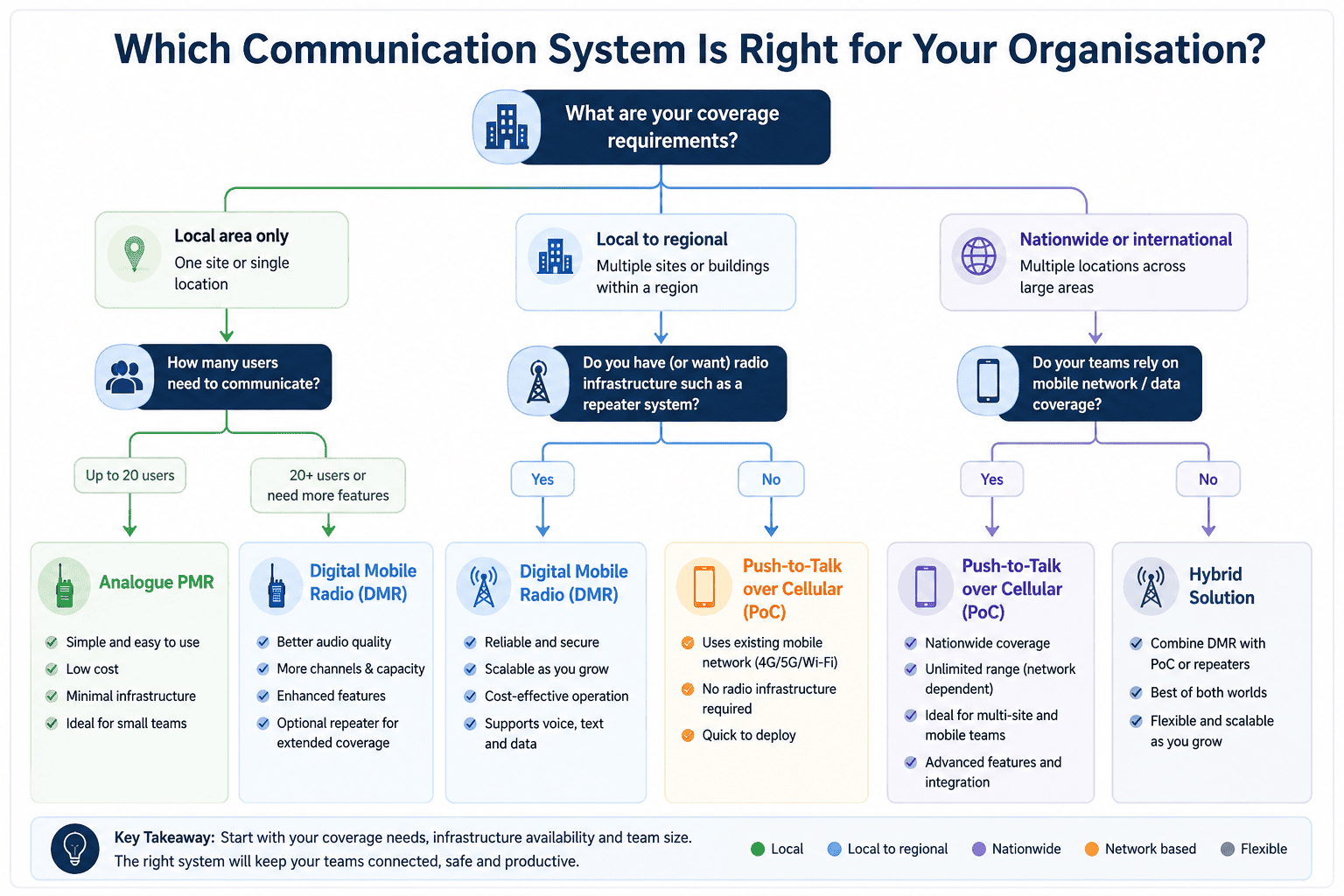
The Main Types of Radio Communication Systems
Most professional business communication systems fall into one of the following categories:
- Analogue RadioAnalogue radio uses continuously varying radio signals to transmit voice communication. It remains widely used for reliable two-way communication across business, industry, events, security and other applications.
- Digital Mobile Radio (DMR)Digital Mobile Radio (DMR) is an ETSI digital radio standard for professional two-way communications, supporting voice, group calling, data and other features on compatible radio systems.
- Professional Mobile Radio (PMR)Professional Mobile Radio (PMR) describes private two-way radio systems designed for business and professional users, ranging from simple radio networks to advanced digital and multi-site systems.
- Push-to-Talk over Cellular (PoC)Push-to-Talk over Cellular (PoC) provides radio-style push-to-talk communication over cellular or IP networks, allowing users to communicate across wide areas where suitable network connectivity is available.
- Mobile Vehicle Radios
- Base StationA base station is a fixed two-way radio installed at a permanent location, allowing an operator to communicate with handheld or mobile radios across a site or operating area. Radios
- RepeaterA Repeater receives a two-way radio transmission and retransmits it, usually from an elevated location, to extend the coverage and reliability of a radio communication system. Networks
- Hybrid CommunicationHybrid Communication combines two or more communication technologies, such as two-way radio, DMR, cellular, Wi-Fi or IP networks, allowing different systems or users to communicate through a common platform. Systems
Each has strengths, limitations and ideal applications.
Analogue Radio Systems
Analogue radio has been the foundation of business communication for decades.
Although many organisations have migrated to digital systems, analogue radios remain in use across numerous industries.
How Analogue Works
Analogue radios transmit voice as a continuously varying electrical signal.
The receiving radio reproduces this signal directly through its loudspeaker.
The technology is straightforward, reliable and familiar to many users.
Advantages
- Lower initial equipment cost
- Straightforward operation
- Compatible with many existing systems
- Simple maintenance
- Suitable for smaller deployments
Limitations
- Audio quality gradually deteriorates with distance.
- More susceptible to interferenceRadio interference occurs when unwanted radio-frequency signals or electrical noise disrupt two-way radio communications, causing distorted audio, broken transmissions, reduced coverage or loss of communication..
- Limited security.
- Fewer advanced features.
- Less efficient use of available radio spectrumSpectrum is the range of radio frequencies used for wireless communication. Two-way radios operate within specific parts of the radio spectrum, subject to frequency allocation and licensing requirements..
Typical Applications
Analogue radio is still commonly used in:
- Small businesses
- Farms and estates
- Local maintenance teams
- Leisure facilities
- Smaller construction projects
- Temporary communication systems
For many organisations, analogue remains perfectly adequate where communication requirements are relatively simple.
Did You Know?
We supply the latest two-way radio technology, including advanced digital DMR, PoC and integrated communication systems, delivering exceptional performance, reliability and coverage for every industry.
Professional Mobile Radio (PMR)
Professional Mobile RadioA Mobile Radio is a two-way radio designed to be installed in a vehicle. It normally uses the vehicle's power supply and an external antenna to provide reliable communication while travelling or working in the field., commonly referred to as PMR, is the collective term for business-grade radio communication systems used by organisations across virtually every sector.
PMR includes both analogue and digital technologies.
These systems are designed specifically for professional users requiring reliable, resilient communication.
PMR systems typically include:
- Handheld radios
- Vehicle-mounted mobile radios
- Base stations
- Repeaters
- Dispatch consoles
- Accessories
- Communication infrastructure
Unlike consumer walkie-talkies, PMR equipment is designed for continuous professional use.
We'll explore PMR in detail in Chapter 6.
Digital Mobile Radio (DMR)
Digital Mobile Radio (DMR) is one of the most widely adopted professional communication standards in the UK.
Developed specifically for commercial and professional users, DMR offers significant advantages over analogue systems.
Key Benefits
- Clear digital audio
- Better spectrum efficiency
- Longer battery life
- Text messaging
- GPS location services
- Emergency alerts
- EncryptionEncryption protects two-way radio communications by converting voice or data into a secure form that can only be understood by authorised radios with the correct encryption capability and keys.
- Multiple talk groups
- Improved privacy
Because DMR uses digital technology, communication remains consistently clear until signal strength falls below a usable threshold.
For many organisations, DMR represents the ideal balance between performance, reliability and cost.
We'll examine DMR comprehensively in Chapter 7.
Expert Insight
Professional Mobile Radio (PMR) provides fast, reliable, licence-controlled voice communications without relying on mobile phone networks or internet connectivity.
Push-to-Talk over Cellular (PoC)
Push-to-Talk over Cellular (PoC) is one of the fastest-growing communication technologies available to businesses.
Rather than using traditional radio frequencies, PoC devices communicate using:
- 4G
- 5G
- Wi-FiWi-Fi is a wireless networking technology that connects compatible devices to a local or wider network. In radio systems, it can support programming, updates, data services and IP-based communications.
Voice traffic travels across mobile broadbandBroadband is a high-speed data connection used by systems such as PoC radio to carry voice, video and other communications over mobile networks, Wi-Fi or IP networks. networks.
To the user, operation remains almost identical to a conventional two-way radio.
- Press the Push-to-Talk button.
- Speak.
- Release.
However, the communication can take place across an entire town, the whole UK or even internationally.
Advantages
- Virtually unlimited coverage
- No repeater infrastructure
- Nationwide communication
- GPS tracking
- Cloud managementCloud Management uses an online platform to remotely manage and monitor compatible two-way radios, users, devices and communication settings from a central location.
- Easy scalability
Limitations
- Requires mobile networkA Network is a connected system of radios, equipment and infrastructure that allows users to communicate across a defined area. Radio networks can range from simple radio-to-radio systems to large multi-site networks. coverage.
- Subscription costs usually apply.
- Dependent on broadband connectivity.
PoC is particularly attractive for organisations with geographically dispersed workforces.
We'll examine PoC in Chapter 8.
Comparison Table of Analogue vs DMR vs PoC
| Feature | Analogue PMR | Digital Mobile Radio (DMR) | Push-to-Talk over Cellular (PoC) |
|---|---|---|---|
| Coverage | Local | Local to regional | Nationwide or international |
| Audio Quality | Good | Excellent | Excellent (network dependent) |
| Voice Clarity at Range | Gradually degrades | Remains clear until signal limit | Consistently clear with mobile coverage |
| Infrastructure | Minimal | Optional repeater | 4G/5G or Wi-Fi network |
| Licensing | May require OfcomOfcom (Office of Communications) is the UK's communications regulator. For two-way radio users, Ofcom manages and regulates access to radio spectrum and the use of radio frequencies in the UK. licence | May require Ofcom licence | No radio licence required |
| Private Communications | Limited | Yes | Yes |
| GPS Location | No | Available on many models | Usually included |
| Text Messaging | No | Yes | Yes |
| Call RecordingCall Recording is a two-way radio feature or system function that captures and stores radio communications for later playback, review, incident investigation or record keeping. | No | Limited | Commonly available |
| Ongoing Costs | Very low | Low | Monthly subscription or SIM costs |
| Best Applications | Small businesses, hospitality, retail | Construction, logistics, manufacturing, security, events | National fleets, healthcare, facilities management, multi-site organisations |
Vehicle Mobile Radios
Handheld radios are not always the best solution.
Vehicle-mounted radios provide:
- Higher transmitter powerAn antenna transmits and receives radio-frequency signals, allowing a two-way radio to communicate. Antenna type, frequency, height and location can all affect radio performance and coverage.
- Larger antennas
- Improved coverage
- Better audio quality
- Continuous vehicle power
They are commonly installed in:
- HGVs
- Delivery vehicles
- Utility vans
- Security patrol vehicles
- Emergency response vehicles
- Agricultural machinery
Mobile radios often operate alongside handheld devices within the same communication network.
Base Station Radios
A base station acts as a fixed communication point.
Typically located within:
- Control rooms
- Reception areas
- Security offices
- Gatehouses
- Operations centres
Base stations often feature:
- Larger antennas
- Mains power
- Desktop microphones
- External loudspeakers
- Improved reception
They provide reliable communication with field teams throughout the working day.
Repeater Systems
When direct radio-to-radio communication becomes insufficient, repeaters extend coverage.
A repeater:
1. Receives a transmissionTransmission is the process of sending voice, data or signalling from a radio using a radio-frequency signal to another radio, repeater or communication system..
2. Amplifies it.
3. Rebroadcasts it.
This allows communication across:
- Large industrial sites
- Ports
- Airports
- Universities
- Hospitals
- Multi-building campuses
Repeaters form the backbone of many larger PMR systems.
We'll explore infrastructure in Chapter 10.
Hybrid Communication Systems
Modern organisations increasingly combine multiple communication technologies.
Rather than relying on a single system, they integrate several platforms into one communication solution.
For example:
- DMR radios for warehouse staff.
- PoC radios for delivery drivers.
- Mobile vehicle radios for fleet operators.
- Base stations for supervisors.
- Dispatch software in the control room.
Some systems even allow users on different technologies to communicate seamlessly with one another.
Hybrid communication is becoming increasingly common as organisations seek greater flexibility.
Licence-Free Radio Systems
Some organisations only require basic communication over relatively small areas.
Licence-free radios operate on designated frequencies that do not require an individual Ofcom licence.
Typical applications include:
- Small retail premises
- Schools
- Hotels
- Leisure centres
- Small warehouses
Advantages include:
- No annual licence fees
- Quick deployment
- Low operating costs
However, they also have limitations:
- Lower transmitter power
- Shared frequencies
- Greater potential for interference
- Reduced coverage
Businesses requiring greater reliability often choose licensed systems instead.
We'll examine licensing in Chapter 11.
Licensed Radio Systems
Licensed systems use frequencies allocated by Ofcom.
Benefits include:
Reduced interference
Greater reliability
Higher transmitter power (where permitted)
Better operational control
Improved scalability
Licensed systems are widely used by:
- Construction companies
- Logistics operators
- Manufacturing facilities
- Utilities
- Security providers
- Event organisers
For organisations relying heavily on communication, licensed PMR systems often provide the most dependable solution.
Choosing the Right Technology
When selecting a communication system, organisations should consider:
Coverage
Do users operate:
- On one site?
- Across multiple buildingsAn antenna transmits and receives radio-frequency signals, allowing a two-way radio to communicate. Antenna type, frequency, height and location can all affect radio performance and coverage.?
- Nationwide?
---
User Numbers
How many employees require communication?
Five users have very different requirements from five hundred.
Working Environment
Consider:
- Indoor
- Outdoor
- Underground
- High-rise buildings
- Industrial facilities
- Remote rural locations
Features
Do users require:
- GPS?
- Lone WorkerA Lone Worker is someone who works without direct supervision or immediate assistance nearby. Compatible two-way radios can provide safety features such as timed check-ins, emergency alerts and GPS location.?
- Emergency alarms?
- Text messaging?
- Bluetooth®Bluetooth® is a short-range wireless technology used with compatible two-way radios to connect accessories such as headsets, earpieces and microphones without a physical cable.?
- Dispatch integration?
Future Growth
Can the communication system expand as the organisation grows?
Scalability should always form part of the decision-making process.
Comparing the Main Technologies
| Technology | Coverage | Infrastructure | Best For |
|---|---|---|---|
| Analogue PMR | Local | Minimal | Smaller businesses |
| Digital Mobile Radio (DMR) | Local to regional | Optional repeater | Most professional organisations |
| Push-to-Talk over Cellular (PoC) | Nationwide | Mobile network | Multi-site organisations |
| Vehicle Mobile Radio | Local to regional | Existing radio systemA Radio System is a complete communication solution comprising two-way radios and, where required, equipment such as repeaters, antennas, base stations, mobile radios and network infrastructure. | Fleet operations |
| Base Station | Fixed location | Existing radio system | Control rooms |
| Hybrid Systems | Local to nationwide | Mixed | Larger or growing organisations |
Key Takeaways
- Different communication technologies suit different operational requirements.
- There is no universal "best" radio system.
- Analogue remains suitable for some organisations, while digital technologies offer significant advantages.
- DMR provides a strong balance of functionality, reliability and cost for many businesses.
- PoC extends communication across nationwide mobile networks.
- Hybrid systems combine multiple technologies to deliver maximum flexibility.
- Careful planning ensures the communication system supports both current operations and future growth.
Expert Insight
- Successful communication projects begin with operational requirements not equipment catalogues.
- The most effective solutions are designed around how people work, where they work and how information flows through the organisation. By understanding these factors first, businesses can select technologies that improve efficiency and remain fit for purpose as operational needs evolve.
Business Perspective
Modern organisations are no longer limited to choosing between traditional two-way radios and mobile phones.
The range of professional communication technologies now available allows businesses to build solutions that match their operational needs, whether that's a simple licence-free system for a small site or a nationwide hybrid network connecting hundreds of users.
Taking the time to understand the strengths and limitations of each technology is the first step towards making a sound long-term investment.
Frequently Asked Questions
Which type of radio system is best for most businesses?
There is no single answer. The most suitable solution depends on factors such as coverage requirements, user numbers, operating environment, required features and future expansion plans.
Is analogue radio becoming obsolete?
Not entirely. Many organisations continue to use analogue systems successfully, particularly where communication needs are straightforward. However, many new deployments favour digital technologies because of their enhanced functionality and efficiency.
Can PoC replace traditional two-way radios?
In some cases, yes. PoC is particularly effective for organisations with geographically dispersed teams. However, traditional PMR and DMR systems remain the preferred choice for many on-site operations where dedicated radio infrastructure provides greater resilience.
What's the difference between PMR and DMR?
PMR (Professional Mobile Radio) is a broad category covering professional business radioBusiness Radio refers to professional two-way radio systems used by businesses and organisations for instant communication, often using licensed frequencies and equipment designed for commercial use. systems. DMR (Digital Mobile Radio) is a digital standard used within many PMR systems, offering improved audio quality, additional features and greater spectrum efficiency.
Can different radio technologies work together?
Yes. Many organisations use hybrid communication systems that integrate DMR, PoC, vehicle radios, base stations and dispatch software into a single communication network.
What People Say About DCS 2 Way Radio
Contact the UK's Premier Two Way Radio Experts Today