
Understanding Radio Communications - Part 1
Part 1 - Chapter 1 – Introduction
The Ultimate Guide to Two-Way Radios for Business
Welcome to the Complete Guide to Two-Way Radios & Professional Mobile Radio
Whether you're responsible for managing a construction site, coordinating a large-scale event, overseeing warehouse operations or improving communication across multiple business locations, reliable communication is fundamental to keeping people connected, productive and safe.
Despite the widespread availability of smartphones and mobile applications, professional two-way radio systems remain one of the most dependable forms of business communication. From manufacturing facilities and airports to hospitals, security teams and logistics companies, organisations across the UK continue to rely on radio communications because they deliver instant, reliable and secure voice communication when it matters most.
Modern radio technology has evolved significantly over the past few decades. Today's solutions extend far beyond the traditional "walkie-talkie". Businesses can now choose from sophisticated Digital Mobile Radio (DMR)Digital Mobile Radio (DMR) is an ETSI digital radio standard for professional two-way communications, supporting voice, group calling, data and other features on compatible radio systems. systems, Push-to-Talk over Cellular (PoC)Push-to-Talk over Cellular (PoC) provides radio-style push-to-talk communication over cellular or IP networks, allowing users to communicate across wide areas where suitable network connectivity is available. devices operating over 4G and 5G networks, hybrid communicationHybrid Communication combines two or more communication technologies, such as two-way radio, DMR, cellular, Wi-Fi or IP networks, allowing different systems or users to communicate through a common platform. platforms, GPS-enabled radios, emergency safety features, advanced dispatch software and nationwide communication networks.
Choosing the right communication system, however, is not always straightforward. Understanding the differences between analogue and digital radios, licensed and licence-free systems, handheld and mobile devices, or deciding whether to purchase or hire equipment can be challenging without a clear understanding of how each technology works.

This guide has been created to provide businesses with an independent, practical and comprehensive reference to professional radio communications. Rather than focusing on individual products or manufacturers, it explains the technologies, terminology and considerations that help organisations make informed decisions based on their operational requirements.
Whether you're purchasing your first radio systemA Radio System is a complete communication solution comprising two-way radios and, where required, equipment such as repeaters, antennas, base stations, mobile radios and network infrastructure. or looking to upgrade an existing communications networkA Network is a connected system of radios, equipment and infrastructure that allows users to communicate across a defined area. Radio networks can range from simple radio-to-radio systems to large multi-site networks., this guide will help you understand the options available and the factors that should influence your decision.
Who This Guide Is For
This guide has been written primarily for organisations and professionals responsible for selecting, managing or operating communication systems.
It will be particularly valuable for:
- Business owners
- Operations Managers
- Facilities Managers
- Health & Safety Managers
- Security Managers
- Warehouse and Logistics Managers
- Construction Site Managers
- Event Organisers
- Procurement Teams
- IT and Communications Managers
- Estates and Facilities Teams
- Emergency Planning Coordinators
Whether you operate a small business requiring a handful of handheld radios or manage a nationwide workforce using hundreds of devices, the principles explained throughout this guide apply across organisations of all sizes.
Why Two-Way Radios Still Matter
Many people assume smartphones have replaced two-way radios. While mobile phones have transformed personal communication, they cannot always meet the demands of fast-paced business environments.
Professional radio systems continue to offer several distinct advantages:
Instant Communication
Unlike mobile phones, which require users to unlock the device, search for contacts and initiate a call, two-way radios enable users to communicate instantly at the press of a single button.
This immediate connection can save valuable seconds during routine operations and may prove critical during emergencies.
Group Communication
Radio users can communicate with entire teams simultaneously.
Instead of making multiple telephone calls or sending messages to individual employees, supervisors can instantly broadcast important information to everyone on a designated channelA two-way radio channel is a programmed set of communication settings, typically including frequency and signalling, that allows compatible radios to communicate with one another..
Reliability
Professional radio systems are designed specifically for demanding working environments.
Unlike consumer smartphones, many commercial radios are built to withstand:
- Dust
- Rain
- Vibration
- Extreme temperatures
- Accidental drops
- Continuous daily use
Many also continue operating during network outages, making them particularly valuable where resilience is essential.
Lower Running Costs
Once installed, many radio systems have minimal ongoing operating costs.
Unlike mobile phones, there are typically no per-minute call charges, and many systems require no monthly subscription beyond any applicable licensing or infrastructureRadio infrastructure is the equipment and supporting systems behind a professional two-way radio network, including repeaters, antennas, base stations, network connections, power systems and dispatch equipment. costs.
Improved Safety
Many modern business radios include safety features such as:
- Emergency alarmAn Emergency Alarm allows a two-way radio user to quickly alert a dispatcher, control room or other authorised users that assistance may be required. buttons
- Lone workerA Lone Worker is someone who works without direct supervision or immediate assistance nearby. Compatible two-way radios can provide safety features such as timed check-ins, emergency alerts and GPS location. monitoring
- Man DownMan Down is a safety feature on some professional two-way radios that can detect a possible fall or unusual radio position and automatically raise an alert if the user does not respond. detection
- GPS location tracking
- Remote monitoring
- Priority calling
These capabilities help organisations improve staff safety while supporting Health & Safety procedures and emergency response plans.

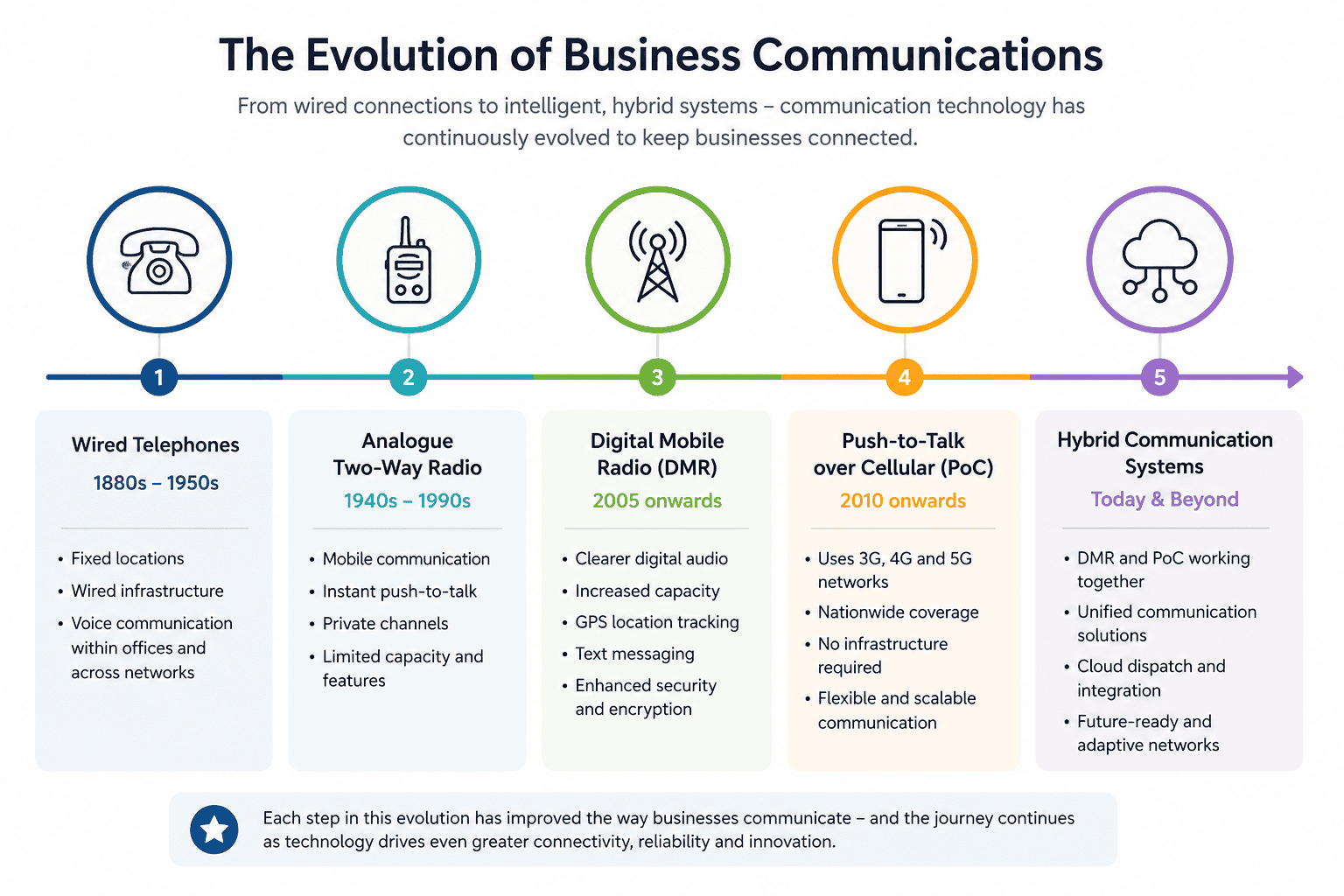
The Evolution of Business Communications
Business communication has changed dramatically over the last century.
Early organisations relied on wired telephones and face-to-face communication. As businesses expanded and workforces became increasingly mobile, wireless radio systems transformed operational communications.
Today's organisations have access to a wide range of technologies, including:
- Analogue radioAnalogue radio uses continuously varying radio signals to transmit voice communication. It remains widely used for reliable two-way communication across business, industry, events, security and other applications. systems
- Digital Mobile RadioA Mobile Radio is a two-way radio designed to be installed in a vehicle. It normally uses the vehicle's power supply and an external antenna to provide reliable communication while travelling or working in the field. (DMR)
- Push-to-Talk over Cellular (PoC)
- LTE and 5G communications
- Cloud-based dispatch systems
- GPS fleet managementFleet Management is the process of managing a two-way radio fleet, including equipment, users, programming, maintenance, firmware, security and radio system configuration.
- Hybrid radio and broadbandBroadband is a high-speed data connection used by systems such as PoC radio to carry voice, video and other communications over mobile networks, Wi-Fi or IP networks. networks
- ntegrated workforce communication platforms
Rather than replacing traditional radio systems, these technologies often complement one another, allowing businesses to build communication networks that suit their operational needs.
What You'll Learn
By the end of this guide, you'll understand:
- How radio communication systems work The history and development of professional radio technology
- The differences between analogue and digital radio systems
- Professional Mobile Radio (PMR)Professional Mobile Radio (PMR) describes private two-way radio systems designed for business and professional users, ranging from simple radio networks to advanced digital and multi-site systems. technologies
- Digital Mobile Radio (DMR) standards
- Push-to-Talk over Cellular (PoC)
- Radio frequencies and OfcomOfcom (Office of Communications) is the UK's communications regulator. For two-way radio users, Ofcom manages and regulates access to radio spectrum and the use of radio frequencies in the UK. licensing
- Repeaters and communication infrastructure
- Modern radio features and capabilities
- Control room and dispatch systems
- Whether hiring or purchasing radios is right for your organisation
- How to choose the most suitable communication solution for your business
- Which industries benefit most from professional radio communications
- Future developments in business communication technology
How to Use This Guide
Although this guide has been organised into logical chapters, it is designed to work as both a complete handbook and a reference resource.
If you're new to professional radio communications, reading each chapter in order will provide a solid understanding of the technologies involved.
If you're researching a specific topic such as DMR, Push-to-Talk over Cellular or Ofcom licensing you can use the table of contents to jump directly to the relevant chapter.
Throughout the guide you'll also find:
- Expert Insight boxes
- Business Perspective summaries
- Comparison tables
- Practical UK business examples
- Frequently Asked Questions
- Recommended resources for further reading
These additional sections are designed to help explain complex subjects in a practical, accessible way.
Key Takeaways
- Professional two-way radios remain one of the most reliable communication tools available to businesses.
- Modern radio systems offer far more than simple voice communication, including GPS, emergency safety features and nationwide connectivity.
- Choosing the right solution depends on your operational environment, workforce and communication requirements.
- This guide provides a practical, manufacturer-neutral overview of the technologies used across UK businesses today.
- Understanding the fundamentals of radio communications will help you make informed decisions when selecting or upgrading a business communication system.
Expert Insight
Technology should support your operations, it should not dictate them.
One of the most common mistakes organisations make is choosing communication equipment based on features alone. The most effective radio systems are those designed around operational requirements, workforce size, coverageRadio Coverage is the geographical area in which a two-way radio system can provide reliable communication. Coverage depends on the radios, antennas, frequency, terrain, buildings and system infrastructure. needs, working environment and future growth. A well-planned communication strategy often delivers greater long-term value than simply selecting the most advanced handset available.
Business Perspective
Professional communication systems are an investment in operational efficiency, safety and resilience. Whether you're coordinating a construction project, managing a distribution centre or providing security at a major event, reliable communication enables faster decision-making, improves team coordination and helps reduce operational risk. Throughout this guide, we'll explore not only how the technology works, but also how businesses can use it to improve day-to-day operations and support long-term growth.