
The Complete Guide to Two-Way Radios & Professional Mobile Radio (PMR)
Part 3 - Chapter 11
Radio Frequencies & Licensing
Radio Frequencies & Licensing
Understanding the UK Radio Spectrum and Ofcom Licensing
Every professional two-way radio systemA Radio System is a complete communication solution comprising two-way radios and, where required, equipment such as repeaters, antennas, base stations, mobile radios and network infrastructure. relies on one essential resource: radio spectrumSpectrum is the range of radio frequencies used for wireless communication. Two-way radios operate within specific parts of the radio spectrum, subject to frequency allocation and licensing requirements.. Whether a business is using a pair of licence-free handheld radios in a small retail store or a sophisticated digital networkA Network is a connected system of radios, equipment and infrastructure that allows users to communicate across a defined area. Radio networks can range from simple radio-to-radio systems to large multi-site networks. covering multiple sites, communication is only possible because the radios are operating on carefully managed radio frequencies.
Unlike roads or railways, the radio spectrum cannot be seen, but it is one of the UK's most valuable national resources. It supports everything from emergency services and aviation to television broadcasting, satellite communications, mobile phone networks and professional business radioBusiness Radio refers to professional two-way radio systems used by businesses and organisations for instant communication, often using licensed frequencies and equipment designed for commercial use. systems.
Because radio spectrum is finite, it must be carefully regulated to prevent interferenceRadio interference occurs when unwanted radio-frequency signals or electrical noise disrupt two-way radio communications, causing distorted audio, broken transmissions, reduced coverage or loss of communication. between users. In the UK, this responsibility falls to Ofcom, which manages the allocation and licensing of radio frequencies.
Understanding how frequencies and licensing work is essential for organisations planning a radio system. It helps businesses choose the right communication solution, avoid interference and remain compliant with UK regulations.
In this chapter, we'll explain how radio frequencies work, the different licensing options available and the factors organisations should consider when selecting a professional radio system.
What Is a Radio Frequency?
A radio frequency (RF)Radio Frequency (RF) refers to electromagnetic waves used to transmit voice and data wirelessly. Two-way radios use RF signals to communicate between radios, repeaters and other system infrastructure. is a specific point within the radio spectrum used to transmit wireless signals.
When you press the Push-to-Talk button on a radio, your voice is converted into electrical signals and transmitted using one of these allocated frequencies.
Each communication system operates within designated sections of the radio spectrum to ensure multiple services can coexist without causing unacceptable interference.
Professional radio systems are only one of many users of the spectrum.
Other users include:
- Emergency services
- Aviation
- Maritime communications
- Television broadcasting
- Mobile phone networks
- Satellite systems
- Utilities
- Transport operators
- Military communications
Careful frequencyAn antenna transmits and receives radio-frequency signals, allowing a two-way radio to communicate. Antenna type, frequency, height and location can all affect radio performance and coverage. management ensures these services can operate simultaneously.
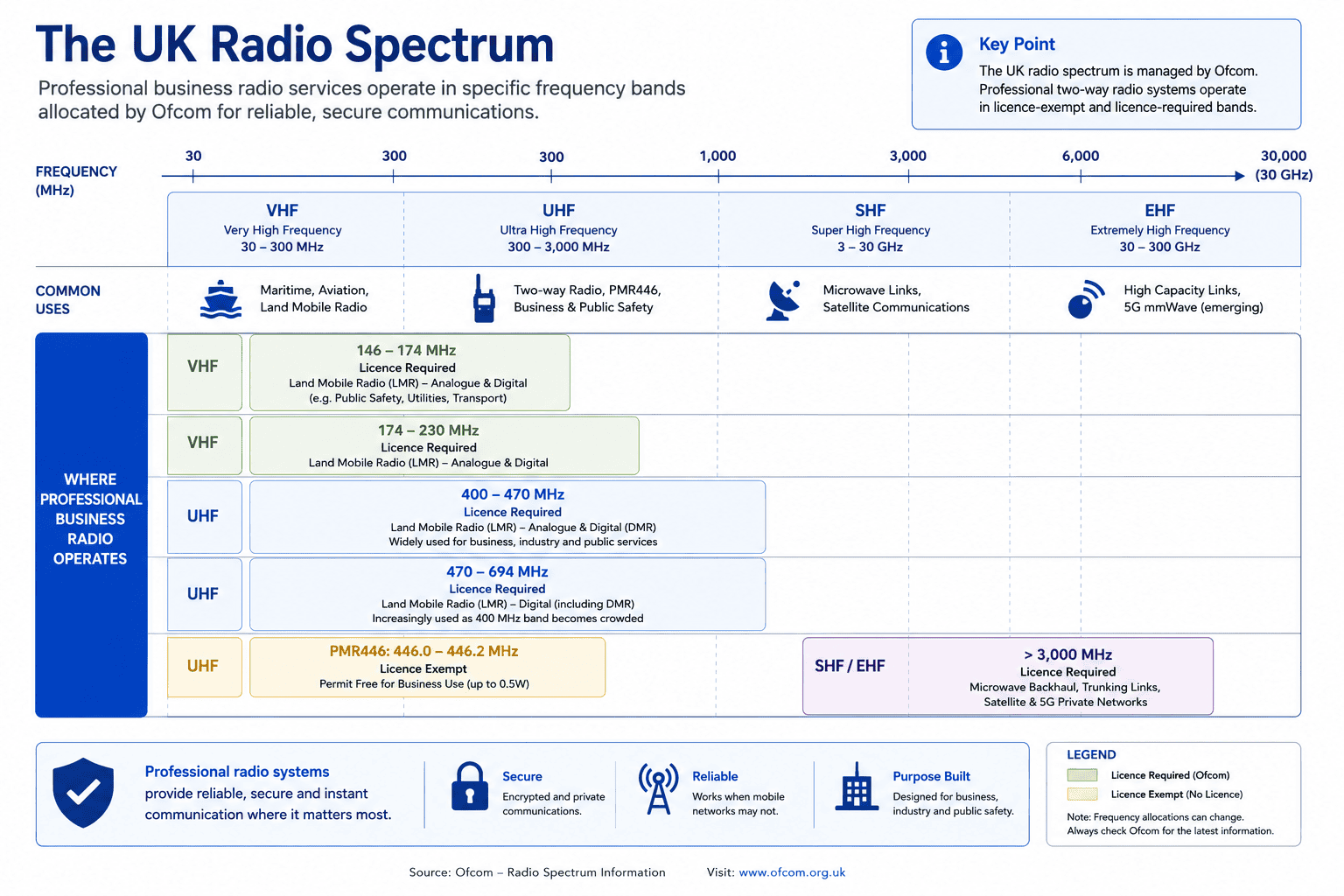
Understanding the Radio Spectrum
The radio spectrum covers a wide range of frequencies, each with different characteristics.
Some frequencies:
- Travel long distances.
- Penetrate buildingsAn antenna transmits and receives radio-frequency signals, allowing a two-way radio to communicate. Antenna type, frequency, height and location can all affect radio performance and coverage. well.
- Work effectively in rural environments.
Others are better suited to:
- High data transmissionTransmission is the process of sending voice, data or signalling from a radio using a radio-frequency signal to another radio, repeater or communication system..
- Dense urban environments.
- Short-range communication.
Different communication technologies therefore use different parts of the spectrum depending on their operational requirements.
Did You Know?
Did you know? DCS 2 Way Radio can advise on frequencyFrequency is the number of cycles a radio wave completes each second, measured in Hertz. In two-way radio, frequency determines where a transmission operates within the radio spectrum. selection, OfcomOfcom (Office of Communications) is the UK's communications regulator. For two-way radio users, Ofcom manages and regulates access to radio spectrum and the use of radio frequencies in the UK. licensing, coverageRadio Coverage is the geographical area in which a two-way radio system can provide reliable communication. Coverage depends on the radios, antennas, frequency, terrain, buildings and system infrastructure. planning, repeaterA Repeater receives a two-way radio transmission and retransmits it, usually from an elevated location, to extend the coverage and reliability of a radio communication system. systems, Push-to-Talk over Cellular (PoC)Push-to-Talk over Cellular (PoC) provides radio-style push-to-talk communication over cellular or IP networks, allowing users to communicate across wide areas where suitable network connectivity is available. solutions and hybrid communications, ensuring your organisation receives a system that is both reliable today and scalable for the future.
Frequency Bands Used by Professional Radios
Professional two-way radios typically operate within specific frequency bands allocated for land mobile radioA Mobile Radio is a two-way radio designed to be installed in a vehicle. It normally uses the vehicle's power supply and an external antenna to provide reliable communication while travelling or working in the field. services.
The most common include:
Very High Frequency (VHF)
Typically used in more open environments.
VHF signals generally:
- Travel well across open countryside.
- Perform effectively in rural areas.
- Cover greater distances where there are few physical obstructions.
Typical applications include:
- Agriculture
- Forestry
- Utilities
- Outdoor events
- Large estates
- Coastal operations
Ultra High Frequency (UHF)
UHF is the most commonly used frequency band for business radio communications in the UK.
Compared with VHF, UHF generally:
- Performs better inside buildings.
- Penetrates structures more effectively.
- Is well suited to urban environments.
Typical applications include:
- Warehouses
- Manufacturing
- Hospitals
- Hotels
- Retail
- Airports
- Construction
- Security
Neither VHF nor UHF is universally better.
The most appropriate choice depends on the operating environment.
Expert Insight
There is no one-size-fits-all radio system. The most effective solution depends on your operating environment, coverage requirements, number of users and future growth plans. Our team can assess your requirements and recommend the most suitable technology, frequency band and infrastructureRadio infrastructure is the equipment and supporting systems behind a professional two-way radio network, including repeaters, antennas, base stations, network connections, power systems and dispatch equipment..
VHF vs UHF Comparison
Very High Frequency (VHF) and Ultra High Frequency (UHF) are the two most commonly used frequency bands for professional two-way radio communications. Although both provide reliable voice communications, they perform differently depending on the operating environment. Understanding the strengths of each frequency band will help you choose the most effective solution for your organisation, whether you operate across open countryside, industrial facilities or busy urban environments.
| Feature | VHF (Very High Frequency)VHF (Very High Frequency) is the 30 MHz to 300 MHz radio-frequency range. VHF two-way radios are widely used for professional communications across outdoor, rural and open areas. | UHF (Ultra High Frequency)UHF (Ultra High Frequency) is the 300 MHz to 3 GHz radio-frequency range. UHF two-way radios are widely used for professional communications, particularly in buildings and urban environments. |
|---|---|---|
| Frequency Range | 30–300 MHz (Business radio commonly 146–174 MHz) | 300 MHz–3 GHz (Business radio commonly 400–470 MHz) |
| Coverage Distance | Excellent over long distances and open terrain. | Very good over shorter distances with reliable local coverage. |
| Performance in Open Areas | Excellent for countryside, farms, utilities and coastal environments. | Good, although typically with a slightly shorter range than VHF. |
| Performance in Built-Up Areas | Can be affected by large buildings and dense urban environments. | Excellent performance in towns, cities and industrial sites. |
| Building Penetration | Moderate. Signals are more easily blocked by concrete and steel. | Excellent. Better penetration through buildings and around obstacles. |
| Indoor Performance | Good in smaller buildings and open structures. | Excellent in warehouses, hotels, hospitals and offices. |
| Terrain Suitability | Ideal for open landscapes with minimal obstructions. | Ideal for complex sites with buildings, machinery and infrastructure. |
| Typical Applications | Agriculture, forestry, utilities, marine, outdoor events and rural operations. | Warehousing, manufacturing, retail, hospitality, security, healthcare and logistics. |
| Advantages | Long communication distances and excellent outdoor coverage. | Superior building penetration and reliable communications in built-up environments. |
| Limitations | Reduced performance inside large buildings and dense urban areas. | Slightly reduced range across large open areas compared with VHF. |
| Best Choice For | Organisations operating primarily in rural or open outdoor environments. | Businesses operating inside buildings, warehouses, factories or urban environments. |
Neither VHF nor UHF is universally better—the right choice depends entirely on your operating environment. VHF generally delivers greater communication distances across open countryside, while UHF provides superior performance inside buildings and built-up areas. If your organisation operates across a variety of environments, a professional site surveyA Site Survey is an assessment of a location to determine whether a two-way radio system will provide the required coverage, reliability and performance. can help determine the most suitable frequency band and ensure reliable communications wherever your teams work.
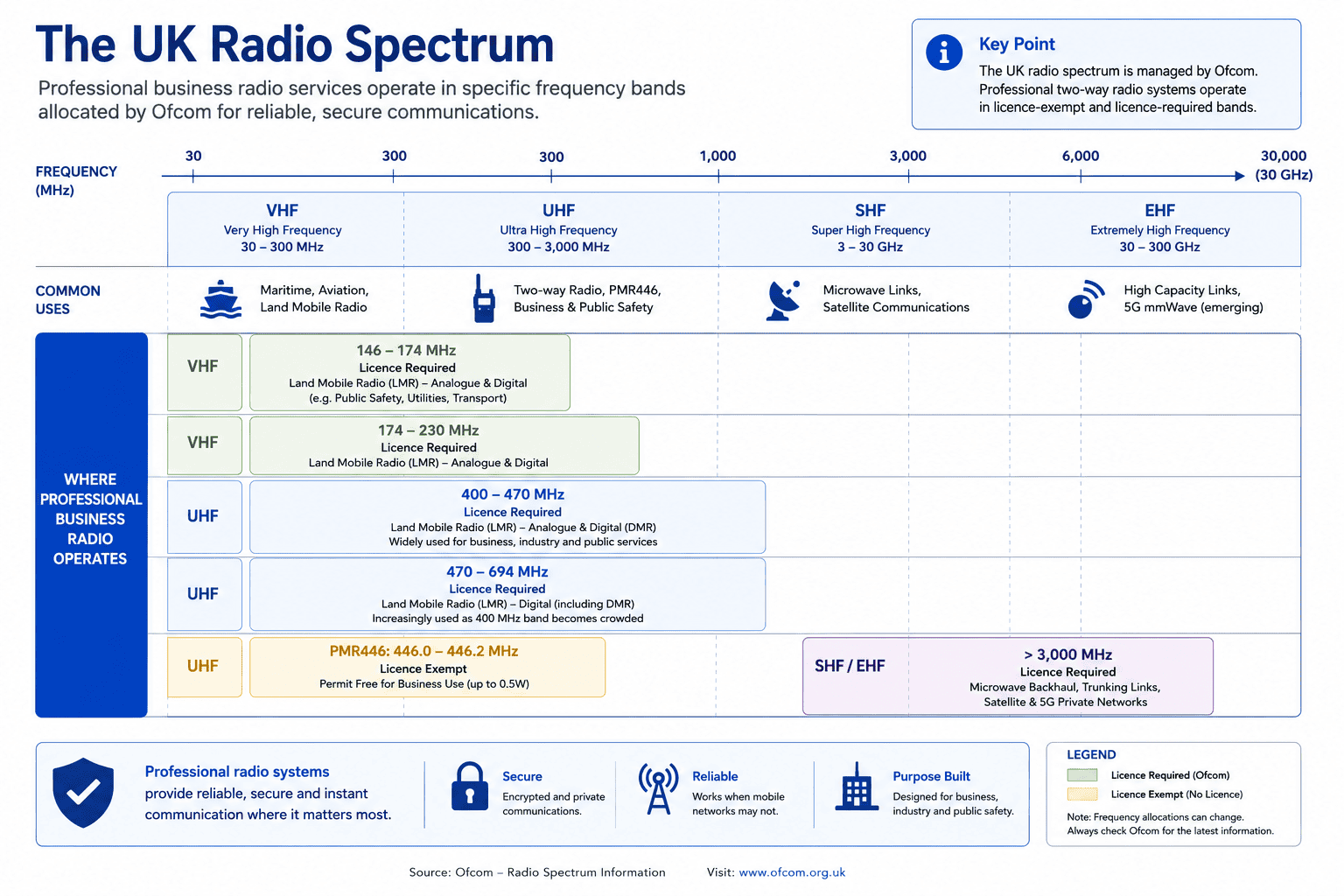
Why Businesses Can't Simply Choose Any Frequency
A common misconception is that organisations can simply programme radios to any frequency they choose.
This is not the case.
Many frequencies are reserved for:
- Emergency services
- Aviation
- Maritime operations
- Government agencies
- Utilities
- Broadcasting
- Military applications
Using unauthorised frequencies can cause harmful interference and may breach UK legislation.
Professional radio systems should always operate on frequencies that are authorised for their intended use.
What Is Ofcom?
The Office of Communications (Ofcom) is the UK's communications regulator.
Among its responsibilities, Ofcom manages:
- Radio spectrum allocation
- Frequency licensing
- Interference investigations
- Communications regulation
Its role is to ensure that radio services operate fairly, efficiently and without unnecessary interference.
For businesses using licensed radioA Licensed Radio is a two-way radio operated under an appropriate radio licence. Licensed systems can provide greater control over frequencies, coverage and infrastructure than licence-free radio services such as PMR446. systems, Ofcom is the authority responsible for issuing and administering radio licences.
Did You Know?
Did you know? DCS 2 Way Radio can manage your Ofcom Business Radio licenceAn Ofcom Business Radio Licence authorises businesses and organisations in the UK to use specified radio frequencies for professional two-way radio communication, subject to the licence conditions. application on your behalf. We'll help you choose the most appropriate licence, complete the application process and ensure your radio system is programmed to operate on the correct licensed frequencies, making it quick and straightforward to get your team on the air.
Do All Two-Way Radios Require a Licence?
No.
There are two broad categories of business radio systems:
- Licence-free
- Licensed
Each serves different operational requirements.
Licence-Free Radios
Licence-free radios operate on frequencies that have been set aside for public use.
They can be used without applying for an individual radio licence, provided they comply with technical requirements relating to:
- Frequency
- Power outputPower Output is the amount of radio-frequency energy produced by a two-way radio's transmitter, normally measured in watts. It is one factor affecting coverage, alongside frequency, antenna, terrain and other conditions.
- Equipment specifications
These systems are often attractive to smaller organisations because they are simple to deploy.
Advantages of Licence-Free Radios
- No annual licence fees.
- Quick installation.
- Minimal administration.
- Suitable for smaller sites.
- Lower initial costs.
Limitations
Because licence-free frequencies are shared:
- Other nearby users may be using the same channels.
- Interference is more likely.
- Coverage is limited by lower powerAn antenna transmits and receives radio-frequency signals, allowing a two-way radio to communicate. Antenna type, frequency, height and location can all affect radio performance and coverage. restrictions.
- Repeaters generally cannot be used.
For businesses where communication is critical, these limitations should be carefully considered.
Licensed Radio Systems
Licensed systems use frequencies allocated specifically for professional use.
Rather than sharing channels with the general public, organisations receive authority to operate on designated frequencies.
This provides greater operational confidence.
Benefits of Licensed Systems
- Reduced interference.
- Greater reliability.
- Support for repeaters.
- Improved coverage.
- Better scalability.
- More flexible system design.
Licensed systems are widely used across industries where communication forms an essential part of daily operations.
Types of Ofcom Business Radio Licences
Ofcom offers several licence options to suit different operational requirements.
Although licensing arrangements may evolve over time, the main categories include:
Simple UK Licence
Designed for organisations operating across multiple locations within the UK.
Suitable for:
- Mobile businesses
- Contractors
- Event companies
- Utility providers
Technically Assigned Licence
Provides frequencies specifically planned for a particular geographic location.
Often used where:
- Higher capacity is required.
- Repeaters are installed.
- Larger communication systems operate.
- Interference must be minimised.
Area Defined Licence
Typically used for larger organisations operating within defined geographic areas requiring more complex spectrum management.
Light Licensing
Certain specialist applications may operate under simplified licensing arrangements where appropriate.
*Note:* Licensing categories and eligibility criteria may change over time. Businesses should always refer to current Ofcom guidance or seek professional advice when selecting a licence.
Choosing Between Licence-Free and Licensed Systems
The decision depends on several operational factors.
Site Size
Small retail premises may operate effectively using licence-free radios.
Large industrial sites generally benefit from licensed systems.
Number of Users
As user numbers increase, licensed frequencies often provide better communication management.
Operational Importance
Where communication is critical to safety or productivity, dedicated licensed frequencies are often preferable.
Future Growth
Licensed systems generally offer greater flexibility for expansion.
Frequency Planning
Frequency planning is an important aspect of professional system design.
Engineers consider:
- Existing spectrum use.
- Nearby radio systems.
- Building construction.
- Terrain.
- User density.
- Future expansion.
Good frequency planning reduces interference and improves overall system performance.
Interference
Interference occurs when unwanted radio signals affect communication.
Possible causes include:
- Nearby radio users.
- Incorrect programming.
- Faulty equipment.
- Electrical noise.
- Poor frequency planning.
Professional licensing and careful system design help minimise these risks.
Frequency Reuse
The radio spectrum is limited.
To maximise efficiency, the same frequencies may be reused in different geographical locations where sufficient separation exists.
This careful planning allows thousands of organisations across the UK to operate radio systems without causing interference to one another.
Digital Frequency Efficiency
Digital technologies such as DMR make more efficient use of available spectrum.
By using Time Division Multiple Access (TDMA)Time Division Multiple Access (TDMA) is a technology that divides a radio channel into time slots, allowing multiple users or conversations to share the same frequency. DMR uses two time slots within a 12.5 kHz channel., DMR allows:
- Two communication paths.
- Greater user capacity.
- Improved spectrum utilisation.
This benefits both organisations and spectrum regulators.
Compliance and Best Practice
Businesses using professional radio systems should:
- Operate only on authorised frequencies.
- Use appropriately programmed equipment.
- Maintain licence details where required.
- Avoid unauthorised modifications.
- Ensure equipment is installed correctly.
These measures help maintain reliable communication while supporting efficient use of the UK's radio spectrum.
Looking Ahead
As demand for wireless communication continues to grow, efficient spectrum management will become increasingly important.
Emerging technologies such as:
- Hybrid communicationHybrid Communication combines two or more communication technologies, such as two-way radio, DMR, cellular, Wi-Fi or IP networks, allowing different systems or users to communicate through a common platform. systems
- LTE integration
- 5G services
- Cloud networking
will continue to influence how professional radio services evolve.
However, dedicated radio spectrum is expected to remain an essential resource for business-critical communication for many years to come.
Key Takeaways
- Radio frequencies are carefully managed to allow multiple communication services to coexist.
- Ofcom regulates radio spectrum and business radio licensing in the UK.
- Licence-free radios are suitable for many smaller organisations but have operational limitations.
- Licensed systems provide greater reliability, flexibility and scalability.
- VHF and UHF each offer different advantages depending on the operating environment.
- Professional frequency planning helps minimise interference and maximise communication performance.
- Digital technologies improve spectrum efficiency through standards such as DMR.
Expert Insight
- Choosing the correct licence is as much an operational decision as a regulatory one.
- While licence-free radios are perfectly suitable for many organisations, businesses that depend on reliable communication often benefit significantly from licensed frequencies. Reduced interference, support for repeaters and greater flexibility frequently outweigh the additional administrative requirements, particularly as organisations grow.
Business Perspective
Radio frequencies are one of the most important but least visible components of a professional communication system. By understanding how spectrum is managed and selecting the appropriate licensing arrangement, organisations can improve communication reliability, support future expansion and reduce the risk of interference. Licensing should be viewed not simply as a regulatory requirement but as an investment in dependable business communications.
Frequently Asked Questions
Do all business radios require an Ofcom licence?
No. Many licence-free radios can be used without obtaining an individual licence, provided they comply with the relevant technical requirements. Larger or more demanding communication systems often require licensed frequencies.
What is the difference between VHF and UHF?
Generally, VHF performs well in open outdoor environments, while UHF typically offers better performance inside buildings and urban areas. The most suitable choice depends on the operating environment.
Can different organisations use the same radio frequency?
Yes, in some circumstancesAn antenna transmits and receives radio-frequency signals, allowing a two-way radio to communicate. Antenna type, frequency, height and location can all affect radio performance and coverage.. Licence-free frequencies are shared, while licensed frequencies are carefully managed to minimise interference. Frequency reuse is also possible in geographically separated areas.
What happens if a business uses an unauthorised frequency?
Operating on unauthorised frequencies may cause interference to other services and could breach UK regulations. Businesses should ensure their radio systems are correctly programmed and authorised where necessary
Can a licensed radio system be expanded?
Yes. Many licensed systems are designed with future growth in mind, allowing organisations to add users, repeaters or additional sites as operational requirements evolve.