
The Complete Guide to Two-Way Radios & Professional Mobile Radio (PMR)
Part 3 - Chapter 10
Radio Infrastructure
Table of Contents
Building a Radio Network
The Foundation of Every Reliable Communication System
When people think about two-way radio systems, they often picture the handheld radios carried by employees. While these devices are the most visible part of the system, they are only one element of a much larger communication networkA Network is a connected system of radios, equipment and infrastructure that allows users to communicate across a defined area. Radio networks can range from simple radio-to-radio systems to large multi-site networks..
Behind every reliable Professional Mobile Radio (PMR)Professional Mobile Radio (PMR) describes private two-way radio systems designed for business and professional users, ranging from simple radio networks to advanced digital and multi-site systems. system is an infrastructureRadio infrastructure is the equipment and supporting systems behind a professional two-way radio network, including repeaters, antennas, base stations, network connections, power systems and dispatch equipment. designed to ensure messages are transmitted clearly, consistently and securely. This infrastructure may be as simple as a pair of handheld radios communicating directly with one another, or as sophisticated as a nationwide network of repeaters, antennas, control rooms and interconnected communication sites.
For organisations where communication is business-critical, the quality of the infrastructure is just as important as the radios themselves. Even the most advanced handheld radios cannot overcome poorly designed coverageRadio Coverage is the geographical area in which a two-way radio system can provide reliable communication. Coverage depends on the radios, antennas, frequency, terrain, buildings and system infrastructure., inadequate antennaAn antenna transmits and receives radio-frequency signals, allowing a two-way radio to communicate. Antenna type, frequency, height and location can all affect radio performance and coverage. placement or insufficient network capacity.
In this chapter, we'll examine the components that make up a professional radio network, explain how they work together and explore the factors businesses should consider when designing or expanding their communication infrastructure.
What Is Radio Infrastructure?
Radio infrastructure refers to all the equipment and supporting systems that enable radio communication beyond the individual handset.
Depending on the size and complexity of the network, this may include:
- Repeaters
- Base stations
- Antennas
- Communication masts
- Duplexers
- PowerAn antenna transmits and receives radio-frequency signals, allowing a two-way radio to communicate. Antenna type, frequency, height and location can all affect radio performance and coverage. supplies
- Battery backup systems
- Network controllers
- Dispatch consoles
- IP network links
- Monitoring software
Together, these components ensure reliable communication across the required coverage area.
Simplex Systems
The simplest radio infrastructure is no infrastructure at all.
In a simplexSimplex is a method of two-way radio communication where radios transmit and receive on the same frequency, communicating directly without a repeater. system:
- Each radio communicates directly with every other radio.
- No repeaterA Repeater receives a two-way radio transmission and retransmits it, usually from an elevated location, to extend the coverage and reliability of a radio communication system. is required.
- Communication takes place on a single frequencyAn antenna transmits and receives radio-frequency signals, allowing a two-way radio to communicate. Antenna type, frequency, height and location can all affect radio performance and coverage..
- Coverage depends entirely on the radios themselves.
Simplex systems are suitable for:
- Small retail premises
- Schools
- Hotels
- Small construction sites
- Farms
- Local maintenance teams
Advantages
- Low cost
- Easy deployment
- Minimal maintenance
- No fixed infrastructure
Limitations
- Limited range
- Reduced indoor coverage
- Obstructions affect performance
- Not ideal for large sites
Repeater Systems
As organisations grow, direct radio-to-radio communication often becomes insufficient.
This is where repeaters become essential.
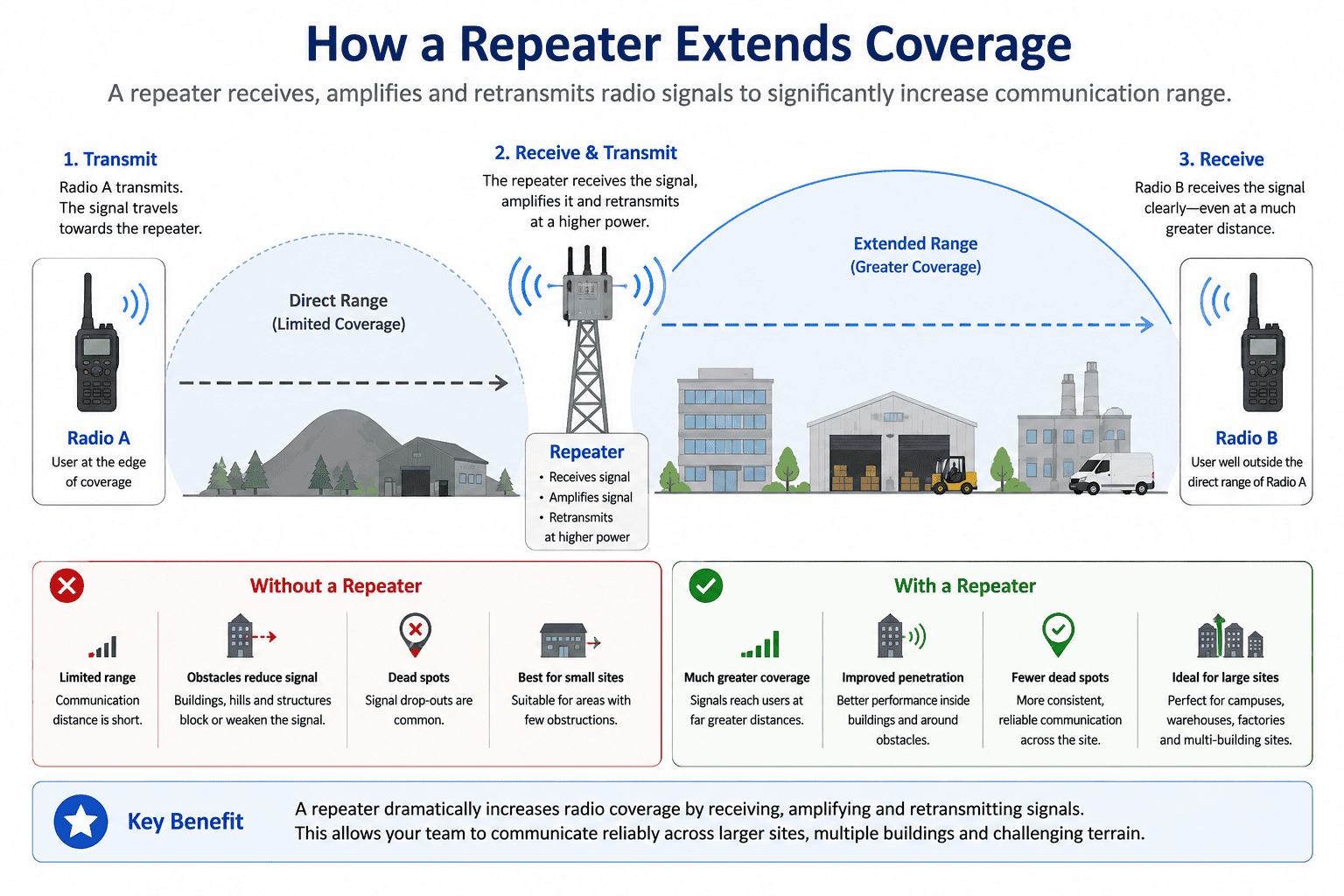
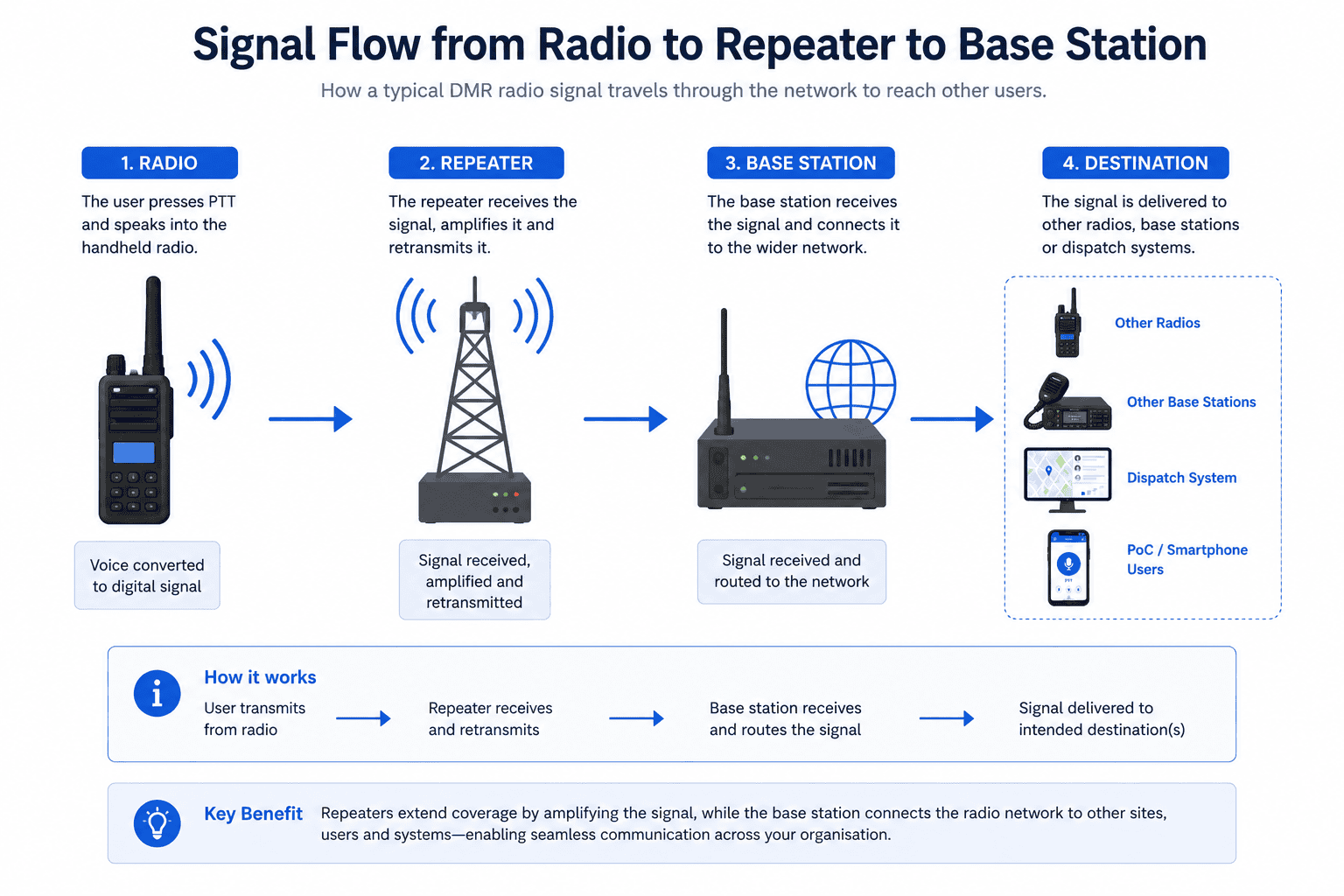
A repeater is a fixed radio station that:
- Receives incoming transmissions.
- Amplifies the signal.
- Rebroadcasts it over a much wider area.
Because repeaters are typically installed on rooftops, communication towers or elevated structures, they can provide significantly greater coverage than handheld radios communicating directly.
Why Repeaters Improve Coverage
Imagine two warehouse operatives working at opposite ends of a large distribution centre.
Without a repeater:
- BuildingsAn antenna transmits and receives radio-frequency signals, allowing a two-way radio to communicate. Antenna type, frequency, height and location can all affect radio performance and coverage.
- Steel shelving
- Machinery
- Distance
may prevent reliable communication.
With a centrally positioned repeater:
- Both radios communicate with the repeater.
- The repeater relays every transmissionTransmission is the process of sending voice, data or signalling from a radio using a radio-frequency signal to another radio, repeater or communication system..
- Coverage becomes far more consistent.
This principle applies equally to:
- Industrial estates
- Hospitals
- Airports
- Business parks
- Ports
- Universities
Single-Site and Multi-Site Networks
Single-Site Systems
Many organisations operate from one location.
A single-site repeater system may provide complete coverage across:
- Manufacturing facilities
- Warehouses
- Hotels
- Hospitals
- Shopping centres
This is often the most straightforward infrastructure design.
Multi-Site Networks
Larger organisations may require several repeater sites connected together.
Each repeater covers its local area.
The sites are then linked using:
- IP networks
- Fibre connections
- Microwave links
- Other communication technologies
Users can move between sites while remaining connected.
This is known as roamingRoaming allows a compatible two-way radio to move between different radio sites or coverage areas, automatically selecting an appropriate site as the user moves..
Base Stations
Base stations provide fixed communication points within an organisation.
They are commonly installed in:
- Security control rooms
- Reception areas
- Operations centres
- Gatehouses
- Maintenance offices
Unlike handheld radios, base stations benefit from:
- Permanent mains power
- External antennas
- Larger speakers
- Desktop microphones
- Higher-quality reception
These features make them ideal for personnel who remain at a fixed location.
Antennas
The antenna is one of the most important and often underestimated components of any radio systemA Radio System is a complete communication solution comprising two-way radios and, where required, equipment such as repeaters, antennas, base stations, mobile radios and network infrastructure..
Its role is to:
- Transmit radio signals efficiently.
- Receive incoming signals.
- Maximise coverage.
Poor antenna selection or positioning can significantly reduce system performance.
Antenna Height
Generally speaking:
Higher antennas provide better coverage.
This is because:
- More obstacles are avoided.
- Greater line of sight is achieved.
- Signal propagation improves.
This is why repeater antennas are often mounted:
- On rooftops
- Communication masts
- Water towers
- High-rise buildings
Antenna Gain
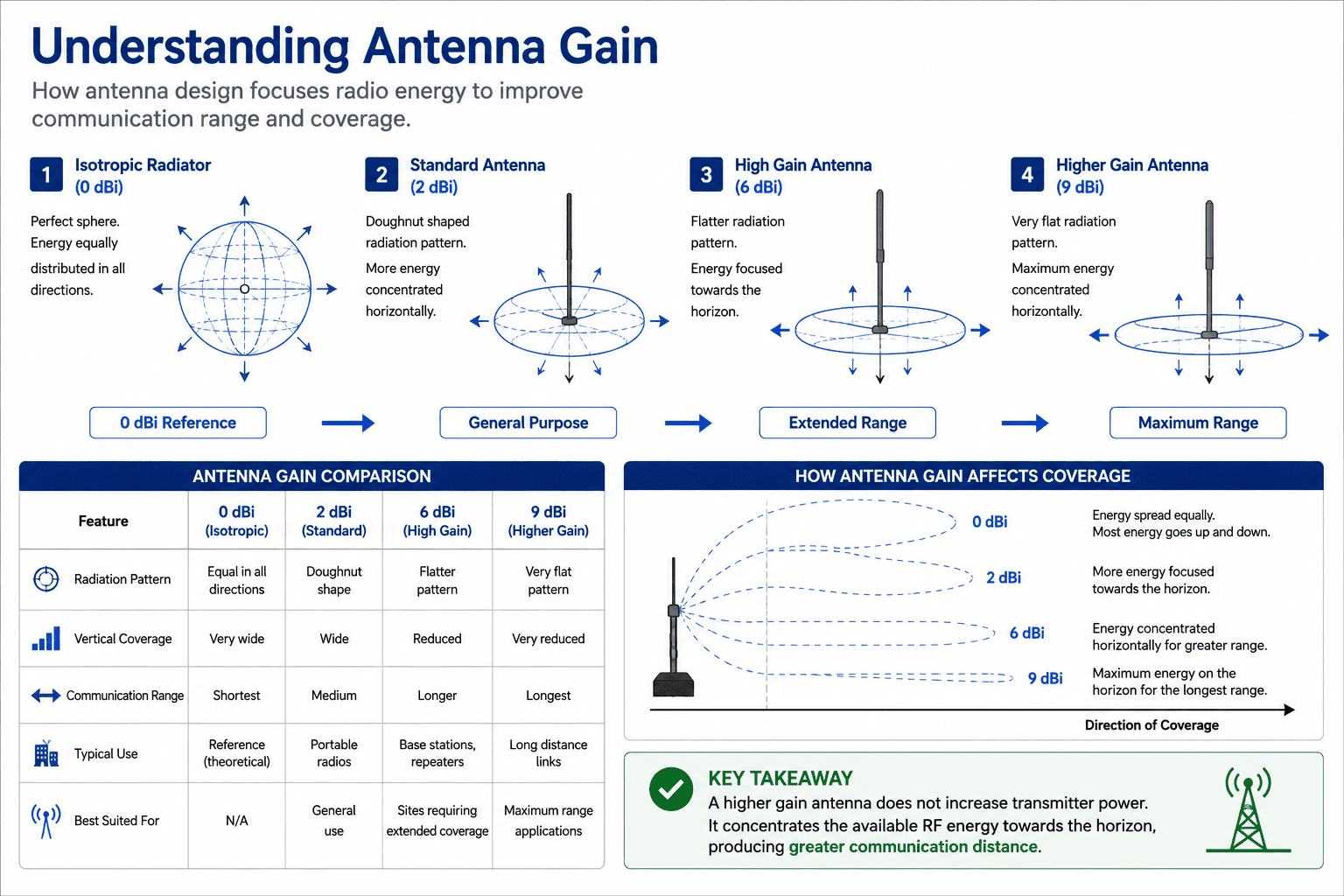
Some antennas focus radio energy more effectively than others.
Higher-gain antennas can increase coverage in specific directions.
However, higher gain is not always better.
The appropriate antenna depends on:
- Terrain
- Coverage objectives
- Building layout
- Operational requirements
Professional system design balances these factors carefully.
Feeders and Coaxial Cables
The radio signal must travel between the repeater and the antenna.
This is achieved using specialist low-loss coaxial cable.
Poor-quality cable or excessively long cable runs can reduce system performance through signal loss.
Professional installations therefore use:
- High-quality cable
- Appropriate connectorsAn antenna transmits and receives radio-frequency signals, allowing a two-way radio to communicate. Antenna type, frequency, height and location can all affect radio performance and coverage.
- Weatherproofing
- Careful routing
to minimise losses.
Duplexers
A repeater usually needs to transmit and receive simultaneously using the same antenna.
A duplexer makes this possible.
It separates transmitted and received signals, allowing both functions to operate without interfering with one another.
Although largely invisible to end users, duplexers are critical components within many repeater installations.
Power Supplies and Battery Backup
Communication systems are often required during emergencies.
Reliable power is therefore essential.
Professional installations commonly include:
- Regulated power supplies
- Battery backup systems
- Uninterruptible Power Supplies (UPS)
- Automatic monitoring
If mains electricity fails, communication can often continue uninterrupted for several hours.
Some critical infrastructure sites also employ standby generators for extended resilience.
Network Monitoring
Modern radio infrastructure often includes software that continuously monitors system health.
Administrators can receive alerts if:
- A repeater fails.
- Power is lost.
- An antenna becomes disconnected.
- Temperature rises excessively.
- Network links fail.
Proactive monitoring helps minimise downtime and supports preventative maintenance.
IP Connectivity
Today's radio infrastructure increasingly uses Internet Protocol (IP) networking.
IP links allow:
- Multiple repeater sites to connect.
- Remote management.
- Centralised dispatch.
- Wide-area communication.
- Software updates.
Importantly, these networks are often private rather than relying on the public internet.
Coverage Planning
One of the most important stages of any infrastructure project is coverage planning.
Rather than simply installing equipment, engineers consider:
- Building materials
- Site layout
- Terrain
- User locations
- Vehicle movements
- Future expansion
This planning helps ensure reliable communication where it is needed most.
Site Surveys
Before deploying larger radio systems, many organisations undertake a professional site surveyA Site Survey is an assessment of a location to determine whether a two-way radio system will provide the required coverage, reliability and performance..
A survey may include:
- Signal strength measurements.
- Coverage mapping.
- Identification of dead spots.
- InterferenceRadio interference occurs when unwanted radio-frequency signals or electrical noise disrupt two-way radio communications, causing distorted audio, broken transmissions, reduced coverage or loss of communication. assessment.
- Infrastructure recommendations.
This reduces the likelihood of unexpected coverage issues after installation.
Capacity Planning
Infrastructure should not only meet today's requirements.
It should also support future growth.
Questions to consider include:
- Will additional staff be recruited?
- Could more sites be added?
- Will new departments require communication?
- Might future technologies be integrated?
Designing with scalability in mind can reduce future upgrade costs.
Resilience and Redundancy
For business-critical communication, resilience is paramount.
Professional systems may incorporate:
- Dual power supplies.
- Redundant repeaters.
- Multiple network paths.
- Backup antennas.
- Automatic failoverFailover allows a two-way radio system to switch to backup equipment, infrastructure or communication routes when the primary system fails, helping maintain communications..
These measures help ensure communication remains available during equipment failures or maintenance.
Choosing the Right Radio Infrastructure
Every organisation has different communication requirements, so there is no single radio system that suits every environment. Smaller businesses may only require a few handheld radios, while larger organisations often benefit from repeaters, dispatch software or hybrid communications that combine Digital Mobile Radio (DMR)Digital Mobile Radio (DMR) is an ETSI digital radio standard for professional two-way communications, supporting voice, group calling, data and other features on compatible radio systems. with Push-to-Talk over Cellular (PoC)Push-to-Talk over Cellular (PoC) provides radio-style push-to-talk communication over cellular or IP networks, allowing users to communicate across wide areas where suitable network connectivity is available.. The checklist below highlights the typical infrastructure required for the most common radio network configurations, helping you identify the components your organisation may need.
| Infrastructure Component | Simplex Radio System | Repeater System | DMR Multi-Site | PoC System | Hybrid DMR + PoC |
|---|---|---|---|---|---|
| Handheld Radios | ✔ | ✔ | ✔ | ✔ | ✔ |
| Vehicle Radios | Optional | Optional | ✔ | ✔ | ✔ |
| Base StationA base station is a fixed two-way radio installed at a permanent location, allowing an operator to communicate with handheld or mobile radios across a site or operating area. | Optional | ✔ | ✔ | Optional | ✔ |
| Repeater | — | ✔ | ✔ (Multiple) | — | ✔ |
| OfcomOfcom (Office of Communications) is the UK's communications regulator. For two-way radio users, Ofcom manages and regulates access to radio spectrum and the use of radio frequencies in the UK. Radio Licence | Usually Required | ✔ | ✔ | — | DMR Only |
| Internet Connection | — | — | Optional | ✔ | ✔ |
| 4G / 5G Connectivity | — | — | — | ✔ | ✔ |
| Cloud DispatchCloud Dispatch is a cloud-based radio management and communication system that allows authorised dispatchers to communicate with, monitor and manage two-way radio users through an internet-connected platform. Platform | — | Optional | Optional | ✔ | ✔ |
| GPS Tracking | — | Optional | Optional | ✔ | ✔ |
| Emergency Alerts | ✔ | ✔ | ✔ | ✔ | ✔ |
| Text Messaging | Optional | Optional | ✔ | ✔ | ✔ |
| Talk Groups | Optional | ✔ | ✔ | ✔ | ✔ |
| Nationwide Coverage | — | — | Regional | ✔ | ✔ |
| Multi-Site Communications | — | Limited | ✔ | ✔ | ✔ |
| Smartphone Integration | — | — | Optional | ✔ | ✔ |
| Typical Applications | Retail, hospitality, schools and small sites | Warehouses, hotels, factories and campuses | Industrial sites, utilities and transport | Mobile workforces, delivery fleets and field engineers | Organisations with both on-site teams and remote workers |
Most organisations start with a simple radio system and expand their infrastructure as operational requirements grow. By adding repeaters, dispatch software, cloud connectivity or PoC devices, businesses can extend coverage, improve coordination and support larger teams without replacing their entire communications network.
Common Infrastructure Mistakes
Organisations sometimes underestimate the importance of infrastructure planning.
Common mistakes include:
- Assuming higher-power radios will solve coverage issues.
- Installing antennas in poor locations.
- Ignoring future expansion.
- Underestimating building materials.
- Selecting infrastructure based solely on cost.
- Skipping professional site surveys.
Addressing these issues during the design phase is usually far more cost-effective than correcting them later.
Infrastructure for Different Organisations
The size and complexity of a two-way radio system varies depending on an organisation's operational requirements. Smaller businesses may only need a handful of handheld radios, while larger organisations often require repeaters, control rooms, dispatch software and hybrid communicationHybrid Communication combines two or more communication technologies, such as two-way radio, DMR, cellular, Wi-Fi or IP networks, allowing different systems or users to communicate through a common platform. platforms to support multiple locations and mobile workforces.
| Organisation | Typical Infrastructure |
|---|---|
| Small Retail Shop | Simplex handheld radios |
| Hotel | Handheld radios with optional repeater |
| Warehouse | Repeater, handheld radios and base station |
| Manufacturing Plant | Multiple repeaters and a central control room |
| Airport | Multi-site repeater network with integrated dispatch |
| Utility Company | Regional repeater network integrated with vehicle radios |
| Nationwide Logistics | Hybrid DMR and PoC infrastructure with cloud dispatch |
Every communication system should be designed around the organisation's size, coverage requirements and operational workflows. As businesses expand, their infrastructure can be scaled to include additional repeaters, dispatch capabilities, cloud connectivity and hybrid communications without replacing the entire system.
Looking Ahead
Radio infrastructure continues to evolve.
Increasingly, organisations are deploying systems that combine:
- DMR repeaters
- IP networking
- Cloud managementCloud Management uses an online platform to remotely manage and monitor compatible two-way radios, users, devices and communication settings from a central location.
- GPS services
- PoC integration
- Intelligent dispatch platforms
The future is likely to see even greater convergence between traditional radio infrastructure and broadbandBroadband is a high-speed data connection used by systems such as PoC radio to carry voice, video and other communications over mobile networks, Wi-Fi or IP networks. communication technologies, creating highly resilient hybrid communication environments.
Key Takeaways
- Radio infrastructure forms the foundation of every professional communication system.
- Repeaters extend coverage and improve communication reliability.
- Antenna selection and placement have a major influence on system performance.
- Base stations provide fixed communication points for control rooms and operations centres.
- Coverage planning and site surveys are essential for larger deployments.
- Infrastructure should be designed with resilience and future expansion in mind.
- Modern radio networks increasingly integrate IP networking and cloud technologies.
Expert Insight
- The most expensive radio in the world cannot compensate for poorly designed infrastructure.
- Successful communication systems are built from the ground up. Careful planning of antennas, repeaters, coverage areas and network resilience often delivers greater operational improvements than simply upgrading handheld radios. Investing in infrastructure design at the beginning of a project usually results in lower costs and better performance over the long term.
Business Perspective
Reliable communication begins long before a user presses the Push-to-Talk button. The infrastructure supporting a professional radio network determines how effectively teams can communicate across buildings, sites and regions. By investing in appropriate infrastructure, conducting thorough coverage planning and designing with future growth in mind, organisations can build communication systems that support operational efficiency, improve staff safety and continue delivering value for many years.
Frequently Asked Questions
What is radio infrastructure?
Radio infrastructure refers to the fixed equipment that supports a professional communication system, including repeaters, antennas, base stations, power supplies, dispatch consoles and associated networking equipment.
Does every radio system need a repeater?
No. Small organisations operating over limited areas may use simplex communication without any infrastructure. Repeaters become beneficial when greater coverage or improved reliability is required.
Why are antennas installed on rooftops?
Elevated antennas improve line of sight, reduce physical obstructions and generally provide wider communication coverage than antennas installed at lower levels.
What is a site survey?
A site survey assesses the operating environment before a radio system is installed. It helps identify coverage requirements, potential interference, dead spots and the most suitable infrastructure design.
Can radio infrastructure be expanded later?
Yes. Most professional systems are designed with scalability in mind, allowing additional repeaters, users, sites and technologies to be incorporated as organisational requirements evolve.
Contact The UK's Premier Two Way Radio Experts Today