
The Complete Guide to Two-Way Radios & Professional Mobile Radio (PMR)
Part 1 Chapter 3 – How Radio Communication Systems Work
How Radio Communication Systems Work
Chapter 3 – How Radio Communication Systems Work
Understanding the Technology Behind Instant Business Communication
Every day, millions of professionals rely on two-way radios to communicate instantly across construction sites, warehouses, hospitals, manufacturing plants, airports, shopping centres, event venues and countless other workplaces. To the user, the process appears simple—press the Push-to-Talk (PTT)Push-to-Talk (PTT) is the button or control used to activate a two-way radio's transmitter. Press it to speak and release it to listen. button, speak, release the button and your message is heard almost instantly.
Behind this simplicity lies a sophisticated communication system that converts your voice into radio signals, transmits those signals through the air and reproduces them as clear speech on another radio.
Understanding how radio communication systems work is valuable for any organisation investing in professional communications. It helps explain why different radio technologies offer different levels of coverageRadio Coverage is the geographical area in which a two-way radio system can provide reliable communication. Coverage depends on the radios, antennas, frequency, terrain, buildings and system infrastructure., why buildingsAn antenna transmits and receives radio-frequency signals, allowing a two-way radio to communicate. Antenna type, frequency, height and location can all affect radio performance and coverage. can affect signal strength, why repeaters are sometimes required and why businesses choose one communication system over another.
In this chapter, we'll explore the journey of a radio transmissionTransmission is the process of sending voice, data or signalling from a radio using a radio-frequency signal to another radio, repeater or communication system. from the moment someone speaks into a handset to the point another user hears the message.
What Is a Two-Way Radio Communication System?
A two-way radio communication system is a wireless networkA Network is a connected system of radios, equipment and infrastructure that allows users to communicate across a defined area. Radio networks can range from simple radio-to-radio systems to large multi-site networks. that allows users to both transmit and receive voice or data using radio waves.
Unlike a traditional radio receiverA Receiver is the part of a two-way radio that detects and processes incoming radio signals, converting them into audible voice or usable data for the user., which only receives broadcasts (such as FM or DAB radio), a professional two-way radio both sends and receives information.
Each radio contains:
- A microphone
- A loudspeaker
- A transmitter
- A receiver
- An antennaAn antenna transmits and receives radio-frequency signals, allowing a two-way radio to communicate. Antenna type, frequency, height and location can all affect radio performance and coverage.
- A battery or powerAn antenna transmits and receives radio-frequency signals, allowing a two-way radio to communicate. Antenna type, frequency, height and location can all affect radio performance and coverage. supply
- Internal processing electronics
Together, these components allow users to communicate without relying on telephone networks or internet connections (depending on the type of system being used).
The Journey of a Radio Transmission
When someone presses the Push-to-Talk button, a sequence of events takes place in a fraction of a second.
Step 1 – Speaking Into the Microphone
The user's voice creates sound waves.
The microphone inside the radio converts these sound waves into electrical signals.
In analogue radios, these signals are prepared for analogue transmission.
In digital radios, the signals are converted into digital data before transmission.
Step 2 – Processing the Audio
Modern radios process the audio before transmitting it.
Depending on the system, this may include:
- Noise reduction
- Voice compression
- Digital encoding
- EncryptionEncryption protects two-way radio communications by converting voice or data into a secure form that can only be understood by authorised radios with the correct encryption capability and keys.
- Error correction
These processes help improve audio clarity and reliability, particularly in noisy working environments.
Step 3 – Creating Radio Waves
The processed signal is passed to the transmitter.
The transmitter generates a radio frequency (RF)Radio Frequency (RF) refers to electromagnetic waves used to transmit voice and data wirelessly. Two-way radios use RF signals to communicate between radios, repeaters and other system infrastructure. signal and combines it with the user's voice information.
This radio signal is then sent to the antenna.
The antenna radiates the signal into the surrounding environment as electromagnetic waves travelling at the speed of light.
Step 4 – Signal Propagation
Once transmitted, radio waves spread outward from the antenna.
Depending on the frequencyAn antenna transmits and receives radio-frequency signals, allowing a two-way radio to communicate. Antenna type, frequency, height and location can all affect radio performance and coverage. and surrounding environment, they may:
- Travel directly to another radio
- Reflect from buildings
- Pass through certain materials
- Diffract around obstacles
- Be absorbed by dense structures
- Be weakened over distance
This behaviour explains why coverage varies between different workplaces.
Step 5 – Receiving the Signal
Another radio tuned to the same channelA two-way radio channel is a programmed set of communication settings, typically including frequency and signalling, that allows compatible radios to communicate with one another. receives the radio waves through its antenna.
The receiver extracts the voice information from the radio signal.
If the transmission is digital, the radio decodes the digital data back into audio.
Step 6 – Playing the Message
Finally, the loudspeaker reproduces the original speech.
The entire process from speaking into one radio to hearing the message on another typically takes less than a second.
To the user, communication feels almost instantaneous.
Simplex Communication
The simplest form of radio communication is known as simplexSimplex is a method of two-way radio communication where radios transmit and receive on the same frequency, communicating directly without a repeater..
In a simplex system:
- One radio transmits.
- All other radios receive.
- Only one person can speak at a time.
- Users share a single frequencyFrequency is the number of cycles a radio wave completes each second, measured in Hertz. In two-way radio, frequency determines where a transmission operates within the radio spectrum..
This is how most handheld radios operate when communicating directly with one another.
Advantages
- Simple to deploy
- No infrastructureRadio infrastructure is the equipment and supporting systems behind a professional two-way radio network, including repeaters, antennas, base stations, network connections, power systems and dispatch equipment. required
- Lower cost
- Highly reliable
- Ideal for smaller sites
Limitations
- Limited coverage
- Buildings reduce signal strength
- Hills and terrain block transmissions
- Larger sites may experience dead spots
Simplex communication works well for:
- Small construction sites
- Retail stores
- Schools
- Hotels
- Warehouses
- Leisure facilities
Duplex Communication
When greater coverage is required, organisations often use duplexduplex, duplex radio, duplex communication, duplex frequencies, duplex operation, duplex spacing, frequency offset, repeater duplex, duplex repeater, full duplex, half duplex, radio repeater communication.
In a duplex system, radios communicate through a repeaterA Repeater receives a two-way radio transmission and retransmits it, usually from an elevated location, to extend the coverage and reliability of a radio communication system..
The repeater:
1. Receives the transmission.
2. Amplifies it.
3. Rebroadcasts it over a much larger area.
This dramatically increases communication range.
Duplex systems are common in:
- Airports
- Ports
- Manufacturing facilities
- Multi-building campuses
- Utility companies
- Large industrial sites
We'll explore repeaters in much greater detail in Chapter 10.
Radio Frequencies
Every radio communication system operates on a specific radio frequency.
A frequency is simply a particular portion of the radio spectrumSpectrum is the range of radio frequencies used for wireless communication. Two-way radios operate within specific parts of the radio spectrum, subject to frequency allocation and licensing requirements. reserved for communication.
Think of frequencies as individual lanes on a motorway.
Each lane allows different conversations to occur without interfering with one another.
Professional systems operate on carefully allocated frequencies to minimise interferenceRadio interference occurs when unwanted radio-frequency signals or electrical noise disrupt two-way radio communications, causing distorted audio, broken transmissions, reduced coverage or loss of communication. and maximise reliability.
We'll examine frequencies and Ofcom licensing in Chapter 11.
Did You Know?
Before any radio leaves our workshop, it is programmed, configured and tested by our engineers. This ensures every device is ready to use straight out of the box and performs exactly as required.
Channels
Although people often use the terms interchangeably, channels and frequencies are not exactly the same thing.
A frequency is the physical radio signal.
A channel is the programmed communication path that users select on their radio.
Modern radios may contain hundreds or even thousands of programmable channels.
These channels can be organised by:
- Department
- Site
- Region
- Function
- Emergency use
- Temporary events
This allows organisations to manage communications efficiently across large workforces.
Why Only One Person Can Speak at a Time
Unlike a telephone conversation, most radio systems operate using half-duplexHalf-Duplex allows two-way communication in both directions, but users normally take turns transmitting. It is the standard operating method for most Push-to-Talk professional two-way radio systems. communication.
This means:
- One person speaks.
- Everyone else listens.
- When finished, another user responds.
The Push-to-Talk button controls who is transmitting.
This approach offers several advantages:
- Simple operation
- Efficient group communication
- Reduced network complexity
- Lower equipment costs
Although only one person speaks at a time, everyone listening on the same channel hears the message simultaneously.
Radio Coverage
Coverage depends on several factors working together.
Terrain
Hills, valleys and natural obstacles affect signal propagation.
Open countryside generally provides greater range than mountainous areas.
Buildings
Concrete, steel and reinforced structures weaken radio signals.
Warehouses, shopping centres and hospitals often require careful coverage planning.
Antenna Height
Higher antennas generally provide better coverage because they reduce physical obstructions.
This is why repeater antennas are commonly installed on rooftops or communication masts.
Frequency
Different frequencies behave differently.
Some provide better building penetration.
Others travel further across open environments.
The appropriate choice depends on the operational requirements.
Expert Insight
There is no one-size-fits-all solution. PMR systems excel in mission-critical local communications, while PoC provides virtually unlimited coverage using 4G, 5G and Wi-FiWi-Fi is a wireless networking technology that connects compatible devices to a local or wider network. In radio systems, it can support programming, updates, data services and IP-based communications.. Many organisations combine both technologies to achieve reliable on-site communications alongside nationwide connectivity.
Power Output
Higher transmitter power can improve coverage, although increasing power alone rarely solves all coverage issues.
Good system design is far more important than simply using more powerful radios.
Repeaters Extend Coverage
A repeater acts as a relay station.
Instead of one radio communicating directly with another, both communicate with the repeater.
The repeater then retransmits every message across a much wider area.
This enables communication across:
- Large warehouses
- Distribution centres
- Business parks
- Towns
- Cities
- Entire counties
Some organisations even link multiple repeaters together to create regional communication networks.
Digital Processing
Digital radios perform far more processing than traditional analogue equipment.
Modern digital systems can provide:
- Error correction
- Voice compression
- Noise suppression
- GPS information
- Text messaging
- TelemetryTelemetry is the automatic collection and transmission of information from a remote device, vehicle, machine or radio to another location for monitoring, analysis or control.
- Encryption
- Status updates
This additional functionality makes digital radio far more than simply a voice communication tool.
Communication Using a Repeater
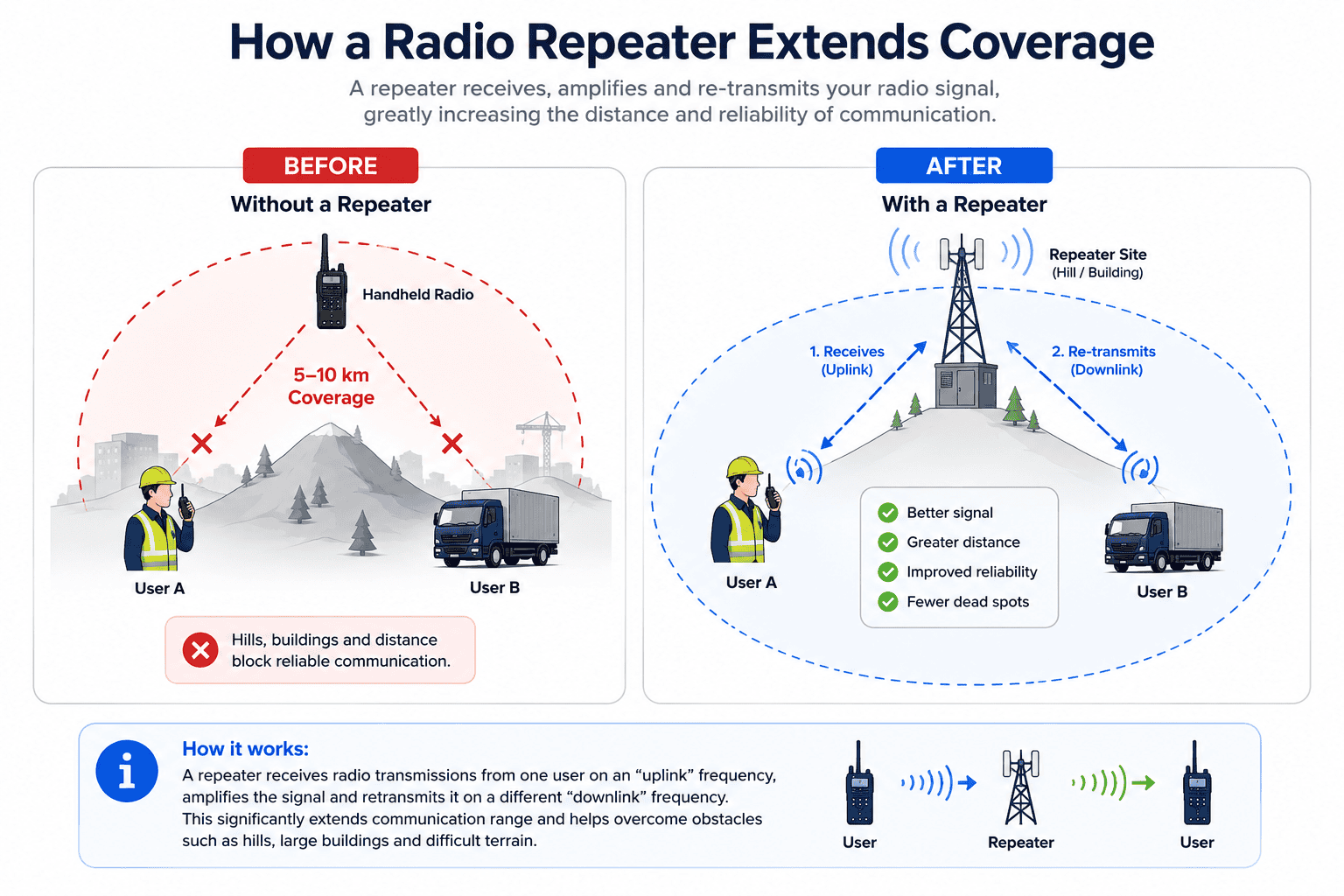
In many environments, direct radio-to-radio communication is limited by distance, buildings, hills or other obstacles. A radio repeater overcomes these challenges by receiving transmissions from one radio, amplifying the signal and retransmitting it over a much larger area. This allows users to communicate reliably across larger sites and more challenging environments.
Push-to-Talk Over Cellular (PoC)
PoC systems work slightly differently.
Instead of transmitting directly over radio frequencies, they use mobile broadbandBroadband is a high-speed data connection used by systems such as PoC radio to carry voice, video and other communications over mobile networks, Wi-Fi or IP networks. networks.
Your voice travels through:
1. The radio device.
2. The mobile network.
3. Secure servers.
4. Another PoC radio.
To the user, operation remains almost identical.
Press the PTT button.
Speak.
Release.
The difference lies in how the message reaches its destination.
PMR vs PoC Communication Pathways
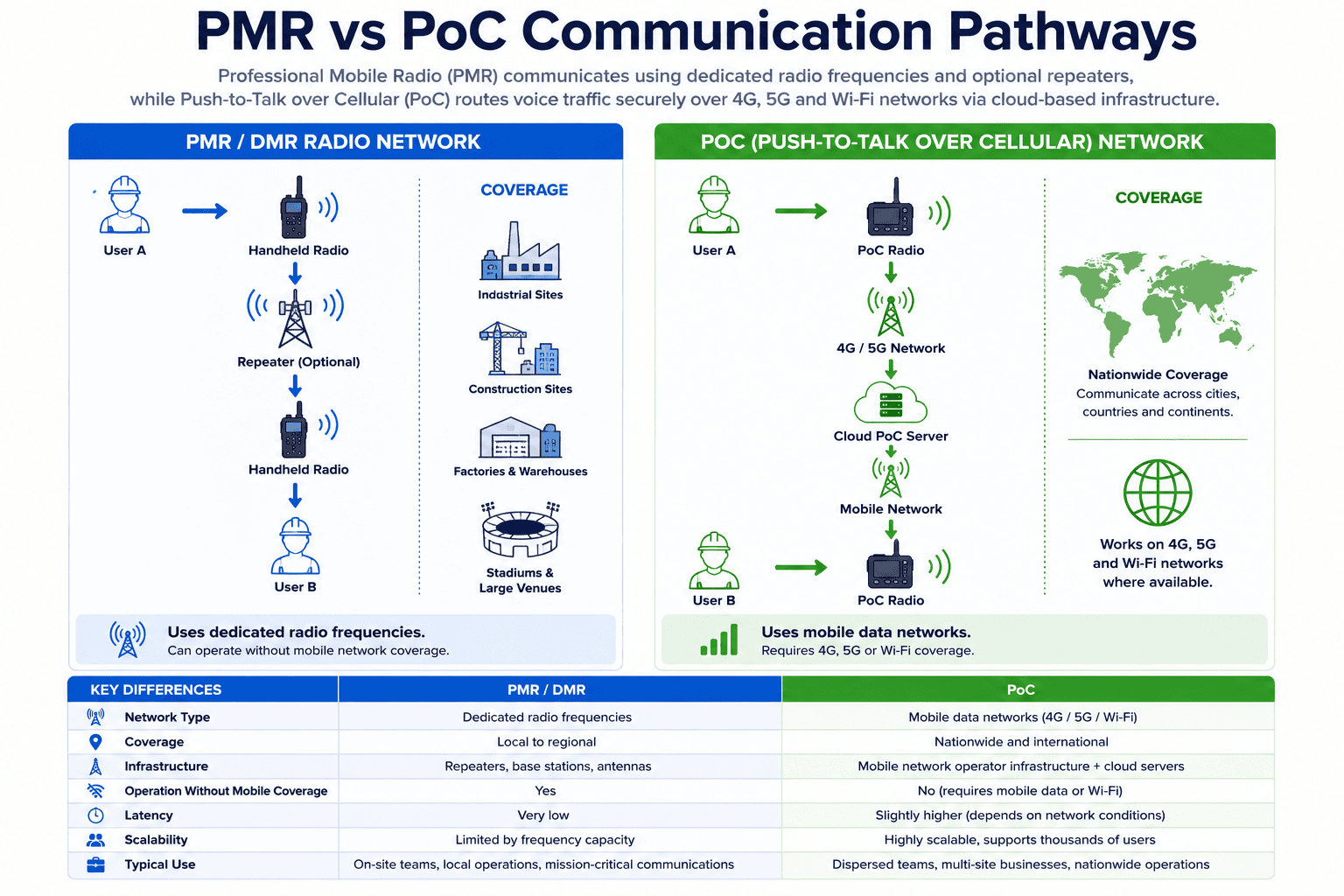
Professional Mobile Radio (PMR)Professional Mobile Radio (PMR) describes private two-way radio systems designed for business and professional users, ranging from simple radio networks to advanced digital and multi-site systems. communicates using dedicated radio frequencies and optional repeaters, while Push-to-Talk over Cellular (PoC)Push-to-Talk over Cellular (PoC) provides radio-style push-to-talk communication over cellular or IP networks, allowing users to communicate across wide areas where suitable network connectivity is available. routes voice traffic securely over 4G, 5G and Wi-Fi networks via cloud-based infrastructure.
Putting It All Together
Although professional radio systems may appear complex, the communication process can be summarised in six simple stages:
1. Speak into the microphone.
2. Audio is processed.
3. Radio signal is transmitted.
4. Signal travels through the air (or mobile network).
5. Another radio receives it.
6. Speech is reproduced through the loudspeaker.
This process occurs in less than a second and enables the instant communication that businesses depend upon every day.
Key Takeaways
- Every two-way radio contains a transmitter, receiver, antenna, microphone and loudspeaker working together.
- Radio communication converts speech into radio signals before reconstructing it as audio at the receiving radio.
- Most professional systems use Push-to-Talk half-duplex communication.
- Coverage depends on terrain, buildings, antenna height, frequency and infrastructure.
- Repeaters significantly extend communication range.
- Digital radios add processing capabilities such as encryption, GPS and messaging.
- Push-to-Talk over Cellular uses mobile broadband rather than traditional radio infrastructure while maintaining familiar Push-to-Talk operation.
Expert Insight
Coverage problems are usually design problems rather than equipment problems.
Organisations often assume poor communication can be solved by purchasing more powerful radios. In reality, factors such as antenna placement, repeater locations, building construction and frequency planning usually have a much greater impact on system performance. A well-designed communication system will almost always outperform a poorly planned installation using more expensive equipment.
Business Perspective
Understanding how radio systems work helps organisations make more informed purchasing decisions. Rather than focusing solely on handset specifications, businesses should consider how the complete communication system including coverage, infrastructure, user numbers and operational workflows will perform in real-world conditions. Investing in a communication solution that matches the working environment can improve productivity, reduce downtime and enhance staff safety.
Frequently Asked Questions
How far can two-way radios communicate?
There is no single answer. Coverage depends on factors including terrain, building construction, antenna height, radio frequency, power outputPower Output is the amount of radio-frequency energy produced by a two-way radio's transmitter, normally measured in watts. It is one factor affecting coverage, alongside frequency, antenna, terrain and other conditions. and whether a repeater is used. Professional systems can range from a few hundred metres on a busy site to many kilometres with suitable infrastructure.
Why can only one person speak at a time?
Most professional radio systems use half-duplex communication. This allows one user to transmit while everyone else on the channel listens, making group communication simple and efficient.
What is the purpose of a repeater?
A repeater receives radio transmissions and rebroadcasts them over a wider area, extending coverage and improving communication reliability across larger sites or challenging environments.
Do digital radios work differently from analogue radios?
The basic communication process is similar, but digital radios convert speech into digital data before transmission. This enables additional features such as clearer audio, encryption, GPS, text messaging and improved spectrum efficiency.
Do Push-to-Talk over Cellular radios use radio frequencies?
PoC devices still use radio technology to connect to mobile networks, but voice communication is carried over 4G or 5G mobile broadband rather than a dedicated PMR radio network.
What People Say About DCS 2 Way Radio
Contact the UK's Premier Two Way Radio Experts Today