
The Complete Guide to Two-Way Radios & Professional Mobile Radio (PMR)
Part 1 Chapter 4 – Radio Communication Fundamentals
Radio Communication Fundamentals
Chapter 4 – Radio Communication Fundamentals
Understanding the Principles Behind Professional Radio Communications
Every successful professional radio systemA Radio System is a complete communication solution comprising two-way radios and, where required, equipment such as repeaters, antennas, base stations, mobile radios and network infrastructure., whether it's used on a construction site in Manchester, a logistics hub in Birmingham or an airport in London, relies on the same core principles of radio communication.
While modern two-way radios have become increasingly sophisticated, incorporating digital processing, GPS, Bluetooth®Bluetooth® is a short-range wireless technology used with compatible two-way radios to connect accessories such as headsets, earpieces and microphones without a physical cable., cloud connectivity and broadbandBroadband is a high-speed data connection used by systems such as PoC radio to carry voice, video and other communications over mobile networks, Wi-Fi or IP networks. networks, the fundamental science behind radio communication has remained largely unchanged for more than a century.
For organisations investing in professional communication systems, understanding these fundamentals is invaluable. It explains why radio signals behave differently in various environments, why some systems provide better coverageRadio Coverage is the geographical area in which a two-way radio system can provide reliable communication. Coverage depends on the radios, antennas, frequency, terrain, buildings and system infrastructure. than others, and why careful planning is essential when designing a reliable communication networkA Network is a connected system of radios, equipment and infrastructure that allows users to communicate across a defined area. Radio networks can range from simple radio-to-radio systems to large multi-site networks..
In this chapter, we'll explore the key concepts that underpin every professional radio system, providing a practical understanding rather than a detailed engineering lesson.
What Are Radio Waves?
Radio communication relies on radio waves, a type of electromagnetic wave that travels through space carrying information.
Unlike sound waves, which require air or another medium to travel through, radio waves can move through a vacuum and many different materials. They travel at the speed of light, approximately 300 million metres per second (300,000 km/s).
Every time you press the Push-to-Talk (PTT)Push-to-Talk (PTT) is the button or control used to activate a two-way radio's transmitter. Press it to speak and release it to listen. button on a radio, your voice is converted into electrical signals, which are then transmitted as radio waves. These waves are received by another radio and converted back into audible speech.
Although invisible, radio waves surround us every day. They are used for:
- Professional two-way radios
- Mobile phones
- Television broadcasts
- Wi-FiWi-Fi is a wireless networking technology that connects compatible devices to a local or wider network. In radio systems, it can support programming, updates, data services and IP-based communications.
- Bluetooth® devices
- Satellite communications
- GPS navigation
- Emergency services communications
The difference lies in the frequencies they use and how those signals are transmitted.
The Electromagnetic Spectrum
Radio waves form part of the wider electromagnetic spectrumSpectrum is the range of radio frequencies used for wireless communication. Two-way radios operate within specific parts of the radio spectrum, subject to frequency allocation and licensing requirements., which also includes:
- Gamma rays
- X-rays
- Ultraviolet (UV)
- Visible light
- Infrared
- Microwaves
Radio waves occupy the lowest-frequency portion of this spectrum, making them ideal for long-distance communication.
Different communication technologies operate within different parts of the radio spectrum, each chosen for its unique characteristics.
For example:
| Communication Technology | Primary Purpose |
|---|---|
| AM/FM Broadcasting | One-way transmissionTransmission is the process of sending voice, data or signalling from a radio using a radio-frequency signal to another radio, repeater or communication system. of audio to large public audiences. |
| Professional Mobile Radio (PMR)Professional Mobile Radio (PMR) describes private two-way radio systems designed for business and professional users, ranging from simple radio networks to advanced digital and multi-site systems. | Instant two-way communications for businesses, public safety and industrial users. |
| Mobile Networks (4G/5G) | Nationwide voice, messaging and internet connectivity for mobile devices. |
| Wi-Fi | Local wireless networking for internet and data access within a limited area. |
| Bluetooth® | Short-range wireless connections between nearby devices and accessories. |
| Satellite Communications | Long-distance communications where terrestrial infrastructureRadio infrastructure is the equipment and supporting systems behind a professional two-way radio network, including repeaters, antennas, base stations, network connections, power systems and dispatch equipment. is unavailable. |
Did You Know?
Radio waves travel at approximately 300 million metres per second.
Frequency Explained
One of the most important concepts in radio communication is frequencyAn antenna transmits and receives radio-frequency signals, allowing a two-way radio to communicate. Antenna type, frequency, height and location can all affect radio performance and coverage..
FrequencyFrequency is the number of cycles a radio wave completes each second, measured in Hertz. In two-way radio, frequency determines where a transmission operates within the radio spectrum. refers to the number of wave cycles transmitted every second and is measured in Hertz (Hz).
Professional radio systems typically operate using frequencies measured in:
- Megahertz (MHz)
- Gigahertz (GHz)
Different frequencies behave differently.
Some travel greater distances across open landscapes.
Others penetrate buildingsAn antenna transmits and receives radio-frequency signals, allowing a two-way radio to communicate. Antenna type, frequency, height and location can all affect radio performance and coverage. more effectively.
Some carry large amounts of data but operate over shorter distances.
Selecting the appropriate frequency is therefore a key part of designing an effective communication system.
Wavelength
Frequency and wavelength are closely related.
Generally speaking:
- Lower frequencies produce longer wavelengths.
- Higher frequencies produce shorter wavelengths.
Longer wavelengths often:
- Travel further
- Bend around obstacles more effectively
- Provide better coverage over uneven terrain
Shorter wavelengths typically:
- Support higher data rates
- Use smaller antennas
- Can struggle more with physical obstructions
Professional communication systems balance these characteristics depending on their intended application.
30 MHz
3 GHz
Long Wavelength
Approx. 10 metres
Short Wavelength
Approx. 10 centimetres
✔ Greater range
✔ Lower data capacity
✔ Shorter range
✔ Better for high-speed data
Did You Know?
Before any radio leaves our workshop, it is programmed, configured and tested by our engineers. This ensures every device is ready to use straight out of the box and performs exactly as required.
Signal Strength
Signal strength determines how well a transmission can be received.
As radio waves travel away from the transmitting antennaAn antenna transmits and receives radio-frequency signals, allowing a two-way radio to communicate. Antenna type, frequency, height and location can all affect radio performance and coverage., they gradually lose strength.
This is perfectly normal and occurs with every radio transmission.
Several factors influence signal strength:
Distance
The further a signal travels, the weaker it becomes.
This is why communication range has practical limits.
Obstacles
Buildings, hills, trees and other structures absorb, reflect or block radio signals.
Dense concrete and steel-framed buildings are particularly challenging environments.
Weather
For most professional PMR systems, everyday weather has relatively little impact.
Heavy rain or snow may have a minor effect in some circumstancesAn antenna transmits and receives radio-frequency signals, allowing a two-way radio to communicate. Antenna type, frequency, height and location can all affect radio performance and coverage., but environmental obstacles generally have a much greater influence than weather conditions.
Interference
Other electronic equipment and nearby radio systems can create interferenceRadio interference occurs when unwanted radio-frequency signals or electrical noise disrupt two-way radio communications, causing distorted audio, broken transmissions, reduced coverage or loss of communication. if frequencies are not properly managed.
Professional frequency planning helps minimise these issues.
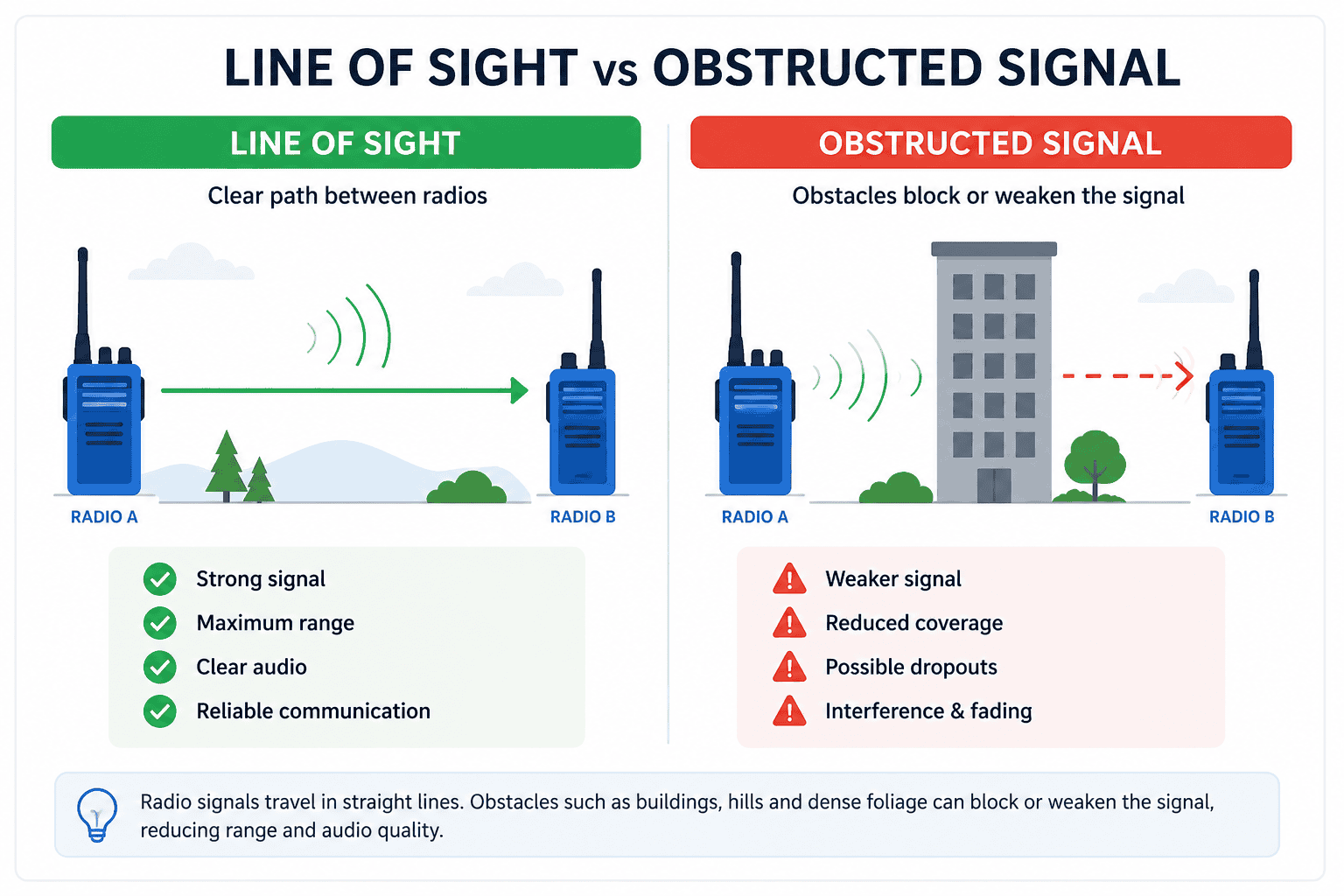
Line of Sight
Many professional radio systems work best when there is a clear line of sight between transmitting and receiving antennas.
This simply means there are no significant physical obstructions blocking the signal.
Examples of excellent line-of-sight environments include:
- Open construction sites
- Agricultural land
- Airfields
- Coastal areas
- Ports
Environments with poor line of sight include:
- City centres
- Shopping centres
- Underground facilities
- Large warehouses with metal racking
- Multi-storey office buildings
Understanding line of sight is essential when planning communication coverage.
Reflection, Diffraction and Absorption
Radio waves do not always travel in a straight line.
They interact with the surrounding environment in several ways.
Reflection
Signals can bounce off buildings, vehicles and metal structures.
This sometimes improves coverage but can also create multiple signal paths.
Diffraction
Radio waves can bend around obstacles.
This allows communication even when the transmitting and receiving radios cannot see each other directly.
Absorption
Certain materials absorb radio energy.
Examples include:
- Reinforced concrete
- Thick stone walls
- Steel structures
- Dense vegetation
This reduces signal strength.
Antennas
The antenna is one of the most important components of any radio system.
Its job is to:
- Radiate transmitted signals
- Receive incoming signals
A good antenna can dramatically improve communication performance.
Conversely, an unsuitable or damaged antenna can significantly reduce coverage.
Professional installations carefully consider:
- Antenna type
- Height
- Location
- Orientation
- Gain
These factors often have a greater impact than transmitter powerAn antenna transmits and receives radio-frequency signals, allowing a two-way radio to communicate. Antenna type, frequency, height and location can all affect radio performance and coverage. alone.
Transmitter Power
Radio transmitters are measured in watts.
Many people assume that increasing transmitter power automatically increases communication range.
In reality, this is only part of the picture.
Coverage is also influenced by:
- Antenna quality
- Terrain
- Buildings
- Frequency
- RepeaterA Repeater receives a two-way radio transmission and retransmits it, usually from an elevated location, to extend the coverage and reliability of a radio communication system. infrastructure
- ReceiverA Receiver is the part of a two-way radio that detects and processes incoming radio signals, converting them into audible voice or usable data for the user. sensitivity
A well-designed system with modest power frequently outperforms a poorly designed high-power installation.
Receiver Sensitivity
Every radio receiver has a limit to how weak a signal it can detect.
Higher-quality professional radios generally offer better receiver sensitivity.
This means they can continue receiving intelligible transmissions where lower-quality equipment may struggle.
Receiver performance is one reason why professional-grade radios often provide noticeably better real-world performance than low-cost consumer devices.
Noise and Interference
No communication environment is completely free from interference.
Common sources include:
- Electrical equipment
- Industrial machinery
- Power infrastructure
- Nearby radio systems
- Electronic devices
Modern digital radios use sophisticated processing techniques to minimise the impact of interference, helping maintain clearer communication even in challenging environments.
Analogue and Digital Signals
Professional radio systems generally use either analogue or digital transmission.
Analogue
Analogue systems transmit continuously varying electrical signals.
Advantages include:
- Simplicity
- Compatibility with older systems
- Lower initial costs
Limitations include:
- Background hiss
- Reduced clarity at longer distances
- Limited advanced functionality
Digital
Digital systems convert speech into data before transmission.
Advantages include:
- Improved audio clarity
- Better resistance to interference
- Enhanced security
- GPS
- Text messaging
- EncryptionEncryption protects two-way radio communications by converting voice or data into a secure form that can only be understood by authorised radios with the correct encryption capability and keys.
- Better spectrum efficiency
Digital technology now forms the foundation of most modern business radioBusiness Radio refers to professional two-way radio systems used by businesses and organisations for instant communication, often using licensed frequencies and equipment designed for commercial use. systems.
Channels, Talk Groups and Networks
As organisations grow, communication becomes more complex.
Rather than every employee sharing one channelA two-way radio channel is a programmed set of communication settings, typically including frequency and signalling, that allows compatible radios to communicate with one another., businesses often divide users into logical groups.
Examples include:
| Department | Talk GroupA Talk Group is a predefined group of users or radios within a two-way radio system that share a common communication group, allowing teams to communicate without involving other users. |
|---|---|
| Security | Security Channel |
| Facilities | Maintenance |
| Warehouse | Operations |
| Management | Supervisors |
| First Aid | Emergency Response |
Digital systems can support many talk groups without requiring additional radio frequencies, improving efficiency and reducing congestion.
Coverage Isn't Just About Distance
One of the biggest misconceptions surrounding two-way radios is that coverage can be measured simply by distance.
Manufacturers sometimes advertise theoretical ranges measured under perfect conditions.
Real-world performance depends on the operating environment.
For example:
Excellent Coverage
- Open farmland
- Coastal areas
- Airfields
- Large outdoor events
Moderate Coverage
- Industrial estates
- Construction sites
- Business parks
Challenging Coverage
- Hospitals
- Shopping centres
- High-rise buildings
- Underground facilities
- Warehouses with extensive steel racking
This is why professional site surveys are often recommended before deploying larger communication systems.
Why These Fundamentals Matter
Understanding these principles enables organisations to make informed decisions.
Rather than asking:
"How many miles will this radio reach?"
A more useful question is:
"How will this communication system perform within our specific operating environment?"
Every workplace presents unique challenges.
The most effective communication systems are designed around operational requirements rather than theoretical specifications.
Key Takeaways
- Radio communication relies on electromagnetic waves travelling at the speed of light.
- Frequency influences how radio signals behave and determines their suitability for different applications.
- Signal strength is affected by distance, buildings, terrain and interference.
- Line of sight remains an important factor in radio coverage.
- Antenna design and placement are often more important than transmitter power.
- Professional communication systems are designed around the operating environment rather than theoretical maximum range.
- Digital technology has significantly improved audio quality, reliability and functionality.
Expert Insight
- The best-performing communication system isn't necessarily the one with the highest specifications it's the one that's been designed for the environment in which it will operate.
- Warehouses, hospitals, ports, construction sites and manufacturing facilities all present different communication challenges.
- Successful radio deployments begin with understanding the environment, the users and the operational workflows before selecting equipment or infrastructure.
Business Perspective
Understanding the fundamentals of radio communication helps organisations move beyond marketing claims and focus on real operational performance. Coverage, reliability and audio quality are determined by a combination of factors working together, including frequency selection, infrastructure design and environmental conditions.
Taking these principles into account from the outset can reduce communication issues, improve operational efficiency and maximise the return on investment in a professional radio system.
Frequently Asked Questions
What are radio waves?
Radio waves are a form of electromagnetic energy used to transmit information wirelessly. Professional two-way radios use them to carry voice and data between devices.
Why do buildings reduce radio coverage?
Materials such as reinforced concrete, steel and thick masonry absorb or reflect radio signals, reducing their strength and limiting communication range.
Does a more powerful radio always provide greater range?
Not necessarily. While transmitter power plays a role, antenna quality, receiver sensitivity, terrain, buildings and infrastructure often have a much greater influence on overall performance.
Why do professional radios outperform cheaper consumer models?
Professional radios typically offer better receiver sensitivity, higher-quality antennas, more robust construction and advanced signal processing, enabling more reliable communication in demanding environments.
Can weather affect radio signals?
Normal weather conditions have relatively little effect on most professional PMR systems. Buildings, terrain and physical obstructions generally have a much greater impact on communication performance.
What People Say About DCS 2 Way Radio
Contact the UK's Premier Two Way Radio Experts Today