
The Complete Guide to Two-Way Radios & Professional Mobile Radio (PMR)
Part 3 - Chapter 12
Modern Radio Features
Modern Radio Features
Beyond Push-to-Talk: How Professional Radios Have Evolved
For many people, a two-way radio is simply a device that allows one person to speak while others listen. While this basic principle remains unchanged, today's professional radios are far more capable than the analogue devices used just a few decades ago.
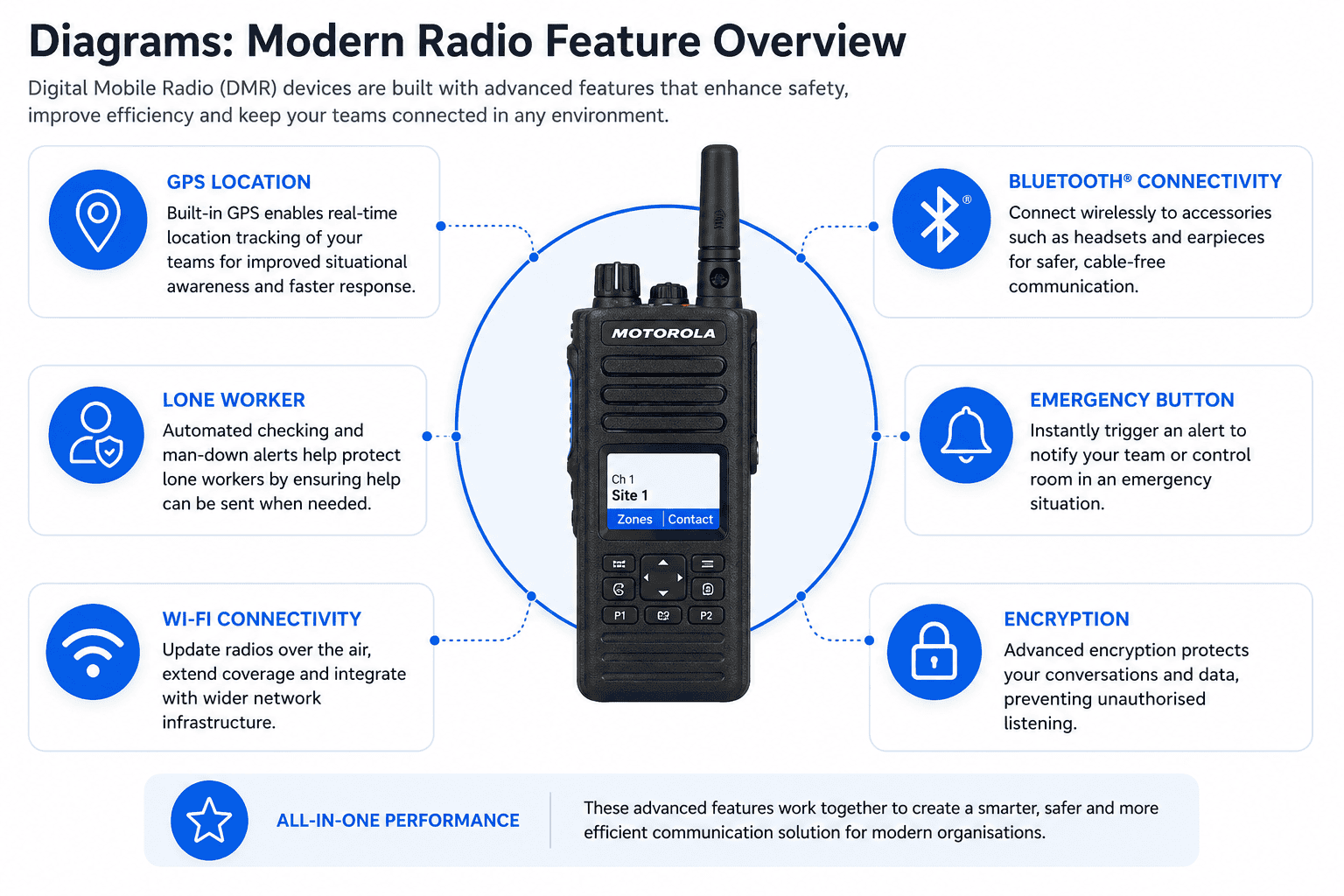
Modern business radios are now intelligent communication devices that combine crystal-clear digital voice with location services, emergency monitoring, encryptionEncryption protects two-way radio communications by converting voice or data into a secure form that can only be understood by authorised radios with the correct encryption capability and keys., Bluetooth®Bluetooth® is a short-range wireless technology used with compatible two-way radios to connect accessories such as headsets, earpieces and microphones without a physical cable. connectivity, data applications and integration with business software. These features help organisations improve productivity, strengthen employee safety and streamline day-to-day operations.
Importantly, not every business needs every feature. A small hotel may require little more than dependable voice communication, whereas a nationwide utility company may depend on GPS tracking, lone workerA Lone Worker is someone who works without direct supervision or immediate assistance nearby. Compatible two-way radios can provide safety features such as timed check-ins, emergency alerts and GPS location. monitoring and computer-aided dispatch.
Understanding these capabilities allows organisations to select equipment that supports their operational requirements without paying for unnecessary functionality.
In this chapter, we'll explore the most important features available in modern professional radio systems and explain how they deliver practical benefits across different industries.
High-Definition Digital Audio
One of the most noticeable improvements introduced by digital radio technology is audio quality.
Traditional analogue systems gradually become noisier as signal strength decreases, often resulting in background hiss and crackling.
Digital radios process voice differently.
They use advanced audio processing to deliver:
- Clearer speech
- Reduced background noise
- Improved intelligibility
- More consistent communication
For users working in noisy environments such as construction sites, warehouses or manufacturing plants, improved speech clarity can significantly reduce misunderstandings.
Intelligent Noise Cancellation
Many modern radios incorporate sophisticated noise reduction technology.
These systems are designed to suppress unwanted background sounds while prioritising the user's voice.
Examples include:
- Machinery
- Traffic
- Wind
- Crowd noise
- Construction equipment
This allows colleagues to hear messages more clearly, even in demanding working environments.
GPS Location Services
Many professional radios include integrated GPS receivers.
These allow organisations to determine the location of radio users in real time.
Typical applications include:
- Locating field engineers
- Monitoring vehicle fleets
- Supporting lone workers
- Coordinating security patrols
- Improving dispatch decisions
GPS information is typically displayed through dedicated dispatch software or fleet managementFleet Management is the process of managing a two-way radio fleet, including equipment, users, programming, maintenance, firmware, security and radio system configuration. platforms.
Lone Worker Monitoring
Many employees work alone for part or all of their working day.
Examples include:
- Security officers
- Maintenance engineers
- Utility workers
- Care professionals
- Facilities personnel
Modern radios can monitor user activity and trigger alerts if expected check-ins are missed.
Depending on system configuration, supervisors may receive:
- Audible alerts
- Visual notifications
- User identification
- GPS location
Lone Worker functionality can form part of an organisation's wider health and safety procedures.
Man Down Detection
Some professional radios incorporate motion sensors that monitor the position and movement of the device.
If a radio detects:
- A sudden fall
- An unusual angle
- Prolonged inactivity
it can automatically initiate an emergency alarmAn Emergency Alarm allows a two-way radio user to quickly alert a dispatcher, control room or other authorised users that assistance may be required..
This feature is particularly valuable for employees operating in higher-risk environments where immediate assistance may be required.
Emergency Buttons
Nearly all professional radios include a programmable emergency buttonAn Emergency Button is a dedicated two-way radio control that allows users to quickly send an emergency alert to a dispatcher, control room or authorised radio users..
When activated, the radio may:
- Alert supervisors
- Initiate a priority voice call
- Transmit the user's identity
- Share GPS location
- Open an emergency communication channelA two-way radio channel is a programmed set of communication settings, typically including frequency and signalling, that allows compatible radios to communicate with one another.
The exact behaviour depends on how the system has been configured.
Emergency buttons should be integrated into an organisation's incident response procedures to ensure they are used effectively.
Text Messaging
Many digital radio systems support short text messages.
These can be useful when:
- Quiet communication is required.
- Detailed information needs to be shared.
- Addresses or job references must be communicated accurately.
- Voice communication would be disruptive.
Although text messaging is not intended to replace email or business messaging platforms, it provides an additional communication option when appropriate.
Status Messaging
Rather than making routine voice calls, users can often transmit predefined status messages.
Examples include:
Available
En Route
Job Complete
Awaiting Instructions
Assistance Required
Status messaging reduces unnecessary radio traffic while keeping supervisors informed.
Bluetooth® Connectivity
Bluetooth® has become increasingly common within professional radio equipment.
It allows users to connect compatible accessories such as:
- Wireless earpieces
- Remote speaker microphones
- Headsets
- Vehicle audio systems
This can improve comfort, convenience and operational flexibility.
Voice Recording
Some radio systems support voice recording.
This may be useful for:
- Incident investigations
- Training
- Operational review
- Compliance
- Quality assurance
Recording functionality is typically managed through dispatch software rather than the radios themselves.
Organisations should ensure any recording complies with relevant legal and privacy requirements.
Encryption
Security is an increasingly important consideration for many organisations.
Modern radios may support various levels of encryption to help protect communications from unauthorised monitoring.
Encryption can be particularly valuable for:
- Security companies
- Utilities
- Critical infrastructureRadio infrastructure is the equipment and supporting systems behind a professional two-way radio network, including repeaters, antennas, base stations, network connections, power systems and dispatch equipment.
- Healthcare
- Local authorities
- Commercial organisations handling sensitive information
The level of encryption available depends on the radio model and communication system.
User Authentication
Some digital systems can authenticate individual devices before allowing them onto the networkA Network is a connected system of radios, equipment and infrastructure that allows users to communicate across a defined area. Radio networks can range from simple radio-to-radio systems to large multi-site networks..
This helps:
- Prevent unauthorised access.
- Improve network security.
- Manage equipment inventories.
Authentication is particularly useful in larger deployments.
Talk Groups
Modern digital two-way radio systems allow organisations to create multiple logical communication groups, known as talk groups. Each talk groupA Talk Group is a predefined group of users or radios within a two-way radio system that share a common communication group, allowing teams to communicate without involving other users. enables specific teams or departments to communicate independently without interrupting other users on the network. This keeps conversations organised, improves efficiency and ensures important messages reach the right people.
| Department | Talk Group |
|---|---|
| Security | Security Operations |
| Warehouse | Picking Team |
| Warehouse | Goods In |
| Facilities | Maintenance |
| Management | Supervisors |
| First Aid | Emergency Response |
By assigning users to dedicated talk groups, employees communicate only with colleagues relevant to their operational role. This reduces unnecessary radio traffic, minimises distractions and improves communication efficiency across the organisation, particularly in busy or multi-department environments.
Private Calling
In addition to group communication, many radios support individual calls.
Private calls allow two users to communicate without broadcasting to the entire team.
This can be useful for:
- Sensitive discussions
- Management conversations
- Operational coordination
- Technical support
Did You Know?
Did you know? Many modern Digital Mobile RadioA Mobile Radio is a two-way radio designed to be installed in a vehicle. It normally uses the vehicle's power supply and an external antenna to provide reliable communication while travelling or working in the field. systems can be customised so each user only sees the features they need, making radios simpler to use while improving operational efficiency.
Priority Calling
Certain users or departments may require priority access to the communication network.
Examples include:
- Security control rooms
- Incident commanders
- Emergency response teams
Priority calling ensures critical messages are delivered promptly when communication channels become busy.
Call Recording and Logging
Many dispatch systems automatically log communication activity.
This may include:
- User identity
- Time of transmissionTransmission is the process of sending voice, data or signalling from a radio using a radio-frequency signal to another radio, repeater or communication system.
- Talk group
- Call duration
- GPS location
Operational records can support:
- Incident review
- Performance monitoring
- Compliance
- Training
Over-the-Air Programming
Traditionally, updating radio configurations required each device to be connected individually.
Many modern systems now support Over-the-Air Programming (OTAP)Over-the-Air Programming (OTAP) allows compatible two-way radios to be configured or updated remotely through a radio network, reducing the need to physically connect each radio to a programming computer..
Administrators can remotely:
- Update channels
- Change talk groups
- Modify settings
- Deploy firmwareFirmware is the software built into a two-way radio that controls its underlying operation, features and hardware. Manufacturers may release updates to improve performance, fix faults or add functionality. updates
This reduces administrative effort, particularly for organisations with large radio fleets.
Did You Know?
Did you know? Modern DMR radios can be remotely programmed and updated over the air, allowing organisations to deploy new features and configuration changes without recalling equipment.
Understanding Digital Radio Safety Features
Modern Digital Mobile Radio (DMR)Digital Mobile Radio (DMR) is an ETSI digital radio standard for professional two-way communications, supporting voice, group calling, data and other features on compatible radio systems. systems include a range of built-in safety features designed to protect personnel, improve incident response and enhance operational awareness. From emergency alerts and lone worker monitoring to GPS location services and encrypted communications, these features help organisations respond more quickly and effectively when every second counts.
| Safety Feature | Purpose | Typical Applications |
|---|---|---|
| Emergency Button | Allows the user to instantly trigger a priority emergency alert to other radios or a control room. | Security, lone workers, construction, utilities, manufacturing |
| Lone Worker | Automatically checks user activity and raises an alert if the radio is not acknowledged within a set period. | Maintenance teams, security patrols, warehouse staff |
| Man DownMan Down is a safety feature on some professional two-way radios that can detect a possible fall or unusual radio position and automatically raise an alert if the user does not respond. | Uses built-in sensors to detect when a user has fallen or become motionless and automatically sends an emergency alarm. | Utilities, engineering, rail, oil & gas, hazardous environments |
| GPS Location | Provides real-time location information to help dispatchers locate personnel quickly during incidents. | Large sites, logistics, events, airports, public safety |
| Remote Monitoring | Allows authorised users to remotely activate a radio microphone to assess an emergency situation. | Security operations and critical incident managementIncident Management is the process of coordinating people, communications and resources during an incident. Two-way radios can provide rapid communication between teams, control rooms and responders. |
| Call Priority | Ensures emergency calls are prioritised over routine radio traffic. | Emergency response, hospitals, event control rooms |
| Encryption | Protects voice communications from unauthorised listening and helps maintain operational security. | Security, government, critical infrastructure, corporate users |
| All Call | Broadcasts an important message to every radio on the network simultaneously. | Emergency evacuations, major incidents, site-wide announcements |
While not every organisation requires every safety feature, selecting the right combination can significantly improve employee welfare, strengthen emergency response procedures and support compliance with workplace health and safety responsibilities. Many professional DMR radios allow these features to be configured to meet the specific operational requirements of each organisation.
Wi-Fi Connectivity
Some professional radios include Wi-FiWi-Fi is a wireless networking technology that connects compatible devices to a local or wider network. In radio systems, it can support programming, updates, data services and IP-based communications. capability.
This can be used for:
- Software updates
- Device management
- Data transfer
- Network integration
Wi-Fi complements rather than replaces traditional radio communication.
Smartphone Integration
Many communication platforms now integrate radios with smartphone applications.
This enables:
- Managers
- Temporary staff
- Contractors
- Remote workers
to participate in Push-to-Talk communication without requiring dedicated radio hardware.
Dispatch Integration
Modern radios increasingly integrate with dispatch software.
Dispatch platforms may provide:
- Live GPS mapping
- User management
- Incident logging
- Messaging
- Voice recording
- Workforce monitoring
These systems help supervisors manage operations more effectively.
We'll examine dispatch systems in detail in the next chapter.
Artificial Intelligence and Automation
Artificial intelligence is beginning to influence professional communication systems.
Emerging capabilities include:
- Voice transcription
- Intelligent search
- Automated incident summaries
- Predictive maintenance
- Workflow automation
Although many of these technologies remain in the early stages of adoption, they are expected to become increasingly common over the coming years.
Choosing the Right Features
Not every organisation requires every capability.
When selecting equipment, businesses should consider:
- Operational environment
- Number of users
- Safety requirements
- Regulatory obligations
- Budget
- Future growth
The objective should be to select features that deliver measurable operational value.
Key Takeaways
- Modern professional radios provide far more than simple Push-to-Talk communication.
- Digital audio improves speech clarity and reduces background noise.
- GPS, Lone Worker and Man Down features enhance employee safety.
- Encryption, authentication and private calling strengthen communication security.
- Bluetooth®, Wi-Fi and smartphone integration improve operational flexibility.
- Dispatch software transforms radios into part of a wider operational management platform.
- Organisations should select features based on operational requirements rather than simply choosing the most feature-rich device.
Expert Insight
- The most valuable radio features are often the ones users never notice until they need them.
- Emergency buttons, Lone Worker monitoring, GPS tracking and automatic alerts may remain unused for months, yet they can prove invaluable during an incident. When evaluating radio systems, organisations should consider not only day-to-day productivity but also how the technology supports staff welfare, operational resilience and business continuity.
Business Perspective
Modern professional radios have evolved into intelligent communication platforms that support much more than voice conversations. By combining safety features, location services, digital networking and business system integration, today's equipment enables organisations to improve operational efficiency while creating safer working environments. The most successful deployments focus on selecting features that align with operational objectives rather than simply adopting every available technology.
Frequently Asked Questions
Do all professional radios include GPS?
No. GPS is available on many professional models but is not included in every radio. Organisations should confirm feature availability before selecting equipment.
What is Lone Worker functionality?
Lone Worker features monitor user activity and can generate alerts if an employee fails to respond within a predefined period, helping organisations support staff working alone.
Why is encryption important?
Encryption helps protect communications from unauthorised monitoring, making it valuable for organisations handling sensitive operational information.
Can professional radios connect to Bluetooth® accessories
Many modern radios support Bluetooth®, allowing users to connect wireless headsets, earpieces and other compatible accessories.
Is Over-the-Air Programming available on all radios?
No. OTAP is typically available on selected digital radio platforms and depends on both the radio model and the supporting communication infrastructure.
What People Say About DCS 2 Way Radio
Contact the UK's Premier Two Way Radio Experts Today